LIVE with Drs Dawn-Elise Snipes and Lindsay Weisner
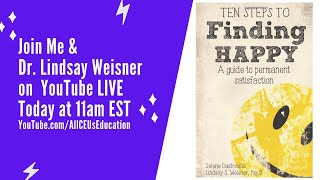
Dr. Dawn-Elise Snipes and Dr. Lindsay Weisner discuss coping with stress and mental health during the COVID-19 pandemic, sharing personal experiences and strategies for maintaining routines and well-being.
Chapters
I can hear the underlying. We've all got it.
Hey there, everybody, and welcome to today's live presentation. I am here with Dr. Lindsay Wisner. She wrote the book 10 Steps to Finding Happy.
Yep, you got it.
Awesome. And we're here to take your questions today about living in a COVID 19 world, dealing with stress, anything that relates to that, or just counseling in general. Or we could talk about Dr. Wisner's book. So any questions you have, please feel free to, you know, put those in the chat room. We will try to answer those. But until everybody kind of gets warmed up and going, I'm just going to start off, off with some chatting and, you know, we'll see where it goes from there. But please feel free to, you know, interject. So welcome.
Thank you. Thank you for having me.
Thank you for being here. I know you are up there in New York itself, right?
I am. I am in Long Island, N.Y. and a few, up until yesterday, I was feeling like, well, at least I'm in Long Island. It's not the city. But now, you know, it's a sort of not appropriate use of the term, but a trickle down effect where now we are, you know, the people who live in Long island often work in the city. And so now it's coming out here. And just yesterday, I know the CDC announced that we should all wear masks. And I also had my meltdown because we all need to have one. You know, when I went to the pharmacy for a can of chicken soup for my daughter and discovered that I was the only person there not wearing a mask and gloves. So it was a moment. And I think we all get to have them.
Yeah. And it's okay to have moments. And we've been talking about that a lot on, on the different broadcasts that our feelings are our feelings. And that radical acceptance is so important right now. When you hear a news story, when you have a moment and it could be not triggered by anything but just having that moment and going, okay, you know, I don't have to unpack here. What can I do now?
And yeah, and I'll tell you, there was a, there's a, there's a certain, certain serendipitous quality to my life as of late, where I walked into the store and literally stood there and kind of burst into tears. And there was a woman standing in front of me staring at me. And then I realized it's she, it's one of my friends, it's my daughter's best friend's mother and she's probably the Last person I would have ever thought of calling to be like, I'm having a meltdown. But she's like, come here. So we went to the back of the store, stood six feet apart and had a little. So it was funny that she was the person that was there and. And it was just a reminder that there's always someone out there when, you know, sometimes when you need them, you know. And so it was. It was nice. And then I had someone I met via Instagram, who I've never met in real life, has been on my podcast, reach out to me and be like, I had a dream about your family last night. I was holding your kids, you know, and like, it's just funny how we're all sort of. I don't know what it is. Subconscious, unexplained intelligence. You know, we know when to reach out to each other during this time, so.
Right. And sorry, in my neighborhood, at least yesterday, it was a glorious day. You know, we were really blessed to have nice weather in. In Middle Tennessee and our neighbors, you know, were out and you could see everybody was social distancing. There were, you know, 20ft between them or something. But we were able to go out and kind of like a parade, kind of wave to each other as you walk by and acknowledge one another. And in our neighborhood, we have. We all have, like, small farms, so it's not like your neighbor is 25ft away. Right. So we don't usually see one another, but there's been a lot more acknowledging and, oh, hey, you live in that house. Nice to meet you.
We have the same thing. I don't live in a farm, but, like, it's a nice neighborhood and people, the properties are sort of set back and so we don't see each other. And when I first moved in, I was sad. We moved in in November and I was like, I don't even know my neighbors. And like, I still don't know my neighbors. But there seems to be a bell rung at like 3 o' clock that we all start walking. You know, it's like we're. I don't know, it's the bell of sanity air. So it has been nice to take. Take long walks and to see people and. And it's doing things with my children that I wouldn't normally do. So.
And that's another thing that's so important right now is doing things as you talk about in your book, just to kind of put a plug in there.
Thanks.
Increase your happiness because we have those stress chemicals going on. But if we can basically force ourselves to. I make the analogy of running a bath and when we're all stressed out, it's all hot water. And if we can force ourself to turn up the cold water a little bit, it will feel more lukewarm. It doesn't necessarily make all the hot water go away, but it's more tolerable.
I really love that analogy. I'm totally going to use it. Yeah, I'll plug my book because, as you know, we spoke initially a couple months ago, my book launch was scheduled for March 18 and. And the formal release was March 20. And of course we went into lockdown, I think, on the 14th. And so everything got canceled and I was not happy, I will tell you this. But we made the best of it. And we did a virtual book launch and I wore a cocktail dress and drank sparkling water from a martini glass for like all seven hours of it. Just to, I guess, bring some levity to the situation. But, but. So I've sort of gotten over it. But you should all still go buy my book, obviously. But the first step in the book is to choose to find happy because. And it's particularly now. I mean, you're not supposed to be happy now. Like, you're. You're allowed. It's normal, you know, everything. The funniest thing was the first few weeks, my patients who had been suffering with the most anxiety and depression, were doing the best because they were like, yeah, world, this is what it feels like in my head most of the time, you know, so it was a funny period of time. And now is the point when we all need to really start making an effort, making a plan on what makes us happy and, you know, and how to do that. And yes, the book is about the 10 steps to do that. And just real quick, I'll share. My personal favorite is find you'd purpose, find your passion. And I think, I think we may have spoken about this when we last time, but you and I both feel this way. Like we feel very passionate about what we do. And so it is something, whether it be working with clients or, you know, doing things like this, trying to get the word out, I feel very passionate about that. And so it has brought me happiness during this time. And yet that does not mean that as a mental health professional, I also don't get to have a moment of, you know, wtf.
So especially as a mental health professional, people look to us for, for modeling. You know, they expect for some reason that we're supposed to be completely, you know, 100%. Whatever. And we're not. We all have moments, and that's just part of being human. And I do want to mention to y' all who are listening, watching right now that there is a short video that I did with Dr. Wisner on the YouTube channel. So, you know, when we're finished with this live broadcast. And you can also ask her any questions about her book or herself.
Yes, please.
During this presentation. But you can learn more about. About her book in that video a little bit later. But something else you said about going out on a walk every day.
Yeah.
One of the articles that I read, and I know you're a research junkie like I am.
I am.
Said that if we exercise at a really high intensity, it, you know, does tend to increase our cortisol because we're stressing our body. But if we exercise at between 40 and 50% of our target heart rate zone, which for me is about 98 beats a minute, which is a moderate walk, you know, it's not even pushing it. You're not hoofing, trying to do a 4.2 mile an hour. It's just. Sure. Moderate walk. Gardening, housework. That actually lowers cortisol level.
I don't want to do the last one. I don't like the housework suggestion. No, thank you.
See, for me, that's a double whammy because not only am I exercising and getting my heart rate into that place where I'm supposed to be burning, lowering cortisol, but then I look around the house and I don't see the dust bunnies or the stuff on the baseboards. I'm a freak about baseboards. So it's just one of those things. My husband came in yesterday and our Internet went out at the office, so I kind of had to drop back and punt. And I was at the farm, and he came in and I'm like, washing the walls. He's like, did something happen? Stressed out. And I was like, no, I just was tired of looking at stuff, you know, smudges on the wall.
Oh, my God, that's so not me. My poor, you know, my poor husband folds the laundry. And, like, he's. Because he's a psychologist working in a psych hospital and so an inpatient unit, and so he has to leave the house every day. So we've sort of tried to manage where, like, I try not to, aside from walking, but, like, I try not to go in places. And as evidenced by my mental breakdown in cvs, perhaps I should not. But, you know, but he, you know, he's working and then he's folding the laundry and he's a saint and he probably very much regrets marrying me, but I have to homeschool the kids now, so it's, you know, God, the bane of my existence. Yes.
Yeah. And how is your daughter? You said you were getting her chicken soup. Is she, is she ill?
Yeah. So I have a 9 year old daughter and an 11 year old son and he is like, we're watching, but we're watching cautiously. Like, I thought she might have had a fever yesterday. Flushed cheeks. And she's also pretty, even tempered. She's like the girl who had a curl in the middle of her forehead. Like when she's good, she's very, you know. And so yesterday she was in a mood and so it just made me a little. I kicked into like fight or flight mode or like I need to do something. She's not ill. My son has been a little rundown and sort of choosing to go to bed earlier than he would normally. Light cough. But we're sort of operating, my husband and I, operating under the assumption. And a lot of people, I feel like this has probably been around this virus. Like we've probably had more people exposed to it and hit by it and we realized, and we just weren't testing and so she's not ill, fortunately. But we're also, every day we're doubling up on vitamin C. You know, we're, we're taking precautions. We're taking, you know, the vitamins that we were supposed to take your whole life, we're actually taking now, you know, and, but we're not going crazy about it because we don't want our kids to feel crazy about it. And that's my theory about schoolwork also. But my husband is more rigid about schoolwork. So we're, it's a boxing match twice a week, let's say, you know, just to see who wins.
It's a tango.
Oh, sometimes, yeah, sure, it's a tango. It's a, it's sort of. He, he is right. He is. Again, I'm married to a psychologist, so he is right in that if we let the kids skimp on some things, they're gonna think that, you know, it's, it's blurring a line. Whereas I also feel like at the end of the day a 4:30 virtual Hebrew school class is not something like if we, it depends on the day, you know, and it's about. This is a marathon, not a sprint. And I don't know if everyone realizes that. And so I need to find a way to keep our family moving. And we also have gotten in this habit of like a 3 o' clock walk. And then at like 5 o' clock, we will 4:30, 5 o', clock, whenever we get back, we'll go to the art room because I'm a dork and I have an art room. And then we'll paint. And we've been painting. We've been doing this sort of a gratitude project for people that don't normally get thanked doing this. And we're using the hashtags gratitude adjustment and the people in your neighborhood. And we've been painting canvases and writing like thank yous to the mailman, the Post, the bus drivers, the. My daughter did one for pilots the other day. And you know, and just people that. We did one for the teachers, of course, but my daughter used like her little, like fashion plates. So the teachers look way sexier than any teachers I've ever seen. But, you know, we'll play music and we'll do some art and then we'll have dinner and then right before bed, the four of us, because my husband will be home by then, and we'd go to the living room and we all read for an hour. And it's a routine of like, calm and also a nice break from all of the screen time we've all gotten by by that point. You know, during the weekend we usually play cards and whoever wins gets to choose a movie or dinner.
So that's awesome. I mean, you guys are keeping some semblance of a routine. The kids aren't, you know, watching Netflix until midnight and then getting up at 11 o' clock in the morning. So that will help a lot. Not only just keep their circadian rhythms and you know how strongly I feel that for just straight up mental health, but also having all of those moments of calm. You're walking your art and your reading and reminding people out there that stress reduces our immune system. And the last thing we want to do right now is reduce our immunity. So if you need a reason to not feel guilty about doing something that makes you happy, it is to keep yourself from getting sick.
Yeah. And I will tell you, I'm starting to actually, like, you know, the beginning of the day is with the schooling is a mess. But by, I will say like, by like 3, 4 o' clock when we start this routine, it's something that we've established and it's starting to feel like. It is starting to feel like enjoyable family moments, you know, rather than just a time of crisis. And I think that's what we all need because we're all going to have our turn at freaking out. Sure.
And one of the things that I've suggested to people is taking 20 minutes and I suggest a meal since, you know, a lot of us are at home with our families right now. But even if you can just, you know, facetime with somebody during a meal, if you're, you know, by yourself. Yeah. Spending that 20 minutes that you're eating, focusing on the positive and you know, the rest of the time, if you want to have monkey mind and go out there to catastrophic thoughts, you know, probably not the best choice. But I'm not saying that we need to ignore everything that's going on 24 7, but giving your brain a break for that 20 minutes to focus on gratitude, to focus on, you know, what did you do well today? And who, World Health Organization actually has six handouts that are really awesome for parents who aren't used to having kids home and reminding them that, you know, we need to help children, redirect their energy. Yeah. And because a lot of kids are noticing our stress and they don't understand, they're. Yeah. They're reacting from the vibes that they're getting off of us. So they're becoming more, as one of my best friends would say, disorganized.
Yeah. Right.
And I always love that euphemism.
I do, too.
And, and we need to recognize that that could be part and parcel of. They are looking for us to provide them a sense of stability and, you know, remind them that the rules do hold. It's. It's not a free for all. It's. Your world is not spiraling completely out of control. There is still some routine there.
Are you, I don't, I don't actually know this and I should, but are you in a lockdown state or whatever it's called?
We are now, as of Thursday, our governor finally put a stay at home, or whatever we're calling Whatever it's called.
Right.
Lockdown order and said police, whatever. It's a misdemeanor if you're not, if you're not behaving.
If you're not behaving. So, yeah. So we have been in one since, gosh, I don't know, at least two weeks. I don't, I haven't been counting the days because I don't know where to start. But, you know, we've been in one for at least two weeks. Again, people are still going out, but, you know, it's, it's supposed to be essentials. And so we have, we have. I have no idea where I was going with this. It's difficult to make it feel normal is definitely. But you know, my. Oh, I know where he's going. So I want. And I'm curious for your opinion. So our school in this district initially sent home an email saying that school will be closed. Closed until X date. I think it was two weeks. And you know, and then like a week later we get another one. And then our governor just canceled spring break, actually. And so. And I believe he did it for a good reason, which is that. So the schools are providing meals for children, you know, for families that can't afford it. They provide breakfast and lunch and if you shut down schools for spring break, they can't do that. And in a time when we having this economic struggle, I believe that's my made up belief that it's out of the kindness because it's the only thing that makes sense because teachers and parents alike need a break. And so they keep depositing this information in piecemeal. Whereas I have been very clear with my kids from the beginning about what my thoughts are on the likelihood of us returning to school this year and even about camp. And I'm wondering what your, you know, what do you think the better strategy is? And I don't mind being wrong, by the way.
I tend to side more with you. I take the information that the schools are giving. You know, both of my kids are taking college classes, so they just switch to online. But the public schools around here are still sending sort of mixed messages. Yeah, well, we may go back on the 24th or we may not go back at all. You know, it's kind of loosey goosey up in the air. We may have graduation, we may not. And that's really tough for a lot of them. And just letting them know, depending on the age, your kids are so much younger.
I know, yeah, my kids are younger, but their parents are shrink. So A, we've already messed them up and B, they're like, they're, they're, you know, my, my daughter, they know to ask about feelings, you know, like they're definitely both precocious in different ways. So I, I just thought I'd be clear with them from the beginning. And my patients also, I sort of say, listen, I, I don't have all the answers, but just to let you know, like looking at the number, looking at the research, because we love our research, you know, I, I don't think there's a good likelihood of, of, of, you know, of life. Of life getting back to normal for quite a while, you know, and so.
And I've been encouraging people to try to think about their new normal. Yes. Because I don't think we're ever going to go 100% back to life as we knew it a month ago.
No, it's like, pretty thing is, you've.
Got these routines that you've established with your family that I hope will continue on even after, you know, I do too.
Yeah.
Quarantine is over. And so that is part of your new normal. But that can be something that you treasure, that you take out of this.
No, I agree. I'm sorry. It reminds me of like pre 911 and post 911 and, you know, unfortunately not everyone is old enough to understand. Understand that. But like we are. We now know that you take off your shoes at an airport, you know, like it's. Whereas before that, that wasn't a thing. And so I agree we're going to have a new normal.
And one thing, one study I read this morning was the fact that because of all of this social distancing and everything else, the number of cases and the number of deaths from the flu, the seasonal flu, have pretty much come to a screeching halt and they're holding steady at 24,000. But for this year, that's actually pretty low. Annually we have, you know, usually in the 30,000 range of deaths from the flu. So, you know, we can learn from this that there are things that we can do. Obviously we're not going to shut down the world for social distancing every year, but there are things.
But it might be a good idea for two weeks every year, you know.
Well, things like washing our hands better. And even those of us who washed our hands before, you know, I wasn't good about doing the whole 20 seconds and getting underneath my fingernails and, you know, I would be a little bit sloppy with it because I always felt like I was in too much of a hurry. You know, a little bit of soap, scrub, a scrub, a rinse. And, you know, now I'm actually paying attention to it because I don't want to get sick and I definitely don't want to get my kids sick.
Right.
So those are some things to consider.
No, I agree. It's, you know, the other, the other thing that we've started doing at dinner is because usually dinner will be after, like we've read and, you know, and so. And then my husband comes home and we have dinner. And one of the things that the Question. I used, you know, used to. My kids are young, so, like, asking about their day is, you know, well, it's always a disaster. But like, what I've started asking them is, what did you learn today? And. And that's a much better, more poignant question. And then I've also started sharing with them things that I've learned from podcasting or whatever, you know, and what. And it's interesting because we're sharing our knowledge and it's specific. You know, the other day I had them do a virtual museum tour. And of course my daughter chose, my nine year old chose Georgia o' Keeffe's museums. And I, like, I just kept my mouth shut. And finally I was like, do you notice anything about her paintings? And she picked up on it. So, you know, so it was interesting. They're learning in different ways. We have plans to go on one of the, you know, language apps one day and just learn a few words in a different language. Just something where let's. Maybe they're learning different, you know, it's. It's outside of the box, school stuff or, you know, and that was one.
Of the things that I loved about homeschooling my kids is, oh, my God.
You do this voluntarily?
I did, yeah.
Did it make it better that it was voluntary?
A sort of. I mean, it wasn't voluntary initially.
Okay.
The school system wanted my son, who is gifted and had ADHD in first grade, to finish his assignments and when he was finished, put his head on the desk for 15 minutes while everybody else finished. And no, they wouldn't let him read a book. They wouldn't let him move around. And it made him, it stressed him out because he was so afraid of misbehaving because he would feel that energy. So anyway, you know, long story short, we, after multiple parent teacher conferences, trying to get them to let him just read a stinking book, right. We pulled him out and he thrived in that environment. We went to the library every single day. He's always been a reader. You know, by the time he was eight, he could, could tell you, I think every bird in the Peterson's Guide to Eastern Birds or whatever. I was like, okay. You know, that's like.
It reminds me of my son. That's like, there's that ADHD always has that little bit of OCD too. So you've got a lot of weird knowledge in your head, kid.
Yeah, but being able to figure out how they learn. And my daughter is completely different. So there was a period when we did one of her art classes, she spent a semester. I found an online interior design course and she took that. So she was able to, you know, do some graphic design to create, you know, interiors. And then I let her. I gave her a budget and I'm like, okay, you can redesign our living room. Because I know that I suck at interior design. I wouldn't have pictures on the walls unless somebody told me to put them there. I'm just saying I don't look at.
My blank, look at my office.
Okay, so, you know, that let her launch out on her own and explore things. And so it was an opportunity. You know, they're not learning in the same way right now like they would in school, you know, sitting at their desk doing their thing. With the exception of things like math, where you don't have a choice, especially like algebra, which she laments right now. She's like, oh, it's, you know, everybody else is, you know, having time off or whatever. Can I, you know, skip algebra? I'm like, no. But, you know, thankfully, the colleges are still. They transitioned online really well, and I was going somewhere with that, but. Oh, kids are having this opportunity while they're not in school if they're doing learning time to figure out. Find their passion.
Yes.
Figure out the things they love. I mean, I would have never thought that to introduce my son to birds.
Right?
And my mother actually did it one time when he went to visit her in North Carolina and he came back and was just enamored with birds. And. Okay, so we let him run with it. And I was wondering for a little bit there if he was going to become an ornithologist. But we're getting a lot of questions all of a sudden. So let me see here. Are people in New York even noticing the economic issues right now or people mainly just fixated on the health issues?
Oh, no, we're definitely noticing the economic issues. In fact, I guess before we pressed record, we were discussing the fact that I said, the sweater that I'm wearing, I am from my. I have two very good friends that both have, like, high end boutique stores. And needless to say, they're both, you know, doing their best to hustle and online deliveries and all that, but they're definitely feeling it. I also have a friend who's in publishing. She does marketing at a major book publishing company. And she was just telling me that they just had. They just had a huge meeting. There were some layoffs, but what they did mostly was based on your salary, you took a salary readjustment so that the higher your salary was, the more, the less, the more the readjustment, the less, you know, like, basically, let's say you make zero to, you know, under 50,000, you might get like a 5% reduction or, you know, and then 50 to 100, you know, a 10 or. But they did this so that they didn't have to let as many people go and so that they, you know, so that they can keep. Keep the. Keep everyone moving forward. You know, it's. Yes, we're afraid of the illness, but we're also. It's drastic financially. And even myself, my husband said to me this morning he thinks we're going to apply for a small business. I don't know if it's a loan or a grant or something, because the rent for our office, it really just depends on. I need to be able to see enough patients. And some people, we've been doing virtual, others have not. And I haven't gotten a lot of new patients yet because I think it's still too scary. So I think we're feeling it at all ends. And then, of course, doctor's offices, if you're not essential, they're closing down. And so the employees are out of jobs there.
Right. And, you know, we've gone in, in Tennessee, we've gone to virtual. Virtual counseling, except for the inpatient units. And I know.
Yeah.
You said your husband works in an inpatient unit, but.
He does. Yeah.
Outpatient, even. The EAPs and plans that traditionally had forbidden billing for telehealth services in the past have all said, you know, at least for the duration of this crisis. And I'm wondering if we'll ever go back to being the same. But I agree. I think I have seen a far smaller increase in, you know, demand from referrals.
Yeah.
Than I necessarily would have expected. On my other YouTube channel that's geared towards consumers. I do a live broadcast every weekday at 2pm Just so I'm there I can answer questions. Because a lot of people, like you said, it may just be too scary. They may not. Or they may just not have the breath to even go there right now. It's just like I've got three kids and, you know, I'm trying to juggle all these balls right now. I can't even think about mental health counseling. It's maybe it's even. Not even that scary. But when, you know, well, I'm barely taking a shower right now because I can't get private time.
Yeah, no, I had. I have a patient who's the mom of two Young kids. And I reached out to her about setting up an appointment. She's like, yes, but only if we agree not to talk about Corona. And I was like, totally fine. You know, like, that's fine. I mean, sometimes we do need to talk about regular, especially we're all living in such close quarters. Let's talk about marriage issues. Let's talk about anything. You know, I think people are worried that they'll be forced into talking about it or that they'll feel pressured into when they need a 45 minute break from talking about it.
Right. And you know, that's a beautiful thing about counseling is people can set their own agendas for, you know, what do we need to talk about or what do we, we need to avoid right now and getting them some time. But, you know, talking about spending more time with families right now, it's really highlighting some of the problems in relationships, unfortunately. We've seen a spike in domestic violence, we've seen, seen a spike in child abuse. All very devastating things. We saw more deaths from suicide last week than we did from.
I didn't know that. I did not know that. Is that in Tennessee? Okay, will you send me that research after.
Yes. But, you know, a lot of people are starting to, they're seeing their, you know, retirement accounts. If they were right on the edge of retirement, they've seen, seen it, you know, cut by 30% or sometimes half if you were in like a high risk, if you had a high risk per portfolio or something. And that's devastating to a lot of people. But back to what we were talking about with relationships. I was telling you before this started that I have a friend of mine who said that his daughter is, who's 3, 3, 4, somewhere right around there, is experiencing a lot more separation anxiety because she's not going to daycare anymore. She's home with her mom 24 7. And now when it's time to separate from mom, they're, they're divorced. So when it's time to go visit dad or whatever, she gets a whole lot of anxiety, a lot more so than, you know, she used to, you know, she enjoy going and seeing dad. And he said that that's the biggest change that he's really seen is whether she's just enjoying this time with mom or she's picking up that there's a lot of stress and she's afraid to leave mom. You know, they're not really sure because at her age she can't really articulate subconscious.
Also, maybe like, she just, you know, like I Said I feel like I'm just. I'm just settling into the schedule and I'm an adult and so. So if you're switching every two weeks, which makes sense. I have a friend who has a. She's divorced and she has a 10, no, 12 year old and they're doing the similar thing. But it's also, it is a little bit unnerving to. This is like what we were talking about before with the school giving updates every two weeks. It is a little unnerving to constantly be changing plans, you know, and so unfortunately, I think it's just got to be the normal for children of divorced parents right now, you know, and I think that it. They've got to. We adapt to anything. So certainly at some point she'll adapt to this. It's just, I'm sure adding one more level of sadness and anxiety to both parents probably.
And that's true. And as you thought, as you were talking about being an adult and adjusting, it made me think of temperament. You know, I am a enfj and I'm like over here on the J side. So this lack of. Or this change. Disruption in structure. I have to breathe. You know, when they announced that they were closing my gym and it probably wouldn't be open for over a month, I was just like, kidding, right? No. But thankfully I don't.
Right.
When this all started kind of brewing back in January, my. My stationary bike broke and I was debating not getting another one because the gym's like three miles down the road. And I was like, no, there are going to be times where. Right. You know, I'm snowed in or something. So. So I ordered a new bike and it got here just before, you know, the shit hit the fan. Sure. I've been so grateful to have that at the house because it's been raining a lot, so there haven't been. There have been some days where going out and running outside or something was not an option. But I need, I need structure. I have to. My kids know I get mean if I don't work out, but I've been.
Working out twice a day and like. Or like working out and then going for the walk. But I also was addicted to my, like really addicted to my gym. And then when we moved, there was a lot when we moved is when we took stuff out of storage and then I had more space and I got my own home gym back and I got used to doing that just because it saved like the 20 minutes of driving there and back. And so thank God, because I Think I would have been a lot more stressed had I had to make this adjustment, you know?
Yeah. I'm seeing other people in the comments say that. Yeah, you know, the. Those of us who are Jays are kind of struggling with this, and then being extroverts, you know, it's. It's difficult sometimes on us because we're used to being. Talking and interacting and. Yeah.
You know, I've never taken that test for myself. I will. This is the perfect time. But, you know, so I don't know what I am, but. But I relate to a lot of what you're saying. Listen, I. Yes, I miss talking to people. I enjoy my sessions with my patients. I always have. But it's even more now because it's talking to another person. It makes this. Doing things like this with you, you know, so much more important for our sanity. And. And it's not because I don't love my family or my husband, but it's because we're meant to be social like humans. You know, we were tribes and clans before we were towns and, you know, villages. So. So this is strange for us.
I think it is. And that's not to say that we don't love our family.
Right.
But we also. We do thrive. And. And people who are more introverted, like my husband, they don't, you know, they have a few really close friends and, you know, that. That's cool. And they're communicating with those three or five people or whatever. But it's important to know, in my opinion, you know, what makes you happy and what works for you and figure out how to make that work in this environment. And I had somebody share the other day that they were doing a live guitar practice session.
That's awesome.
With their friend who happened to be, you know, three states away. And that was one way that they were connecting. And they'd never done it before, but they found that, you know, it was really pretty cool. So we're. We're finding new ways and we're being creative, which I think is really awesome.
I do, too. Yeah. My son has not spoken to a single friend since this started, whereas my daughter is in a group chat and, you know, is constantly playing video games with other kids. You know, like, it's just not as important to my son as it is to her.
Oh, yeah. And. I don't know. I think neither one of my kids has been super social. My daughter has had, you know, extended contact with her boyfriend. FaceTiming, you know. Yeah.
Our.
Our data for FaceTime is just, you know, over the moon right now. But that's okay. You know, it's helping to keep her sane, being locked in the house with all of us. And, you know, we've also, when we've.
Gone on these walks, we've passed by, like, people's, like, we've done, like, window waves, you know, or like, I call it a wave date, you know, like, where we just, you know, wave to them and they get to see each other. And we went to my friend's house and I spoke to her through the window for all of three minutes. But, you know, just trying to. I don't know, to keep going. To keep this normal. To keep acting like humans are supposed to.
Exactly.
I'm so curious about the questions that we have, people.
Let's see, let me scroll back here. Talking about. The school's putting out a lot of, you know, partial information and going to what you said, you know, how do you help kids deal with the uncertainty of what's going to happen? Because I remember, you know, when I lived in Indiana and we had snow days, you know, you knew you were going back to school. It may. It may be a day, it may be three days. But you knew you were going to have to study for the test.
Right?
You were going to have to. There was stuff you were going to have to do. And kids now are going, well, I may not even have to take that test. So I study.
Right. I mean, we've got. We've been given a lot of direct information in the last week, it looks like. So we're just. We have a quarterly system, and I guess we're just finishing up the quarterly grades. I mean, again, I have a third, third grader and a sixth grader. So, like, you know, it's all relative. But it looks like they'll probably go to pass, fail for this, for the middle school, the fourth quarter, and that's fine. And, you know, the third grade where they. They get 1, 2, 3, 4 grades. So it doesn't, you know, this is not going to affect their college applications. But also they're not all going to be able to write this for their college about the coronavirus for the college applications. They're going to have to find something different. But, you know, but I actually ran into, like, March 20, the day of my book lounge, I ran into someone from the school who basically, like, flat out told me, off the record that, you know, I made. I threw it out there as a test, as like a fishing, you know, like a troll thing. And I. Whatever it's called, and I was like, yeah, I don't think we're going back this year. And she. And this person was like, oh, no. You know, and so I've had definite. And this is like, you know, this person has, is not a teacher and has a place where their understanding of this situation makes them. Gives them the unique perspective, I think being able to assess, you know, black and white, whereas I think teachers and principals and everyone else is trying to figure out the consequences of these actions. But early on we were supposed to have X amount of school days. And early on we were. The governor eliminated that. And the funny thing is, in my small Long island town, we spend a lot of time each year fighting about the calendar. And now the calendar went to shit. And I kind of love that part of it. Not to be evil, but like, I love the fact that you guys spent all this time arguing about the calendar and then it just went to shit. And now we're on.
One person points out that a lot of people have been talking about the importance of having structure but also adding in transition time when switching from, say, working to studying to exercising.
Sure. I don't, you know, I think I have a structure in my head and then some of it comes together and some of it doesn't. And that's for myself and my kids, you know. And also, what's transitioning time? If you ask my kids, transitioning time is playing Roblox, this computer game that I don't. Whatever. And so it's not, you know, or even sometimes transitioning time could be taking a shower. You know, I think we all need to have. Well, not we all, but what I find that works best for me and my kids is I have an idea. And like, I write down like the four or five things they have to do that day. And one is schoolwork. And then I'll throw in an extra assignment or, you know, do the dishes or they've been. They actually did this writing class with an author who she. Children's author. And she had. I want to remember her name. Her book is called Girl Click and her name is Eileen. I'm blanking on it. Which stings because she was fantastic. But she basically, when this came up, she started this thing where everyone who, if you bought your book, bought. If you buy your book, then you get in this class for, you know, you can do this class, this class for free, where the kids did a five session writing course, creative writing. And my kids loved it and they were sad when it ended. And her name is Eileen Moskowitz. And I think she'll do it again, which is why I mention it. And so. Because I would love to, you know, my son was sad, you know, and like, they learned stuff from it, and it was really cool and it was just nice. My daughter did it with a group of her friends. My son did it with just people who didn't know. But it was a way of learning something different. And so that was structured because there was a time for it. But other than that, it was more like, I suggest you try to get this done by 12 so that the rest of the day can be spent more leisurely. But it's up to you, you know? And so that's how we've tended to work this out. Because otherwise it's just. The day is just me. I feel like I can never. I feel like Bailey from Grey's Anatomy who just spent like the first three seasons yelling, do your rounds to everyone. Like, that's what I feel like I've been doing. You know, like, if I have. If I'm trying to do a schedule, then I end up as, like, just losing my mind and it doesn't work for anyone. So. And also I realized that a strict schedule would require me to make sure they were transitioning at the times that I said. Whereas on Mondays, I see patients for about nine, 10 hours. You know, so what am I going to do? Be like, hold on, it's 2:15, I got to go tell them to switch? So, yeah, so I think it's about finding what works for everyone.
Yeah. And I find for me, just kind of talking about transition, especially for those of us adults who are working at home, it's important for me to change clothes. And I have my workout clothes, I have my work clothes, and then I have my relaxation clothes. And if I stay in my relaxation clothes, I. E. My jammies all day long, I feel like a slug. I feel unproductive. I have a hard time getting motivated. So just, you know, taking a shower, putting on my. Putting on my big girl clothes helps me get into work mode. But I've also found that it's important. Important for me to change out of my big girl clothes. Otherwise I still keep working until. Yeah, you know, I have difficulty if I'm not separating by going to an actual office. If I'm working from home, I have difficulty turning it off. So that's. For me, that's helpful for transition time. You know, I put on my. My, you know, bang around the house clothes or whatever, go up, start making supper and, you know, start that kind of routine. Sure.
I have a patient who lives in a two bedroom apartment with her, with her fiance. And we were discussing that. Basically, you know, she's a teacher, and so she's been like living on her couch, you know, for work and all day. And we definitely discuss, like, time to move things around, you know, so whether it be clothing or location, I agree with you. I've gotten into this habit of, like, I try to work out first thing in the morning because otherwise something's going to come up and then I'm going to be angry that I didn't work out, you know, and I am not as good at putting on big girl clothes as you are. But. But it is important and it is. You know, we do have the kids doing it. Like you put on clothes in the morning, you shower. And I think it's got to be because we've got to do things like this because of how long it's going to last.
Right, right. And for some people, I mean, I saw my son, he's finishing up his A. A.A. but it's been 100% online. And unless I force him to get out of the house, he doesn't leave. He doesn't.
What's aa, by the way?
His associate's degree. Okay, but he, he doesn't. That's just the culture for a lot of people who are younger right now, millennial, zoomer, whatever that cut off is, I don't know, but who are going to college now and that for a lot of them, there is no reason to really leave the house. So this hasn't been that much of a change for him. But it's important to me as a parent to make sure that he learned, learns to transition. And he's done a really good job of learning. You know, this, this is my school time. And then, you know, video games afterwards.
Right, right, right. But, you know, I don't know. I mean, I feel the same way with the video games, but also they socialize through the video games, so they.
Do, you know, he. He plays multiplayer games and stuff and, you know, I'm. That's fine by me. You know, as long as, you know, he seems to be happy and well adjusted. You know, just because he's not doing what I would choose to do doesn't mean it's the wrong thing.
Sure.
And then one more question that comes in is, you know, what do you think about the effect this will have as far as suicides and what can we do to help people prevent getting to that place where they are feeling that helpless and hopeless? Right. Now.
Yeah, you know, I actually. So I specialize in suicidal teens and it's really become my passion and I am currently writing a book about suicide for teens and their family. And so this is something I've been really thinking about a lot. And the reason I sort of jumped on your research on the, you know, Tennessee is because although I don't know how prevalent, how much, how affected you guys are, especially because if you just went into shelter in place or whatever it's called, but it obviously could go one of two ways. You know, one is people could start feeling people that weren't feeling hopeless and helpless before or were and are now feeling worse because we're all watching, you know, these numbers on our screens rising like crazy and you know, they could decide to, it could drive an increase in suicides. I really did a lot of research last week and trying to find a correlation between like previous pandemics or like major events, like negative events and suicide. And I'm still filtering through the information, but there's another way it could go too. And so as I mentioned, my patients who were like the most anxious, depressed, suicidal, they're actually sort of having their feelings normalized and feeling less alone, less isolated by their mental health issues because the whole world's going crazy, you know. And so and also the fact that we, when you're put in a position where you have to try to survive, it might sort of, it might change how you're feeling about your own desire to die, you know, about your own lack of willingness to live. And it sounds a little odd, but I started thinking about this because, you know, in historically and now now as well, but in like, you know, underdeveloped or non developed or whatever we used to call third world countries or places where food, you know, famine was an issue. You didn't have eating disorders like there were, you know, if, if it's something that's a struggle for you, if it's not an issue of, you know, obviously with eating disorders there's a control element. But people in those not supposed to be calling them third world countries didn't have an issue with eating disorder. And so I wonder if now as we're all trying to get past this, it might reduce suicide rates because we do have to take special precautions to live, you know, which is an interesting point.
It reminds me of the Substance Abuse and Mental Health Administration's publication on trauma tip 57. For those of you who read all Assamsa's stuff. They talk in chapter two about community traumas and mass traumas and the fact that during a community trauma, people actually come together. So normally you have people who are struggling with anxiety and depression and they feel isolated. Isolated. They feel like nobody understands. And now they're actually getting the support they need. Hallelujah. From one another. Not only do they feel normalized, but there are other people who are going, oh my gosh, I get it. Let me, let me reach out and help you. Let's go to the back of the store and talk for 15 minutes.
Exactly.
Exactly.
You know?
Yeah.
So I don't know. I think that I, maybe I'm being a little bit hopeful, but I think that, I don't know, that's my thought, you know.
And that would be a blessing.
Yeah.
For that to happen. And I don't know what happened. I haven't looked at the research for after 9, 11 or after Katrina.
Right, that's a good point. And also I think we have to separate the first. First response responders from the non first responders. But you're right, that is a good point. That's what I'm going to do. That's how I'm going to spend my afternoon, is looking at that. Thank you for giving me that.
But there's also an article in the Lancet, and after we're finished here, I will find it that I did a podcast on that talks about the. And this was more first responders, but it talks about the mental health effects of quarantine on, and pandemics on nurses and first responders during MERS and SARS outbreaks. They looked back at that data and they really didn't see that much of an increase in suicides. What they did see was a dramatic increase in PTSD symptoms and substance misuse, maybe crossing the line into, into addictive behaviors. But, you know, that definition is somewhat loosey goosey.
It is loosey goosey. And also I, I gotta tell you something. The other part of my routine, by the way, is that at some point in the evening, as we're painting or as we're reading, like, I will pour myself a cocktail. And it is like it's a habit, which means it's going to be tough to break, but it's also a way of, I think, taking down my cortisol levels at the end of the day and transitioning me to a nighttime, which. And I bring it up because I think the problem is when we get used to relying on it, then it's, you know, well, afterwards, how do we break that pattern? So, you know, and looking at, you.
Know, a Cocktail versus a bottle of vodka. You know, they're two different things.
That's a valid point. I'm sure I could do a valid bottle of vodka, but I gotta get up the next morning to homeschool, so.
Didn't mean it as a challenge.
It's a challenge accepted. Yeah.
So I am just looking up here. There are a lot of comments people have enjoyed hearing from you. Can you share with the people who are watching right now the your podcast?
Oh, yes, sure. I am the host of the Neurotic Nourishment podcast and I've sort of made it my mission to try to talk about topics that make people uncomfortable. Each week I have a guest, I believe. Well, this the last two episodes. One of them, there is a woman named Rebecca Delgado Smith and she is the host of the Alarmist podcast. And if you like podcasts and research and science and all of those things, it's a great podcast. They look back at major events like the Titanic and they, you know, they sort of try to find someone to blame, but it's all in like jest and comical, but it is, it's information for us geeks that like information. And then the week before I actually had on a man named Raith Drazi who is an all natural bodybuilder who is HIV positive. But we spoke about it because there was a time when AIDS was a death sentence, obviously. And now science has reached a point where it's called U equals U and it's un detectable equals untransmittable. Which is basically they can get their I mess up the science of this. But like the platelets or the white blood cell count to a point where it's high enough that their people with HIV are living life just like the rest of us. And I had interviewed him before the pandemic, but I also thought it was important to air it now that we're, you know, at this point just to say that there is an after there is, you know, this is the possible new normal for people with hiv. So that's the Neurotic Nourishment podcast. And then you can find me on Instagram pykeshrinkmom or more about the book at 1010 steps to finding Happy. And you can also find me on, oh, Instagram at neuroticnourishment. Sorry. And if you want the book, it is available on Amazon and Barnes and Nobles. You can also. Today is the last day that IPG Books, it's IPGBook.com is offering 30% off all indie authors which is just kind of cool because I've spent a lot of money on books in the last two weeks. I've spent almost as much bunch running on books as I did on the sweater, but it's well worth it, and as are the books. So if you are stuck at home and I got books for me and books for my kids, and it's.
Oh, right.
The Coupon code for IPGbook.com is Keep Calm and read on. And so I like that.
Yeah, that's cool. That's awesome. Well, thank you for being here with me on a Saturday morning. Of course. I look forward to having you back. And, you know, hopefully things will. Will start finding our new normal and, you know, maybe we can meet again for a more. What am I looking for? A podcast episode that's more like neurotic nourishment, Talking about, you know, some of those uncomfortable topics. Yeah, I mean, Covid is a little bit uncomfortable, but that's kind of.
We're.
We're desensitized to it now. It's. It's true.
Well, Don, thank you. I love talking to you. And we are both such research geeks. And now you've structured the rest of my day with. With doing more research, and. And I'm excited and reading the stuff that you send me, so thank you, and this is great talking to you, and thank you to all everyone who stopped by and asked questions. And if you have any more questions, you can always. You know where to find me.
All right, so Remember, this was Dr. Lindsey Wisner. We have her book or an a video about her book on the YouTube channel, so you can watch that interview before you go to Amazon or IPG.
Books, IPG Book.com or Barnes and Noble. I'm particularly proud of the Barnes and Noble. No offense. IPG book. So.
And we will catch up with y' all later.










