Mental Health Support For Those Impacted by the Tornados in Tennessee
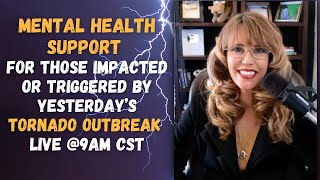
A live YouTube livestream by Dr. Dawn‑Elise Snipes offering immediate mental‑health support and practical coping strategies for people affected by the recent Tennessee tornadoes (Dec 2023). The session explains common trauma reactions (emotional, cognitive, physical), offers behavioral tips to restore safety and routine, guidance for caregivers and children, and recommends community/structural responses and self‑care practices to support recovery and resilience.
Chapters
Foreign, Everybody. And welcome to this kind of impromptu live stream that I'm doing as a result of the very impromptu tornadoes that happened last night. I'm glad to see that are there are a few people here. What questions do you have? I mean, I can go into, you know, lecture. Y' all know, I can lecture really well, but I'd like to know what specific questions might be of interest to you and how I can best be of service to you in this time. Many of us who survived the tornadoes from last night were also around here during the 2020 tornadoes, and those were just devastating as well. So there may be a lot of people who are. Weren't directly impacted. It didn't actually do damage to their house last night, but they're triggered by it because they did experience damage or they did experience trauma as a result of the 2020 tornadoes. And it's very normal when you've gone through a traumatic experience, even if you don't have ptsd, it's very normal for your brain to go, oh, I remember what this is all about. And to trigger those feelings in you a little bit again. And acknowledging those feelings, recognizing that if you are being triggered by something that happened in 2020, recognizing how awful that was, you know, acknowledge your feelings, validate your feelings, but also look at the facts in context with this particular situation, at this particular time. Am I in danger? Am I being threatened? So that's kind of one of the issues that I wanted to address today is to not minimize secondary victimization or retraumatization, because when we do what. What we're basically telling our brain is, I hear you feel unsafe right now, but shut up. And so your brain doesn't know what to do with these feelings or has a difficult time figuring out what to do with that and the beliefs that are coming with it about, am I safe? Could this happen again? And you may start spiraling into obsessive thoughts about danger and what happened in the past. So it's important to acknowledge it when it happens and say, all right, this sucks. No doubt, this sucks right now. And at this moment, in this context, I am safe. And I learned some things from the last time. So people can start integrating that knowledge so they can tell their brain, hey, you are safe right now. And that sounds really weird that you've got to tell your brain things. But our brains, at their very core, our amygdala at its very core, is a very primitive part of our physiology. So it is more feelings based, I feel scared, therefore I must fight or flee in reality, feelings aren't facts. Feelings tell you just like a smoke alarm, there might be a problem and get off your butt and figure out if there is. If there's not a problem, okay, that's fine. Then figure out how to handle that. If there is a problem, get to safety. But when we're reacting from feelings, then we may be making a lot of decisions and creating a lot of thoughts that may be inaccurate. Because we're looking for a threat, we feel scared. Therefore, quote, there must be a, a threat out there. And that's another one of those little tools to consider. I see we've got 10 people in here right now. And welcome to Misunderstood and J. Odi. I hope I pronounced that right. I'm glad to see you today. If you have questions about recovery from disaster, especially as it pertains to these tornadoes or your feelings as a result of these tornadoes, based on your past tornado or hurricane experience, please feel free to ask. So until we start getting questions, let's just look at a few handy tips. The longer there's disruption of normal routines, the worse the stress and traumatic reactions will be. And I want you to think about if you were here in 2020 for those, those tornadoes. Many of our schools got absolutely decimated. So children were not going back to the same school, and it was a while before they were going back to school at all. And that was unavoidable, but that contributed to prolonging the distress because things were not typical. I try to avoid using the word normal, but it was not their normal daily routine. And that's stressful for any of us, especially if you're real structured like me and not spontaneous. It can be really, really stressful. So the longer there's disruption of normal routines, the worse the stress and traumatic reactions will be. Disruption of routine causes stress. The trauma caused stress. So you're adding stress plus stress, and you're just kind of sitting there steeping in it until you can regain a sense of safety and personal power. Trauma and disaster can rip away, at least temporarily, our sense of safety and personal power in our bodies, in our houses, in our communities. And. And one of the first things we need to do is to start restoring that sense of safety, thinking, what can I do to get back to my normal routine? What can I do to best take care of myself right now to allow my body to heal? When a tornado, we'll just use the tornado as the example. When the tornado went through, that was really stressful. And we saw how it ripped up and threw around a bunch of Debris. And it was horrific. In some ways, you can draw a parallel to what was going on in some people's brains with their stress chemicals. Their stress chemicals were just in there and causing all kinds of turmoil. And it takes a while for the brain to recover because that is exhausting. Even if you went to sleep like I did last night after, after the tornado warning was lifted and we were allowed to leave our bathrooms, it was still exhausting. You can get good night's sleep and still be exhausted. And I'll admit I didn't sleep as well last night as I usually do because it continued to rain and hit against my window. And there was a little part of me that said, well, what if? But then there was a bigger part that said, facts in context. The weatherman said that we were in the all clear. It's okay to relax right now. And so sometimes you've got to sort of argue with that amygdala, with that fear based or emotion based part of your brain that says, are you sure? Are you sure you're safe right now? Many people are in a state of shock from what they've been through or what they've seen. This includes law enforcement. This includes neighbors. This includes people who are directly impacted. This includes reporters. My mother was a reporter for many years and her entire career, actually. And I remember she covered the Oklahoma City bombing. She covered Hurricane Katrina. She covered something else that escapes me right now. But I, I remember especially Oklahoma City because that was one of her first really traumatic experiences. And it stuck with her partly, I think, because she minimized it and she's like, I'm here. I'm going to intellectualize it. I'm not going to feel. But my mother was a very compassionate person. So it, she couldn't help but feel. And as a human being, you almost can't help but see another person suffering and have compassion for them. I know there are some people out there that say I can turn it off. All right, I might disagree with you, but now's not the time to debate that. But it's important to recognize that it's anybody who sees this suffering with their eyes, whether it's in real life or even on the TV or on Twitter, is going to be impacted by it. It's going to be impacted by it. Now, reactions vary based on the size and scope of the disaster. Right now, we still don't know what the scope of the disaster was. We know there's been loss of life. We know that Clarksville got hit really hard. Springfield, Hendersonville, Gallatin, but the, the extent of the damage, it's only been daylight for a few hours right now. Therefore, you know people's sense of being out of control and being powerless. We don't know how long this will go on for. After the 2020 tornadoes, like I said with the schools, they were closed because they were decimated. So the scope of that disaster was much bigger and kept people out of their routines for much longer. The probability of reoccurrence, well, tornadoes, Tennessee, they go hand in hand like peanut butter and jelly, unfortunately. And that is something that we all have to come to terms with in our own way. And then the characteristics of the survivor, the age of the person who is surviving, may impact their reaction. Children understand it very differently. And children are going to pick up on your distress. If you're a caregiver and they may think that they're still in danger because they're picking up on your distress, children may not understand what's going on, so they may start being more clingy. And we'll talk about reactions in children later. If I keep doing these lecture aspects, if we're not getting a lot of questions, prior distress, we only have so much energy, we only have so many neurotransmitters in our body. And if somebody was already under distress because they had physical illness, they had pain, they had, they were going through a divorce, they had something going on in their life, they were struggling with mental health issues to begin with. Whatever caused their pre existing distress, that had already built up the pressure in the pressure cooker. So they don't have as much room, if you will, in the pressure cooker to before the top blows off. When we're experiencing stress, we're adding pressure, we're adding heat to that pressure cooker. And so somebody who's already started at pressure level 10 doesn't have far to go before it's a problem. Somebody who wasn't already distressed has more wiggle room, they have more energy, they have more resources. A person's individual resiliency is also going to impact them. If the person is a negative Nelly, feels like they are a victim, feels like they are powerless in life, then they're going to have more difficulty dealing with distress. People who are resilient, I don't, when I was little we had something called weeble wobbles and they said weebles wobble, but they don't fall down. And they were these little characters that I don't even know what to make the analogy like. I'm sure you can Google it. But if you pushed them, they never fell down. They would just pop down and then they pop back up. And that's what resiliency is about. And people who are more resilient acknowledge the distress and they have faith and hope that they can actually get through it. And then recovery capital, and this is kind of a generic term, but that means the resources available to recover. Do you have days that you can take time off from work if you're just emotionally and mentally exhausted, or if your kids are emotionally and mentally exhausted? Do you have financial recovery capital to help you recover from any damage that was done to your house, to help you afford any medical care? Because when we're stressed, it increases inflammation. When we increase inflammation, we increase pain. You can see how physical ailments might start to flare even more. Recovery capital also pertains to supports. If you are all by yourself, you have nobody that can help you get groceries. You have nobody that can help you pick up all the limbs in your yard. You have. You get my point. It's a lot more stressful and it's a lot harder to recover and rebound from it than somebody who has an entire neighborhood or a family that shows up and says, hey, we're here to help. What do you need us to do? It's a whole lot easier to recover. You're already exhausted after a trauma. It's a whole lot easier to recover when you don't drain yourself completely out, when you've got other people that are willing to help share the burden. General Tips Talk with someone about your feelings or if you don't like the F word, your reactions. What's going through your head right now? What is your gut saying? What is your head saying? And if you're willing, what. What's your heart saying? What are you feeling right now and why? Feelings are natural, automatic reactions that are born out of our prior experiences, our prior learning, and our values, if you will. So once you have a feeling, then we need to say, okay, what thoughts are prompting that feeling? If I'm having the feeling that I'm completely helpless and completely unsafe, all right, what are the thoughts that are triggering that feeling and what are the facts for and against those beliefs? Try not to feel responsible for the disaster or get frustrated because you cannot help directly during rescue efforts. This is one of my big personal hang ups. And I have to remind myself regularly, even this morning, to rein it in a little bit. Driving up to Hendersonville to try to help, I'm just going to be in the way. And there are a lot of things that people do, trying to do things out of the goodness of their heart and they end up just being in the way or adding more to people's plate, like bringing them resources, if you will, when they're still trying to clear up and clutter and make room for those new resources. So there is a timeline and it can be frustrating not to be able to reach out. This is another one of my frustrations in Tennessee and in. When I was in Florida, we had a system as licensed professional counselors. When we renewed our license every two years, there was a check block and you could say, yes, I want to be available in the event of an emergency to help provide mental health recovery resources. And if there was an emergency, which Florida hurricanes, you know, kind of like Tennessee and tornadoes, they go hand in hand. So when there was an emergency, we would get a break, broadcast message and have the opportunity to connect with the director who would let us know what was needed, where it was needed, and we could volunteer our time. So there was somebody in Tallahassee that was serving as the single point of contact to try to arrange mental health response to the affected areas. And I really, I'd love to see that in Tennessee because those of us who are mental health professionals, there's not a lot out there. The Red Cross tends to immediate biopsychosocial needs and of the people that are directly impacted. But if you had a loved one that was in Hendersonville last night, you experienced a heck of a lot of stress. If you were in Hendersonville and you weren't necessarily directly impacted, you didn't lose your house or your business, then Red Cross isn't going to be a whole lot of help to you, even though emotionally you are struggling right now. So a coordinated mental health response, in my opinion is just as important as a coordinated physical, environmental health response. Take steps to promote your own physical and emotional emotional healing by healthy eating, rest, exercise, relaxation and meditation. Some people are going to want to go out there and they're going to want to work 16, 17, 18 hour days. They're going to come home, they're going to pass out for five or five or six hours and they're going to get up and do it again. They're not going to eat well, they're obviously not getting enough sleep. And while I see where that is coming from and I applaud their generosity and their compassion and their desire to help, your body is much like the battery on your mobile device. Once it gets drained, once it's dead, it doesn't do any Good. Once you burn yourself out, you're not going to be any good to anybody. And we know that the neurotransmitters that help us feel happy and get motivated and cope with all this crap and the hormones and everything else that helps our body repair that comes from what we eat. So if you're not eating or you're eating crap, then your body is not going to be able to sustain that. If you are not getting quality sleep. When you sleep is when your body does a lot of its restoring and repairing. When you get sleep deprived, you're going to have more intrusive thoughts. It's going to be harder to deal with life on life's terms. You're going to have more inflammation, you're going to have more pain. These are not things that you want. It's going to impact your sleep and your energy levels, which again, is going to wear you down faster so you burn out. It is important to take a minute, take a minute and rest and recharge because you're going to be so much more effective if you do that. And Stephen Covey even talks about it in the book 7 Habits of Highly Effective People. He talks about sharpening the saw. Can you saw a log with a dull saw? Maybe, but it's a lot faster. It's a lot. Takes a lot less energy and takes a lot less time. If you took the time first to sharpen the saw and by resting and restoring and eating well, you are actually sharpening the saw. It's not a demonstration that you don't care. Matter of fact, it's a demonstration that you do care. Because when you're there, you want to be a hundred percent, 100% of the time. Now, that's not real reasonable because nobody's 100, 100 of the time. But you get my point. Maintain a normal family and daily routine. Limiting demanding responsibilities on yourself and your family. If you've taken on this whole other issue here, trying to help people rest and restore and recover from the tornado that's taking your energy, that's taking your time. So it's important to limit excessively demanding responsibilities. Don't offer to host Christmas dinner. If you're dealing with this right now, probably better to call up one of your family or friends and go, can you host this year? I just. I don't have it in me. And that is okay. Setting boundaries, oh, my gosh, what a concept. And for your kids. I don't know what the school schedule is like right now. My children and when I was young, back in the day. We would be going through final exams and everything right now. Oh, my gosh. Can you imagine for a child who either directly impacted it, was impacted by it, or who had friends that were directly impacted by it, can you imagine them trying to concentrate to take final exams? Can you imagine how hard it is for them to sleep and feel safe in their beds? We need to address these issues. And it. There is no magic thing you can say that suddenly says, okay, Junior, you're safe, you're secure. Go to sleep. Have a great night. And Junior says, all right, thanks for that. We need to repeat it. And it's going to be a gradual process where each person, child, adult, starts to gradually feel safer, starts to gradually feel more empowered. Use existing support groups of family, friends, and if you're religious, religious institutions. There are some community centers. I don't know what the network is in the impacted cities, but if there are resources out there, use them. I know we have a couple of recreation centers in the counties around me for people who are elderly. I don't know if that's the politically correct term anymore, but sorry, but that's a great place for people to go so they can reconnect. And that's also if that was what they used to do. It's a great thing to get back into doing because keep that schedule as much as possible so it feels less like an ongoing intrusion and disruption of your life. Are there questions? I see a lot more people have joined us. I am very happy to answer any questions you have about coping with disaster. Thank you for sharing, Cindy. I really appreciate it. All right, so let me go on a little bit more craves. And if you've watched my videos, you know, this is the mnemonic for creating secure attachment. When we feel anxious, when we've experienced trauma, we crave feeling safe, we crave feeling secure. So nurturing those secure attachments is really important. Consistency really important during this time because somebody's already stressed. And if you're being inconsistent in the way you respond or your attentiveness or whatever, and that's going to increase their stress, they're going to feel more hypervigilant, more on edge. So being consistent, being consistent in your life, we've already talked about that. Getting back to your routine as much as possible, that's important. Being consistent with yourself. Not saying, one day, okay, it's fine to feel your feelings, and then the next day get angry at yourself because you're not a hundred percent. Consistency, recognizing, hey, we're still going through a Recovery process, which takes us to responsiveness. When you're consistently mindful of your needs, your thoughts, wants, and needs in the present moment, you're better able to respond. When you're consistently aware of how you feel and what you're thinking, you're better able to identify what's going on with you, check it out based on facts and context, and make the best decision to help you use your energy to move toward your rich and meaningful life. And emotional intelligence falls under that responsiveness. If you don't know how you feel, it's hard to figure out what to do. But it is important to respond. It's also important to respond to your other needs, not just your emotional needs. If you're hungry, eat. If you are feeling anxious or depressed, seek support instead of eating. And some people eat to cope with feelings. And it's important to recognize that and be compassionate with yourself. When we eat to cope with feelings, when we eat to self soothe, it produces the release of serotonin and dopamine in our brain. So it does help us self soothe a little bit, but it doesn't solve the problem. So, thinking about your behaviors before you do them, how are you going to respond? And is it the best use of your energy to help you deal with the current situation and move toward your rich and meaningful life? If you've engaged in a behavior that maybe wasn't the best choice, you drank, you binge ate, you yelled at somebody and bit their head off for something that they didn't deserve it for. Whatever you did, okay, it happened, can't change the past. Responsiveness means recognizing that behavior and choosing how to respond henceforth. What do I do now in order to get back on track in my rich and meaningful life? Responsiveness means having compassion for yourself. Attention and, and in this mnemonic, attention is really that positive attention, where it's not all about criticism, it's not all about fixing something. Attention is positive attention that says, hey, you know what? I deserve to take a break. I deserve to get some good sleep. I deserve to laugh and have fun. Validation is so important. You feel how you feel, and that's based on how your brain interprets what's going on based on your prior experiences. If you're angry that this happened, all right, that's how you feel. Nobody has the right to tell you not to feel angry. If you feel depressed, that's how you feel. It's important to examine where that's coming from so you can figure out if it's. You can figure out how to Improve the next moment. Anger is not meant to be nurtured and held and carried around like a baby doll. Anger is a feeling that's part of the fight or flight response that says, hey, you need to get up off the couch and do something. All right? So validating your responses, empathizing with yourself. You recognize how you're feeling, you validate it. You say, okay, you feel angry, you feel depressed. It is what it is. You have the right to feel that way. And then empathizing with yourself going, you know what, that's not something that's really all that unusual. Or empathizing with other people, even if you don't agree with how they feel, empathizing with them and understanding how difficult and how dark and how scary it must be for them right now. And then S stands for solution generation. What can I do to improve the next moment? So again, I'll ask, are there any questions? Is there anything that I can cover for you that I, I haven't covered yet. I know sometimes in life, not just in psychology, we don't know what we don't know or we have no idea what to ask. So I'm going to keep presenting information to you for a little while and if you have suggestions or questions, please feel free to put them in the, in the chat room and I will respond to them as much as possible because that's actually what today's for. It's less about me recording and more about you getting your questions answered and getting the support you need. In this video, we're going to talk about physical reactions after a disaster. A lot of people after a disaster think about emotional reactions and maybe cognitive because we, we, not all, most of us have a certain amount of brain fog after a trauma. Okay, that's no doubt. But we also have physical reactions. Anger and anxiety are feelings that we have. They're emotions that we have, but they're triggered by the stress response. And when the stress response is kicked off, it sends out cortisol, glutamate, thyroxin, all kinds of neurotransmitters and hormones to help us fight or flee. It turns our body on, it revs our engine, whatever metaphor you want to use. So physical reactions, tension makes sense. You don't want to be caught flat footed if something bad happens. So immediately after a trauma, or if a trauma goes unresolved or until the trauma is resolved, people tend to have a lot more physical tension. They're on edge. They're kind of like that squirrel in the middle of the road. That's like, crap, which way do I go? I need to be alert. I don't want to get run over. Well, we got the same thing here. And it's your body's way of helping protect you. And we call this, in some ways, we call this hypervigilance. And hyper vigilance means being aware and being hyper aware. And when you're hyper aware, you're al. You also tend to be more tense, more prepared to spring into action. Fatigue. Well, guess what? If you've ever worked out, you know that even holding a contraction or doing a light workout, if you do it for long enough, it's exhausting. And people are, because they don't feel totally safe and totally empowered, they're staying to a certain extent in that fight orf flight zone, which is going to keep them from getting good sleep. Restlessness, when you feel just like the tension, when you feel like you're not completely safe, you tend to be a little bit more on edge and tend to be a little bit more restless because your body is just pumping that energy in there, saying, all right, I'm giving you the energy so you can fight or flee. What are you going to do with this? And if you've ever drank too much coffee, for example, or had a Starbucks, oh my gosh, and then tried to sit still for two hours, you may have some inkling of what that might feel like. Because your body's going. You're supposed to be moving, and you're not. You're not moving. But the restlessness makes sense. Your body wants to propel you to action. Sleep disturbances, as I mentioned, if you don't feel safe, it's not going to be possible to totally relax enough to get good quality sleep. You may wake up more frequently. You may have other problems. Aches and pains, stress goes up. Inflammation goes up. Aches and pains go up. Stress goes up. Serotonin goes down. Pain tolerance goes down. So we have a double whammy here for aches and pains. If you have autoimmune issues, those are likely to be triggered during a traumatic situation, especially one that's ongoing. Appetite changes are very common, partly because you're stressed. And when we're stressed, our body is in fight or flee, not rest and digest. But also partly because if you're not getting good quality sleep, your circadian rhythms are getting disrupted. If your circadian rhythms get disrupted, then your hormones like ghrelin and leptin, your hunger and satiation hormones get out of whack and all of the rest of your body clock Gets out of whack. So it may not know when to be hungry and when to not be hungry. When, which is again why we go back to get back to your routine as quickly as possible. And one of the things that helps set your routine, not just daylight, but also your activities. Things like eating. If you typically eat on a relatively regular schedule, you're aware that your body is aware of that too. And if you typically eat lunch at noon, you probably start getting hungry at about 11:30 or noon because your body is sending out hormones going, okay, time to eat. Hypertension, blood pressure goes up when you're stressed. Racing heart and panic attacks. It's very common. Especially if you are feeling anxious. Your heart may tend to race More nausea caused by stress. A lot. If you've ever eaten something when you've been really stressed out, you may feel nauseous because your body's going, we're not supposed to be digesting food right now. We gotta get safe. So it doesn't compute. It gets all this stuff in your gut and it doesn't know what to do with it. When we're under stress, our gut microbiome changes. That's another issue. And some people just feel nauseous even without eating because of the stress. An exaggerated startle response, totally common. And in this particular situation, it may be more related to weather phenomena. For example, for me, after 2020, when the wind would blow really hard, we're up on a ridge and sometimes we get 30, 40 mile an hour gusts and it kind of rattles the house a little bit. And it kind of rattled me a little bit. And that was my exaggerated startle response going, not again. No, wasn't again. It was just a bad wind gust that may or may not have taken off a couple of shingles. But it's important to recognize that your body's trying to protect you. It's trying to help you stay safe. And each time you have a startle response and you recognize, you know what, I'm safe, you're reprogramming that memory so you can start feeling safer. What is the best way not to be jumpy all the time? Part of it, again, depends on what is causing you to be jumpy as a result of the tornado itself. A lot of times that those are weather things. And it's important to acknowledge your feelings when you have that startle response. Well, crap, that was, that was unpleasant. Acknowledge that feeling and go, I'm safe. I am perfectly safe in this context at this time, that's one thing. Eliminate triggers for your anxiety and eliminate things that are going to keep you feeling unsafe and powerless in your particular environment. Those are always helpful in the case of weather related events, hurricanes, tornadoes. Having a safety plan, a preparedness plan is also helpful for a lot of people because they feel empowered. They know if this happens, I've got a plan to stay safe. If this happens, I'm not just winging it, hoping that I come out of it lucky. And that can also help people feel more empowered. Each time we moved here from Florida and we don't typically have tornadoes in Florida. So it's been a learning curve for me. The first few times the tornado sirens went off, I didn't even know what they were. Then when somebody told me, I was like, oh my gosh, I guess I should have been paying attention. But I digress. The after that, you know, I knew get to the lowest floor of your house and blah, blah, blah. But I didn't think about water, medication, shoes, helmets, crowbars, those sorts of things. Those are all things that I've learned as I've gone through the process a few times and gotten into our shelter and been like, well, crap, it'd be really nice if I had, you know, a weather radio or if I had shoes in case I had to go out. So those are all things that you can do to help yourself feel safer preparing for the next weather event and it's it will happen. Good question though. What else can I answer for you about coping after tornadoes or hurricanes? I mean, that's really what we're focusing on today is what happened in middle Tennessee last night. But gosh, I don't remember what year it was. We had the fires down in Gatlinburg and that was equally as devastating. So some of these, as they call them acts of God are really terrifying because there's only so much you can do to prepare. And that makes a lot of us feel a little bit powerless, a little bit out of control because we like control. Emotional reactions after a disaster. Fear is a very common emotional reaction. Fear that it's going to happen again, fear that you're unsafe. And there can be ancillary fears. For example, if there was a particularly bad windstorm or storm and your house got, took some damage, it was doing some shaking, rattling and rolling. You may be fearful that the wiring got loose or something and there would be a fire, or you may fear something else that structurally something happened to it. So fear is common. Fear of losing loved ones, fear of not seeing them again. That can be really prominent for anybody not just children. When you realize, hey, my sister was up in Hendersonville last night and she could have been really hurt, you know, it really brings things home. It really makes things a lot more real to people. It causes people to feel threatened. Remember, anger and fear are reactions to a threat. So the question is, whatever you're fearing, whatever you're afraid of, what can you do to address it to minimize or mitigate the threat? Guilt is another very common feeling. And guilt is anger at yourself for doing something that you shouldn't have done or not doing something that you should have done. And a lot of people have survivor guilt for surviving when their neighbors didn't, or when their neighbor's house was completely decimated and theirs wasn't. This, it is very unfair. It doesn't just seem unfair, it is. And people can feel guilty. However, it's important to check that. Acknowledge your feeling that it shouldn't have happened and you feel guilty. And understanding that and deciding whether using that energy to beat yourself up for surviving is the best use of it, or if you could use that energy to help your neighbor recover, either way, you're going to be using energy. Some people have guilt for feeling relieved when they wake up the next morning and they look outside and they're like, we made it. And then they realize that other people didn't. Whether it's their neighbors or somebody three towns away. There can be a element of guilt for feeling relief. And again, it's important to recognize you're not invalidating the tragedy. You're recognizing and feeling relief. And that's your body saying, you know what? You're safe and empowered in this context at this time, you're good, it's okay. And then you can focus your energy on other things, trying to figure out why something happened to one person and not another. We don't have answers to that. So when you feel relief, that's okay, that that's a natural reaction. What do you do with it? What do you do afterwards now that you're not using all that energy to be stressed out? Depression is a sense of hopelessness and helplessness. And it is really easy to look around at devastation and go, I don't even know where to begin. I feel hopeless and helpless. It's okay. A lot of us have moments of depression, the grief process, denial, anger or guilt, bargaining, depression and acceptance. Those are very normal things. And we are grieving as a community right now. We're grieving because we've lost people in our community. We're grieving because we have lost To a certain extent, a little bit of our sense of safety. Even if you've been through tornadoes before and every time it happens, it feels ever more present, ever more likely to have to happen. And I haven't looked at the charts to see are we having tornadoes more frequently? I tend to think we're having them more frequently and stronger, but I have no facts to back that up. That is an emotion based thought that may or may not be accurate. And it's important to recognize that and acknowledge. After a trauma, after a stressor, your brain has dumped a whole bunch of neurotransmitters and your dopamine was going full bore saying, you need to get safe, you need to get out of here, you need to, you need to, you need to. And now it's going, okay, I'm done, I'm out of gas, my battery's done, and that's okay. Behavior is communication. Feelings are communication. And it's important to look at our behavior and our feelings and say, what is my body trying to tell me right now? Or what are my actions trying to tell me right now? Feeling despair or hopelessness. Very common. How can you grieve the loss? How can you grieve for the people who are grieving? And I know that sounds weird, but many of us hurt for those who are hurting, so how can you grieve for them? Emotional numbness. It's common not to feel anything right now, and especially people who were directly impacted or who had to respond to the scene to put up power poles or clean debris or something. They may have had to shut it down for a minute. And sometimes it's hard to turn it back on after they shut it down. It's hard to feel anything. It's just. I don't know. And that's important to recognize now. Emotional numbness, as you start to feel safer and more empowered, tends to go away. But it is important to understand that not feeling is a perfectly valid reaction to trauma. Everybody experiences trauma differently, everybody grieves differently. So there is no script, there is no, well, if you're not feeling this, then blah. Or you should be acting this way. No, you should be acting however you feel you should be acting and feeling overwhelmed. Look around, there was already too much to do and not enough hours in the day. And now we've got to rebuild. Now we've got to help people put, to put their lives back together. And a lot of times we don't know how to do that because again, we, we don't have the infrastructure that's really built for effective disaster response. If in Tennessee, if you go on to the Tennessee app or the Volunteer Tennessee, those are pre determined volunteer opportunities. There's really not a lot for long term response to disaster. Remember the Red Cross, They're Johnny on the spot. They are out there really quickly and helping to respond. But then once their relief efforts are over, that doesn't mean that people don't still need relief. What things can we see that are positive in these types of situations? It's a great question and it's important to. How shall I say this? It is important to see the positive. It's important to see the whole picture. We don't want to discount the negative. We want to acknowledge it, understand it, validate our feelings about it and recognize the positive. And many people feel guilty for doing that. And if you do, okay, let's look at why. You're angry at yourself for acknowledging that some things in your life are going well. So that's one thing. We call it traumatic growth. And examining what you can learn from it, examining what didn't go wrong can help balance the picture. Again, we're not going to negate what did happen. And that's one of the biggest mistakes that a lot of clinicians and pastors sometimes make is saying, well, let's look at the positive. You're still alive. Let's look at the positive. Your house is still standing. What? Yeah, and that's true. But when you start with that, that invalidates the person's feelings. People need to be permitted to have their feelings as long as they feel them. It is not my job or my right to take someone's feelings away. I can be there to support them as they try to get rid of their feelings or change their feelings. But it's not for me to set a timetable on it or to take their feelings away. It's important to recognize that. But when they're ready to try to see the bigger picture, then that certainly can be something that we look at. How did it help the community bond together? What things did survive? I remember we had some floods a few years ago and an elderly gentleman that was living up in that same area that was hit, bless his heart, his, his trailer flooded like six feet of water in his trailer. And a couple of his dogs also unfortunately passed away. But he was grateful. He was so grateful for the ones that survived. He was so grateful for the people who rallied around to help him rebuild fences and get stuff back together. Yes, he was hurting from losing his trailer, from losing his dogs, from what he had gone through. That was true. And he also recognized that there was strength to be found in it. And not everybody is ready to examine how they grow through challenges. Think back over prior challenges you faced in life. Whether you had surgery and had to recover or, or you went through a divorce or whatever the traumatic situation was. How did it change you for the better? Hopefully there was some better in it where you learned how much courage you had. You learned you were stronger than you thought you could be. You learned blah about yourself. And that can be really empowering for people to look back over past challenges or traumas that they've experienced and survived and then apply those and say, okay, how do, how did those things that I learned, how did they help me get through now? And what else do I have? How am I growing through this experience? Other questions. Alrighty. Well, it seems like there's not going to be a lot of activity right now and that's not surprising to me because as I said, this happened last night after dark. People are just now waking up and assessing what's going on. I will probably do a couple more live sessions over the next week as people start leaving that shock zone and starting to actually feel the impact of what happened. But please recognize that I do have videos on the YouTube channel that relate to dealing with trauma, the after tornadoes and disaster. I believe the playlist is Coping After Disaster or Disaster Response. It's called Disaster Response. But if you type in in YouTube doc snipes and disaster, hopefully those are the videos that are going to come up. I actually haven't tried that. You can also actually even better you can ask my AI slash dash AI it's doc snipes.com doc snipes-AI and that will parse all 1500 and some videos that I have on the YouTube channel. So and get you the answers to your questions so you don't have to go, well maybe I'll find the answer here or maybe there it is. Great about helping you figure out where those answers might be. Everybody have as good a day as possible. I really appreciate you being here and hopefully I will be able to reach out to more people and connect with more people and y' all again in the coming days. Take care.










