Mindfulness And Self Care for Burnout Prevention
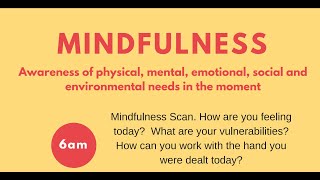
This is a recorded talk by Dr. Dawn‑Elise Snipes on recognizing, preventing, and managing burnout using mindfulness and self‑care, with attention to both professionals and informal caregivers. The speaker explains physiological mechanisms (HPA axis dysregulation, cortisol/serotonin effects, sleep/adenosine), enumerates common signs and causes (exhaustion, insomnia, cynicism, excessive workload, lack of control, perfectionism, caregiver stress), and presents practical interventions: prioritize sleep and nutrition, low‑intensity exercise, SMART goals, mindfulness scans, cognitive restructuring, psychological flexibility, resilience-building, boundary-setting, and social supports. The talk includes concrete tools (success journals, “perennial garden” visual cue, respite planning) and workplace advocacy suggestions, ending with a CEU sponsorship plug.
Chapters
Foreign. I'd like to welcome everybody to today's presentation on mindfulness and self care to prevent burnout. I'm your host, Dr. Donnelly Snipes. Now, when we talk about mindfulness and self care and burnout, a lot of times we think about ourselves. But it's also important to recognize that a lot of parents and a lot of caregivers also struggle from burnout. And it's important to help them develop tools to prevent burnout. Even my daughter, she was, she just finished her first semester of college, and at the end of the semester, she was just looking at me going, I wow, I never expected it to be that exhausting. So we're working together over the next few weeks to, to develop some strategies to help her prevent burnout next semester. Because she's kind of over it at this point. And a lot of students are experiencing that right now because they're in virtual classrooms and they're not used to that. So I'm going to try to weave all that in. As we go through today, we will identify signs and causes of burnout, explore techniques for burnout prevention. What does burnout look like? Well, when we say we're burned out, a lot of times we are feeling physically and emotionally exhausted. Burnout can be caused by the HPA axis being activated for too long because of chronic stress. Sometimes it's just because we have not been taking care of ourselves. So it's not necessarily emotional stress, but physical stress that's contributed to the physical and emotional exhaustion. And that HPA axis just kind of throwing its hands up and going, no, not gonna do it. So instead of fight or flee or even freeze, we're at the forget about it stage. Insomnia is another sign of burnout. Why is this? Well, when our HPA axis is activated, when it's starts to become dysregulated, a lot of times we have lower levels of serotonin, which means we have less melatonin available. We may have impaired concentration or memory if we're not sleeping well, not getting that quality sleep, the adenosine is not getting cleared out of our brains. So when we wake up, we still feel foggy. We still have what they call sleep pressure that is caused by that adenosine still being in there. That residual people may also have physical symptoms like heart palpitations or high blood pressure, panic attacks, appetite changes and increase in illness. We know this is a side effect of HPA axis dysregulation. When people are stressed out, their cortisol levels are high and their immune system is likely suppressed. Likewise, there is an increase in inflammation, which can. Is associated with increases in depression and. Or anxiety. But depression and anxiety can also increase just because you may be frustrated or feeling hopeless and helpless in a particular situation. If you remember back to college, for example, you know, a lot of us got to finals week and we were just kind of sitting there with our jaw open going, omg, I don't know that I can make it all the way through this, or I can't wait to get through this and I'm going to sleep for two weeks. And that is not an uncommon experience. And we'd really ideally prevent that from happening by buffering along the way, spreading things out a little bit more. But when you get to that point, sometimes you can start to feel stressed out. You can feel anxious that you're not going to be able to do what you need to do or feel just over it because you're like, I just don't have the energy. I don't know how I'm going to pull this out. A lot of times when people are burned out, there's an absence of positive emotions. Think about colleagues that you work with or caregivers that you work with that really need some respite care. There's an absence of positive emotions. They're just kind of there. They may be negative, or they may just kind of be numb and in a zone. There can be a sense of cynicism and disillusionment when we see burnout at work. Then we can become cynical and disillusioned about, you know, why did I get into this in the first place? Same thing for people who are in college who start to get burned out with caregivers. There can be some cynicism and disillusionment. From the perspective of it just. It doesn't seem like anything I do helps. There's a lot of hopelessness and helplessness. There can be a lack of patience when we're burned out. HPA axis is activated, and then our body becomes less responsive to the cortisol. Remember, we start developing glucocorticoid resistance, which means that our body doesn't respond to cortisol until it's a big deal. So we go into that situation instead of fight or flight, fight or flee. It's flat or furious. You know, so we're. We go from 1 or 0 to 200 like that. And we generally. Anything in between, something that's not a big deal, we just look at it. It's like, I just. I don't have the Energy to deal. I just, whatever. There can be a lack of resilience. Everything feels like a crisis. And this is what that flat to furious. The emotional dysregulation that happens start to get burned out as a result. Relationships can start to deteriorate. You start to lose patience with other people. You don't really want to be around them. You don't have energy to deal with anybody else's stuff. You may become cynical and disillusioned, feeling like you give and give and give and nobody else gives back. You can gravitate towards some of those cognitive distortions, the all or none thinking, the pessimism, the personalization. Sometimes we see substance misuse or substance abuse. And I, I should have changed that to addiction because it's not necessarily substances for every person. Some people withdraw into video games, some people withdraw into shopping. There are a lot of different behaviors that people take on in order to try to numb or escape their distress and get a hit of dopamine. They're just not feeling very much right now. So they're really trying to in some ways self medicate with that addictive behavior. And because of, you know, not feeling well and being impatient and just not having the energy to care, they may start foregoing important personal activities. This can be going to kids plays, this can be holiday parties, or it can even be things like activities of daily living. You know, they just don't have the energy to bathe. You know, when you have an employee or somebody coming in and it's clear they haven't bathed in a few days, you know, we probably want to start checking that out as a symptom of burnout or depression. Causes of burnout excessive workload. Sometimes when you feel like that inbox, not only is it never empty, but it just keeps getting more full and more full and more full. It can start to feel overwhelming and you can feel like you're working at 120% and it's still not enough. Emotionally draining work can cause burnout, and it can be emotionally draining. You know, our work as behavioral health professionals, we give a lot emotionally. We get invested emotionally with, through empathy with our clients. So that can be emotionally draining. Caregivers, you know, they are trying to take care of a loved one that they dearly care about. And you know, a lot of times they're watching this loved one deteriorate or they not get any better. And it can be very frustrating whether you're dealing with somebody who has, you know, dementia, Alzheimer's, or even if you're a parent. To a child with severe neuro atypical issues, it may be very emotionally draining to constantly feel like you are walking on eggshells trying to figure out how to make the environment comfortable for that person. You love them dearly, you don't resent that, but it can be very exhausting and it can be frustrating when some days it feels like nothing you do is helping. A lack of support is a big contributor to burnout. A lot of times we can handle hard workloads and emotionally draining work if we've got social support and we've got the resources we need to deal with it. And we've got some rewards. Yes, it may sound superficial, but we do need rewards. And I refer you back to love languages for this. It's not necessarily money, it's not necessarily like getting a plaque or an award, but we need to have some intrinsic rewards in the work that we do. If you're working with a person who has Alzheimer's, having a good day, or having that person smile may be a reward for somebody. It's like, okay, I finally helped that person feel happy for a second. So we want to use this concept of rewards kind of broadly. But it's important for whoever you're trying to prevent the burnout, whether it's you or somebody else, they need to sit down and really make a list of what are the rewards that I can look for for in this environment, in this situation? Too often we're looking for something that, you know, may not happen, or we're looking for something extreme. I want this person to be happy and, you know, get better. Well, that's, that's vague, number one. So what are some small rewards? What are some moments or some random things that might be rewarding? It could be a smile, it could be a hug, it could be a thank you. A lot of times rewards don't have to be huge. But again, going back to those random act, not random acts of kindness to love languages. You know, thinking about what your love language is may help you figure out the types of rewards that you might be seeking in what you do. You know, if you're a teacher, maybe a reward for you is if a kid comes up and tells you that, you know, they never cared about something before, but you made it interesting. And that words of affirmation might be just what that person needed at that point in time. So think about what kind of rewards you need and seize on the little ones. Don't wait for this ginormous reward. Likewise, make a list of the resources that you need to cope with whatever this situation is that is draining and, you know, seemingly overwhelming, that's contributing to your burnout. What would be helpful to have. It doesn't mean you're going to get all of them, but once you get it down on paper, then you can start looking and going, okay, well, I can call this person who might be able to help me out with this, or, hey, I have this resource over here I can tap into or this social service agency that I can reach out to to connect somebody. So it's important to know what resources we have. Too often we're not organized enough to really recognize the resources that we have and we can use, so we don't use them. I am guilty of that. You know, I have some very, very good friends, and sometimes when I feel stuck or I'm feeling frustrated, instead of reaching out to them for support, you know, I may for a moment think, you know, I wish I had somebody to talk to. Well, hello, you know, I have those resources out there. I just have to remember to reach out to them because. And tap into them. They don't know to reach out to me. And it's important for us to do that. So often as behavioral health professionals, we're used to people coming to us and telling us their problems, and we're not used to reaching out to others. We need to model that behavior. If we're telling people to reach out for help, we need to reach out for help, whether it's to our spouse or our best friends or a counselor or whomever. Another cause of burnout is a lack of a sense of control or say in the matter. Now at work, this can be debilitating. I did a set of seminars with some organizations in Chicago last year, and this was one of their biggest frustrations was because they felt, and you know, I've seen it happen. So senior management was regularly changing edicts, changing the direction, changing the priorities and what the expectations were. It was like goalposts that were constantly moving and they didn't feel like they had any possibility of success because of the changing requirements and the lack of control over what was going on. It just came down. There was no, let's ask the line staff what they think or let's ask middle managers what they think. It was the C level executives making decisions. And that can be very toxic in an environment because a lot of times people feel empowered if they're at least heard. Even if they don't get their way, if they are heard and they are given a reasonable explanation for why that can't happen, at least not right now. Then they feel connected, they feel like they did at least try and hopefully the other person worked hard to create a win win. Now sometimes organizations are not designed with an abundance mentality or good leadership or the idea of, you know, the seven habits of highly effective people, which I wish they were but so sometimes this is not going to happen with C level executives. I found in one of the agencies that I worked for there were a lot of good things and my supervisor was amazing. He was absolutely amazing and he taught me a lot about being a buffer between senior management and line staff because we did have one of those top down agencies. So figuring out what is it that you do have control over, you may not have control over, you know, whether you're transferred or not, but what do you have control over now that's at work. Let's talk about caregivers. You know, some people may feel like they are getting burned out because if they're working with a person who's neuro atypical, you know, they may not have a sense of control or say in what happens because that person, depending on where they're at that particular day, may have different needs. And so it's hard to predict what is going on. And when you lack predictability, that can be challenging for some people. The same thing is true with, you know, somebody who has Alzheimer's, for example. Some days may be great, they may be totally lucid and recognize you and other days they may not. And you never know, even from a moment to moment, hour to hour basis, exactly what you're dealing with. And that can be really exhausting because there's no, a lot of times, you know, with Alzheimer's, for example, there's no rhyme or reason to exactly what's going on. And it can feel overwhelming. Total side side note, y' all have to look up this video on YouTube. It's a ballerina and somebody started playing Swan Lake music for her. And I would guess she's in her late 80s, early 90s. You know, she was chair bound. But as soon as. And she had some neurological issues. I don't know if it's Alzheimer's or dementia, but as soon as they started playing the soundtrack to Swan Lake, she started doing all of the arm movements that would accompany that particular dance. She was back dancing again and she remembered every single movement. They had the a ballerina split screen so you could see what she would have been doing if she were actually on stage. And then you could see her in her chair doing Those same arm movements. And it was just. It was so touching to see this woman experiencing a pleasant moment from. From her past. And it didn't seem like she really recognized a lot of what else was going on. She seemed like she was really in pretty far stages of advanced Alzheimer's. So anyway, I encourage you to look that up on YouTube because it was a very moving video. Not very long, but very moving. Anyhow, in burnout work environments, there can be severe consequences if there are mistakes. Well, we've probably all worked in those environments, and it's important to figure out what you need and what you need to feel safe in that environment. If there are severe consequences, then you're probably going to feel unsafe a lot of the time. So what do you need to feel safe? If worst case scenario happens and you get fired, what is your backup plan? I encourage people who work in really toxic environments, and if they feel like they need to stay there, or if they've decided they're going to stay there, okay, well, if it makes you feel uneasy, if you're never sure whether you're going to get written up and you're always worried about getting in trouble, how can we help you feel safe? What plans can you make so you've got a backup to protect yourself? With people who are caregivers or with us as clinicians, sometimes if we make mistakes, the consequences can be pretty devastating. Somebody could get hurt or worse, and that is a huge responsibility to hold. And it's important for people to recognize how much energy and how much stress that causes. Not that it's necessarily something you would give up because, you know, it's something that you've gone to college for, it's something that you chose to do, or it's if you're taking care of a loved one, it's somebody that you love dearly. But there is that anxiety. I remember even when my children were little, when especially my son, since he was a micro preemie, and to come home from the hospital, what he had to do. He had to be over five pounds and go an entire week without stopping breathing. I'm like, really? That's all? So it was very stressful bringing him home. And, you know, I was always being a new mother. I was terrified I was going to make a mistake and do something to hurt him. So new mothers can also fall in this category. Not only of, you know, potential postpartum depression, but also burnout. It can be very exhausting sometimes to have an infant at home. Work life imbalance is another cause of Burnout. We all know people, if it's not yourself who go to work, they come home and work is still emailing them or they're still on their email up until 9, 10 o' clock at night, they're still getting phone calls and it interrupts dinner, it interrupts family outings. And that can be exhausting when you can never feel like you can devote yourself 100% to another part of your life. Now let's talk about work life imbalance in terms of caregivers or parents. Wow, that's a 24, 7 job. So you are working even though you're at home, you're responsible for the care and well being of somebody else. So it's hard to separate that and say, okay, you know, you can't say my job's done, I can take the evening off if that other person, you know, needs you 24, 7. So it's important to help people figure out if they are full time caregivers, how to get that caregiver me balance. They still need to have time to explore their interests, their hobbies and to take care of them. And a lot of times that involves helping them find social supports, respite care, et cetera. Perfectionistic tendencies can really lead to burnout if you feel like nothing you do is ever good enough and you're always trying to make it just a little bit better, you know, at a certain point. And there's that point of diminishing returns. And I talk about this with my kids a lot. You know, you can, my son especially, I'm like, honey, you can get a good solid A or an A plus on a project, but you can't get much more than that. So you know, he's getting, he was getting straight A's and he would like complete these projects and then he'd say, okay, I did it, but I want to improve upon it. And he would spend literally hours improving upon something that was already an A project and he wasn't going to get any benefit from it except for his personal learning. And then he would get frustrated because he didn't have any time to himself and he was getting burnt out. So we struggled quite a bit that first year he was in college, helping him recognize that it is important to do well and to do his best. But, but you know, once you've done the assignment, going over and above is not mandatory. So it's important to recognize that in ourselves as well. We want to do a really good job. But do we also have to volunteer ourselves to be on seven different Committees, pessimistic view of yourself in the world. Well, when you start feeling burnt out and you start getting a negative attitude and not sleeping well, you may start feeling like, you know, it's me. I'm just, I can't do this. I'm not good enough, I'm not strong enough, and nobody cares. And it's important to step back and assess factually. You know, what are my. What are the facts for and against my belief? You know, go back to that cognitive processing. What are the facts for and against my belief that nobody cares? What are the facts for and against my belief that I am no good at this? And I encourage people in supervisees I've had, whether they're their clinical supervisees or employees, to keep a success journal. It's very easy to focus on our things that didn't go so well, but encouraging people. And this would go for caregivers and parents and students as well, to keep a success journal. Things that they did right. Whenever my clinical supervisees come in, the first thing I have them tell me is tell me about three things that went really well this week. And then one thing that didn't go so well because I really want them to turn their attention and make note that of the fact that yeah, some things may have gone crappy, but there were some great things. And when we talk about individual clients, I will have them start out by telling me what was the most important thing that happened in your session with that client, or what was the most. The best aha. Moment that you had. And generally there's something in there, and if not, then we can talk about that. But I would say 85% of the time, people have some level of connection with their clients every session, and they can pull something out. The need to be in control and reluctance to delegate to others also causes burnout. And this can go back to obsessive compulsive personality disorder. It can go back to a history of trauma. There are a lot of things that could prompt this need to be in control. But it's important to have people examine what this behavior is communicating, what is prompting this behavior, and what would happen if they weren't in 100% control of everything all the time. People who are high achieving type A tend to get burned out more easily. And if you're in an environment, if you're in a job that is poor, fit for your temperament, you may get burned out more easily. For example, there was one job I took as a clinical director, and it was a great job. And I love being a clinical director. But within about four months it had morphed to where I was supposed to be doing 36 hours a week of direct sales. I don't do direct sales. I still stink at it. It is a very, very poor work person fit for me. And I very quickly became, you know, exhausted and burnt out, you know, ever changing requirements. I had no control over that fact and there were severe consequences for mistakes. And that particular supervisor would be emailing me up until the wee hours of the morning every single day. So yeah, there were a lot of burnout warning signs in that particular environment. So what do we do about it physically? Okay. The same thing you've heard in 17 other presentations. Make sleep a priority. You're not going to be able to be effective at work tomorrow if you're all groggy. So it's important to prioritize sleep. Turn the phone off. Turn it off. And engage in good sleep hygiene. Create a sleep routine that is essential for helping regulate the HPA axis. Regulate the person's circadian rhythms. Clear out that adenosine sleep is so important. And if they are caregivers, you know, if it's not work, if they're a caregiver, especially for example, with an infant that wakes up every three hours. If it's possible, having somebody take one of the shifts and bottle feed the infant can be helpful if the person is starting to feel burned out. My husband was on midnight shift when my kids were infants, so he would take the 2am feeding, so I would get at least five solid hours of sleep. Now that's not enough to avoid triggering that HPA axis, but it was a whole lot better than two hours at a time. Good nutrition is essential. We need to make sure the body is getting all of the nutrients it needs to make the neurochemicals that can help us calm down and replenish the resources that we burn up when we're stressed. So nutrition is important. Go easy on the stimulants and this is coffee, but also nicotine and any over the counter stimulants that, that you may consider. Stimulants trigger that HPA axis. They're going to increase anxiety, they're going to increase the HPA axis dysregulation and speed up the rate at which you are reaching that burnout finish line. Regulate your circadian rhythms with good sleep hygiene. That's helpful. Bright light when possible throughout the day. If you work in a place where it's dark a lot of the time, making sure to get out periodically into the Bright light, they found even with neonatal intensive care unit nurses. And it's really dark in the NICU. If they went out for five to 10 minutes, three times during their work shift into the sunlight, it helped keep their circadian rhythms regulated. But bright light is important. Even better if you can get the bright light from the sun, where you're also getting vitamin D. But, you know, whatever it takes. Pain management is important. When our HPA axis is dysregulated, our pain tends to go up. When our pain goes up, it activates and maybe dysregulates our HPA axis. So anything people can do for pain management that may not be even related to the burnout, but when you're in pain, it's going to, again, speed up the rate that you are getting exhausted, that you're going to become dysregulated and speed up the, the pace that you are, you know, racing towards that burnout finish line. And exercise, low intensity exercise. I know I've said it before. Going to say it again. Low intensity exercise at 40 to 50% of your target heart rate, which is not very high, you can go online, you can find a heart rate calculator and figure out what yours is. Mine, I think 50% is like 98 beats a minute. It's not something that's hard to do. You know, you can just walk around. But low intensity exercise reduces cortisol levels. They found that fatigue that comes from exercise. So if you, for example, walk on a treadmill at two and a half, three miles an hour, you're not really hoofing it. You're just, you're walking on the treadmill, getting your oxygen flowing when you start to feel fatigued. They found that the brain actually makes more tryptophan available and increases serotonin levels. I thought that was really fascinating. So even low intensity exercise, or maybe especially low intensity exercise can actually be rejuvenating for people and increase serotonin levels. So that's an awesome thing that they can do. If they are a caregiver, maybe they can push the person in a wheelchair or a baby, they can push him in a stroller, you know, finding out things that they can do. Maybe if they can't leave the house for some reason, they can, you know, do some sort of video. There's a lot of videos on YouTube that they can do, or they can download an app that shows them how to do yoga. Any of those things are going to help increase oxygenation, reduce cortisol and reduce stress. So those can all be Helpful. Now, a lot of times when people are already burned out, they're going to be looking at you like, you think, I've got the energy to exercise right now. Even thinking about yoga is just overwhelming. So it's important to prevent burnout from really developing. We want to help people intervene as quickly as possible. As soon as they start feeling like, yeah, this is starting to wear me down. They need to check these things and make sure that they're in check. If they can prevent them, you know, if they're getting ready to have a baby, they can plan for these things ahead of time. If they are getting ready to move in grandpa to live with them, and grandpa's got Alzheimer's, you know, they can plan ahead of time as much as possible for, you know, how am I going to make sure that I get the sleep I need, that I'm able to cook and get the nutrition I need, and that I'm able to exercise at least 30 minutes every day? I know that sounds overwhelming to a lot of us. Affectively and cognitively set smart goals. Specific, measurable, achievable, relevant, and time limited. And when we say work, you know, I'm really trying to put everything in here, whether it's schoolwork or work work or even goals for caretaking for whomever you're taking care of, setting specific goals. You know, maybe you're not going to get everything done today, but what is it that you can do get done today? What is it that you can get done this week and really be methodical about what needs to be done as opposed to what you want to get done? You know, let's get the need to's done first. And then if you've got extra time and energy, well, great. Brainstorm ways to work smarter, not harder. How can you combine things so it's more efficient, more effective? You know, when you go grocery shopping, I remember with my children, I put them in a little Baby Bjorn and, you know, so I had extra resistance when I'm walking around and I would take my time walking through the stores and that would kind of double as my low intensity exercise for that day. So try to figure out ways to work smarter, not harder. Take a squeegee breath, that deep cleansing breath where you breathe in for as long as you can. If you can do it for eight, great. You hold for a second and then you blow out. And it's important when you're being mindful, you notice that air coming in, filling your lungs and your belly. And then as you breathe out, envision Pushing out all of the, you know, bad energy and negativity. Take time to add in the positive daily, and this is beneficial to do everywhere. You know, if you add in the positive, and maybe you do it at work, you do it in the break room. You know, you share a funny video with whoever's in the break room with you. Spread a little positivity while you're getting it yourself. Do the same thing with, you know, if you're a caregiver, if you've got kids or something, do something that you all will enjoy that's going to be positive and make you smile, make you laugh, because that also increases serotonin and dopamine each day. Be mindful of the things that are going well, not just the things that are going poorly. Make sure to take breaks. If you can do it at lunch and at dinner, great, but at least at dinner, look back over the day and identify three to five things that went well. Keep a scrapbook or journal of your positive experiences. If you're a behavioral health professional, no phi in there, obviously, but have something that you can go back and look at and go, yeah, I remember that client was just, we had a really awesome session. Or, you know, it ended up very positively. You can do that and do it vaguely where you're going to remember, but you're not including any phi. You can create a perennial garden. Remember, perennials are plants that come back year after year. And every time you have a good experience at work or, you know, as a caregiver, whatever, a good experience that invigorates you for whatever you're doing, instead of drains, you plant a perennial plant. And then over time, you'll be able to look out at this perennial garden and see just represented by, you know, the number of plants that are out there or flowers, how much beauty and wonder that you've brought to the world and how much success you've actually had, you know, it adds up very quickly if you start paying attention to it. You can do the same thing with ornaments, wind chimes, stepping stones, a Lego wall for kids, or a backsplash tile wall. You know, those little tiny tiles they use on backsplashes now and sometimes even in the bathroom. You can have one wall, and every time you have a positive experience, you add another tile to it. You can also do it with construction paper. If you want to make something that's more temporary. You're only limited by your own creativity, but what you want is something that you can look at that builds on itself over time. And, you know, Six months, a year from now, you can look at it and go, wow, I've actually had a lot of positive experiences and some people just prefer to journal and that's cool too. Use psychological flexibility, remembering to define for yourself right now. To me, a rich and meaningful life is it incorporates these people, places, things, activities, whatever. This is what's important to me in my life. And then looking around and figuring out, okay, how many of those do I already have? So you can check those off and then you can figure out how to work towards the stuff that you may not currently have. Once you figure out what a rich and meaningful life looks like, that is your end goal. You want to use most of your energy doing what you need to do to work towards that end goal. So every time you start using a bunch of energy, you want to ask yourself, is what I'm doing, thinking or feeling helping me move towards the things that are important in my life? You know, and, you know, for a lot of us, our job is very important to us. It's important to us to help people feel happy, feel healthy, and have a rich and meaningful life themselves. So is what I'm doing, you know, asking yourself, is what I'm doing right now helping me achieve my goal of being the best behavioral health professional I can be? If so, great. If not, what can I do to improve the next moment? And it may be perspective taking. You know, if you are angry that your boss made you do something or change the rules somehow, all right, well, step back for a second and try to take your boss's perspective to see, you know, why that change was made. And it's frustrating if you're always having to step back and take their perspective. No doubt. But sometimes it can help you understand, you know, because a lot of times supervisors, especially C level executives, make decisions that are based on the fundamentals of the organization, hence money. And so it's important to step back and recognize, well, what I want to do is help people and help them be happy, and that's great. However, if we don't actually complete the billing and we don't actually get the money in, then I ain't going to have a job. So I'm not going to be able to contact people. So money's important to me too. Even though, you know, that's not my primary job. I can see their perspective that if we can't pay your salary, then you can't do what you love doing. Decision making. Sometimes you just need to make a decision about what's working and what's not and what you need to do next. You can practice with coping and emotion regulation strategies. What is it that I could do right now? Do I need to. And Linehan has the mnemonics accepts and improves and you can find those. But what strategies can I use to just improve this next moment? I'm not saying make me happy forever and always, but what's the next step I can take towards happiness? Sometimes, especially in a burnout work environment where you feel like you have no say and and everything's out of control around you. Sometimes assertiveness can be helpful where you stand up for yourself and you tell somebody this is what I need right now. Instead of expecting them to read your mind or know what you want actually communicating to them assertively, whether it is at home with your spouse and I need you to take care of grandma for the next two hours because I just, I need to take a bath and decompress. You know, your significant other may not know that. They may not mind read that. So it's important to be assertive and tell people, tell your supports what they can do to help you or what you need, what resources you need to make this situation work. Relaxation. Sometimes it just comes down to taking a breath and engaging in some activities that can help you relax and decompress. And this is helpful after you've had a long hard day at work. Maybe it was a bad day at work. Coming home and being able to decompress can be very helpful at improving the next moment because it can help you get out of that HPA axis flurry and downregulate into rest and digest, which generally puts you in a different mind space. And cognitive restructuring. Trying to use dialectics to embrace the good with the bad. Look at both aspects. Try to see, is there any positive way I can look at this? Is there any way I can look at this that gives me control. Identify the strengths and resources you do have. Remember I said earlier, we need to make sure that we're organized so we know what strengths and resources we actually already have. So we remember to use them. Make a list of them. If you're like me and you get when you get into that emotional mind, you have a hard time figuring out, okay, you know, what resources do I have available? Well, have a list. Mental agility is the ability to look at situations from multiple perspectives and think creatively and flexibly. State the other perspectives or solve from multiple approaches. There are some people who say there are three ways to do anything. You can do it cheap, you can do it fast or you can do it right? Well, you know, and you can modify that a little bit for interpersonal interactions, whether it's counseling, working at an agency, being a teacher, you know, you can do it the most expedient way, you can do it the best way, but you need to figure out, or you can do it in the way that is most profitable. That's especially true at an agency. But we need to figure out why people want things to be done a certain way and then compromise. You know, it doesn't necessarily have to be mutually exclusive, cheap, fast, or right. You can do it right and as fast as possible and as inexpensively as possible. So you can meld those together, but it's going to require compromise. Practice mindfulness regularly. I find it's helpful when I'm seeing clients to take a minute or three before I go into any session and just do a mindfulness scan. You know, how do I feel right now? Emotionally, mentally, physically? What do I need in order to be centered and focused and on my A game for this session? And that's a good reminder because, you know, every once in a while, I'll do that, and I'll be like, oh, I got to pee before I go in there. 20 minutes from now, I'm going to have a hard time focusing, probably more information than you wanted. But, you know, doing that helps us get off autopilot and actually notice what our body and our mind are telling us. Be aware of your trauma triggers. If you have a history of trauma, then at some point in your life, you felt unsafe and disempowered. And guess what? Burnout work environments are in their description, a lot of times cause people to feel unsafe and disempowered. So a burnout work environment in itself can potentially trigger prior trauma because you feel. Feel out of control. And it's important to be aware of that and figure out how you're going to deal with those situations when they come up. Deal with instances when you are potentially powerless to change something and what you can do about it. Develop resiliency. And I have the acronym mnemonic, whatever it is here, Godiva, one of my favorite chocolates. But gratitude can help us be more resilient. And if you remember, resiliency is the ability to bounce back. So, you know, like this elephant that is on the ball, when he stepped on it, it probably squished down, but the ball was resilient. So theoretically, it bounced back up. We want to be that ball. We want to be able to be resilient underneath some. Sometimes the Elephant or the albatross. And we can do this with gratitude. Being grateful for the things that we do have instead of focusing on what we don't have, developing that abundance mentality. We can have an optimistic, explanatory style, the ability to expect the positive, focus on what you actually can change, and then use your energy to actually change it. You know, and optimism is good. Sometimes you need to sit down and just think, all right, these are all the things I don't like about this situation or that are stressing me out about this situation. What parts of this can I control? What parts of this do I have the ability to make better in some way, and how can I make that happen? And expecting the positive, expecting, if you take proactive steps, that good things will happen. Distress tolerance skills. We already talked about living with integrity. One of the things that contributes to a lot of people's burnout is if they feel like they're doing something that is inauthentic. And it's important, regardless of what you're doing, to be able to live with integrity and do what you're doing with integrity so you're not beating yourself up and feeling angry at yourself for going against yourself. So integrity is really important, and it's important to define what that means in every situation. What does it mean to me to behave with integrity in this situation? Vulnerability prevention and mitigation. We've already talked about that. Vulnerabilities make you more likely to respond with an exaggerated stress response to unpleasant events. Vulnerabilities make you more likely to experience excessive distress. So think about, what is it that makes you vulnerable? For me, lack of sleep. I don't do well. Lack of sleep, illness, pain can make people vulnerable. Having a stressor, you know, maybe grief triggers can make them vulnerable. Vulnerabilities can change on any given day because sometimes, you know, you may get up and you have a grief trigger from, you know, something that happened a couple of years ago. And it gets your day started off kind of in a funky sort of way. And it's important to recognize and acknowledge, mindfully acknowledge that grief and go, okay, today might be a difficult one. What can I do to prevent this from negatively influencing my day any more than it needs to? What can I do, you know, if I'm feeling irritable, what can I do to prevent my irritability from turning into impatience with other people? What can I do to prevent my irritability from, you know, causing me other problems throughout my day? And that's where the mitigation comes in. It doesn't mean you're not going to feel things or not going to have distress. It means recognizing when you. When you're not on your A game, having strategies to cope with that so you can have the best day possible and have an awareness of what you can and cannot control. And just asking yourself, every time you start to get frustrated about something, you can ask yourself, what parts of this do I have control over? And is this a good use of my energy? I remember my daughter one time when I was recovering from a pretty significant illness, we were sitting on the couch and I started getting frustrated about something, and, you know, out of the mouths of babes. She was, I think, 12 at the time. And she looks at me and she goes, mother, is that a good use of your energy to help you move toward the goal of getting healthy? Well, I'll write it in. You're right, it's not. But it's important to recognize what you can and cannot control. And that drove home for me that day that cognitive flexibility is not something that only adults can do. Kids, even, you know, preteens, can wrap their head around the concept of, is this a good use of my energy to help me be happy and healthy? Another thing you can do is describe for yourself or to a friend why you got into the field or why you took on this task. Visualize that intention. You know, you can make a collage, whatever it may be, because you thought it was going to give you lots of money, because you wanted to help people. You're an adrenaline junkie. You wanted status, power. Whatever reasons you got into it, that's between you and you. But remembering what that is and noting on a regular basis how what you're doing is helping you to achieve those things. How is this helping me achieve the reasons that I got, you know, fulfill the reasons that I got into this, into this task. Make sure to regularly check your need for perfectionism and control, because like I said earlier, once you got an A, you can't do much better. Any more effort you're putting into it is just kind of spinning your wheels. Use your character strengths to engage authentically, overcome challenges and create a life aligned with your values. A lot of times when people start step back and look at creating a life aligned with their values and dedicating energy to all of the things that are important in their rich and meaningful life, they realize that, you know what? I've been devoting way too much energy over here, and it's important for me to feel fulfilled, to also dedicate attention to These places, and sometimes it may mean changing your situation or starting to figure out how you can change your situation. You may not be able to quit your job right now, but if it is an extraordinarily toxic environment with no hope of improvement, and you've already gone to human resources, you've already talked to your boss, you've already, you know, tried all of those other things, at a certain point, it may be important for your health and well being to start looking at what other options are available to you. Develop support coworkers, peers, supervisors. If it's a really toxic environment at work, for example, it may be helpful to have a few co workers where you guys can just get together and go, oh my gosh, all right, let me just tell you what happened. Where you can vent, you can be validated, and then you don't stop there. You can brainstorm ways to effectively solve the problem, and coworkers can be helpful for that. As long as you surround yourself with the positive people, not the ones that just want to stick on the venting part. Surrounding yourself with peers. Support groups can be super helpful. Significant others. Develop support at work from your supervisor. You know, be able to go into their office and sit down and just have a frank conversation. It's not always possible, but with good supervisors it is. Know and ask for what you need in terms of resources and create that work life balance. Develop and nurture relationships. Some people need to schedule it in. I'm one of those people, you know, I'm a J. Anyway, I need to schedule in time with my friends. So I'll, you know, schedule dinner with, dinner with Rita or whatever. But it's important for me to make sure that I'm making time to do that. Try to leave work at work. And this is becoming super difficult for a lot of people right now because they are working from home. So home and work are kind of the same thing. But when it's time to quit work for the day, try to set a cognitive and physical boundary between you and work, even if that means just closing the door to wherever you're using as an office. And take time for self care and relaxation. Limit your contact with negative people. Connect with a cause or a community group that's personally meaningful to you. Your job may be kind of a burnout work environment, but if on your personal time you're able to get fulfilled and recharged, it may give you enough oomph to deal with whatever's going on there and advocate for yourself and others with your supervisor or human resources about the resources you need. About consistency of communication and transparency in communication. About needing to have the ability to admit mistakes and learn from them without feeling fear of getting fired. About the need for support and celebration. Recognition of our good achievements. Not just, you know, no news is good news. Boundaries and job control Having some say over what you do on a day to day basis. Those are, you know, pie in the sky ideal things that you would have in a work environment. But a lot of times you can bring these to the table and seek some sort of compromise. Burnout Work environments are a reality and burnout environments, even in the home environment, can be a reality. But burnout doesn't have to be. Burnout causes problems in health, mental health, relationships, the work environment, kind of the energy and employee retention and the ability to provide client services or do the job that we really want to do. If it's caregiving or teaching or whatever it is, it's important to develop resilience and identify the sources and interventions for your burnout and develop that abundance mentality. If this podcast helps you help your clients or yourself, please support us by purchasing your ceus@allce.com or getting your agency to sponsor an episode. A direct link to the on demand CEUs for this podcast is@allce.com podcastceus that's allce.com podcastceus to sponsor an episode of Counselor Toolbox and reach over 50,000 clinicians per week, go to allce.com sponsor thank you.










