Observing Without Intruding: Creative Observation in Supervision
Dr. Dawn-Elise Snipes (recorded webinar/YouTube) explains direct and indirect methods for observing supervisees and offers 10 creative supervision/observation techniques (videotapes, audio, live/co-facilitation, one-way mirror/closed-circuit, role play, hypotheticals, process recording, case presentations, fast‑forward/nonverbal focus, dubbed voiceover). She covers ethical/practical guidelines (consent, selection of teaching moments, feedback pacing, risk management, erasing tapes), how to prepare supervisees/clients, and advantages/challenges of group supervision.
Chapters
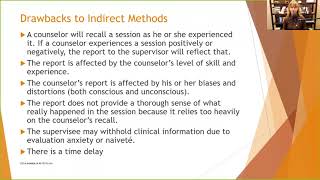
This episode was pre recorded as part of a live continuing education webinar on demand. CEUs are still available for this presentation through all CEUs. Register@Allce.com Counselortoolbox you I'd like to welcome everybody to today's presentation on 10 Creative Methods of supervision. And I'm sure there's a lot more out there. I'm not creative myself, so I tend to, you know, rely on the information and the knowledge of people who are kind of more that side of the brain. We're going to talk about 10 methods of observation and explain a little bit the benefits and ways to use group supervision to enhance learning. So group soup is one method of observation. Most states restrict group supervision to a certain percentage of the number of supervision hours that can be had. But you know, I really think that group supervision can be really beneficial if it, if you take advantage of it and it's used as a teaching tool. Not just how many people can we shove into a room and call it group supervision supervision and be done with it? So, you know, I'm not talking about using group supervision for that, but using group supervision to get feedback from multiple people and you know, it can be really cool. Anyhow, there are direct and indirect methods of observation. And a lot of what we're going to talk about today are direct methods of observation. You're observing a video you're observing, it may not be real time direct observation. We're going to talk about a couple indirect methods that you still might use. Indirect methods have their drawbacks because a counselor is going to recall a session as he or she experienced it. So if the counselor went in and had an awesome session, the report is going to be positive. They're probably going to focus on the positive things and overlook any of the hiccups, which there's not necessarily anything bad with that. But you're not getting a full picture of what happened and you're also not getting a full picture of what was the client's perception. The counselor may have thought, score, that was an awesome session. We made some real progress. And the client may have a differing opinion. So if you look at the nonverbals, you can and obviously listen to the verbals, you can get some ideas about whether the counselor and the client are kind of on the same page. This is especially true in the first couple of sessions when they're developing that therapeutic alliance see a little bit easier, you know, especially as a fly on the wall, if you will, whether the therapeutic alliance is being developed. You can focus on that more that new counselors tend to think rapport is being developed, even when it's not sometimes. So the report is also affected by the counselor's level of skill and experience. So if they went in and they thought it went fine, you know, that might be very, very true for their level of skill and experience. But you being a clinician for 5, 10, 15 years, may look at the tape and go, oh my gosh, you could have gone down this avenue and you could have pushed here and you could have gotten so much further in dealing with this issue or you totally missed this issue. And that's not the counselor's fault. The counselor's not omitting something, trying to hide it. They just don't know what they missed. It just they didn't realize it was significant. So getting direct observation, you can point out those things that might be significant. Now, like I said yesterday, the clinician is sort of the expert on their client because they see them for an hour every week, you know, 8, 10, 12 weeks, whatever. They have more of a relationship. We get snapshots. So whenever I see things that I think might be significant, I personally tend to hedge it a little bit and ask, do you think this is significant in the session or what do you think this means? Have the client supervisee expand upon it a little bit, because I may be wrong. It may be something that's totally innocuous. We can get better information, obviously with direct methods where we can see what's going on and we can ask questions. The counselor's report is affected by his or her biases and distortions, both conscious and unconscious. So the counselor is going to have certain ideas of what should be going on, what they hope is going to be happening, what they would define as happiness. And it's hard to get out of those biases. No matter how much we do a client centered treatment plan and we try to be as strengths focused and client centered as we can, there's that little voice in the back of our heads, that is how we would do it. And so it's important to make sure that the counselor is really looking at it from the client's point of view. Indirect reports may not provide a thorough sense of what really happened in the session because it relies too heavily on the counselor's recall. So this is going to be like your process notes. The counselor comes out, writes down everything that happened, or you're just looking at a simple progress note. And that's really going to be a lot more sparse compared to what you would get from a video or an audio tape or even a process note, the supervisee may also withhold clinical information due to evaluation anxiety or just being naive. They may not realize something's important, or they may realize they missed something or they're afraid to delve into this. And so they may not want to put, put that out there for you. If something didn't go well, they may not want to admit to it for fear of negative evaluation. And with indirect observation, there's always a time delay. There is sometimes with direct observation when we're looking at videos and things like that. But with indirect, there's always a time delay. So it's harder if something needed to be addressed with that client, it's harder to kind of jump in and handle it at that point because a week or two weeks may have passed since that session. So there are certain guidelines that apply to all methods of direct observation. Simply by observing a counseling session, the dynamics will change. But if you observe the counselor frequently, you're going to get a fairly accurate picture of the counselor's competencies. Now, this doesn't just apply to being in the room. And you know, when I was doing my internship as an instructor, and even when I was doing my internship, some in clinical work, occasionally my supervisor would come and sit in the class or sit in on the group and it was a little stressful. You know, I tended to be sort of trying to be on my A game and I was a lot more focused on that. So it changed that. The dynamics. Some it changes the dynamics with the people that are in the room, whether it's a classroom or whether it's a clinical group, it changes the dynamics. Now, I think I shared with you in one of the classes that where I did the majority of my work, we shared offices. So clients got used to other clinicians being in the room while they were having their sessions. We didn't have a place where you could go and do an individual unless you were going to go outside or something. So they often got used to that. So it didn't interrupt it quite as much. But if my boss, who was always in a three piece suit and they knew he was the vice president, came in, the dynamics were just completely blown. So we want to pay attention to that. But it also affects the dynamics of the session. If the supervisee knows and even if the, the client knows they're being taped and you probably experienced it when you did your tapes, everybody's a little bit nervous. And a lot of times that apprehension and stuff goes away 10, 15 minutes into the session and it's not a big deal, but it does tend to change the dynamics of the session a little bit if the supervisee knows this is one that's going to be reviewed. So again, you want to get snapshots. You also want to get the supervisee and obviously, hopefully the clients used to taping, used to being taped, so they're not apprehensive when that camera comes out. You and the supervisee must agree on procedures for observation to determine why, when and how direct methods of observation are going to be used. So you don't want to just say, you know what, I'll just show up and supervise one of your sessions at some point. That's not necessarily how you want to do it. You want to agree on what's the purpose of observation. When are you going to do it? Is it going to be, you know, on Wednesdays or. You need to tell the person ahead of time because ethically the clinician needs to tell the client ahead of time that this session is going to be taped, this session is going to be supervised or reviewed or whatever. So it's important to let the client and the supervisee know ahead of time that that particular session is going to be observed, if you will. Whether it's live observation or videotaped, the counselor should provide a context for the session. So if you've got your supervisee and you're getting ready to supervise through one of those one way mirrors or whatever it is, and you don't know anything about this client from Adam, it's going to be hard for you to figure out what's important, what's not important. So the supervisee needs to give you sort of the background, what's going on, what they hope to cover in this session, etc. And then they'll go in, they'll work with the client and you at least have some background. You know, for me, it's kind of like when I go to the movies. I hate going to the movies if I haven't read or watched the trailer or read the description of what the movie's about first. Because I can't just sit there and watch the movie unfold. It's one of my little quirks. But the same sort of thing goes with when you're getting the background from the supervisee. The client should be given written consent for observation and or taping at intake and before beginning counseling. So if they don't want to be observed, and that's a mandatory part of getting treatment in your facility, if maybe you're a treatment hospital, or a teaching hospital or something, then they need to know that so they can make an informed consent and they can say, you know what? No, I don't want to do that. But they also need to be notified before the observation occurs. So if they're getting ready to cover something that's particularly delicate, they can sit, they have the opportunity to say, you know, I really don't want this particular session observed. I just don't feel comfortable doing that. Observations. When you're doing tapes or when you're doing live supervision, observations should be selected for review because they provide teaching moments. Not to be critical, but you want to select good teaching moments, like, wow, that was a really awesome statement there, or I wouldn't have even thought of asking that question. But also other areas where maybe the counselor, the supervisee, went in a direction you wouldn't have gone in. So you can pause it and say, I'm curious why you went in this direction instead of this one, or why did you ask that question? And then obviously there are going to be the places where they get hung up or the counselor feels uncomfortable. You can see them start to fidget, and then we can stop and go, all right, it seems like you were stuck right there. Let's talk about in the future, what might you have done? So select teaching moments. Select things that are not just looking at it going, yeah, that looks pretty good. That's not useful. When observing a session, you gain a wealth of information about the counselor you want to focus on what is the most important issue here to address in supervision? I mean, you could come up with a litany of things. And it's kind of like when. When I inspect the house right before we have company coming, you know, we go through and we clean because living on the farm and having animals and stuff, but stuff gets dusty, we go through and clean. And there's, you know, door frames and stuff that I check that I don't normally check. There's a lot of stuff, and it can get overwhelming. What's the most important here thing here? So when I'm getting ready for company, sometimes if I don't have all the time in the world to prepare, I'm like, okay, we need to focus on the main area where they're going to be. The kids, bedrooms, not so much. Same thing. For supervision, you're going to get a litany of things. Maybe the counselor did something that you felt was distracting, like looking at their watch several times or, you know, whatever it is, if that's a prominent issue. Okay. But you don't want to come at the clinician with a litany of, you did this wrong. Find the most important issue, what seemed to go well, that's one of the most important issues. And what might you have done differently or what could have gone better? So I generally have two, but I always try to make sure I find some something or some things that the clinician did well. So it doesn't feel like every time I watch their videos or observe their sessions that I'm being critical and I'm looking for something to henpeck. A supervisee might claim resistance to direct observation, but most of the time, client resistance is more likely counselor anxiety. And it could be that the client is going, yeah, you know, I don't know if I want to be taped. And the counselor's going, you know, I don't want to be taped either. So okay, we'll just not do it. Supervisees need to understand why it's important to have those tapes. They need to feel confident in asking clients to participate in the video. They need to be able to communicate that it's a method for them to get feedback from others about ways to better help the client. Frame it in a way that it's beneficial to the client, but it's also beneficial to the supervisee. If the supervisee sees it as a tool to enhance treatment effectiveness as opposed to a tool for evaluation and criticism, it often goes better. Another thing that I've done with my supervisees is I've shared a video tape that I've done with them before I watch any of their videos, and we go through those together, especially my level one supervisees who are still kind of trying to get their land legs. We may watch a couple of the videos that I've done and they have the opportunity to say, why did you do that? Or I would have done this. And we talk about that. But so I've been on the hot seat first, so to speak. It helps ease the transition some. The supervisee should know at the outset of employment that observation and or taping will be required as part of the informed consent to supervision. So if it's somebody that's employed or at the outset of the relationship between the two of you, it may not be an employee. Supervisees need to know if you are going to require taping and if you are going to require live observation, what you do, how you supervise. So methods of observation. Now the fun part. Videotapes. There's at least three ways you can use them. Audio tapes, co facilitation, live observation, where you're actually sitting in the room. Live observation by a closed circuit video or when I was at uf, this is what we used for our first practicum. We had multiple counseling rooms and the clinical supervisor would be in the control room watching multiple client sessions go on at the same time and able to observe through closed circuit video. So if anything were to go wonky, he or she could have stepped in. Not that it did, but. And it also recorded each room so we could go back and review them later. One way, mirror supervision is obviously the old standard, like they use in interrogation rooms. Role playing, hypotheticals, process recording, and case presentations. All of these can be used as tools. So working with video and audio tapes, because those are the ones that we most frequently encounter. And there are a few kind of creative ways that you can use them. But first, you need to know what's the purpose. So you need to have clear goals to determine why, when, and how video session videotaped sessions will be conducted. I like to, for my supervisees, I have them pick three clients and I want to see at least three tapes for each client. One being at the beginning, you know, not necessarily the assessment, but it can be the assessment, one of those first two or three sessions, something kind of in the middle, and then something right before they're getting ready to terminate. So I can watch the progression. And if we need to do more in there, we can. If they've got an issue coming up that, you know, maybe the, the client is struggling with issues with a relationship or abuse issues, and they feel like they're sort of out of their depth, or they don't feel like they're handling it as effectively as they wish they could. Then we might add additional video supervision sessions. And, you know, this is why we're using it. We're using the videos to help you see what you do is because, you know, you're in your body, you're in your skin when you're doing counseling. When you're watching the video, you're a fly on the wall, and you can see things and hear things that you don't notice when you're in the session about yourself as well as about clients. So when, why and how the interactive processes recorded on tape should be related to the actual counseling session, its goals, and the memories of the session. And the rationale for the intervention should be explored. So you want, you want to make sure that you're getting the actual counseling session, not talking before and talking after. You want to know what the goals were when you're going in to Review this session, you want to kind of have some documentation on that. You want to know what the supervisees memories of the session were, because then you can compare their memories to what actually happened. And then as you go through the session, if you're going through, you know, bit by bit, each time the supervi uses an intervention, supervisee uses an intervention, you might pause the tape and go, why did you use that? Give me. What were you. What was your hope to get out of that tape? Segments should be selected for review because they provide teaching moments. The supervisor should provide gradual feedback, not a litany of judgments, and allow time between segments to discuss and assimilate feedback. So if you're watching an entire session, you don't want to go through it, pause it, say, you know, what was your thinking there? All right, move on to the next one. What was your thinking there? Each time you ask the supervisee a question, you really want to process it through. What was your thinking? Did it go as well as you'd hoped? Anything else you want to bring up or add to it and then move on to the next segment. So you may not be able to do more than four or five segments in a particular supervision session, but that's more than enough. That's a lot for the supervisee to take in. When I do those, we're spending pretty much the entire supervision session on one video. Then I may ask the supervisee to go home, think about what we talked about, and write down any questions or comments or feedback that they have and we can process that in the next supervision session. You know, so in retrospect, they can tell me how watching it felt, whether they still felt they did the same, whether their opinion of the session is the same. After reviewing the tape and how they felt about the interventions that we discussed, it's vital to have signed releases from patients prior to taping. We've gone over that. Risk management considerations necessitate that tapes be erased after the supervision session. So if it's a actual real client, you don't want to hold on to those supervision tapes because they can be admitted as part of the clinical record. If you're going to erase tapes, which it's recommended that you do, it needs to be stated in agency policies and they always. It needs to be a policy to erase them, not just willy nilly, I'm going to erase this one and not this one. So creative ways to use videos, run the video and fast forward to give you a heightened image of the counselor and client's body movements. So you know, you can do, Especially now that we don't have to do that. We have digital tapes. You can do it at three times, six times, nine times speed. So it doesn't have to be like they're, you know, freaking out or something. You can do it where it's a moderate, but you get a sense of what's going on. You can see people leaning forward and sitting back and crossing arms and fidgeting and get an idea about what's going on. And you can talk about, you know, did you get that sense? And what do you think this means? Turn down the audio of the tape and try to fill in what's being said on the basis of non verbals. You know, obviously the supervisee kind of remembers this session. It should be one that they just did in the past week or two. So have them try to fill in. You know, what was she talking about there when she obviously became quite irritated. You can cover the counselor and observe the client to guess what the counselor is doing. And if the counselor is having difficulty developing therapeutic alliance, you might cover up the counselor view the client. And if the client starts fidgeting and acting disinterested, you might think about what were you doing at that point in time. And then you can flip it backwards or you can do it the other way, where you're just watching the counselor and you're covering up the supervisor, covering up the client, and you're wondering, you know, what's going on. You see the clinician stop and look down for an indeterminate period. You know, it may be that the client started crying, or it may be that the supervisee started to get bored. So you want to go back. And they may not have realized that they disengaged their eye contact. Focus on the counselors non verbals. So you can watch the entire session, you can listen to it, but paying specific attention to the nonverbal. Sort of a gestalt approach to supervision. Using the videotapes, if you remember. Oh, golly, what were those videos? I think a lot of you probably saw them too, where it was Carl Rogers and several others. I'm escaping right now. Did interviews with this one particular woman and the one on gestalt counseling. You had him observing her and she was shaking her leg. And so he's like, well, what does that mean? What is your leg trying to tell me? So you can sort of do the same thing with counselors, nonverbals. All right. With audio and video, you know, you don't have to have video for these. While reviewing the tape Prior to supervision, you can do a voiceover, dubbing questions for the supervisee onto the tape. So you can use a program like Audacity, for example, is the one I have on my computer, and it's free, pretty easy to use once you get the hang of it. It's a lot of drag and drop, but you can find a place. And either right before or right after, whatever happens, you can insert a question. So you're not actually dubbing over anything, you're not losing any part of the session, but you're inserting a question for the supervisee to pause and think about and respond to. This way, if you're doing supervision, and maybe it's asynchronous there, you get the videotape, you review it, you make questions, you give them the videotape back, they watch it, they listen to the questions, they develop responses to them, and then you discuss that in supervision. You can also review the tape and stop after a client's statement and ask the counselor to respond. So if they're talking and Jane says, you know, I have tried everything and I just, I don't know what I'm going to do. I feel like I just don't know what the next step should be. Pause it and then ask the counselor, what would you say to that? You know, maybe if you remember what you did say, what did you say? But, you know, when a client says that, what would you say? In group supervision, this can be a really useful tool. If you're reviewing a tape in group soup, which again, can be really intimidating. The first couple of times after the client says something, stop it and go, how would you respond to that? That takes the pressure off. You're not always second guessing the, the supervisee. You're not waiting till the supervisee responds and then going, well, why did you say that? You're stopping it ahead of time and going, okay, now that the pressure's off, what do you think a good response would be to that? Or what would you say to that and why? And the supervisee who's working with the client will obviously have a rationale based on their relationship and the history that they have. But other people can also throw out suggestions. You know, I might have said this. What do you think would have happened if I would have said this? And the supervisee can respond to that and say, well, that might have worked really well. Or, you know, based on her issues with authority, you know, when I come at her with something, that's that directive, she tends to shut down. Okay, you know, no Harm, no foul. So but the supervisee is thinking through why different responses would be useful versus not useful. And everybody else in the group is thinking through. How would you respond if your client said this? So co facilitation and live observation, this is when you are in the room and you are going to disrupt dynamics, it's just unavoidable. It is time consuming. You have to be there for that full piece of time, for the hour or hour and a half, however long it is, it can be obtrusive and alter the dynamics. Especially if you're not co facilitating. If you're in there, but you're really supposed to be just observing, it alters the dynamics whether you intend to or not. One way. One thing I did with my supervisees, my staff when I was working in the residential unit and I would pull a chair outside the door and I would sit so they couldn't see me, but I could hear everything that was going on. You know, you could do it if walking down the, walking down the hall, I would periodically hear something. It would make my ears perk up and I'd stop and I'd listen for a few minutes. But where we were, the doors were always open for the group rooms. So I would pull a chair up and I would just sit and I'd listen for a minute, see what was going on. But if you're in the room, know that it's going can be obtrusive. It could be anxiety provoking for both the counselor and the client for obvious reasons. If the session's not also videotaped, there's no record of the session to review later. So videotape has a place. You know, if you're doing live supervision, that's great. But then if you and the supervisee remember something that happened and you remember it drastically differently, which happens, there's no way to go back and rewind and say, well, what actually happened? Because it's probably somewhere in the middle between what the two of you remember. So it's always helpful to videotape sessions, even if you're doing live observation. If you're doing live supervision and you're in the room, begin the session with a pledge of confidentiality so the client knows that hey, this person's going to be as confidential as everybody else. Prior to the session, briefly discuss the background salient issues and plans for the session. That way in your mind you have an idea of where this is going and then if it doesn't go that way, you can talk about why it didn't and why it went this other direction. But if it does go that way, you're kind of filling in the puzzle pieces. The supervisor should take notes during a session as a means of recalling key issues to be discussed later. Now this, especially in, in person, where you're in the room, supervision can be really anxiety provoking to clients because something's going on and they say something and you start writing something down, they're like, oh, the boss just wrote something down. What did I say? So, you know, I try to make, if I were to do this, I would try to make those notes as minimal as possible. I prefer to make the notes when I get, when I get out. You know, as soon as I walk out of the room, I take five minutes and I jot down the things I want to talk about because I want to make it as natural possible. Supervisors interventions during the session should be limited to no more than three or four comments. And sometimes clients will be having a discussion and they'll ask for feedback from the supervisee. Supervisee will give it, and the client will look to the supervisor, look to you, and go, what do you think? You really want to try to make sure the client understands your role. And if you do have to provide interventions or make suggestions, limit it to no more than 3 or 4 comments. Feedback needs to be given to the counselor as soon as possible after the session. You know, it's kind of like going into an interview, you walk out and you're like, well, I have no idea how that went. I think it went pretty well, but I don't know. Supervision is kind of the same way. So even if it's not a full supervision session, which is likely not going to be pulling the supervisee aside and going, I thought that went really well. Or, you know, try to find a couple of good things to say and identify a time when you're going to talk about it in the future, which hopefully is their regularly scheduled supervision time. If a group session is led by two counselors, the supervisor should meet with each, with the supervisees jointly. So if you're supervising a group that's co facilitated, you want to meet with both people together to get their impressions about what's going on. And I had this occur when I was in Gainesville. Sometimes the two people that are co facilitating the group, one would be my supervisee and one would not. So in that case, when you do supervision with them, you do supervision together. But do you want the other supervisor to sit in? So there's, you know, four people. Or since you were the One that did the live supervision. Do you meet with them both together and then each one meets individually with their supervisees? That's something you need to talk about with the other supervisors in your facility. Co facilitation should be used in. In conjunction with videotaping whenever possible. When I first started counseling, my first prac, we went into groups and my supervisor was the main therapist in the group. But I co facilitated. Now, we weren't able to videotape these sessions. I wish we were. But videotaping during co facilitation allows you to review and see, you know, when the sup. When the other facilitator tried to hand something off to you and you may have missed it or. And help people learn how to better co facilitate. In addition to making sure that the supervisor doesn't dominate the session. Other methods, live observation by a closed circuit and one way mirror supervision. So both of these still take a lot of time, but they're not as obtrusive and you do have the opportunity to intervene. So if you're working with clinicians who are doing their first or second practicum, maybe their internship, and you're not sure kind of if they're ready to work with clients, or you just want to be able to observe the first time they do a session to make sure that they've got all the basics. These methods are definitely helpful. Most of the time these methods are not available. So it's kind of a moot point. But if you can set it up, especially the way a lot of facilities have computers in every room where you can set up a webcam and have it go not over the Internet but to another computer in the building. That way the supervisee can or supervisor can see what the supervisee is doing. Another method for supervision is just providing hypotheticals. You're not necessarily, you're not dealing with their clients, but it's still supervision because you're still asking supervisees, what would you say? What would you do? So shows like Dr. Phil Intervention used to be Jerry Springer, you could pull up and listen to somebody tell their story, whatever was going on, and pause it periodically, pause it and say, how would you respond when the client says that? What do you think the person in the show should say to that? It does require additional time to get those together. The good news is that if you get them on videotape, you have them in perpetuity. So you can use them with multiple different groups of supervisees. Obviously, if you're just doing something with something on tv, you have no Ability to try it out and follow up. So it's not like you can say, well, why don't you try that intervention next week and see how it goes? Because you don't know the clients. But it does give you the opportunity to see the process and talk about the clinician's thought pattern in choosing their responses. Case presentations are useful in groups and individual supervision. I like case presentations because I really like to hear the in depth and I like to see how the counselor is visualizing and conceptualizing the case. Case presentation should be built around problems and solution oriented questions to be answered. So the client is presenting with postpartum depression and I want to figure out what the next best step is to work with her. These are the things that we've tried so far. So then the supervisee will present their case up until now and go, okay, now I'm trying to figure out which direction to go. Should move from client information to dynamics, prognosis and treatment plan. So you're going to get the foundation, you're going to get that integrated summary or if you're lucky, the entire assessment, progress notes leading up to that. So you've got background information. I really like the charts. When I've had supervisees that come from other agencies, I don't always get all of the paperwork that I'd really love to see. But if you're supervising within your own agency, you should be able to get your hands on that. You get the client information, then you start talking about the dynamics. How is the relationship building? How does the client seem to be progressing? Do they seem to be motivated? All those sorts of things. What's your prognosis for this client and why? And then moving on to the treatment plan. So your prognosis is good because of the social support and her willing willingness to seek treatment. Yada, yada, yada. What's your treatment plan? What are you intending to do with this client and why? Not just what, but why? And then I find it helpful with supervisees to also propose other things. Have you thought about using this or why do you think? And sometimes I'll throw things that are completely not appropriate interventions, throw them out there and ask the supervisee, you know, well, would you use this? And my hope is they say no, because I don't think that would be appropriate in this situation for this reason. So occasionally I do throw those little things in there. Case presentations allow us to observe the counselor's actions. We get to see sort of the play by play of what's going on as they tell us over the course of multiple sessions. So we see how they're developing their interventions as the client is developing in recovery, and we see how things change. We're able to determine the supervisee's impact on the client because we see the client going hopefully from being at a 1 on a scale of 1 to 10 to maybe a 6 now and, you know, score or at least a 6 on 1 or 2 of the treatment plan problems. Case presentations let us assess the counselor's clinical reasoning process. The. Well, what. What is your thought process in using this particular intervention? I use the word why. I use why questions a lot. And I know you're not supposed to, but I tell my supervisees ahead of time that I use why questions just because I'm curious. I'm not, you know, it's not that you did something wrong. I'm just curious. So if I use a why question, you know, don't think I'm being critical, but if it's bothersome, let me know. And I haven't had any supervisees really have a problem with it. Once they realize I'm not being critical with most of the why questions, I'm like, why did you do that? And they'll tell me. I'm like, oh, cool. And we move on. So they get used to me using that word. And case presentations help the counselor improve treatment delivery because they're presenting it and they're getting feedback. There's. Well, they're presenting it and they're formulating that case more and in more depth, and they're really weaving together all the pieces to present it to you, more so than they do for most of their clients, probably. And thinking about the clients that we work with, you know, that's true. You know, I don't write together or write out after the integrated summary, you know, this detailed narrative of how things are progressing on each and every client. That would just take too much time. Do I think about it? Sure. But I don't write it down as much. And clinicians will develop their own method for monitoring treatment progress. For me, I encourage supervisees to have the treatment plan with them and go over it at every session, ideally when they're doing the progress notes. So they pull out the treatment plan and they say, okay, we worked on treatment plan issue number one today, and we talked about this objective and this objective and this objective. It takes that treatment plan and it makes it useful for the client so the client can see why they did it. Makes it useful for the supervisee because it makes documentation easier. And you're able to show stepwise progress. But anyway, case presentations can be useful. And I find that if I'm having trouble with a client, if I feel like I'm stuck or I'm not making the progress I had hoped to. If I do a case presentation, even if I don't present it to anybody, the process of case prep helps me really sort through everything and think about exactly, you know, what my goal is and get refocused on where I'm going. Case presentation problems, though. You can look for too many presentations in too short of a time. Most of the time you can only do one good case presentation per supervision session, maybe two if you're doing a two hour group soup. But when I do supervision with my supervisees, we do the case presentation. But I also need to know about every other client that they're seeing, because that's part of my thing with supervision is I need a status update on each and every client that you're seeing at each and every visit. That way I have an idea about what's going on and I know, I feel confident that clients aren't dropping off and falling between the cracks and all that kind of stuff that can happen. When you've got a caseload of 15 or something, you can focus on a specific problem instead of giving a case overview. So instead of using the example we used before, instead of focusing on everything that's going on in Sally's life, the case presentation may focus too much just on that postpartum depression. But, well, what's causing the postpartum depression? You know, what else is going on in her life and how is that affecting her relationship with her kids, with her spouse, with her work? How is that affecting how she feels about herself? How's that affecting her health? Because with postpartum depression, like any of the other depressions, you may have changes in sleeping and eating and gastrointestinal problems and all kinds of other stuff. So you really want to make sure that you're getting the complete biopsychosocial snapshot of what's going on. Material may not be totally contextualized. So a good case presentation is going to give you the background so you know how we got from point A to point B, which is where you are. Supervisee dynamics may interfere with free and open discussion of the case. This is more problematic in group supervision where one supervisee may feel like others are picking on them or whatever, or maybe have some evaluation anxiety or something. So you want to make sure to normalize supervisee dynamics as much as possible. The final main problem is that there can be expectations for interventions beyond the capacity of the counselor. So, I mean, we've been doing it for a long time. What we're asking the clinician to do may be a little bit too advanced. So we do want to pay attention to kind of what are we asking them to do? If we're asking them to use some motivational interviewing strategies, well, that's great. Do they know what motivational interviewing is? You know, it's something that we've been doing for 10 years, but do they know what it is and how to implement it? So you may need to say, all right, motivational interviewing might be great here. Let's spend the next couple sessions focusing on that. Here's some reading to do in the meantime, and we'll pick up next week. Role playing can be an alternate to observing the clinician in an actual counseling session. So you. You go in and sit down and, you know, pretend that you are Sally and go through a session with the client or with the supervisee and see how this supervisee reacts or acts to you. It's ideal for practicing skills, and it's an opportunity to learn by doing in a safe environment and receive helpful feedback. So if they're working with a client who has postpartum depression or borderline personality disorder or something, you've probably worked with a similar client. So draw on your memories and try to embody that client as much as possible and help the supervisee or work through that. Work through that session. Process recording is another method, and this is really a written account of everything that was said and done in session. It is painstaking. It can be worth it. I have one friend of mine who's a supervisor who just swears by process recording. I don't personally like it as much, but I'm putting it out there because, like I said, some people swear by it, and she's an awesome supervisor. You're only getting the supervisee's point of view and what they remember, which is, you know, just like indirect supervision, you're not getting. Well, it is indirect supervision you're not getting. The objective of what happened. Intentional and unintentional errors and omissions can occur. But if you're going to use process recording, one way you can do it is, is to combine it with video. Have the supervisee leave, you know, end the session, write down everything that they remember happened. She said this, I said this. And it's going to end up being sort of a dialogue. And obviously an hour is going to be kind of long. You know, you're going to have multiple pages, and then you pair that with the video and see how true or true is not the word you want to use, how they reflect each other. Because the supervisee's recollection is going to be somewhat different from what actually happened in the session. So when there are discrepancies, you can pause it and go, so there's a discrepancy here. What do you think caused that? So group supervision, as I've said, has a lot of benefits. It can provide a cost effective way of supervising more people in the same time. So if you're not supervising for licensure, group supervision can be helpful. But you want to make sure not to get too many people in the supervision session. I believe Tennessee restricts group supervision to a maximum of six. It offers each counselor a reality testing of her perceptions through peer validation. You know, you watch a tape and the supervisees like that tape just, oh, I bombed that session. Then she may get feedback from others in the group that said, well, you know, maybe it didn't go the way you wanted, but here are some good points, and maybe you could try this the next time. So it validates, it supports, it encourages learning is enhanced by the diversity of people in the group. The first place I worked, we would do this weekly meeting, which was four hours long every week. But we would go through each and every client on the unit and talk about where they were at in their treatment plan, where they were at in terms of motivation and readiness for change, et cetera, and any issues, particular issues that the team needed to be aware of. But on that team, there were two marriage and family therapists, two clinical social workers, a mental health counselor, and an addictions professional. So these were people who were. Came from different camps, if you will, different theoretical orientations. I learned so much hearing how each one perceived what was going on with different clients, what might be motivating different clients. And it really gave me an appreciation for a multidisciplinary team. Groups create a working alliance among counselors that engenders a sense of psychological safety. Everybody's on the hot seat, so all of them are going to go in there, and each one of them is going to have good days, and each one of them is going to have bad days. And they get together and it normalizes everything. And they don't feel. Clinicians don't feel like they're the only one that has a client that relapsed or, you know, whatever the case may be. Groups provide the opportunity for Multiple people to review and see things on the tape. So you can periodically stop the tape and go, okay, what are y' all seeing here? And you know, obviously I'm a visual learner, so I use that phrase a lot. But you can, what are you hearing, etc. And get an idea of different people's interpretations of what's going on. And you know, sometimes somebody may see something that nobody else did. Maybe the client suddenly shifted their weight or every time they start talking about a particular topic, they shift their weight to one side and they can point that out. So you basically got multiple people trying to figure out what's going on with the client. And it can provide you a lot of really awesome extra input. The group process facilitates learning by setting up a microcosm of the larger social environment. So they're getting feedback from peers. Not all peers are going to be as gentle as others, but, but they're going to get more information. Group disclosure enhances the potential for self disclosure, confrontation and opportunities for growth. One of the places that did supervision in Gainesville was known for providing a lot of confrontation to their supervisees. And interestingly, it was one of the hardest placements to acquire because they only accepted people who they thought had the ego strength to be able to handle the confrontation. And it was a, it was a suicide hotline in the suicide prevention unit. So obviously you had to work want to work with that particular population. But they were regularly confronted and rather directly about their blind spots and about some of their issues that may be coming up in dealing with this particular client. It's going to be up to your particular style how you handle confrontation with your supervisees. But it is good in groups and in individuals to point out those blind spots and point out those obviously personal issues. We don't want to impede on the counseling process. Empathy and a sharing of interests are available to a greater extent than an individual supervision. You may have three clinicians that are interested in learning about emdr. You may not be able to provide supervision on that, but they can get together and kind of go off on a little tangent and learn about EMDR and find an EMDR supervisor once they get past your supervision. When the group works together over time, personal growth on the part of the individual members can be reinforced by the group. So the group is able to go, wow, Initially when you met with clients, you were a little apprehensive and now you go in and you just kind of take charge of that session and clients feel confident in you and calm from the get go or Whatever the case may be, but the group is able to really point out the growth that the supervisee is making. Alternative clinical approaches and methods are available to a far greater extent than a single supervisor can offer, which, like we just talked about, and the potential for constructive feedback greatly expanded. So sort of the same thing. A lot of different people watching the video are going to see a lot of different things. Just like you take five people at a crime scene and get their witness statements, you're going to get five very different witness statements. Because we all pay attention to different things and interpret things a little bit differently. Processes in group supervision that are beneficial, a sense of cohesiveness and a sense of we ness, a shared frame of reference. They're all going through supervision. They learn tolerance of diverse opinions and movement toward the common goal of licensure and doing the best they can with the client. In group supervision, though, like any group leader, the task of the supervisor is to help the group identify its norms and to model the appropriate qualities, behaviors and skills, skills for constructive feedback and observation and all that stuff. So creative methods of observation, using videotapes like we talked about, fast forward, turning down the audio, just watching the non verbals, maybe covering up the client or covering up the supervisee to kind of guess what the other person is doing based on the non verbals. Co facilitation, Live observation in the room, live observation by a closed circuit video. One way mirror supervision, role playing. Hypotheticals like, you know, using Dr. Phil or some other show where somebody is telling a story that is similar to what you might hear in a counseling session and you can stop it, have the clinician come up with, well, what you. What would you say to that? Hypotheticals and role playing are really effective, especially for new counselors or seasoned counselors that are learning new techniques. Process recording can be helpful, especially if combined with video. When you compare the two and case presentations really force you to weave together not only everything you did to create the integrated summary after the assessment, but weave together everything that has happened since then to really see the narrative, how you got from intake to where you are right now, and then start writing the narrative that helps you help the client achieve their goals. Are there any questions? Do you have any other tools that you use in supervision that can help clients or supervisees learn new techniques or reflect on what they're doing. All right, everybody, I really appreciate you coming today and you know, if you have any thoughts about, you know, different ways you could do supervision that we didn't cover, please feel free to email me or share tomorrow in the last installment of our I think, yes, the last installment of our Supervision series. If you enjoy this podcast, please like and subscribe either in your podcast player or on YouTube. You can attend and participate in our live webinars with Dr. Snipes by subscribing at allceus.com counselortoolbox this episode has been brought to you in part by allce.com providing 24.7 multimedia continuing education and pre certification training to counselors, therapists and nurses since 2006. Use coupon code counselortoolbox to get a 20% discount off your order this month.










