Opiate Commission Report
Dr. Dawn-Elise Snipes breaks down the Opiate Commission's recommendations to address the opioid crisis: expand treatment access, mandate prescriber education, increase naloxone availability, and strengthen prescription monitoring. She flags real barriers: Tennessee has only 12 methadone clinics, Medicaid billing limits counseling to 15-minute increments, and veterans and uninsured people face major gaps.
This episode was pre recorded as part of a live continuing education webinar on demand. CEUs are still available for this presentation through all CEUs. Register@Allce.com Counselortoolbox you.
I'd like to welcome you to this special episode of Counselor Toolbox. We're going to be talking about the.
Opiate Commission's preliminary report that came out last week.
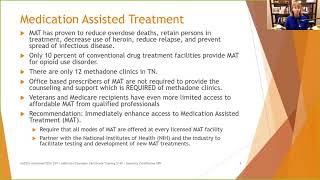
In 2015, 27 million people reported current use of illegal drugs or abuse of prescription drugs. Only 10% of the nearly 21 million citizens with a substance use disorder received any type of specialty treatment. So of those 27 million that are using illegal drugs or abusing prescription drugs, only 21 million, which is still a lot, meet the criteria for substance use disorder. So there's still some people out there that don't quite meet criteria. With approximately 142Americans dying every day, America is enduring a death toll equal to September 11th every three weeks. Now let that sink in for a minute. So one of the first recommendations of the commission was to rapidly increase treatment capacity by granting waiver approvals for all 50 states to quickly eliminate barriers to treatment resulting from the Federal Institutes for Mental Diseases exclusion within the Medicaid program. This exclusion prevents federal Medicaid funds from reimbursing services provided in an inpatient facility treating mental diseases in including substance use disorders that have more than 16 beds. And you know, I'll tell you that when I was working in a clinic in Florida, we were talking about trying to figure out how we could serve persons with Medicaid in our residential facility. And we kept running into this because we had 84 beds and there was nothing we could do. And we actually looked at opening up a wing that was just for that and that didn't meet Medicaid criteria. So this will help for those agencies that are already approved to take Medicaid for intensive outpatient and those sorts of services. This will help make it easier for them to provide services on an inpatient basis. Right now, states are entirely responsible for Medicaid eligible patients in inpatient treatment facilities, including patients in detox. So, you know, when again, where I worked, when people showed up to detox and they met criteria for under the influence, we had to accept them. There was no do you have insurance? We had to accept them. It was required. So if they had Medicaid, they couldn't use their Medicaid to pay for that. So we had to use state funding or any funds that they had, which at the facility I worked at was usually zero to none, in order to pay for that treatment. So this will take off some of the burden from from the states and allow them to use federal Medicaid dollars. So that's good cause theoretically states can reappropriate that money to increasing state funded services or prevention. According to the recommendations, this will immediately open treatment to thousands of Americans in existing facilities in all 50 states. Will it? Medicaid requires extensive provider enrollment procedures. So if the facility is just a residential fac, then they're not already approved to take Medicaid. Like I said, if they have IOP and they've already been approved, then it should be a relatively easy transition. Medicaid documentation and who can provide what services and knowing the ropes, so to speak, of Medicaid also is kind of challenging. So the staff is going to have to be completely retrained on how to do their notes. Medicaid bills in increments of 15 minutes for a lot of services. And there are certain services such as group that can only be provided by specially trained providers. And you can't just use someone who doesn't have a degree to provide group counseling services. So what we're looking at is a shift in the way that services are provided and the requirements which agencies are going to have to get up to speed with. And it'll require extensive modifications to the electronic health record and policies and procedures for those agencies again that don't already bill Medicaid. Because there are different billing methods, especially that whole 15 minute increment thing that are important to look at. And Medicaid does care whether you round up or round down. If you are in the middle of a 15 minute segment that will be important to prevent agencies from having to do have a lot of paybacks. So along with that, you know, the agency or the commission did not recommend this. But I would put out there for agencies that are looking to become Medicaid certified or approved, that they require any person that's working in their facility, from technicians and clinicians and managers to receive specialty training in addictions counsel. This will make sure that people providing services are able to bill for services under Medicaid. For example, somebody with a bachelor's degree with specialized training in behavioral health disorders, human growth and development, evaluation assessments, treatment planning, basic counseling and behavior management interventions, case management, clinical record documentation, psychopharmacology, abuse regulations and recipient rights. That is a laundry list of training that most agencies are not going to provide their techs. But if this person has a bachelor's degree and has this specialized training, then they are able to do and bill for biopsychosocial evaluations and group therapy services, group counseling and day treatment programs, community support and rehabilitative services, clubhouse services and therapeutic behavioral on site support services with persons under 21 in many states. Now each state has their own little Medicaid requirements, so you need to double check that in your state. I'm basing it off of Florida, which I know the best. Now if the person that you're. If your employee does not have a bachelor's degree, that doesn't necessarily mean that they don't have a job anymore. What we need to look at is can they get certified as a recovery peer specialist, a recovery support specialist, or a behavioral health technician. So even if they don't have a bachelor's, but if they're certified by the state, then they can provide and bill for certain services under Medicaid. So that is the long version of. For agencies that decide to start providing Medicaid billed residential services, it is going to be really important to make sure that all of your staff is either state certified or has the minimum required training. Prescriber education fewer than 20% of the over 1 million prescribers licensed to prescribe controlled substances have patient training on how to prescribe opioids safely. So just think about that. You know, dentists, oral surgeons, physicians, surgeon, surgeons, anyone who can prescribe opioids. Only 20%, one in five ever received any training on how to prescribe opioids safely. Only 20% received training on how to screen for addiction or what to do if a patient becomes dependent on substances or presents with a substance use disorder. So if someone comes in and they're already experiencing a substance use disorder, many clinicians, many doctors and dentists and stuff have no idea what to do about that, how to make the referral, how to help them get treatment, or even how to screen for somebody who may currently have an addiction. The recommendations also go on to say that it's important to mandate prescriber education initiatives with the assistance of medical and dental schools to require all Drug Enforcement Administration registrants, so people who write prescriptions to take a course in proper treatment of pain. Now this is really important. What is proper treatment of pain? What we have gotten away from treating pain that is excruciating to treating pain because people think they should be pain free all the time, which is one of the things that leads to overuse of pain medications. The recommendations are also to work with partners to ensure additional training opportunities, including continuing education courses for professionals to help them know how to screen, what to do if somebody shows up and they've already got a substance use disorder, if they become addicted. And how to prescribe opioids safely. And it's recommended to promote the expanded implementation of the CDC guideline for prescribing opioids and chronic pain. And you can Google that and look at the guideline. It's not that difficult. It's important to note that four out of five new heroin users begin with non medical use of prescription opioids. Now, I do want to point out that of those four out of five, not every one of those people was the prescription theirs. It could have been junior getting the prescription out of mom and dad's medicine cabinet. It could have been roommate taking it. It could have been someone who had the prescription opioids, selling them to somebody else, or giving them to somebody else that was a friend or whatever, which none of those are okay. But I want to point out that it's not necessarily the prescribee that becomes addicted to the prescription opioids. Another recommendation was for medication assisted treatment. Medication assisted treatment has proven to reduce overdose deaths, retain people in treatment, decrease the use of heroin, reduce relapse, and prevent the spread of infectious diseases. So there's a lot of benefits to medication assisted treatment. And I do want to point out that in most cases medication assisted treatment is two years or less. This is not a lifetime thing. In order to keep somebody on medication assisted treatment longer than two years, especially methadone, you have to make really clear arguments about why this is medically necessary. Most methadone clinics and medication assisted treatment facilities use that two years to help the person wean off of the opiates, learn how to manage their pain. And yes, they wean off of the medication assisted treatment as well. Learn how to manage their pain, learn how to manage their stress, and develop the skills they need to stay clean and sober. Of important note is that only 10% of conventional drug treatment facilities provide medication assisted treatment for opioid use disorder. So right now, when you go into a drug treatment facility, most of the time it's a detox process. And that's not exactly how some people want to do it. So some people don't seek treatment. By the same token, it's important to recognize how many people are currently in conventional drug treatment that have opioid use disorders. We need to figure out a better way to treat this group of people which could be making medication assisted treatment available. To give you an example of how easy it is to access medication assisted treatment or methadone, there's only 12 methadone clinics in the entire state of Tennessee. Other places have applied to open methadone clinics in Tennessee and they've been denied. The state doesn't see a need for it, despite the alarming number of deaths. One of the things that I like about methadone clinics as opposed to office based prescription of Suboxone or buprenorphine, is the fact that office based prescribers of methadone assisted treatment, medication assisted treatment, are not required to provide the counseling and support which is required, underline, underscore, bold required of methadone clinics. So when somebody goes to a methadone clinic, even if they're getting Suboxone, they are still required to go through the counseling and receive the skills and get a biopsychosocial assessment to figure out how can we help this person stay clean and sober? How can we help them get the wraparound services that they need? And I use the term clean and sober pretty, pretty loosely. I just don't want them to relapse. What is recovery for one person may be different than recovery for another, but I want them to get to a place where they are healthy. Veterans and Medicare recipients have even more limited access to affordable medication assisted therapy from qualified professionals. There are very few mat approved doctors and clinics in the Veterans Administration system. So veterans who often have chronic pain issues and do have a history of opioid use, that's a higher percentage in that group, have even less access than the general population. Oh my gosh, that's mind boggling. And Medicare in most cases does not pay for medication assisted treatment. So it's important to look at what are we doing because Medicare, we have people who are elderly. Now people who are elderly start feeling a lot more pain and we probably will see a lot more opiate use and or abuse in that population. How can we manage their pain? That's what I'm looking at. Even if we're not talking about getting rid of opiate addiction, if we can prevent grandma from, from getting addicted to opiates, that's awesome. We need to look at different ways we can help manage pain in the elderly, in veterans and in the general population. Another recommendation from the committee was to immediately enhance access to medication assisted treatment, requiring that all modes of medication assisted treatment are offered at every licensed medication assisted treatment facility. Now, if they mean every methadone clinic that's really not going to expand services that much. If they mean every doctor's office that's approved to prescribe buprenorphine or Suboxone, that's huge because that means that those doctors offices will also be able to prescribe methadone and, you know, any of the other medication assisted treatments like Vivitrol. So that's huge. If that's what they meant. I'm hoping that's what they meant. And the recommendation to partner with the National Institute of Health and the industry to facilitate testing and development of new medication assisted treatments right now for chronic pain, there aren't a lot of things out there. SSRIs, your selective serotonin reuptake inhibitors can help with some chronic pain, but it's not a pain reliever by any means. The drug and the name escapes me right now. I'll think of it in a minute. But there are Neurontin, Gabapentin is out there and that does help with certain neurological pain. So that's another one to have on the radar. That's not an opiate. But then the rest of them are pretty much opiates. So if you have somebody who you know, for whatever reason does have intractable chronic pain, how can we help them in a way that's not going to harm them? Another recommendation was to provide model legislation for states to allow naloxone dispensing via standing orders and require the prescribing of naloxone with high risk opioid prescriptions. So if you go in and you have surgery and they prescribe a high risk opiate, which they didn't define what those were, if it was all opiates or just certain ones, but if they prescribe an opiate, then you'll also get a dose of naloxone with it. That way, if you accidentally overdose or if someone in your family takes your meds and overdoses, you have naloxone handy. Is this encouraging use? No, what it is, is a preventative measure. I know in my medicine cabinet I've got syrup of ipecac. Does that encourage people to drink poison? No, but I have it on hand in case there is an emergency to prevent death. And the recommendation was to equip all law enforcement in the US with naloxone. There are some law enforcement agencies in Ohio, for example, who have decided that they will not carry any naloxone. They said that when they respond to these calls and somebody needs it, they give it to them. The person goes into the hospital, gets stabilized, gets out, relapses, and they're back out there the next week or the next month giving them naloxone again. Well, this may be true, but that's not because of naloxone. That means they're not getting access to the treatment services that they need. Now, even if the services are available, which is hit or miss, we have to engage the clients. So we have to train providers how to engage clients into treatment. We have to make treatment more available. But naloxone will save lives and give people a chance at treatment. And I would argue with the fact that naloxone is useless, as some of the law enforcement agency directors might want us to believe. Yes, there are some people that are not ready for treatment. They're in pre contemplation. But I believe in my heart of hearts, the majority of people, if they got naloxone, they got access to high quality, effective treatment. They wouldn't relapse. So we need to figure out how to get them in there. And we're going to talk about Medicaid in a minute. Enforcement, prioritize funding and manpower to the Department of Homeland Security, Customs and Border Protection. Okay, well, great. So we keep less drugs from coming into the United States, but we know from looking at patterns, go back to prohibition, go back to when we first discovered heroin, when that starts to be heavily regulated. If people need an escape, if people need the high, if people need the rush, whatever reason is motivating them to use, if they can't get their substance of choice, they're going to find something else. So just eliminating it from the system is not going to solve the problem. Now, we might reduce overdose deaths, especially if we can get rid of fentanyl, but it doesn't mean it solves the problem. They want to also increase funding to the Department of Justice, Federal Bureau of Investigation and the DEA to develop fentanyl detection sensors and disseminate them to federal, state, local and tribal law enforcement agencies. Now, if you're not familiar with fentanyl, it is like 50 times more powerful than heroin and it's a lot cheaper. So street dealers will take pure heroin and they will cut it with fentanyl because it's a lot cheaper. Then they sell it to somebody who thinks they're getting pure heroin or they don't know how much fentanyl is in it. They take the dose of heroin that they usually use, which, since it's cut with fentanyl, is 30 to 50 times more potent and they overdose and die. They didn't intend to, but they're getting basically dirty drugs. And you say, well, why would street dealers want to do this? Because once you kill somebody, then you don't have Them coming back to buy more. Right now the opiate epidemic is so huge, when one goes away, there's another one to replace them. So dealers aren't as concerned with that. They're concerned more with immediate profit. And there was a recommendation to support federal legislation to staunch the flow of deadly synthetic opioids through the U.S. postal Service. That would be great if that could happen. Another recommendation was to provide federal funding and technical support to the states to enhance interstate drug interstate data sharing among state based prescription drug monitoring programs to better track patient specific prescription data and support regional law enforcement in cases of controlled substance diversion. So basically that's the long way of saying they want to help stop doctor shopping right now. If Jim Bob is addicted or if Jim Bob is a dealer, he can go to a pain management doctor in Florida, get a prescription for opioids theoretically, then cross the border into Georgia, do it again, cross the border into Alabama and do it again. And those states are not communicating because we're not communicating interstate about opiate prescriptions. And if he does it fast enough, even if they were communicating, it may not register. So if we have this computerized system that as soon as a prescription is written it goes into the interstate system, then Jim Bob wouldn't be able to cross the border without that doctor seeing that he just got a prescription for opioids. So this is a really good program if we can convince doctors to use it, and there's going to have to be some teeth in it to make sure that people are actually compliant with using the system. You know, when they write the prescription and it could be written into the electronic prescribing. You know how they automatically send prescriptions via the Internet to the pharmacy now. So anytime the doctor writes the opiate prescription, it automatically puts a note in the system as well as notifies the pharmacy that it needs to be filled. That would be useful. Another problem that we've been facing is the fact that Code of Federal Regulations 42 Part 2, or you may know it as CFR 42 Part 2 prohibits clinicians who work with somebody with addictions from divulging the information that they have an addiction. So you kind of run into problems if you're trying to share information, if you're not allowed to divulge that information. So you know, if you have a patient that goes in for emergency surgery, they get into a car wreck or something, and it's not in their health record that they have an addiction, then they may get Demerol when they are in the recovery room and send them into a relapse area. It's important that providing clinicians be able to access people's medical record, including including whether or not they have an addiction. So the recommendation is to better align patient privacy laws to addiction with the Health Insurance Portability and Accountability act or hipaa, to ensure that information about substance use disorders is available to medical professionals treating and prescribing medication to someone with a substance use disorder. They speculate that there is an end run around HIPAA and CFR 42 part 2 by using the Overdose Prevention and Patient Safety Act. Parity. I told you we were going to talk more about Medicaid in a minute. But this is not just Medicaid. This is all insurance. Enforcing the Mental Health Parity and Addiction Equity act to ensure that health plans cannot impose less favorable benefits for mental health and substance use diagnoses versus physical health diagnoses. Well, on paper they may look like they're providing parity. When you look at it in action, you want to look at whether the pre authorizations are as easy to get, if you will, or being handed out equally for physical health, mental health and substance abuse. If not, then there's really not parity, even though they say that there is. So we want to look at whether when we look at it in Operation Parity happening and right now, according to the committee, it's really not. In many cases, what we're not looking at and what the recommendations didn't address were the uninsured. Single men without dependent children may not be able to qualify for Medicaid, may not be able to afford insurance, and persons with felony convictions in many states are not able to get Medicaid. So if they just get out of jail, and we know that the people just getting out of jail are at higher risk for relapse and recidivism, they're in a dangerous position already and they can't access medical health care that they need in order to, you know, be healthy and happy and stable and all that kind of stuff. So we really have a problem here. The recommendations didn't even consider these people or recidivism and how dangerous of a time it is when people get out of jail. So we need to look at how are the uninsured able to access substance abuse treatment. The other issue that they didn't consider in the recommendations was people who do have insurance, but they can't afford to use it because their co pays and deductibles are too high. Most Americans can't scrape together $2,000 for an emergency medication assisted therapy, for example, costs on average $3,500 to $6,000 per year without counseling. This is just your doctor's office buprenorphine prescription. Most people can't afford that. And when your deductible is over $1,000 a year, you have to come up with that thousand dollars up front before insurance will even help you. So, you know, again, we're setting people up by saying, okay, you have insurance, you can access services. Well, that's not necessarily true if they can't come up with the deductible. And then most people's coinsurance is 20% for residential treatment. For example, a month in residential treatment in a Nonprofit averages about $19,000. A month in residential treatment in a private facility averages about $30,000. So 20% of $19,000 or $30,000 is a whole lot more money than most people have available. So treatment is still cost prohibitive for most people. Prevention programs was another recommendation. Great, that's wonderful. An ounce of prevention is worth a pound of cure. I got it. They want to make evidence based prevention programs for schools a available. But unless they make it a priority, like the state testing for academics, it's not going to happen. Because right now I can tell you from having kids in public school when I did was the fact that teachers teach to the test. Their jobs are dependent on how well their students do on that test. Schools are ranked in terms of how well their students do on that test. So everything is ranged around the test. When I was trying to get my child therapists into the schools in order to do school based counseling, it was always a fight because the administrators never wanted to allow the student time away from the academics. That was more of a priority in their minds. And for some of these students, their parents just couldn't get them to counseling for whatever reason. So school based counseling was the best chance of providing continuous treatment. It also recommended tools for teachers and parents to enhance youth knowledge of the dangers of drug use. Okay, let's enhance their knowledge. But we need to start doing that when they're knee high to a grasshopper. By the time they're in high school, they've already googled most of it and some of them have already experimented with most of it. So we need to make sure we get that information out there early. But the dangers of drug use sometimes pale in comparison to the pain they're feeling or the peer pressure they're experiencing. And they're going to do it anyway. So just telling them about the dangers is not going to prevent a large proportion of these youth from experimenting with drugs. Another recommendation was to provide early intervention strategies for children with environmental and risk factors such as trauma, foster care, adverse childhood experiences and developmental disorders. Well, that sounds great, but how are we going to get these early intervention strategies to the children? Because the teachers certainly don't have time to do it. How are we going to get the information to the parents so they can provide the information to the children? And when we're talking about children who've experienced adverse childhood experiences, for example, their parents may not be any better equipped to provide them this information than the child is already. The parent may be one of the perpetrators, for example, of the abuse or neglect or whatever. So you may be asking, what are adverse childhood experiences? Physical abuse, sexual abuse, emotional or physical abuse or neglect, intimate partner violence. And that can be either child on child dating violence or seeing parental domestic violence. Substance misuse, not abuse, not dependence. Substance misuse within the household, household mental illness. And when you add up the percentages for anxiety, depression and bipolar disorder, that's nearly 35% of Americans parental separation or divorce. Our divorce rate is 68%. So if this is an adverse childhood experience that we need to provide intervention strategies, and that means that 68% of kids in the US need these right now, how are we going to get them to the youth? And an incarcerated household member is another adverse childhood experience. So again, prevention programs are great in theory, but I really want to know how are you going to operationalize it to get that information out to the youth, to the parents? As I said, the teachers just don't have time to do it. So we need to make sure that we have some way to disseminate the information, even if that's allowing or mandating prevention programs in schools so that agencies who want to go into schools to provide these services have an easier road with getting into the schools instead of having to fight against annual testing requirements. Pain scaling the examination of the need for satisfaction with pain level as a satisfaction criteria through which a health care provider is evaluated is an important recommendation because right now healthcare providers are evaluated on how well are you managing your patient's pain? Since a lot of people expect to be pain free nearly always then and that's really next to impossible to accomplish, we see a lot more prescribing instead of having providers go okay, we need to get your pain somewhere down around a three, but I can't promise you a zero and helping people figure out how to manage their pain non pharmacologically and accept that they're just going to have some pain days. Treatment program improvement they recommended improvements in treatment programs based on adherence to evidence based practices. That's wonderful. What they didn't consider was the fact that evidence based practices, to implement them correctly or to fidelity means that people have to or agencies have to train their entire staff on this evidence based practice. And for most EBPs that means bringing in a consultant to provide the training. And that is expensive. You know, anywhere from 5 to $15,000 to get a consultant to come in to provide this training. And some EBPs even require ongoing consultation for two years after the beginning of implementation. So there needs to be some money to the agencies in order to provide the ability for them to train their staff and EBPs and implement them. They also want to encourage enhancement of the continuum of care. And this is something that I've always kind of complained about. Going from residential, which is 247 controlled situation, back out to life on life's terms and once or twice a week after care and theoretically 90 meetings in 90 days. If it's a 12 step program, that's not enough. That's like taking a high school student who has had regimentation their entire life, going to public school, knowing when things need to be done and you know, having a curfew and all that kind of stuff. The first year they go to college, we see a huge dropout rate and failure rate in college freshmen because they are unable to make that huge transition. So a better continuum of care would be to require patients who discharge from residential to go to IOP at least briefly until we make sure that their skills and tools are as solid as they think they are, when they have to apply them in the real world and then quickly step down to aftercare, looking at outcome measures to figure out what we're doing well and enhance doing that and educate patients on quality treatment, helping patients understand what options are out there. Because sometimes patients feel like there's only one way and if this way doesn't work for me, then I'm kind of screwed. That's not it. There are so many different treatment approaches that it's important to help patients realize that maybe this doesn't work for you. Let's look at this other option over here. But they need to know their options available. Other areas identified for evaluation include targeted data collection and analytics needed to identify most effective prevention and treatment strategies, quality treatment access programs and ways to aid law enforcement activities. Another recommendation was to develop a behavioral health surveillance system run through the CDC that tracks prevalence rates, treatment modalities and comorbidities with other illnesses in real time. So if you've got a client that has opiate dependence and eating disorder, major depressive disorder and lupus, you know, we want to look at what's co occurring and are there specific treatments? The statisticians can take that data and say for this population with these particular characteristics, this treatment works better than that one because right now we're kind of spitting in the wind. A lot of times when we start trying to provide treatment to people because we're starting with, well, this generally works and if it doesn't work, then we can look at something else. This surveillance system would help us narrow it down so people have a better chance at success their first time. I hope that gave you a general introduction into the recommendations of the opiate commission. And you know, they made some really good steps and I'm hoping that they actually put the money where their mouth is and are able to operationalize this in a timely fashion. Thanks for tuning in. If you enjoy this podcast, please like.
And subscribe either in your podcast player or on YouTube.
You can attend and participate in our.
Live webinars with Dr. Snipes by subscribing@Allce.com.
Counselortoolbox this episode has been brought to.
You in part by allce.com, providing 24. 7 multimedia continuing education and pre certification training to counselors, therapists and nurses since 2006. Use coupon code counselortoolbox to get a 20% discount off your order this month.










