Parenting Skills
A recorded presentation by Dr. Dawn-Elise Snipes outlining parenting skills across four child development stages (preschool, elementary, middle, high school). It covers biopsychosocial development (physical, cognitive, psychological, social, ethical), stage-specific needs (sleep, nutrition, exercise), major developmental theories (Piaget, Erikson, Kohlberg), common behavioral issues, protective factors, and practical parenting strategies and tools.
Chapters
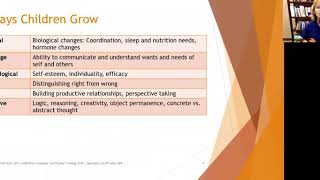
You. I'd like to welcome everybody to today's presentation on parenting skills. In this presentation, we're going to talk about six key areas of child development. And basically we're talking about the biopsychosocial development of children in four stages. And we're not going to do infant toddler today. We're going to start with preschool, elementary school, middle school, and high school. Then we'll identify key principles to help you deal effectively and work with or parent children. So a lot of what we're going over today is stuff that can be used in a parent education class. And you can decide based on your approach and the people that are coming to your class how heavy you want to go on. Theory versus practical tools. So one thing I want everybody to recognize is the fact that developmental age and chronological age may not be the same. And if you have a preemie, you are very, very familiar with this. My son was born three months early, so there was a huge lag initially in that difference between developmental and chronological age because, you know, when he was actually three months old, he was actually just getting out of the hospital. So we want to look at what the child is expected to be doing based on how old they really are, because chronological age is the time from birth and developmental age is what they're actually doing. Culture, environment, health and personality all impact developmental age. So if it's a culture that extremely stimulating, then the child may develop a little faster in certain areas than other children if it is an environment that is very poor in any sort of stimulation. When I ran the mother baby unit, we had a 15 slot, I will say mother baby unit, so we could have 15 moms and their children. And one of the things that I found and that I worked on changing when I took over that unit was the moms didn't know how to parent. They didn't know what to do with these kids. Some of them did, but the majority of them would take their child and they would put the infant in a swing or in a car seat in front of the television and expect it to sit there all day long. There was no floor time. There was no playtime. There was very little carrying and hugging and anything like that, except for during feeding periods. So, you know, that environment was very empty of anything that could stimulate the child. So, but environments that are very stimulating, where the child has things to play with, things to touch, things to see, those are things that are going to help stimulate the environment, stimulate the child, their health. If a child is sick early on, if they have A lot of illnesses, and it can be, especially children who have problems with their ears, may have delays in speech. They may also have delays in walking, depending on what's going on. Because if they're getting fluid in their ears, then their balance is going to be a little bit off. You know how it is when you get an earache. So health problems can contribute to delays. Likewise, good health. You know, children that are more robust are going to be able to experience more things. And personality, some kids are just, you know, more reserved, more withdrawn. They need a little bit more time to ease into things. And then some kids are wide open. So their personality is going to impact the types of experiences that they choose to engage in. So thinking back to Maslow's hierarchy, we have your biological needs and we're going to look at each of these for each stage of development. For lack of a better. We're not going to look at self actualization because a lot of adults don't even get there, but we're going to look at the rest of it. So biological needs. At each stage, the child has to have their health. They have to have adequate sleep and proper nutrition safety. They need adequate sleep and they need to be able to not have nightmares. They need to be able to sleep, you know, not just adequately, but they need to be able to go to sleep and feel safe going to sleep. And they need to feel safe risk taking. And that kind of sounds contradictory, but if we have a secure attachment, then a child is going to take more risks. I'm not talking about jumping off a building. I'm talking about introducing themselves to someone else, to trying to do something, something new, to going to preschool, any of these things that are risks that are taking them out of their comfort zone. They have to know they've got a safe home base to which they can return. And then love and belonging comes along with secure attachment and unconditional positive regard and self esteem. Children need to have a sense of self worth to know that they're okay. Self efficacy, that they can accomplish things, and self awareness. You know, what do I need right now? And most of us can't necessarily say that we are completely mindful at any particular time. So six ways children grow physically. Biological changes happen and that can be growth spurts. And children experience these when they experience them. For my children, for example, they would go through spurts where intellectually maybe math would be the thing that they were doing and they were excelling at, and it would seem like their language skills would fall back a little bit and then it would swap and it was this sort of two steps forward, one step back thing all the way through early elementary school. And the pediatrician said, yeah, that's just normal development that's expected. When children are going through growth spurts, they need additional sleep, they may need additional food, they like to eat more. And that can also impact their learning and their attitude and their mood and a whole bunch of things. So we need to be alert to biological changes and the impact that it has on this little human being. It can affect their coordination. And somebody who has never been able to throw very well may not really notice it. But you know, as children, especially in middle school, go through these major growth spurts, they may feel self conscious, they may be less coordinated, and that can affect their self esteem and their sense of self efficacy, language. They develop their ability to communicate and understand the wants and needs of themselves and others. And it's up to us as parents and clinicians to help children become mindful in order to understand their own wants and needs. They've got to be mindful, they've got to be self aware of what those are. Psychologically, children develop self esteem, individuality and that sense of self efficacy ethically. Now this is a throwback to Kohlberg, and we're going to talk about him in a minute. But this is when children start learning to distinguish right from wrong. And as children grow, the reason something is right or wrong in their mind tends to change socially. Children grow, learning how to build productive relationships and take other perspectives. And cognitively, this is your throwback to Piaget. Logic, reasoning, creativity, object permanence and concrete versus abstract thought. Now why do you care about all these? Well, because the way we parent or interact with a child or the interventions that we use are all going to be impacted by that child's developmental age in each one of these areas. So Piaget, in a nutshell, we're just going to hit the highlights as they pertain to this presentation. Piaget talks about thinking, reasoning and problem solving in the pre operational period. You know, the child doesn't really have object permanence and has difficulty understanding. If I put my glasses in my purse, did my glasses go away or not? So they have, they're developing their capacity to understand things a little bit. And there's a lot of fantasy, concrete, operational, which is a lot of elementary school children still need to see things, which is why they use manipulatives so heavily when they teach math and science in elementary school. It's not because it's just more fun to do it that way. It's because cognitively, children can't wrap their heads around this idea of theoretically, one train leaves the station at 3pm and this other train leaves the station at 4:05pm and they're both headed towards the no. The kids are sitting there going, I don't know. But if you have two little trains and you start making them move and you're representing relatively accurately in terms of speed and stuff, then they can see how the two trains might meet. Love and belonging comes from Erickson. And if you remember his stages of psychosocial development, trust versus mistrust. Then comes autonomy versus shame and doubt. This is your preschool age. This is where children are learning to be the masters of their own little person. They're developing the potty training, they are starting to dress themselves, they're probably starting to bathe themselves, and they're developing this sense of independence. This is the terrible twos and the even worse threes. I don't know how to rhyme that. But this is when a child is really learning that no word and trying to set boundaries and get some power and figure out what they've got control over. Industry versus inferiority. So when we're parenting and intervening at that stage, we want to make sure to empower the child within safe limits. And if we have to say no or we have to contradict them, we have to help them understand why so they can learn from it. But a lot of times they also want structure. At that point, then industry versus inferiority is your elementary and some of middle school. This is when kids are starting to figure out what they're good at. They're starting to learn how to communicate with others. And what they're good at isn't just science or math. It's also making friends and communicating and being funny and all of those things. And this helps children kind of figure out what their strengths and their skills are. And then once they've got their strengths and skills, they move on to high school. When they start developing identity, they start figuring out, you know, who is it that I am? What is it that I stand for? So they take from their strengths and everything, hopefully, and pick from that in order to develop their personal identity. And any kinds of problems in these areas can cause anxiety and depression. So Kohlberg, Kohlberg's levels of moral development, level one is preconventional. The focus is on the self. Can I do it and not get caught? The question the person asks or the child asks is what? What makes me happiest? And you'll notice there are no ages on this because Kohlberg said that not everybody develops into future moral stages. But this is generally what we see. Generally preconventional is your younger children. What's going to make me happy? How can I get away with it? Level two is focus on others, conforming to the will of the group and figuring out what makes others happy and gets me approval. Now you can hear middle schools coming out right here and authority on social order. What does society say I should do? And for a middle schooler, society is school. You know, they're not looking to the president and the laws and all that kind of stuff. They're looking to their microcosm of what is their world, what do they need to do to fit into their world. And then level three is post conventional and it focuses on principles with the social contract and human rights asking, do the rules need to be changed to fit the current culture? You know, do I need to advocate, do I need to be somebody that stands up and tries to fight injustices? You see this a little bit in some high schoolers, but a lot of high schoolers stay at that conventional level where they're really seeking approval from, from their social circle. So let's start with preschool biological needs. 10 to 13 hours of quality sleep. Now I want you to think about yourself or clients that you've had and who've had preschool age children. And you know, they work, they pick the child up from daycare at 5. You know, they get the child home, eat dinner, take a bath, child goes to bed, then child gets up again. How many of those preschoolers actually probably got a full 10 to 13 hours of sleep? Not a lot, the way our society is now. What's the problem with that? Well, sleep, regardless of age, sleep is when your body balances out. Sleep is when your brain restores. Sleep is when learning takes place. Sleep is when all those neurotransmitters get balanced back out. And sleep deprivation leads your body to think that it is in a state of stress because, you know, think back to the, you know, most primal times, you know, the sick and the sickest, the slowest and the sleepiest one is probably the one that's going to get eaten first by the big lion. So, you know, when you think about sleep deprivation, your body, when you're too tired, keeps levels of cortisol higher. It keeps you on alert more. So how is this going to impact a preschooler? A preschooler is going to have difficulty learning. A preschooler who's sleep deprived is going to have difficulty developing because learning takes place during those sleep phases. So they're going to have problems putting stuff together as much. They're probably going to be more irritable. They're probably going to have more difficulty concentrating. And we know that preschoolers have the attention span of a gnat, and that's okay. Everything is new to them, so it's really exciting. But if they have difficulty paying attention, then that attention span is even smaller. We want to make sure that we emphasize the need for sleep and point out how many different ways it can help in behavior and emotional management. Exercise. 30 minutes of structured physical activity and at least 60 minutes of unstructured physical activity each day. Well, that's kind of, you know, loosey goosey on what you consider structured and unstructured. But we want the child up and moving about 90 minutes a day for preschoolers. And so this can be recess, this can be playing after school. This can be a variety of things, but it's ideal if, you know, you encourage the preschooler to not just sit in front of the Xbox. I see when I take my kids to martial arts, a lot of times their siblings are in the waiting room, and these children are just completely glued to their mobile devices, watching videos and cartoons and everything else. And so my thought is, you know, are these children getting up and moving? So we want to encourage exercise. Exercise keeps the body healthy. Exercise helps get oxygen around so people have more energy, and so the body can grow. Exercise has also been found to help with stress reduction and releasing of serotonin. So it can help kids be a little bit happier. A lot of times, kids, especially once they get into school, but even in preschool, sometimes they have to hold it together. They have to be on their best behavior all day long. So when they go home, they're just. They've kind of been stuffing it in all day long and holding it together. They need to cut loose. So this is a great time for that 60 minutes of unstructured physical activity. So encourage them to not just come home and get in front of the tv. And that will help a lot with behavior issues later in the evening. Now, nutrition. Preschoolers need about 1400 calories a day. And you might be going, oh, my gosh, that's as many calories as I'm allowed in a day. Well, yes, preschoolers are growing. They need more calories because their body is growing, their metabolism is faster. Why do I bring this up? Same reason I bring up sleep, because the neurotransmitters are made from the food that we eat. So if they're not getting enough food, they're probably not getting the building blocks to make the neurotransmitters to help them concentrate, learn, be motivated, experience, pleasure, all those things. Additionally, nutrition, you know, gives us the food we eat, gives us the building blocks to grow. So physical development as well as emotional stability can both be impacted by not getting enough quality nutrition and 1400 calories, we know, are not the same across the board. You know, you can eat 1400 calories of Oreos, which sounds really good, but it does nothing for your health. It actually is probably harmful. So we need to make sure that parents have access to resources to get good nutrition. Piaget during this preschool period, kids need to start developing an understanding of things that are going on. So when they get in trouble, when they make a mistake, you want to use concrete examples, number one, and ask them, you know, if the child goes and steals somebody's ball, how would you feel if Johnny had come over and stolen your ball? So that's concrete. They know what's going on inside them. Because they're very egocentric at this stage. They may not understand what's going on inside Johnny. So you may be able to take it to the different level after they've said, it would make me mad. Okay, but if it would make you mad, then how do you think Johnny felt? Do you think Johnny felt mad too? And it can help them start developing empathy. Egocentric thinking is also popular or common at this age. It's about me. So it's important to clarify what is and is not the child's doing. If you come home and you are in a God awful mood, which happens occasionally, making sure to tell the child, you know, mommy's in a really bad mood today. It has nothing to do with you, I had a bad day at work, or whatever. You want to share with them however much information you think is appropriate and then let them go with that so they understand, okay, it's not about me. And it's not my job to try to apologize or make it better. Children at this age think in all or nothing terms. They have difficulty with sometimes, you know, so consistency is really important when parenting a preschooler and clarifying the media. Preschoolers remember, they're still having difficulty with understanding fact from fiction. Well, they also have difficulty understanding whether something's ongoing or if it's reruns. So if you're watching a disaster, for example, a hurricane, or, you know, the Twin Towers going down or whatever it is that the media is replaying 247 for weeks on end. To a preschooler, that means it's happening now and now and now and it's continuing to happen. They don't really get the concept of video replay yet. So we need to explain to them this is something that happened two weeks ago. It's not happening anymore. You're safe right now. Because they can get really upset by it and traumatized by what they see because they don't understand. And they also don't understand when it's coming into their living room on the TV or if it happened in New York or Australia or wherever it happened. That means nothing to a preschooler. You know, they understand where they are right now. They don't understand how far away New York is from where they are. So we want to make sure we clarify these things for children. So in preschoolers, when parenting and using interventions, make sure to use concrete examples. You can use manipulatives too. You can also use with training. You can also use dolls if they want to act things out. Now dolls are, if you're doing any sort of trauma counseling, you probably need special training in that. But if you're just watching the child play or doing imagination activities with them, dolls can be somewhat concrete. Make sure to clarify all or nothing kind of terms for them and help them understand the difference between, you know, what happened in a television show, which is fiction, and what's happening in real life and whether it's continuing to be ongoing. Preschoolers need to feel this sense of initiative. They need to feel like it's okay for them to leave and have fun at school and then come back to mom and dad. They need to feel like it's okay for them to experiment with, you know, in the dress up corner or on the playground or whatever, with different things to try out their, their skills. You know, they're discovering this little body that they were born into. So it's important for us to emphasize that parents need to express unconditional positive regard. We're not always going to like the things kids do. That's just the way it is. You know, people don't always like the things we do and that's just the way it is. We make mistakes, but we're good people. So we need to remind parents to focus on the behaviors. When a child does something. I love you, I don't like this behavior. And there are self esteem needs encouraging parents during this period because children are going to try things, they're going to take initiative and it may not go so well. So we provide them unconditional Positive regard. I'm proud of you for trying and focus on and help the child remember the things that they can do. You know, maybe baseball is not for you, but you were really good at soccer. And help them, you know, start understanding that they're not going to be good at everything all the time. But that doesn't mean that they are less lovable or less important. And during this preschool phase, and you know, we all have been there, this is when children want a good deal. They want to know what's going to work in their favor and make them the happiest. So when you're reasoning with a child at this point, asking them about whether it's the most socially appropriate choice to make, probably not going to go anywhere. So we want to ask them or tell them why they need to do something and what the benefit is to them. So common observations in preschool, a strong attachment to home and family. We hope if we don't see this, then as clinicians or if you're a teacher, you may want to start taking a look at what might be going on there where the child is not attached. A short interest span. They're interested in cars one day and dinosaurs the next day. And you know, a lot of projects may go half finished, but they're preschoolers. You know, projects for a preschooler should probably be, you know, an hour long, not a week long. They have short attention span. It's hard for them to focus on any one thing, even stuff they're interested in for extended periods of time. They are becoming aware of themselves and their own desires. They know what they want. Whether they want Cocoa Puffs on the cereal aisle or they want to stay up late, or they know what they want now. They're not really sure, you know, why they can't have it. So we need to educate them about why they can't stay up until 10 o' clock at night or whatever. We need to set those boundaries. But they're starting to, you know, they're figuring out what they want and what they need. They're imaginative and they often think that things that are inanimate, like stuffed animals have, can come to life. And you know, if you think of the, the Velveteen Rabbit, I love that story. But a lot of children have difficulty understanding that, you know, toys can't come to life at this age. They're curious. They want repetition of enjoyable activities. At this age, boys and girls readily play together. You don't have this diversion nearly as much until you get into later, later years. They're still dependent on Adults for getting their needs met. They need consistency and thrive on structure. Now, some children need more structure and prefer more structure than others, but they do need somebody, a parental figure, a caregiver, to set limits. You know, even if you're not providing a whole lot of structure, they need somebody to set limits and to say, you know, you need to take a bath, you have to eat your supper and make sure that they're doing what they need to do to grow into healthy, happy adults. Children are much less stressed if their environment is predictable. That doesn't mean you have to do the same exact thing every single day, watch the same movies. No, but there needs to be a certain amount of consistency in their environment for them to feel calm when they get to elementary school. Now, preschool we talked about, you know, maybe kids are still getting their 10 to 13 hours of sleep in elementary school. A lot of children are not getting nine to 12 hours of sleep. And it depends on the child how much they need. But nine hours, not every child, you know, is going that needs nine hours is always going to need nine hours. When they're going through a growth spurt, they may need 13 hours. So we want to encourage children to start paying attention to their bodies and when they're sleepy, to go to sleep. If that means they're going to sleep at 7 o', clock, you know, that's okay. But we do, as clinicians, we want to encourage parents, as parents, we want to be aware that children at this age need this much sleep. So we need to kind of work our day and our schedule around it to make sure that they're getting that so they can learn, so their body can develop and so they can feel more emotionally stable. At this age, they need 1600-2000 calories. That's a lot of calories. But they're growing. And you know, put the link in here to the USDA website that recommends how many calories for each age group. So, you know, I'm not just pulling it out of thin air, but we want to make sure that children are getting this amount of healthy, quality food. Sometimes that can be mean. Experimenting and exposing them to new foods and new experiences. They need to be moderately active, 60 minutes a day, at least five days a week, or have at least 11,000 daily activity steps on a pedometer. Oh my gosh. When I made this presentation, I started watching how many average daily steps I get during the work week. It is nowhere near 11,000 steps. So that has encouraged me to up my goal. But children, now that we do have pedometers and we do have the fitness watches. It's a lot easier for us to help encourage children. At my house, we compare our steps at dinner each night to see how many steps my daughter always wins. But it's a little competition between the family and it's something we can talk about. And if most of us haven't met our goals, then we'll go out. We live on a farm, so we'll go out after dinner and walk around the pond or do something in order to get a little bit more activity. During this age, cognitively, they still need concrete examples. So we want to use activity analyses, for example, to break activities into their component parts to help children see how, you know, when you're playing soccer. For example, an activity analysis of soccer would look at dribbling, would look at kicking, would look at defending the goal. I should have picked something I know more about, but you're breaking it down into those parts. If they are cooking now, I know that one. They need to get the recipe out. They need to get their ingredients together. They need to measure the ingredients, yada, yada, yada. So this is an activity analysis that helps children start understanding how to go from nothing to something. You know, how to have no skills or no, none of this done to something. And this is the beginning of goal setting. Because then when they get older, you know, if they want to run for student government, okay, let's break it down into an activity analysis. What do you need to do to get enough votes? You know, how are you going to promote yourself and etc. And have them break that down? But they're starting to learn how to set goals at this age. They have less all or none thinking in elementary school. They're focusing on a lot of different things and they are able to focus on the sometimes, sometimes I can get away with this. Love, belonging and self esteem. At this age, we want to emphasize the goodness of the child, model positive expectations, remember to teach acceptance of failures and encourage calculated risk taking. You know, I'm thinking back to my when my kids were in elementary school and they were just learning and experiencing so much. I mean, they'd only been on this planet for six, seven, eight years and so, so much stuff they had never even dreamt of. And they wanted to go out and explore and they wanted to try new things. And this is the time that we really want to help them feel comfortable going out and take those calculated risks. We don't want them to go out and do something that we know they're going to fail miserably at. So we want to look at, you know, what might you start with? If you think that what they're proposing to do is too much, start slower. And this is the calculated risk taking. When a child learns to ride a bike, you know, first they start out with a big wheel, usually, then they start, then they go to a bike with training wheels, and then they go to a regular two wheel bike. And that's calculated risk. We know with training wheels, the chances that they're going to wipe out terribly are a lot slimmer than just with the two wheels. At this stage, children are often thinking about being good and living up to what others expect of them. So we want to encourage them to openly communicate what their feelings and thoughts are. But we need to openly communicate about our expectations and our rationale for those. The whys. Why do I have to go to bed now? Why do I have to eat my vegetables? Why do I have to go to school? Why do I have to learn algebra? All of those things. We need to help the child understand that there is a reason for it and how it will help them integrate and achieve the life that they want to. At this point, we want to help children identify who others are. Because if they're conforming to what others expect of them, who are these others that we're talking about? What influences are they paying the most attention to? Reward conformity to expectations. Now that sounds contradictory to what I've been saying of, you know, encourage them to try and encourage them to explore. Yes, but there are certain expectations that we want them to do. We want them to do their chores, we want them to do their homework. We want to reward them for when they're doing the next right thing and provide choices. Sometimes they have to do something they don't want to do. And remember from one of the other presentations a few weeks ago, you want to use the when then statement instead of if then. So instead of saying if you get your homework done, then we can watch a movie. Say when you get your homework done, then there's no question it's going to be done. It's just a matter of when. When you get your homework done, we will watch a movie. So when then takes away some of those options. But you do want to provide choices. So you say, when you get your homework done, we can do something you would enjoy. What do you think that would be? So that gives the child choices for things that are under their control. They don't have the choice about doing their homework. Well, they could, but we want to try to take that choice off the table because they need to in order to pass. But then we do want to give them a certain amount of control and agency over their lives. Safety needs for elementary schools make sure they're safe and independent in their exploration. You're not going to drop an elementary schooler off at the mall and go see in three hours. That wouldn't be safe. But we do want to let them start feeling like they can leave the house and be safe. They can play outside or they can join a scouting team where. Or scouting troop where you're not the scout master. You know, you want to encourage them that, you know, there are safe places outside of home that you can explore and meet new people. You want to encourage cohesiveness in the environment, which promotes a feeling of confidence that the environment is predictable and things will probably work out as well as can be reasonably expected now. Not going to work out perfect all the time, but cohesiveness in the environment means that, you know, if you take a chance, for example, and it doesn't work out all right, well, you can come home and you're going to be welcomed with loving arms. So, yeah, it didn't work out perfect, but it worked out as well as could be reasonably expected. You tried something, you learned something about yourself, and you're still loved. In elementary school, the observations, they have a little bit of a longer attention span, not as long. And one of the things I see in elementary school classrooms is children having to try to pay attention for 30 or 40 minutes. And I have college students that can't pay attention for 30 or 40 minutes. So we want to make sure that we're presenting information and presenting stuff in chunks that children can handle and giving them breaks. Children at this age have difficulty managing boredom, whether that's in line at the. At the store, in the classroom, in church, wherever. So it's important for parents to understand they need to provide positive alternatives. Do I want to always rely on the mobile device? No. But there are some really cool apps that children can use when you're in a place where they don't have other options. If they can't, like standing in the line at the grocery store, they can't whip out a coloring book and work in that. So, you know, there are some creative apps where they can learn their ABCs and their math and different things, but we do want to give them those alternatives. And that's another thing. When I was working with my children in elementary school, learning math was not their favorite thing. They found it to be Rather mundane. And so there were a lot of activities and apps that were available that made it more gamified, if you will, and that helped them become more engaged in learning because it was more of a contest. If you do all these things, if you get all these problems right, then you get a prize at the end that you can, you know, do something with. And that helped them. So that was one way to help them manage their boredom. Now you can argue the downside of that, that that means they never learned to deal with boredom. And we're seeing that in the millennial generation where everything has to be gamified. But, you know, that's a parenting choice. And the question comes in, is it okay for them to be bored and learn to be centered? It is. We just need to make sure that we're taking into account everything that's going on. A little bit of boredom here and there when children are younger is not a big deal. 3, 4 minutes if they're standing in a grocery line, if they're standing in a grocery line that's 15 people long and you're there for 40 minutes. You know, most of us adults are bored and having difficulty managing. So you need to think about boredom for children in terms of the length of time out. And that's what I generally suggest to parents. So a five year old can probably tolerate being bored for five minutes. A two year old is probably only going to do well being bored for about two minutes. When they're two, they're usually in the stroll in the buggy and we can make stupid faces and sing songs and that's easy. But paying attention and not getting upset with a child because they get bored quickly when developmentally they just can't do any better at that point. At this age, they're aware of others and oftentimes willing to share. They desire acceptance from peers and express themselves freely in play and art, which is awesome because this is when we can start helping them develop their emotional vocabulary. They can draw it, but they may not know the words. So we can help them learn words like happy and elated and curious and whatever else. They want to obey the rules. So we need to explore their feelings related to non conformity. When a child in the classroom breaks the rules, how does that make you feel? And help them start understanding their own feelings Regarding people who don't do what they expect. They strongly identify with their own identified gender. And so at this point they're going to start wanting to dress like the gender with which they identify. And they may seek affiliation with Older siblings. Older siblings get more freedom, they get to stay up later, they get all kinds of perks from a five year old standpoint. So they may want to hang out with their older sibling who they may idolize too. The older sibling may not be quite as happy about this. So we want to help them help the elementary school child affiliate with friends their own age. But we also want to make sure that we have some sort of communication and time for them for that child to hang out with their older sibling. Whether it's on Saturday afternoon or whatever. It doesn't have to be all the time, but it's going to feel like a huge rejection if your older sibling never wants to spend any time with you. Common issues in preschool and elementary regression. A lot of times if there is a trauma or, or a change, maybe mom gets remarried, dad gets remarried, there's a divorce, there's a new baby in the house. There's a lot of things that can encourage a child to regress to that age where they're wetting the bed, where they're sucking their thumb, throwing temper tantrums, complaining and whining often goes up at this age. They figure if they can just make it feel like dragging fingernails down a blackboard long enough, they'll get their own way. Temper tantrums and a sense of entitlement. Biting and hitting oppositional behavior. They're trying to individuate a little bit at this point. So they may not know how to set healthy boundaries and communicate what they need to. And they may be saying no in order to try to get a reaction. They may have shyness and social anxiety, sleep issues. They may start splitting parents. So they'll go to mom and ask if they can go over to Johnny's on Saturday. And if mom says no, they turn around and go to dad and say, can I go to Johnny's on Saturday? And if dad says yes, then they are pitting the parents against one another. I had clients that used to do this in residential treatment all the time. And technology is another issue. Parents arguing about how much time on technology is appropriate and children not wanting to be separated from it. So questions to ask to address these issues. What is the benefit of this behavior? Whether it's temper tantrums or biting or being oppositional, what is it getting this child? Because the child is going to do it. If it's providing rewards, are they seeking attention? Are they seeking limits, Are they trying to decompress? They just don't know any other way to get rid of all this stuff. That they've built up over the day, or are they acting in self interest? They're doing it because it's something they want, thank you very much. And they're very egocentric. Does the child have the vocabulary to express what's going on? Regression, complaining, whining, temper tantrums, biting, oppositional behavior, all of these things can happen. If the child has something going on, anxiety or stress or depression that they don't know how to articulate. Did something recently change? So we need to look back and see, did their friend move away? Did they get promoted to the next level in school? Did they change teachers? Is the child going through a growth spurt? A lot of children will become lot crankier when they're going through a growth spurt. And you may see more whining and temper tantrums because not only is their body changing, but their neurotransmitters are changing as well. Are either of the adults experiencing stress, anger, or anxiety? Well, adults, even though we don't mean to and we think we hide it really well, we don't. Children are extraordinarily perceptive. And. And when the adults in the household are experiencing some sort of dysphoria, the children pick up on it. And since they can't really identify what's going on, they don't know why they're unhappy, they don't know why they're stressed, but they know they are, they may start acting out. Is this behavior being modeled? Is there another child in the family or adult in the family that is modeling this behavior? So the child thinks it's a way to get his or her needs met? And how can I create a Kohlberg centric solution? So think about the stage of moral development that the child's at. Are they trying to do what's best for them, that it's all about me? Are they trying to conform to norms and get approval from the parent? You know, probably one of those two at this age. So how can we help them make a choice that will benefit them? In middle school, children still need 9 to 12 hours of sleep and nutrition, 1800 to 2200 calories. Exercise is now up in middle school to 13,000 daily activity steps on a pedometer. Oh, my gosh. Cognitively, they're still thinking a lot of, in many cases concretely. This is why they don't start teaching algebra until later in middle school and high school, because a lot of children are not in that formal operational place where they can think abstractly. Time and space can be understood and applied, but not as independent concepts. So they have difficulty generalizing from one thing to another. At this stage, we want to encourage goal development. So if they want to be on the football team or on the cheerleading squad or whatever it is, all right, envision the end and then help the child work through it and say, okay, you want to be on this team? Great. That's awesome. So what do you need to do to get there? You need to try out. Okay, what are they going to test you on at tryouts? Okay, so those are the skills again. You're doing that activity analysis. So the child is basically working backwards to figure out what they need to do to prepare for the tryouts so they can get on the team. In this stage, the child needs to take calculated risks to identify strengths and needs to learn to accept weaknesses. And there is so much pressure, even in middle school on children, and they feel like they're under a microscope, that it's important to provide that unconditional, positive regard. With Kohlberg, interpersonal accord and conformity is where a lot of them are still reasoning, being good and living up to what others expect of them. So they want to be good. They want to follow the rules and live up to whatever their social circle expects of them. Safety needs safe, independent exploration. Safety. Still, we're looking at scouts, sports teams, hobbies. At this age, you're still not dropping them off, but they may be doing more sleepovers. They may be leaving home for a little bit more time than they were when they were in elementary school. Protect them from exposure to drugs, alcohol, and pornography. The brain and the body are still developing. The part of the brain that's responsible for impulse control doesn't even fully develop to the age of 25. So at this point, they can actually do a lot more damage to their body and brain through the use of any of these than they would if they had finished growing. And protect them from bullying, both virtual bullying in chat rooms, Instagram, any of those things, and in real life, because if they're going to school, they're going to be seeing people, so there's bullying. But at this age, a lot of children are plugged into one another pretty much 24 7. They want peer acceptance, so they may need assistance figuring out how to choose peers. And, you know, that sounds overly controlling, but sometimes they just need to bounce ideas off of parents. And you may not love every one of their friends, and you can express, you know, encourage parents to express the fact that, you know, I'm not crazy about what that person does. Again, separating the behavior from the child and then letting the youth choose who they're going to be friends with. And they need to learn to accept individual differences, recognizing that even their best friend is not going to agree with them on everything. They can develop and pursue short term goals, seek status through knowledge and skills. So we want to encourage exploration. If their status is through their knowledge of science or their knowledge of drama, well, let's encourage them to really hone that knowledge and become experts in that thing that they are such so interested in. They're concerned with physical size and appearance and they have the beginnings of puberty, which throws a lot of them into a tailspin because now hormones get in there and hormones, testosterone, progesterone and estrogen all impact the availability of certain neurochemicals like norepinephrine and serotonin. So it impacts their mood. The sphere of influence becomes peers in media. Parents not so smart anymore. Peers in media are the ones that are communicating to them. So it's important for parents to remember they need to maintain open discussions. Monitor Internet usage, including on mobile devices. There are apps you can put on that your youth cannot take off unless they're really good at breaking into their computer. But there are apps you can put on their mobile devices that can block them from adult content, even when they're not on your home network. Biological needs in high school, they still need eight to ten hours of sleep. Now I know when I was in high school, I didn't get eight to 10 hours, I got six if I was lucky. And nutritionally, 2,000 to 2,800 calories per day. They need to be moderately active 60 minutes a day or have at least 13,000 steps on their pedometer. In high school, they are capable of formal operational thought so they can use abstract thought and reasoning. Hypothetically, if this were to happen, what would be the outcome? Hypothetically, if I decided to do this, what would be the potential consequences and can I live with the fallout from that? Use Socratic questioning to encourage problem solving abilities and perspective taking. Instead of saying that is the wrong thing to do or that is a bad choice. Ask the youth, you know, what do you think the consequences of this would be? Ask the youth to think it through instead of telling them what your opinion or your thoughts are right away. Continue to emphasize dialectics, the fact that two seemingly contradictory things can both be right. You know, continue to develop problem solving skills and encourage the student person to emphasize commitment, control and challenge. Have them identify those things in their life that are important to them. Those things they're committed to their family, their faith, their pets, their friends, whomever. Have them identify what things in each of those areas they can control. Have them look at life as a challenge. And it's a challenge to continue to strive to improve those areas and work towards those things that are truly important in their life. In high school, they're moving on to identity versus role confusion. So they're developing that ever fragile identity. So encourage appreciation of individual differences. Help them learn, you know, when they do group work, not everybody's going to have the same skills. So this is when you synergize. You know, if Sally is really good at note taking and writing and John is really good with doing the experiments, then when you do your chemistry lab, John will do the experiment, Sally will take the notes on it, and everybody else will put in input or something. But encourage them to instead of look at what they don't have or what somebody else doesn't have that they have, encourage them to look at it like a balancing act or puzzle pieces that fit together to make a whole. Encourage them to start learning how to develop a win win situation when they are communicating with their friends in order to handle conflict. You know, this is what I need to have done and this is how it will benefit you when it's finished. You know, and it could be, I need help moving and I will be extremely appreciative. That may be enough. But you want to make help youth start developing these social skills now and have them start developing and identifying their values, what's important to them. And parents can go online and print out a list of like 50 of the top values. Have the youth look at it and identify the top 10 or 15 that they think are important, that they think characterize them like honesty, loyalty, creativity, you know, whatever. You can find the list. And these are things that if we plant them in the children's path, they can say, oh yeah, that's important to me. And then when they're starting to make a decision, they're going to think back on, you know, one of the values that's important to me is loyalty, is am I being loyal in terms of moral reasoning, they're still often looking at being good and living up to what others expect mainly from that social circle. Now, oftentimes social obedience is a must during high school, so they're working on trying to please their friends and their parents at the same time. It can be a very stressful situation, which is why it's important for us as parents or for us as clinicians helping parents to help them figure out how to help the youth navigate. You know, how can you create a win win? Your, your friends want you to go out and stay out until 2am on Saturday night, but your curfew is 12. You know, how do you, how do you work that situation? Safety needs. We still need to protect them from bullying. And at this point they're going out on their own. My son just started driving. Oh my gosh. We can't protect them. We can't, you know, control every aspect of their life. But we do need to make sure that we provide them as much safety and knowledge as possible when they're going out there into the world in high school. Common observations. There's a strong desire to either conform or to rebel. And you know, a lot of times when people are rebelling, they are with a social group that is rebelling. They're not just out there on their own, but sometimes they are. So we want to look at what the youth is embracing, help them develop psychological flexibility. What does that mean? That means becoming aware, becoming mindful of how I'm feeling, what I'm wanting and needing right now. And then you have two choices. You can engage in thoughts and behaviors that move you away from those things that you already identified as important, or you can engage in thoughts and behaviors in relation to this situation that will move you closer to those things that are important. So if a student hates school, and you know, it's not uncommon to hear that, alright, that's what's going on right now. But you want to be a computer programmer when you grow up, all right, that's important to you to have a career that pays the bills. And this one you chose computer programming. So does avoiding your homework help you get closer to or further away from that goal? Well, further away, okay, yeah, you want to avoid your homework, but probably not the best behavior to do in order to help you get closer to your goal. So encouraging them to accept how they feel in the moment and make choices about what to do about that, that will help them to get closer to those things that are important. And it works really well if you chart it out for them. Increased capacity for. Oops, I skipped ahead. They seek belonging at this age. They are competitive outside of the group rather than within. So we want to encourage our youth to challenge groupthink with by using dialectics. So if you happen to have a youth that's especially political, mine is, you know, and he talks about groups in terms of huge generalizations and we have to stop him and go okay, let's consider the other person's point of view and how could they be right or what points might they have that are valid in order to help him get out of his single mind? They have intense feelings and emotions. So because of growth, because of hormones, because of everything, because of identity development, we want to educate them about vulnerability prevention. Make sure they get enough sleep, make sure they're eating enough, make sure that they are doing things to encourage and increase the happy in their lives. All of those things are going to help them be less emotionally vulnerable. And you can look into dialectical behavior therapy on vulnerability prevention. Really helpful with teenagers. Help them develop mindfulness and distress tolerance and be patient with their rapidly changing interests and ambitions they're going to explore at this point. You know, they may want to be a project manager one day, an MBA the next, and you know, an astronaut the next. Who knows? They don't have to make a decision right now. They have increased capacity for independence. So we want to support them taking on increased responsibilities. But criticize constructively, not that's a stupid idea, but let's look at constructively what might happen here. My son briefly went through a phase where he decided he wanted to go from doing something in computers to going into law enforcement. And you know, his dad was in law enforcement for 20 years. So you know, I can't say no and I wouldn't say no. But we looked at it and I presented my case against it, emphasizing the fact that he had to make the choice that was going to make him happy. But these were my concerns and that was sort of constructive because it gave him some things to think about besides just the rosy picture he was thinking about. So you want to present constructive evidence, not emotional evidence. Youth are self critical and self conscious at this age. So encourage the development of healthy self esteem and encourage them to do things and reflect on how they're a good person and puberty continues. So things that we want to help parents as well as communities and teachers do. We want to help everybody, including the youth, have knowledge of health promoting behaviors and the impact of risky behaviors. That way they can make an educated decision. We want to help them develop negative attitudes towards substances and substance use because a little substance can really wreak havoc in an adolescent brain. Encourage them to bond, to pro social culture both online and in real life. Encourage somewhat of an internal locus control. Internal locus of control. If you remember Back to counseling, 101 means the youth believes that they have control over things that happen to them. Now none of us has control over everything. Which is why I say a somewhat internal locus of control. We need to accept there's certain things out of our control. But when they feel like they've got agency in affecting a fair amount of things in their life, they're going to fare a lot better emotionally. They view parents, teachers, doctors, law enforcement and other adults as allies. They feel socially competent. They're involved in alternate activities, not just school. They have a sense of well being and self confidence and positive future plans and a view of the future. So all of these things can help buffer youth against depression, anxiety, substance abuse. If they have a sense of humor, if they're perceptive, if they love learning, if they're self motivated, if they can figure out how to persevere even if they're bored or they hate what they're doing, if they're creative, if they have a sense of personal competence and psychological flexibility. Again, all of those things help them help buffer against bad things that happen and help them have a better chance of avoiding anxiety and depression and stuff. Family protective factors. Close family relationships characterized by communication and compassion, consistency in rules and consequences, expectations, and even personal behaviors. You know, they want to see consistency because a lot of times what we do a whole lot more impactful than what we say to our children. So if we react a certain way or if we do a certain thing, the child wants to see that consistently. Encourage parents to only have a few simple rules or expectations. The more rules you have, the more you got to keep track of. Involve the children in developing the rules, post the rules visually, teach the rules systematically and reinforce the rules initially at high rates, especially when you're talking about young children. For example, when we do, when I switch up chores at the house, I have a check sheet that each child goes through. And initially after we switch chores or chore duties, I'll go through and I will check chores every single day and then I will back off to once a week and then once a month. But initially I'm giving them feedback relatively regularly. Mindfulness that is monitored or that is modeled in the family can help serve as a protective factor. So children learn to become mindful families that encourage education and parents that are actively involved in education. And even if you can't help Johnny with his homework, if you're actively involved, then it goes a long way to helping him push through. A family that models positive coping skills and health behaviors, provides a learning environment for children to develop and grow. Same thing if they teach life skills, doing laundry, making meals, etc. A family that encourages supportive Relationships with adults outside of the family can also be a protective factor. And this doesn't mean everybody, but this can mean, you know, teachers, clergy, scout troop leaders, whatever. So youth learn that there are trustable people, trustworthy people in the world. Encourages supportive relationships with adults. Shares family responsibilities and family members are nurturing and support each other. Appreciating one another generously. So you're not only hearing from somebody in the family when you've done something wrong. It's important that people regularly nurture one another with kind words. Peer protective factors include pro social values, intolerance of bullying, health promoting behaviors. So peers that are into exercising and eating healthy are going to greatly influence one another. Peers model effective interpersonal skills. Relationships are characterized by trust, communication and mutual support. Peers are mutually involved in substance free activities and they disapprove of alcohol and drug use. Remember, peers are pretty much the greatest influence on youth at this age. School protective factors that we can help develop positive attitudes towards school. What is it that you're getting out of this place? What are some benefits to your school? Regular school attendance. A school that encourages goal setting, academic achievement and positive social development. A positive instructional climate, leadership and decision making opportunities for students, parents and community members so everybody feels like they're involved. A school can sponsor substance free events to give youth something to do when school's not in session. And schools need to be responsive to students needs for safety, affiliation, stimulation and diversity of experience. So we need to be sensitive to youth and provide them opportunities to engage one another, not just to be there for eight hours to be taught to the test. Community protective factors opportunities for community involvement, including volunteering, laws that are consistently enforced, informal social control and norms that encourage pro health and pro social behaviors. Community service opportunities, resources. Now obviously this pertains more to the parents than the children, but children need to have safe housing, health care, they need to have somewhere to go. So childcare is important. It's important that parents have jobs or access to some sort of income so they can have less stress and they can afford to, you know, keep a roof over the head. And there needs to be recreation opportunities, parks, you know, it doesn't have to be organized stuff, but places children can go to recreate comprehensive prevention focused programs available for children. Parents of children and adolescents can be super helpful. And I found that attendance at those tends to be best if they're held in libraries or community centers. So seven parenting tips and tools we're almost to the end. People promise consistency, be consistent in what you do, what you say, what you express. Provide unconditional positive regard, remembering to love the child and dislike the behavior. Provide positive redirection by identifying the function of the behavior that you don't like and helping the child find an appropriate alternative way to get that need met. So for example, if you want my attention instead of saying, mommy, mommy, mommy every five seconds until I turn around and I go, what, what can you do to get my attention that that's positive, or instead of running around in the aisles on the airplane, what can you do when you get bored? Effective communication between parents is important. So everybody's on the same page. And with the child being age appropriate, helping them increase their emotional vocabulary and teaching them active listening. And I think most of us have done that occasionally with our young children when we've said, okay, you know, what did mommy just ask you to do? So they're learning to paraphrase a little bit. And as they get older, we don't have to say, now tell me what I just said, but they're a bit more used to it. Model communication, coping, health behaviors, positive relationships, mindfulness and self awareness. So if you're having a rough day, if you're exhausted, acknowledge that you're exhausted and go take a nap or something. Model appropriate behaviors for self care and vulnerability prevention. Help children learn why it's important to eat enough, why it's important to get good enough sleep, why it's important to take a bath with soap. So behaviors that persist over time are usually working for the child. Got to remember that and go, okay, what's the benefit? And how can we find a different way to meet this need? Challenging behaviors often have a message and serve a purpose. So again, ask that question, what's the purpose? Positive directions involve asking the child to do something instead of asking him to stop doing something. So instead of saying, stop hitting your sister, say when your sister upsets you, I need you to come tell me or go to your room or whatever the case is. That allows Johnny to have another response option. If the child were given alternative, appropriate behaviors, they're often going to use those in place of challenging behaviors. They just need them. Building relationships assists youth in learning to communicate, encourages feelings of empathy, and provides a supportive environment in which children can learn and grow. And finally, children of all ages may need activities to minimize inappropriate behavior. I mean, even adults do sometimes, but they don't have to be physical activities. So we can encourage children, you know, if you're having difficulty sitting still, what can you do? Can you draw? Can you color? Can you write? Can you Think about something in your own head in order to help them to learn to tolerate those times when they may be bored or stressed out. Alrighty. I saw a lot of stuff that went through. And yes, the way we react to how things go that models for a child. You know, what's the appropriate response? How do, how do I behave when something, you know, if they tell you something or they do something that makes you angry, you know, what's an appropriate way to express anger? And if you, like, freak the freak out, then they may a, get scared and B, develop an a belief that that's how you respond when you're angry. So we do want to make sure that we model the stuff that we want our children to pick up on. Alrighty, everybody. I'm sorry I ran a little bit over today. Jason pointed out. For those of you who didn't see it, Ellen Satter's work on nutrition and the family is amazing. So you may want to check that out. I'm sure you can Google it, Ellen. And Satter is S A T T Y. Okay, everybody, I'll see you on Thursday.










