Question and Answer and Living with Borderline Personality BPD Part 1
Dr. Dawn-Elise Snipes explains borderline personality characteristics as survival adaptations from invalidating childhoods, covering intense abandonment fear, unstable relationships, and identity diffusion. The session teaches DBT strategies to distinguish emotional from rational thinking, build values through ACT exercises, and manage procrastination and relationship compatibility.
Chapters
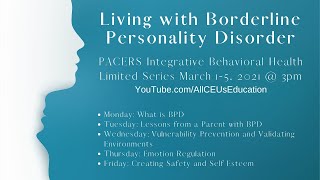
Good afternoon everybody and welcome to today's presentation of PACER Integrated Behavioral Health Care. If you remember, this week we are going to focus on living with borderline personality disorder. Today after the question and answer, we're going to talk about what is borderline personality disorder? Tuesday we're going to talk about lessons from living with a parent with bpd. Wednesday we're going to talk about vulnerability prevention and validating environments. Thursday, emotion regulation and Friday we're going to wrap it all up by talking about how to create safety and enhance your self esteem so you feel safer and more empowered and have a an environment that is more empowering. With that being said, let's go ahead and move on. As always, I'm your host, Dr. Donnelly Snipes. And on Mondays I answer questions that I have gotten in email from y' all about all things mental health to the best of my ability. Now remember, this is for educational purposes only and not a substitute for counseling or medical care. If you're experienced experiencing a mental health or physical health crisis, it's important to call 911 or go to your nearest emergency room. One of the first questions I got was understanding or identifying the difference between your rational self and your emotional self. And this is one of those things that Linehan talks about a lot in Dialectical Behavior Therapy. Because we do have both self selves. We have our emotional mind and we have our rational mind. So in order to discern the difference between rational fact based reasoning and emotional feeling based thinking, we need to step back. We need to be able to use our distress tolerance skills to re regulate ourselves, to downregulate in order to get into our wise mind. And then we can ask ourselves, are my thoughts, feelings, urges and behaviors motivated by facts, emotions or both? And that is actually more simple than it sounds. We, once we get out of that adrenaline haze, that fight or flight reaction where we feel like we have to do something right now, once we are able to take a step back and we start identifying the facts, whether that is just writing down the facts or creating a pro and con list, it's getting very objective about what is going on in this situation. I usually use the example of snakes because most people have encountered snakes and that's one that YouTube won't demonetize me for. But with snakes, when you see a snake in the middle of the path when you're out hiking, you get scared. You may get anxious. Some people don't. Some people are like, oh my gosh, what a cute little snake. If you remember the crocodile hunter he would always say, oh, what a beauty. But most of us who aren't used to being around snakes probably have an initial anxiety feeling that is a feeling based reaction. And those thoughts that we generally have, our urges are often then guided by those feelings. Unless we take a step back and say, okay, I feel anxious, so my body has activated, my fight or flight system has given me the energy to examine the situation, to figure out what to do next. And the first thing to do in examining the situation is obviously take a step back and make sure that you're physically safe. But then look at the facts. A lot of times, you know, I go hiking a lot and the snake that's lying on the middle of the path wants nothing to do with me. It's trying to warm up, it's laying in the sun, it's often green, which to the best of my knowledge in America there are no poisonous green snakes. But I have gotten knowledge over the years about what to look for to identify if a snake is one of those few poisonous snakes. So I take a step back to make sure that I've got good distance between me and the snake and then I use that knowledge, I use those facts to inform my decisions henceforth. It doesn't mean that my fear, my initial anxiety reaction was wrong. That's my brain saying, hey, these things can sometimes be a problem. So you probably ought to think about it a little bit. Okay, I get that, you know, I wouldn't want to try to walk around, walk a water moccasin because they can be a little bit snarky. But most other snakes, you know, they really don't want to bother me as especially if I'm not trying to bother them. So when we are thinking, feeling, experiencing urges, getting ready to do things, we need to make sure that, okay, our emotions motivated us to do something, but the behaviors that we choose and the thoughts that we hone in on are those grounded in fact. You know, if I see it and it's a water moccasin, I am going to behave much differently than if it is a garter snake. We also want to examine, are my thoughts extreme, like all or nothing? All snakes are poisonous. Well, that's not even true. That's not a fact based thought. That is an emotion based thought because, you know, I maybe I don't know anything or I don't know much about snakes. So it's important to get the facts. Is it focused on only one aspect? You know, and this is true in relationships and, you know, all kinds of other things, not just Snakes. But you know, with the snake, is it focused on only one aspect? Snake is in my path, therefore it must be there to do me harm. Well, that is only one aspect. The snake is in your way. But looking at the big, the totality of the situation, maybe that is the only little glimmer of sunlight coming through the tree canopy and the little suckers cold. So we trying to warm up and is it overly personal? Well, you know, it's hard to make the snake one work here because the snake isn't going to think, ooh, I want to bite that person. But we don't want to make decisions because we're afraid of rejection or we assume people are judging us. And you know, obviously I am totally oversimplifying the all the actions that we've got to go through when we are trying to get into our wise mind and make the best decisions. So it's important to go back to some of the DBT skills videos that are on the website or go to, I believe it's dbtskills.com There are a couple of really good websites that talk about dialectical behavior therapy and the difference between the rational mind and the emotional mind and how to integrate them. We don't want to generally operate totally based on fact because that leaves out the heart. We don't generally want to operate totally based on feelings or the heart because that may ignore some of the facts. So we want to try to smush the two together and figure out what is the best decision. What. What is going to be the most rational, logical thing to do that is going to make me the happiest possible at this point in time. The second question talked about building identity and avoiding extremes in today's world. A lot of what we do is. So it's not a phrase, but it's a phrase I use a lot. So it's my phrase. It's so swipe left or right. You know, we have so many options and it. A lot of times it's hard to know what we're going to stick to. It's hard to really build an identity because we feel fragmented all of the time. So building an identity is important. And a lot of times, even as adults, we don't have a solid identity built. Sometimes that can come from a history of trauma or abandonment where we always felt like we needed to be a chameleon in order to avoid abandonment or rejection. Other times it may have just come from, you know, when you were going through that developmental phase, you never really found a place where you fit In. There are a lot of reasons why people may not have a solid sense of self right now. But what's important is to recognize if you don't have a solid sense of self. Okay, what do I do? And one of the first things you can do is to define and envision who you are. What's important to you? Envision your rich and meaningful life. And this is one of those techniques that comes out of acceptance and commitment therapy. Hayes talks about this a lot. It's important to think about, what are my values if I were no longer here? What are five things that I would want someone to use? Five words I would want someone to use to describe me? Now, you can. There are other ways to do that activity. But think about what are five words that you want your best friend or your boss or your pastor or your parents or whomever to use to describe you. That gives you an idea of where to start. You know, those are some characteristics that you think are important that you want to embody. Well, that's awesome. In addition to your values, it's important to figure out what is important in your rich and meaningful life. We can get so focused on one thing that we may forget all other things. And I talk a lot about hardiness in a variety of the videos on the website. And. And you can watch those videos on hardiness when we talk about commitment. And it's important to recognize all of the things in your life to which you're committed. I am committed to my job. I am committed to my health. I am committed to my spouse. I'm committed to my children. You see where I'm going with this. But there are a lot of aspects of me that make me me. And I've got to figure out how to use my time in order to nurture my. All of those things. You don't want to ideally focus exclusively on one area to the detriment of everything else. So that's the first thing you want to define and envision your rich and meaningful life. What is it that I want to have as my identity? And once you figure that out, then starting each day envisioning it, and before you take action, before you change jobs, before you do anything, asking yourself, is what I'm getting ready to do? A good way to use my energy to help me move toward those things that are important in my rich and meaningful life is what I'm getting ready to do, a good use of my energy to help me become the person that I want to be. And only you can answer those questions. But that will help you continue moving forward and not get distracted every time a new trend comes along. Because we are a little bit challenged in our focus and our attention these days. Part of it is because stuff changes so quickly. Don't get me wrong, there's a lot of things that change and sometimes you've got to try something out and you may try it out for six months or a year, maybe even a month, and you're like, oh yeah, no, this doesn't work for me. That is normal experimentation. But there's also people who have have difficulty sticking with things because it's just not meeting their needs. When we get into something and it's extreme behavior, whether it's a relationship or a job or some kind of identity that we're trying to embrace, that is communication, why are you doing that? What is motivating you to do that? What benefits, what rewards are you hoping to get out of it? And it's important to figure that out because the only way to keep doing that behavior is if it's motivating enough. So a lot of people will throw themselves headlong into something thinking this will make me happy. And six months down the road they're like, yeah, not doing it for me. And then they scrap that and they move to something else. They keep hoping they're going to find the thing that makes them happy. So it's important to figure out what are you hoping to get out of that behavior and are there other ways to achieve that? You know, maybe you are trying to get love and acceptance, so you're trying to do that by becoming an influencer on YouTube or Instagram or one of those things. Is that really what you want or is that the only way you know how to meet that need? If it's not really what you want? If you really want a in real life relationship that's based on other things, you know, then it's important to define what it is you want and try to figure out how to get there. There are things that sometimes will attract your attention. And I know with me, when I get involved in something, when I take a new job, when I get involved in a new project for a period of time, I can get that laser focus and I have to force myself to, you know, take time out because you know, my kids aren't going to be little forever, etc, so it's important, it was important for me. It is important for me still, even though they're grown, to make sure that I take time out and not spend 16, 18 hours a day at work working on a new project. So it's important for me to look back at that rich and meaningful life and say, okay, in the big picture, in the big scheme of things, is it a better use of my energy to spend 18 hours at work or to work for eight or 10 hours and then go home and use some energy that I have left to actually focus on those other things that are important in my life, what best meets my needs. And again, we want to go back to that wise mind. Only you can answer that question. Procrastination was another question that came up. Procrastination, avoidance and fear. Procrastination is when we are avoiding doing something and it communicates a lack of motivation. Now it could be that you're just not motivated. You're like, eh, whatever, no, not doing it for me. Or it could be a variety of other reasons. So you need to go through all of the pacer dimensions and ask yourself, why Am I not motivated? Am I not motivated physically because I just plum don't have the energy or the strength to do it? Am I not motivated because whatever this is is not going to make me happy? I know, you know, doing my documentation and my paperwork, I hate doing it. So I'm not motivated to do it because it's not something that makes me happy. I have to do it. But it's one of those things that I have to really push myself for cognitively. Am I not motivated because I don't understand how to do it, or it doesn't make sense that I have to do it environmentally? Are there things in my environment that are keeping me from doing it? Am I being distracted? Do I not have the tools I need? And relationally, are there people who are encouraging me not to do it? You know, maybe you think I need to go to the gym and your best friend goes, ah, nah, why don't we go out, go out to dinner instead? You know, that would be something that would unmotivate you to go to the gym, for example. So there are, there are a lot of reasons in each one of those dimensions, but it's important for you to evaluate for yourself for that particular task at that particular point in time. Why are you not motivated to do it? And if it's fear, okay, what are you afraid of and why? If you're afraid of rejection, then it's important to examine, you know, going back to what we talked about in the first slide, examine the facts in the situation. If you do what you think you need to do, what is the, what are the chances? What is the Likelihood that you are going to experience rejection. It may mean that you fail at doing it. But does that mean you fail as a person or you're just not good at that? Like, I tried making a souffle this weekend. Woo. That did not turn out well. You know, I blame the dogs because they were barking and carrying on, so they made it fall. No, seriously. I'm sure it was something I did, but I tried, I failed. I will try again next weekend. But it's important to examine, you know, if for some reason making that sule I had, you know, built up some fear that I was going to be rejected if I couldn't make the perfect souffle. Or maybe I tried. I was trying to make it for the first time for a dinner party. You know, I could see where there would be some anxiety. So it's important to examine why are you avoiding it at this point in time and what do you need to do now? The next step is how can you get motivated if it. If you're not motivated because you don't have the energy? Well, how can you get the energy? How can doing this help you have more energy? How can it make you happier? You know, for me, with my documentation, okay, doing it doesn't make me happy. But getting it done, the sense of relief I feel once I have that done, that does make me happy. Getting paid makes me happy. No documentation, no paycheck. So, you know, logically it makes sense to get that done. Environmentally, when I do my notes, I either I put something on on music or something that can make the environment more pleasant. So I'm at least enjoying myself while I'm writing those notes. And relationally, I do it when I'm at work. That way, Misery loves company. There's other people that are having to do paperwork. So that works for me to get me motivated. But so there are two things when you're dealing with procrastination. Examine why you're not doing it, why it's not motivating, and then figure out how many different ways you can get motivated. And I've got multiple videos on the YouTube channel on the dimensions of motivation if you want to do a deeper dive into enhancing your motivation. I think I also have a video on procrastination for time management. Going to go through this one real quickly. Must do lists. And this is one of my favorite activities. I have people write down all of the things that they have to do. And I put have to in quotes because a lot of times things we feel like we have to do really aren't have to's, they're shoulds. You know, I should do the laundry, but I don't have to. There are workarounds. So write down all the things you think you have to do, then go through that list and eliminate anything that doesn't have to be done. You know, if, if it doesn't get done this week, you know, no big major consequences will happen. I mean, you may have to pay your bills, you may have to, to eat. So there are things on there that you have to do. But cross out anything that will not have major consequences if you don't get it done this week and then figure out with what's left, what can be delegated to somebody else, you know, what can somebody else help with to get things done? You know, we started spring cleaning in my house last weekend and so I had my kids pitching in. You know, my daughter was mopping, my son was helping with the baseboards. You know, I was doing the windows. So we were delegating so we could get it done more quickly. Simplify when possible, try not to make everything this major ordeal this weekend since we were doing spring cleaning, you know, I wasn't compounding that by making these huge meals that had all kinds of dishes to go with them. So I made simple. You know, I did a lot of casseroles and we actually got pizza one time. I simplified and then plan ahead. You know, some weeks are going to be busier than others. So for example, if I know I've got a really busy week coming up, I may pre cook all of my meals the weekend before. That way I don't have to worry about getting home and figuring out what to throw together. Make to do lists. Once you have eliminated, delegated, simplified, make those to do lists. Ideally, you know, I like having one for a daily to do list, but that just keeps me more on track. You may prefer a weekly whatever you like and then adopt that getting things done mentality and this. There's a book called Getting things Done and I can't remember who wrote it right now, but it's actually a trademarked system. But one of the key features in getting things done is when you think of something that you need to get done, if you can do it, do it. Don't just put it off. So for example, last evening there was some recycling sitting on the pass through and I thought, well, that really needs to go out to the recycling bin. Well, the getting things done mentality told me, well, don't just think about it, it's going to Take you two seconds to do it. So grab that stuff and walk it out and put it in the recycling bin. And lo and behold, I did and it was done. And I didn't have to walk past the pass through six more times in the evening going, that really needs to go out to the recycling bin. So getting things done, one of the key tools is when there are things that can be done, I think he Sundays, in under two minutes. But whatever, you know, some things can be done really quickly, really easily. Put your shoes away, put your keys away. You know, that saves you time later because then you know where they are. Highly recommend that book. It helps a lot of people and finally, compatibility in relationships. And this is a difficult question, because it's difficult. I won't say impossible because I think people have met their soulmates and may know that it is quote the one from. From Jump. But that is probably not the rule. That's probably the exception. So in terms of knowing whether you're with the one, there are a lot of things to consider. Number one, your goals and dreams for the future. My husband and I have very similar goals and dreams. Well, we did when we got married for the future. We, you know, saw the next 10, 15, 20 years. Very similarly with having children, raising them, you know, working, earning money, those sorts of things. Now that we've gotten older, you know, our ideas, our goals and dreams for the future have diverged a little bit because he loves to travel. He is a pilot, he loves to fly. I don't. I don't really like to travel. I'm a homebody. I can do it occasionally, but I like spending time on the farm with my critters. Now, does that mean that we are incompatible? No, it just means we have to be willing to compromise and we have to be willing to give and take a little bit. Sometimes he goes and travels and, you know, does his thing with his friends. And it doesn't necessarily mean I have to go. And likewise, you know, when he does that, I'm staying home with my critters and I'm happy as, you know, a clam. So it's important to examine your goals and dreams for the future, but recognize that those may change. So can you figure out ways to compromise in order that each person can evolve and grow into the person that they want to be and each person can have their rich and meaningful life independently as well as with you. And I've talked in other relationships. I've given my analogy of chocolate chip cookies, the short version. Sugar cookies. Awesome. On their own. Chocolate chips, awesome on their own. Put them together, oh my gosh, wonderful together. They bring out the best in each other, but they're also great by themselves. They have their own unique characteristics, and that is an awesome creation when you can have that in a relationship. Honesty and ability to trust the other person is crucial in relationships. If you're in a relationship with someone and there isn't honesty and there isn't trust, then that is probably one of those deal breakers. But it's important to examine. That being said, it's important to examine whether honesty and the ability to trust is because of something that person did or didn't do, or it's because of your stuff from the past that you're holding them hostage for, you know, other people that have been dishonest and not trustworthy. Are you holding this current person hostage for their mistakes? So it is important to recognize what's going on in that relationship and whether that person is honest and trustworthy. The ability and willingness to compromise and synergize. When I've talked about temperament in other videos, you all know that my husband and I are very, very different. We are probably polar opposites on most things, but we have found a way to synergize. Just like a negative and a positive magnet, or I guess that's what they're called. You know, they fit together really well, really strongly. And my husband and I do the same, even though we are very different in terms of our time management, our information processing, even. I'm an extrovert and he's an introvert, you know. So the environments that we prefer tend to be somewhat different, but we respect each other's needs and we compromise. And that is important in relationships. It doesn't mean that you are the same, but it means you're willing to respect the other person, respect their needs and their boundaries, and compromise when necessary so both of you can live harmoniously. Same thing with the ability, ability and willingness to communicate and empathize. Thinkers, for example, you know, communicate and think through things and are motivated by facts. Feelers tend to be motivated and thought. They focus their thoughts on harmony, doing what makes people feel the best or what is going to make them feel the best. So it's important to recognize those are just two different ways to envision a situation. Going back to what we talked about in the first slide, if you want to think about it as the wise mind and the emotional mind, one person is motivated by one thing, one person's motivated by the other. Neither one is better or worse. They're equally important. So being able to communicate effectively and recognize, hear effectively, hear what the other person is saying is important. Chemistry. Some people will say chemistry is important in a relationship. Other people will say not so much. And that is a decision you've got to make on your own. Habits. Same thing. Some people are very tolerant of other people's habits, even if they're different. Other peop. Other people have difficulty living with someone who has vastly different habits. My. When my mother and my stepfather got together, he was a very neat, clean person. I mean crumbs anything drove him nuts. Her, not so much. She was a little bit more relaxed with things and they ended up, you know, kind of meeting in the middle. Over the course of 20 or so years they developed a rhythm where he was less rigid about cleaning and neatness. And she worked diligently to try to remember to put everything in its place. So they compromised and both of them grew towards sort of a middle ground. Same thing. You know, if you're a night person versus a morning person, it's difficult to be in a relationship if one person, you know, stays up until three in the morning and the other person gets up at 3 in the morning. It's something you need to consider about whether that is workable. How you handle money, that is one of the biggest challenges or arguments, stumbling points, whatever you want to call it, a lot of people have in their relationships. So it's important that you can openly talk about that and figure out how to handle that. If you have very different ways of handling money. So some people just keep separate bank accounts. If you, you've got to figure out how you're going to make that work because money keeps a roof over your head and food in your belly. And then values and culture, child rearing, gender roles. There are a lot of things that are influenced by our personal values and the culture in which we were raised. So it's important to talk about some of those important things. Things and figure out whether you're compatible. For example, my grandmother and and grandfather adhered to very strict traditional gender roles and they were deliriously happy. You know, that is what they wanted and they were happy with that. Now, other people may not be happy in that situation and so that it's important to talk about those things ahead of time, know what is important in your rich and meaningful life, know how you envision it, and then know which things you're willing to compromise on. Relationships are all about compromise are all about figuring out, you know, how can we fit together as people and do we bring out the best in each other or the worst. So thank you for sending in all of those questions. I really appreciated getting all of that, all of that input and having the opportunity to think about it a little bit more instead of just going on the fly. I hope that was helpful. A lot of those have other videos on the YouTube channel if you want a deeper dive. I did promise though that we would get started today talking about borderline personality disorder. So I do want to touch on that now. Today, all we're talking about really is what is bpd? You know, a lot of people use it sort of in slang and may not really know what borderline personality disorder is or they may know, you know, I don't know. Basically my belief is that borderline personality disorder is a group of behaviors developed to protect the person and help them survive. Remember I've said a bazillion times before, I don't know how many zeros are in a bazillion. I've said many times before that behavior is communication and we don't do things unless they are rewarding or have a purpose. So we want to look at what is this behavior communicating and in how could it have been useful to the person when it was developed? Now it may not be helpful in, right now, in, in adult life, but when that behavior first developed, in what way was it rewarding? In what way was it protective? In what way did it help the person survive? A lot of people who have borderline personality disorder type border behaviors, I really don't very often assign a diagnosis of borderline personality disorder. I really examine the behaviors as a functional reaction to a dysfunctional situation for a child because a lot of people who have borderline personality disorder type behaviors developed those behaviors in childhood. So we want to look at what was going on in that child's life at that point in time that would have created those behaviors. An intense fear of abandonment. A four year old needs their primary caregiver to take care of them. They can't go to Walmart and get their groceries. They can't keep, pay the rent. They, there's a lot of stuff they can't do. They don't know how to cook. You know, children don't, can't articulate that, but they know they need a caregiver who is consistently present, responsive. You know, we're going back to that attachment thing. Consistent, responsive, attentive, validating, encouraging and, and, and supportive. So it's important that we recognize if the child was not getting that then because of the way they think and children think very dichotomously. They may have feared, well, if my parent isn't here right now, then they're never going to be here. So they think all or nothing. So that fear of abandonment may have triggered certain behaviors to try to get the caregiver to pay attention, to show up. Okay, so they may have a pattern of unstable, intense relationships, including with themselves. Some mornings they hate themselves, some mornings they love themselves, some days they hate their parents, some days they love their parents. Now we all go through this a little bit, especially in the teenage years, but this is intensified, you know, times like a hundred. This isn't just your normal moodiness of, of adolescence. So it's important to recognize if people have unstable and intense relationships, you know, they go from loving a person to despising them. Or you are, you are my world. And then the person does something you don't like and you're, you just cut them off. It's like, fine, be gone. For a child who thinks in all or nothing terms, I love you or I hate you, well, that makes sense. That is how they formed their love map. When they were little. They may have gotten that message, you're either lovable or you suck. They and they internalized that. So they think in all or nothing terms. Rapid changes in self identity and self image that may include shifting goals and values or feelings that they don't exist at all. When a child grows up with intense fears of abandonment, a lot of times they are very chameleon esque in their identity. They try to be whatever they think somebody wants them to be in order to get love. It's like, I will be whatever you want me to be. Just don't abandon me, please. So it makes sense that they may never really develop a self identity based on what they want because they're so worried about figuring out what other people want them to do or be. They never check in with themselves. There is very little self awareness of what they actually want, think or need. And that is a huge task in helping people who have borderline personality type behaviors is helping them identify, you know, who are you, what is your identity and who do you want to be? Impulsive and risk taking behavior or sabotaging success by suddenly quitting a good job or ending a positive relationship. Those are just a couple examples. This is often one way of trying to get people to either pay attention and, and help them. It may be a way of trying to avoid abandonment by being proactive. It's like, okay, I'll dump you first. It May be a way of increasing dopamine. Impulsive and risky behavior often increases dopamine and endogenous endorphins. So it may be a method of self medication to deal with anxiety. Each one of these behaviors can happen for a variety of reasons. I'm just kind of giving you some of the more common ones. But it's important again to go back and ask that person to really ponder what is this behavior communicating? In what way did this behavior help you survive? What are you trying to say? What are you trying to get from this behavior? Self injurious behavior often often occurs in response to fear of separation or rejection. This is sort of the extreme step. And a lot of times, obviously not every time, but a lot of times when people with borderline personality characteristics engage in self injurious behavior, their intention is non suicidal. Now sometimes it can be suicidal. So I don't want to say, you know, not to pay attention to it because it's definitely a cry for help. It's definitely a behavior that's saying I'm struggling now. A lot of times self injurious behavior is designed to take that mental pain or that pain in your heart and make it into something that's physical, something that's controllable, something that can distract your attention from what's going on inside and divert it to something going that's going on outside. So it's again this is a behavior that has a function. When we understand its purpose then we can figure out alternate ways to meet that need. When we someone we love is engaging in non suicidal or self injury or suicidal behavior. That both of those are that person saying I feel overwhelmed. I don't feel like I can take this anymore. I need help. You know. It is a method of indicating that the person is may not have the coping skills necessary to deal with what life is throwing at them right now. Wide mood swings lasting from a few hours to a few days. And this can be happiness or sadness or anger or all of the above. You know, like I said, they can last for for a few hours or you can have really good periods follow punctuated by really chaotic periods. And when you are around someone with borderline personality characteristics, you notice I keep saying characteristics, not disorder characteristics. A lot of times it's exhausting because you don't know what mood it the person's going to present in. The same is true if you are the person with borderline personality characteristics. It is exhausting to have emotions that feel like they just swing like a pendulum and you don't know which one to expect. And it feels, feels many times like they come from out of nowhere. Like it's this speeding bullet that just suddenly shows up. It's important to be empathetic with people who have borderline personality characteristics because it is an extremely terrifying place to be in their head. When they regularly fear abandonment, when they aren't sure who they can trust, when they aren't even who they are because they've spent so much of their life trying to get other people's approval. When life seems so completely overwhelming, so agonizingly painful that they need to try to escape or avoid or control it somehow with risky behaviors, ongoing feelings of emptiness and inappropriate or intense anger. That emptiness goes back to that shifting self image and that lack of self love, you know, that, you know, we talked about. Sometimes people with borderline characteristics wake up in the morning and they hate themselves. I mean their relationship with themselves is very, very different on any given day. And just like they can get angry with somebody else and then happy with them, they do the same thing. They have those same mood swings in their own internal existence. Sometimes they can be enraged with themselves and other times they can be happy with themselves and then all of a sudden they hate themselves again. And it is just such a chaotic place to be. Which is why it's so important to figure out how is it we can help this person or how is it you can help yourself? If you are the person with borderline personality characteristics, first create safety. Because what the child lacked when they were growing up was a safe, secure relationship and a safe, secure, validating environment. That's like dialectical behavior therapy 101. The first thing is trying to figure out how to create safety so you feel heard, safe, heard, understood and empowered. And we're going to talk about a lot of that in each of the successive days this week. Are there any other questions that might be that I might be able to answer real quickly? I've gone way over time today. Okay, so remember going back to the first thing tomorrow, we, we're going to be talking about lessons from people learn from living with a parent or caregiver with borderline personality characteristics. And Hannah, in answer to your question, emotionally unstable personality disorder really isn't a diagnosis. Most people with personalities, especially cluster B personality disorders, but most people with personality disorders will have some degree of emotional inst. Stability. So it's important to, to discern if you want to diagnose it exactly which personality disorder it is. I would say start out with your cluster B, your histrionic, borderline dependent, narcissistic, antisocial. Those are the ones that tend to have more emotional ability associated with them. I thank everybody for being here today. I thank you for being here and, and sharing your questions and sharing your thoughts. And I will try to provide you a little bit more, a few more nuggets on Tuesday. You can also find other videos on borderline personality disorder, motivation and vulnerability Prevention on the YouTube website. Between now and tomorrow, if you want to get a jump start on what we're going to talk about, there is a video called Surviving the Borderline Parent and that might provide you some helpful tidbits. Have a fabulous day and I'll see you tomorrow.










