Reducing WASTe (Worry Anxiety Stress and Tension) | CBT Counseling
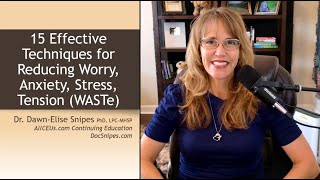
A clinician-led YouTube talk by Dr. Dawn‑Elise Snipes that defines WASTe (Worry, Anxiety, Stress, Tension), describes cognitive causes using the NO MAP mnemonic, and teaches 15 practical CBT-informed strategies to reduce wasted emotional energy. The video catalogs common cognitive distortions (all-or-nothing/nothing-or-all, overgeneralization, mind‑reading, availability heuristic, personalization), promotes mindfulness and reflective evaluation, and offers three mnemonic toolkits: FREEZE (Facts, Realistic, Exceptions, Explanations, Solutions) to reframe worry; TRIES (Time management, Rest, Identify successes, Environment, Skill acquisition/Synergy) to manage present stress; and behavioral/body-based methods to relieve tension (massage, vagal stimulation, breath-based activities, yoga, progressive muscle relaxation, stretching). The overall goal is to redirect energy toward a rich, meaningful life rather than rumination.
Chapters
Hey there, everybody, and welcome to this presentation on 15 strategies to reduce worry, anxiety, stress and tension, or what I call waste. I'm your host, Dr. Donnelly Snipes. When we worry, it is a natural emotion, but when we hold on to worry, it's a waste. Worry and anxiety are feelings based on expectations of the future or a sense of powerlessness. You just don't know what's going to happen in the future. Stress, on the other hand, can be due to being overloaded or overwhelmed in the moment. So when I say, oh my gosh, I'm so stressed out, I'm generally referring to something that's going on right now, not something I'm worried about. Tension is the muscular response to activation of the stress response, or what we call the HPA axis. While feelings are designed to tell you something, holding on to them and nurturing them wastes a ton of energy. So let's talk about how we can reduce them. First, we need to understand the causes of your worry, anxiety, stress and tension. And I've boiled this down into a mnemonic nomap. Anxiety and his friends are often caused by not having a clear answer about the future or about how to get to where you want to get in the future. This can be based on unhelpful or inaccurate thoughts or cognitive distortions that are based on prior experiences or a lack of them. So when we worry about something, it can be the result of having similar experiences in the past and worrying, having anxiety that that's going to happen again. Or it can be we're worried about something because we've never experienced something similar, so we don't know what to expect. And that can cause a fair amount of anxiety and stress. And then when we start feeling stressed in the present, that can also be due to feeling overwhelmed and overburdened with what's going on and not having a clear direction of kind of how to get out of the rubble that you're buried under right now. No map stands for or represents your cognitive distortions. And basically it's saying you don't have a map for how to get from where you are to where you want to be from where you are. Feeling unsafe, feeling threatened, feeling overwhelmed, feeling vulnerable to, feeling safe, nothing or all. And I know normally we say all or nothing thinking, but that didn't work for the mnemonic, so we flipped it. Nothing or all thinking. Thinking in extreme words can cause you to feel really anxious when you think, every time it rains and I go out driving, I get into a car accident, I Don't know. When you think that every time I do this, this bad thing happens, then you're likely going to cause yourself a lot of anxiety and worry. When you think every time I take a test I fail, then that's going to cause undue stress in the moment. So you're going to want to start looking for exceptions. But we'll talk about the solutions in a few minutes. Overgeneralization is the next cognitive distortion or thinking error. When you assum that all things like this one are going to be bad, all people that are like my ex are going to be harmful to me, all people that are like my best friend are going to be wonderful and loving and safe, you know, that's over generalization. Every person that we meet is different. If you say that all organizations that provide this particular service are good, well, okay, great, or unfortunately we hear more often all treatment centers are bad, they're ineffective. And that's not the case. There are exceptions. Mind reading or jumping to conclusions can also cause a lot of anxiety and stress. If you are assuming you know what someone else is thinking, and a lot of times that means you think that they're judging you, then that can cause a lot of stress in the moment. If you are mind reading or jumping to conclusions about what's going on in a relationship, for example, if somebody is not returning your text in what you perceive to be a timely fashion, you may jump to conclusions and assume you're being ghosted. Well, what are some other explanations? Maybe they drop their phone in the toilet and they can't respond until they get a new phone. I don't know. Availability heuristic is another cognitive distortion. And availability heuristic means that we make decisions or we react to what is going on or what is about to happen based on the information that is most available in our mind. And the best example I can give is planes. When we hear about airplane flights, the only time we hear about them is when they crash or when somebody acts the fool in midair. And that can cause you to think that all over generalization, all airplane flights are dangerous and that no other airplane flights. It's not safe to fly on an airplane because that's what's available to you. You don't generally have the information that 25,000 other flights happened yesterday and none of them had a problem. So you're basing your reaction on what is most salient, what is most available in your memory banks and personalization. We can have a lot of anxiety about stuff when we take it personally. When we go in for a job interview, we may be really stressed out about it and anxious about whether we get the job. Because we are thinking, well, if I don't get this job, it's a rejection of me. Okay, well, it could be. It could be that you weren't a good fit. It could be that doing interviews was just a formality and the hiring manager already had somebody picked out a lot of other explanations. But when we personalize things, it makes us feel vulnerable. It makes us feel sometimes attacked. It may make us feel judged. When judgment was not the intention, it had nothing to do with us. It has everything to do with something else. So we need to really look at these and think. When I personalize something, when I assume it's my fault or all about me, how does that affect my anxiety levels? How does that affect my sense of safety and empowerment? What can you do about it? The first thing is mindfulness. And we come back to this a lot. Mindfulness is so important in life. Acknowledge your feelings. If you feel anxious, all right? You feel anxious. If you feel angry, all right? That's how you feel. Acknowledge it. Recognize that it's a feeling, not a fact. Just like when a smoke alarm goes off, that's what's going on. It doesn't mean that there's a fire necessarily. It may be going off for some other reason. So it's important to recognize that it's a clue, an indication that there might be a problem. But it's not a fact. Fact. It doesn't say, I feel anxious, therefore this must be dangerous. And reflect. Be mindful on how you're using your energy. Reflect on whether using energy to worry about something that hasn't happened yet and is not guaranteed to even happen is worth using your energy for. Is it worrying about this helping you move toward your rich and meaningful life? Or. Or is it taking energy that you could use to move toward it and using it to kind of spin around in the sand frees you from worry and anxiety. These tools will help free or freeze you from worry and anxiety. And FREEZE stands for facts, exceptions, explanations and solutions. First thing, remember I said feelings aren't facts. So the first thing you need to do is get the facts. Facts. If we'll go back to the plane analogy. If you're getting ready to go on a plane and you're worried that it's unsafe, get the facts about what, how safe it is. And in that current context, how safe is it? If you're getting ready to get on an airplane and you're going to be flying into the middle of a hurricane, well, okay, that's different than and, and you wouldn't. A pilot wouldn't do that. But that's different than pretty much any other flight that you're getting ready to get on where the weather's clear, yada yada. So you want to look at the facts in context. How often has something bad happened when these conditions are present? R stands for realistic. How realistic is it that your worst fear is going to occur? We'll go with a plane crash. You know, that would be your worst fear. How realistic is it thinking about the probability of what's going on? Might you hit some turbulence? Sure. And that would suck. Might it be an unpleasant flight? Sure. However, how likely is it that the worst thing is going to happen? So let's really look at the probability, the reality of what your options or what could happen based on the facts and context. The next thing is E for exceptions. Identify times you've been worried about something in the past and it's turned out okay. And you can also identify times that this thing has happened before and it's turned out okay. So how many other flights have happened that didn't crash? How many times have you been worried about something in the past and and it turned out okay? That can help you recognize if your threat, smoke alarm, so to speak, is hypersensitive or if it's on target. The next E stands for explanations. What are other explanations besides you that might account for what happened? That might account for getting into a car crash, that might account for not getting a job, that might account for your significant other being three hours late and not calling? I don't know. But these are all things that may make you worry. I remember my grandfather, towards the end of his life, he developed of gork phobia and got very, very anxious every time my grandmother went anywhere. And if she was literally a minute late getting home from Bingo, he would start to completely spiral. And it was important to examine for him to examine. What are alternate explanations? Maybe Bingo ran late. Maybe she had to go get gas. You know, there are a lot of maybes out there. And this was before cell phone. So it's not like she could just like text in that she'd be there soon. But it looking at alternate explanations for why something might be happening often relieves a lot of anxiety. But if it doesn't, you can also look for solutions and resources. So in terms of solutions, what can you do right now, if anything, to address the worry? If you have you're waiting on somebody to, to arrive and they're late, or your kids haven't gotten home and it's way past curfew. All right, so you're worried that they might have gotten into a car accident or something bad might have happened. Okay, so what can you do besides just sit there and look out the window and worry? You can call the hospitals, you can, you know, call law enforcement to see if there were any major crashes. Will that give you hard and answers? Probably not. The other thing is to look at the facts in context. How old is your person? Have they ever done this again? Or have they ever done this? And how likely is it? What's the probability? What's the realistically thinking that they were actually in an accident versus they lost track of time playing video games or ran out of gas or who knows? Another thing that you can do is get a second opinion. If you're stressed out about something like waiting on blood, blood work to come back, results to come back from a test or hear back from a job interview or something. You can also get a second opinion, call a friend or call somebody who's knowledgeable in the area and say, hey, this is what's going on. What are your thoughts? What are your opinions? Gather more information in order to make a better judgment, in order to get more facts. And finally, resources. And this goes with solutions because you want to consider what resources do you have available to you to help you cope should the worst thing happen or should something unpleasant, even if it's not the worst thing, should that happen? What resources can you rely on to help you get through this, to help you solve the problem? Stress, as I mentioned earlier, can be thought of as a problem in the present, like being overwhelmed. And the mnemonic I use here is tries. Stress can really try your patience, and boy, does it try it. T stands for time management. You want to recognize that a lot of times when you feel stressed out and overwhelmed, part of it is due to poor time can. Can be due to poor time management. So it's important to establish a routine so your circadian rhythms are set that will help some Identify everything that's going on. Identify everything that's in that rubble pile that you're buried under. Eliminate anything that you can, anything that's not necessary. Move it off to the side, you can deal with it later. Prioritize what's left. All right, of these 30 things that are left on my list, which thing, which things have to be done urgently? Which things need to be done in the next week, and which things need to be done at some point. Once you've prioritized, simplify them. Not everything has to be a major production. So maybe for the next week or so, because you're short on time, you're going to order in or get takeout or eat frozen dinners or whatever. Yeah, it's maybe not the healthiest option, but it simplifies. So you're not having to cook, you're not having to do dishes, you're not having to do all that. Delegate. Ask people to help. Whatever they can do, ask them for help. They'll probably at some point in the future ask you for help too. It's not unfair to ask people to help you out when you're feeling really stressed. And then with what's left on that list that you have to take care of, make a plan for how to get it done. Actually put some, like, dates and timelines down there so it's manageable for you. R stands for rest. I know I just talked about getting things done, but it's important to rest as well. Cuy talks about this in the 7 Habits. You need to sharpen the saw, so to speak. If you are worn down and exhausted and not getting enough sleep, you're going to have brain fog. You're not going to be as efficient, you're not going to be as effective, and you're probably going to have a much lower frustration tolerance, which is going to increase your stress even more. Take time out to make sure that you are giving your body time to rest and recharge so you can be at 100% battery when you get started the next day. Identify sources of empowerment and success. When we feel stressed, when we feel overwhelmed, sometimes we can feel like it's hopeless and everything we do fails. And we can get into that all or nothing thinking or that nothing or all thinking, recognizing, looking back and saying, okay, I've gotten through tough times like this before. I've turned in projects similar to this one before and it's gone fine. I've gone on job interviews and gotten jobs before, so I have had successes. I don't quote, always fail at this. And that can help people recognize that, all right, I can do this. I got this. Just one step at a time. E stands for environment. Reduce sources of overstimulation and distraction in your environment. When you're already stressed, your stress response system is kind of in overdrive. So you may be more irritable, you may be more easily distracted, you may be less able to filter out some of the stimulation. So it's Important to figure out what is it that you need right now since you're really stressed? What is it you need in terms of your environment in order to support optimal productivity and address your stress? And S stands for skill acquisition or synergy. Sometimes we get stressed out because people are asking us to do stuff we just don't have the skills to do. And it's important at that point to figure out, how can I learn these skills? Whether it's watching a YouTube video, reading a book, taking a class I don't know, or synergizing, working with somebody who has those skills and working in tandem, or even getting a mentor who can help you learn the skills and teach them to you as you're doing the project. All of these are helpful for reducing stress, and it shows that you're trying, which is why I use the mnemonic tries. And finally, tension. Tension is a byproduct of stress and anxiety and worry. Anytime that stress response system kicks off, you will have tension in your body. That's your nervous system's way of helping you be primed and ready to spring into action to address whatever the threat is that's causing those feelings. Okay, what do we do? We need to try to help reduce tension in our body in order to get good sleep. It's important to reduce tension cognitively through some of the strategies we already talked about. It's important to get rest like we already talked about. But in the moment when you're feeling a lot of tension in your neck and your back and wherever else, it's important to be able to get rid of some of that so you can focus, so you're not in pain. Massage can be helpful. You can, you know, massage your own neck. You can go get a massage, whatever. Vagus nerve stimulation, and we've talked about this in other videos, you can massage your vagus nerve by putting your middle finger on your tragus, which is the little ear flap, and your index finger behind your ear, and gently rubbing. Now you're just rubbing hard enough to move the skin around. You don't want to be actually pressing that flap, ear flap down just gently enough to do that. That can help trigger the vagus nerve. You can also trigger the vagus nerve by breathing slowly. But a lot of people don't like to do deep breathing, and they feel like you're dismissing them if you say, take a few deep breaths. So I try to avoid doing that. But you can take a few deep breaths by singing loudly, by blowing bubbles, either with bubble stuff or bubble gum or Blowing up balloons. All of those things cause you to take in a deep breath and slowly exhale. And yoga, some people prefer that when you are practicing yoga, you. You assume a physical position, but one of the things that you're supposed to focus on is your breath. Not hyperventilating, not straining, but relaxing into the pose and holding the position. Progressive muscular relaxation is a great technique and I don't have time to go through it here, but there are lots of videos on YouTube on progressive muscular relaxation that helps you start becoming more mindful of the difference between how it feels when your muscles are tense versus relaxed and helps you learn how to sort of tent tense and relax those muscles a few times. So you're essentially making the muscles massage themselves. And finally, stretching. Stretching can be wonderful for tension because a lot of times we hold tension. I know I grit my teeth a lot and so I'll massage my jaw throughout the day, but I also tend to have really poor posture when I'm sitting at my desk. So periodically I will get up, I'll stretch my neck, I'll stretch my back, I'll stretch my legs and try to release some of that tension that I'm holding in my body. Anxiety and his buddies are part of the fight or flight response and just a natural occurrence. We don't want to get rid of rid of them. We just don't want to invite them to unpack and stay for a while. Fears are often based on prior learning and may not be accurate in the present. A bad experience you had with a doctor or a significant other or something else five years ago. Okay, that was unfortunate. However, it doesn't mean that when you encounter a similar experience in the present and it's necessarily going to end up the same way, stress is often the result of poor time management and or a lack of sufficient skills or rest. And tension is the physical result of anxiety and stress. The tools shared in this video will help you reduce waste, that is your wasted energy, so you can use your energy to move toward your rich and meaningful life.










