Releasing Trauma from Your Body | Resetting the Vagus Nerve
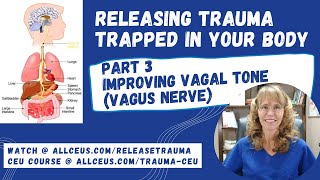
Dr. Dawn-Elise Snipes explains how trauma gets wired into your nervous system and shares concrete ways to reset it: humming, singing, box breathing, massage, and specific eye movements. Start with one or two practices in the morning or evening to strengthen your vagus nerve and interrupt stress responses.
Chapters
Hey there, everybody, and welcome to this presentation on releasing trauma trapped in your body, strengthening the vagus nerve and the relaxation response. I'm your host, Dr. Donnellice Snipes. If you missed parts one and two, how trauma gets trapped in your body, you can still see those on the YouTube channel@YouTube.com docsnipes in this video, we're going to review why vagal tone is important in releasing trauma and explore strategies to help you gain more control over your autonomic nervous system. Well, kind of. Let's start with some of the concerns people may have. Releasing trauma does not mean that trauma isn't part of you. It will always be a part of your narrative. What you're doing is changing how your past trauma impacts your future. Releasing trauma means helping your brain more effectively recognize contexts when you're safe and reducing the strength of the connection between the amygdala, where they do thought and fear processing, and the default mode network, which is also kind of your autopilot. You don't want to be on fear autopilot all the time. Trauma experiences associate many stimuli with threat, causing people to feel constantly unsafe and on guard. And we talked about that a lot in part two, how when people either anticipate a threat or experience a threat, their sensory awareness becomes heightened. Their sensory sensitivity threshold gets turned way down, so they're more aware of things, and all of the stuff that they notice during that experience gets encoded as associated with threat when they encounter it in the future. Even if it's not associated with threat, it may still trigger that same schema, that same mental expectation, which triggers the autonomic nervous system to kick off the threat response system. So what we're doing by trying to release trauma is helping the person unpair or uncouple stimuli from a stress response where they can be exposed to a stimulus and not have that stress reaction. The goal of many of these exercises is to help you learn to tell your body, hey, you know, guess what? You're safe, you're experiencing something. And I've shared with you in a couple other videos that when I was a child, I was a crime victim. And when we went through the pandemic, masks would trigger my memories, would trigger flashbacks to that incident, and it would trigger my stress response. And I had to learn when I would see masks to manually override, to intentionally override that stress response and remind myself I was safe. I did it through focused breathing and distress tolerance skills. But we're going to talk about a lot of other things here too. Another Goal of these exercises is to trigger the relaxation response in order to help decouple that trigger stress response. Interestingly, yawning is associated with the relaxation response. It's also associated with getting you more oxygen. But when children start to get overtired, over stimulated, stressed out, especially infants, they may start to yawn more, and that can be an indication that they are getting stressed out. When you yawn, it's your body's way of saying, okay, we need to try to relax, which I thought was kind of interesting. We also want to increase the frequency of the relaxation response and paired stimuli. So not only do we want to decouple stress with benign stimuli like masks, for example, but we also want to increase the association between feeling relaxed and being in different environments and being exposed to different stimuli. Imagine if you could go into your boss's office or a job interview or the doctor's office and you would completely decouple that and your stress response didn't kick off. How awesome would that be? Strategies I suggest now, vagus nerve activities are not going to be the magic solution for everything. It is but a tool in your toolbox. And some people may not find that it's very helpful at all. If they've got certain neurological issues going on, they may, and it's important to really talk with your neurologist about that. But for a lot of us, we tend to have a hyperactive stress response system. Let's just face it, we are a stressed out society. So strengthening vagal tone can be very helpful to reducing the frequency that that HPA axis gets tripped. So what can you do? Pick one or two activities that you can start doing when you awaken in the morning. What can you do to set that vagus nerve response? Interestingly, when you awaken in the morning, your cortisol is theoretically the highest. It's supposed to be throughout the day, and it's supposed to gradually decline as you get closer to bedtime. Now, a lot of us recognize that that's probably far from what actually happens. But when you awaken, especially if you wake awake and stressed out, doing one or two of these activities either before you get out of bed or for me, I do it while I drink my coffee in the morning. Decaf, of course, in order to start the day out with a relaxation response. Also, doing this before bed can be very, very helpful for a lot of reasons. Not only does it help trigger the relaxation response, but it can also help reduce some muscle tension and pain that may make it harder for you to sleep throughout the day. I want you again. Pick one or two activities that you not only might do when you awaken and before bed, but periodically throughout the day. For, for me, I hum, I sing, that's just what I do. And sometimes I get the same stupid song stuck in my head, but I'm still singing. And we'll talk in a moment how that can be helpful. And then also have activities. These maybe the same one or two activities that you can use in response to stress or anticipated stress. Maybe you've got to go into a meeting with your boss or, or a job interview or something else that is you're anticipating being stressful in some way. Which of these activities can you use in order to trigger that relaxation response so you can get more grounded and feel safer before you walk in? We've talked before about how people with anxiety disorders and PTSD tend to have a stronger response to stressors than people who don't have those pre existing issues. We've also talked about how one of the reasons for that is because people with anxiety and PTSD are already primed. They're already kind of a little bit stressed out. So they're ready to leap, they're ready to launch, they don't feel safe. By doing these exercises prior to going into a stressful situation, you're actually reducing that priming, if you will, which may make it easier to regulate your emotional response in the situation. Do remember the importance of breathing and mindfulness if you remember no other activity. Breathing, slow breathing. Breathe in for four, hold for four, Exhale for four, hold for four. Do it a couple of times. It doesn't have to be, you know, super dramatic, but by slowing your breathing like that, it actually does trigger that relaxation response. And that can be very helpful. You've got breathing anywhere you can. Sometimes it's not, you know, the best to be sitting there giving yourself a facial massage or something when you're in a, when you're in a meeting, but you can practice that four square. Breathing and mindfulness can also be helpful being aware of your situation. To remind yourself in this context at this time, I am safe. Pair that with slow breathing. It can help tamp down that stress response. For the stretching or movement activities that we're going to talk about, start out by doing them for 30 seconds to a minute or until you have a good yawn, until you have that reset response. Some people, and I know 30 seconds doesn't sound like very long, but 30 seconds feels like an eternity when you're first starting to do some of these things for People. So be kind to yourself. Don't increase your stress by pushing your limits. So let's talk about some of these things. Vagal tone improvement, mindfulness and grounding. The more frequently you check in with yourself and become non judgmentally aware of the moment, the more frequently you will be using your executive control network, which deactivates your default mode network. And the more frequently you are sort of reprogramming those schema. So if you're mindful in a situation and you're like, okay, this, this is fine, I've been in this situation before, it wasn't so good. But right now I'm good. Right now I'm safe. So you are cognitively reprogramming those schema or those expectations that could trigger the stress response. Now remember, going back to those other videos, our vagus nerve takes in information from the outside and communicates it to the brain. The brain consults our schema or our expectations based on those sensory readings and then tells the body what to do. That's why the vagus nerve is important. We need to get the message to the vagus nerve that it's okay. We need to get the message to the brain that this situation is okay now. So when the vagus nerve takes in those stimuli, maybe it's a smell, maybe it's a sight, sends it up to the brain and says, hey boss, what do I do? The brain says, oh, no problem, nothing to get upset about. That's what we're working on. But sometimes we have to overrule it. So mindfulness and grounding can increase those times when we're just generally relaxed, which makes us more aware of stimuli in our environment and encodes those stimuli with what? Relaxation sensations, slow breathing, I've already talked about. And if you're an adult or a kid, you know, you can do the square breathing that I talked about. You can blow bubbles. That's another way that people can relax. Now, if you are an adult and you don't feel like blowing, you know, blowing bubbles is something that you can do. You can chew gum and blow a bubble. What happens when you try to blow a great big bubble? You know, you have to breathe in, take a big breath, and then you exhale slowly. If you exhale too quickly, the gum bursts. So bubble gum actually can be useful. Loving kindness. Meditation is another activity that can be useful for vagal tone improvement because you are sending thoughts of peace, safety, health and happiness to yourself as well as to others. And you're trying to feel those sensations. When you feel those Sensations, it triggers the relaxation response. It tells the vagus nerve, hey, we've got all these positive, you know, sensations coming on. Send it to the brain and check it out. But I think we're probably good now. I talked earlier about how our vagus nerve is largely involved with our autonomic nervous system. Now, the autonomic nervous system is what some people call the automatic nervous system. And these are things that happen without our intention. We don't have to think, breathe, remember to breathe, or remember to blink your eyes. These are things that happen automatically. When people get stressed, their heart rate goes up. Now, if they are continually stressed, then instead of going from a heart rate of we'll say 60 to 100 and then back down to 60, they may go from a resting heart rate of 85 up to 100 and then back to 85. So there's less, what they call heart rate variability. What we want people to do is to be able to return their heart rate to actual baseline. And that shows that the body's no longer under stress. So you want greater heart rate variability. When I quit working out, you know, at the end of my workout, I watch to see how long it takes my heart rate to go from where I was to a relative baseline response. Now, after a hard workout, it's not going to go all the way back down right away. There's going to be a deceleration period. But there are certain parameters that cardiologists look at to see. You know, how quickly do you, does your heart rate recover to identify the effectiveness of your heart, to identify whether you're under stress. So one of the things or you can do is exercise. I'm going to do this backwards from what I have listed on here. Yoga. I've talked about yoga in other videos. I've talked about yoga in video number two. But when you do yoga, you are not just, it's not meditation, it's not sleeping. You are engaging your body in poses. And as you hold those poses, which get progressively more difficult, you are mindfully and intentionally returning your breathing and heart rate to baseline. You are mindfully and intentionally activating that vagus nerve and saying, hey, we need to trigger that relaxation response. So yoga can be very helpful and it's a great gentle introduction to gaining more control over your heart rate variability. Other articles that I read, and I can attest to the fact that it is true. Interval training, whether it's high intensity or medium intensity interval training, also helps improve heart rate variability and vagal tone. Medium intensity training would be going From a very light activity to increasing the intensity. So maybe strolling to power walking back to strolling again and having the heart rate, training the heart rate to more rapidly recover from that. So instead of going, you know, up like this and then down at a 45 degree angle, we want it to go up and down at approximately the same inclines. It takes time. As your heart becomes gains better control, then you'll see more heart rate variability. High intensity interval training. Really need to check that out with your doctor before you do it because it's intense, but it is another tool in your toolbox. Weights are another example. You're resting and then you start lifting weights and your heart rate is going to go way up and then you rest until it comes back down to baseline before you do your next set. That's training with heart rate variability. Those are things that you can do just in general to improve your vagal tone. Not in response to any specific stressor or any particular issue. Probiotics have been found to be very helpful and I forgot to put the link in there with vagal tone. They did one study many, many years ago actually now that they took rats, poor rats, and they severed the vagus nerve connection between the gut and the brain. And what they found was rats that had that intact, that were treated with Lactobacillus rhamnosus and bifoc bifidobacterium. I can never say that longum showed a decreased anxiety response and fewer stress behaviors than the rats that were fed the same probiotics that had the vagus nerve cut. So clearly alterations in the gut microbiome as communicated through the vagus nerve contribute to the stress response and contribute to inability of the vagus nerve to trigger the relaxation response. So cool stuff. Omega 3s have also been shown to be helpful at improving neural communication in general as well as reducing inflammation. And we know that systemic inflammation contributes to a whole host of other issues such as pain, depression and anxiety. So Omega 3s are a very benign intervention that may be helpful. Before changing your diet or engaging in any exercise program, always check it out with your doctor. Have to say that cold showers and you know, I heard that and I was like, oh, not doing it. But they have found that cold showers or even splashing water on your face or plunging your forearms into, into cool or even ice water actually does trigger the vagus nerve response. Some people love it. Helps them feel energized. Some people hate it. It's not my favorite thing, but research shows that it does interact with the vagus nerve and may improve vagal tone. So if you need a tool in your toolbox, that's right there for you, you got it. Now, I can see when you're upset, for example, splashing cold water on your face can sort of jolt you. And I can see how that could be helpful. But cold shower is just not my thing. So let's talk about some exercises. Let's talk about some things that we can do. The first one is really interesting and I encourage you, as I do, talk about these things, to do them. Put your. I'm going to take my glasses off. Try to read. Put your hands right here on your temple and kind of resting on your cheekbone very lightly. And then when you look to the left, you will feel muscles and innervation. And then when you look to the right, you will feel the same thing. This is one of those things that you would do. You would look to the, to the right for 30 seconds to a minute, and then you would look to the left for 30 seconds to a minute. And that would be one way of stimulating the trigeminal nerve that is connected to the vagus nerve, if you will, and help trigger that relaxation response. Now, a lot of us have been around, animals have been around babies, and we know that rubbing their nose, up the bridge of their nose and right to what they call the third eye can be very relaxing. That is also stimulating the vagus nerve through the trigeminal nerves and over top of the eyebrows. Just gentle. You don't need to press. Matter of fact, don't press. Just very gentle stimulation over there can help stimulate that relaxation response. Now, you may not get the yawn response. It may only be just a feeling of relaxation. And some people have it if they stroke their cheekbones, up their cheekbones like you would if you were putting on blush. I personally don't sense too much from that, but I do now. I grind my teeth like nobody's business. I wear a splint at night. So they do grind their teeth and they do feel a sensation in the trigeminal nerve that comes down to the jaw. So for some people, going from the chin all the way up to the jaw, jaw joint, if you will, can also help them. Or even higher up through, I don't know if you can see over the cheekbone and right to the temples. And then gently massaging the temples can also feel good. Promote relaxation, stimulate that relaxation response. Temple massage. I kind of jumped ahead. You can see a lot of those nerves come right back to right at the temple, right above the cheekbone. So a gentle temple massage there. You also find, and I wouldn't do this a lot, but if you have your hands resting on your temples and you grit your teeth, clench your teeth really tight, you will feel those muscles tense. Tense muscles communicate stress. We don't want stress. We want all of that area to relax. When those muscles are tense, it sends the message through the trigeminal nerve to the vagus nerve that, hey, there's stress out here. Now your tragus and your concha, these are areas on your ear. A lot of the research has been done on the tragus, which is the little flap thing in the front of your ear. And you can either just massage that gently. And the vagus nerve also has innervation that goes right behind the ear. So I find it's most helpful to put your middle finger on your tragus and your index finger behind your ear and just gently massage coming down and back up. You're just pressing hard enough to move the skin. You don't want to be pressing down on your tragus, so you're blocking your ear canals just, just hard enough to move the skin, stimulate a positive sensation. In some people, it actually can trigger ASMR by rubbing right here because you're hearing that rubbing sensation. So it could be a double bonus for those of you who are able to experience ASMR now. TENS units are available now, and that's transcutaneous electronic nerve stimulation. There are a lot of videos on YouTube about how to use the TENS unit for TVNs. Transcutaneous vagus nerve stimulation. Basically, you have a TENS unit and you get a special clip that you clip right onto your tragus. And then you put the other lead wire generally right on the upper part of your scapula on your back, you know, right back here. And then you turn on the TENS unit. And there are certain wavelengths that have been found to be more helpful for vagus nerve stimulation. But there are instructions for how to do that in those videos if you're interested in doing that. Because it is using a TENS unit, I would always encourage you to check with your doctor first, but it's non. Invasive. Never, never, never, never put electrodes for a TENS unit on your neck. Never do it. It is bad if you have a pacemaker or have heart problems. Also, definitely check with your cardiologist prior to using a TENS unit. If you don't have those conditions, then you can make your decisions. They are sold over the counter. Another activity that stimulates the vagus nerve as well as the muscles of the face is the half smile. When people smile for real and I don't know if I can, if I can actually fake it, you get a little crinkle up here when you do a fake smile. A lot of times the muscles that are activated are a little bit different. So it's important to have, if you're going to do a full smile to have a good smile smile because that does trigger the relaxation response. But a half smile can do almost as well. And Linehan suggests open hands and half smile. But I have a lot of people who will just put their hands on the side of their face or rest their hands on their belly because they're also making sure they're breathing deep. And just a half smile, you know that smile that says aight, I got this, it's okay, we can get through this. It's not a smile that says woohoo, but it is a smile nonetheless. And when that happens, and again, I encourage you to think back to babies. When babies smile, they're happy, they don't smile to fake it. So our body automatically associates activation of smile muscles with, with safety and relaxation, unless it's been counter conditioned. Humming is another excellent one. When you hum, it causes vibrations throughout your head and neck and all that stuff. And I hypothesize that similar to a tens unit which stimulates the nerve endings humming, the vibration from the humming also stimulates those nerve endings and may promote the release of endorphins as well as activate the relaxation response via the vagus nerve. Laughing I have down here because everything we covered on the last slide is sort of face up and the neck area also you can see the yellow lines on that drawing are your is your vagus nerve and associated nerves on your neck. So you can imagine what kind of information it's getting if you're carrying all your stress up here in your neck. So laughing can be very helpful because when you laugh, not only are you usually breathing deeply, but you are also causing vibrations in your larynx. Singing has been associated, you know, I said humming earlier. Humming tends to be more of a face oriented thing. Singing is going to cause vibrations in your larynx. When we sing, we typically breathe more slowly and deeply and we typically are focusing on whatever we're singing and the mood associated with that. So if you're singing, you are triggering that relaxation response in multiple ways. I encourage you to experiment. You know, try seeing how you feel after you clean the house or whatever, whatever you want to do where you can either Sing or hum versus doing the same thing. When you're not singing or humming, you may find that it improves your response. Now, the head tilt and the head turn are two activities that have been noted in several other books. I figured I'd include them here. Why do they work? Well, in part because they encourage stretching and relaxation of all these muscles here. So the head tilt, and it's important to start out, and you're going to lay down, put your hands behind your head. Just relax your head in your interlaced fingers. And then you're going to looking at the ceiling, you're going to turn your head to the side. You're going to hold that for 30 to 45 seconds, sometimes 60 seconds. Or when you yawn, and then you're going to do it to the other side. You always want to do it to both sides. If you yawn on one side, you may not yawn on the other. That's okay. Yawning is not required. But that helps loosen some of these muscles in here. Head. I'm sorry, I did head turn first. Head tilt is when you put your ear to your shoulder. So you can put your ear to your shoulder. And again you can do this either when you're sitting up or laying down. Ear to your shoulder, hold it for 30 seconds to a minute and then do the other side. So your strength, you're stretching these muscles here, your trapezius and your other muscles, all of those muscles that might be, you know, tense around the vagus nerve. These are all things that can be very helpful if you work on a computer. I encourage you to do this. Do those two activities at least once or twice a day while you're working in order to keep all of that sort of loose and flowing. Now you can combine the head tilt or the head turn with the eye movements as well. So you can tilt your head. Also look all the way down to that side and hold that for the same amount of time. And then of course, obviously, always do that on the other side as well. When you improve vagal tone, you're attempting to gain more control over the autonomic or automatic nervous system so you can reprogram your associations. You may have an initial stress response, but then you override it and say, nope, this isn't a stressor anymore. And you're retraining your brain and your nervous system how to respond to that stimuli in the present. While the vagus nerve wanders throughout the body, it's most easily accessible in the neck and head region, the neck, jaw and face tension may tell the vagus nerve that it's not safe to relax. So releasing that tension may help to alter that message and promote the relaxation response.










