Revealing 21Simple Habits for Health and Happiness
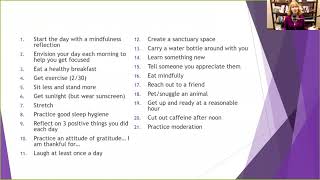
This is a transcript of a podcast episode of "Happiness Isn't Brain Surgery with Doc Snipes" (YouTube/Facebook Live) hosted by Dr. Dawn-Elise Snipes. The episode presents a sequential, practical list of 21 daily habits (framed as "top 20" plus a bonus) designed to improve mood, health, sleep, and overall quality of life with small, low-effort changes. Habits include morning mindfulness and envisioning the day, healthy breakfast, exercise ("2 to 30" ratio), limiting TV, increasing steps, getting sunlight and sunscreen use, stretching, sleep hygiene (blue-light reduction, rituals), gratitude and reflecting on three positives, laughing daily, creating a sanctuary space, staying hydrated, learning something new, expressing appreciation, mindful eating, social connection, pet interaction, getting up at a reasonable hour, limiting caffeine after noon, and practicing moderation. The episode also includes practical examples and brief rationales for each habit and closes with website resources and membership/call-to-action.
Welcome to Happiness Isn't Brain Surgery with Doc Snipes.
This podcast was created to provide you.
The information and tools Doc Snipes gives her clients so that you too can start living happier. Our website, Docsnipes.com has even more resources, videos and handouts, and even interactive sessions with Doc Snipes to help you apply what you learn. Go to Docsnipes.com to learn more.
Hi, everybody, and welcome to Happiness Isn't.
Brain Surgery with Doc Snipes.
Practical tools to improve your mood and quality of life. Today, we're going to talk about 20 daily habits that you might want to consider starting. So there are a lot of things we could do, and there were way more than 20 things I could have put on this list, but we are going to hit what I kind of call the top 20. And these are habits that can make a significant improvement in your life without a significant investment of time or energy. The first one is to start the day with a mindfulness reflection. That is, when you get up in the morning, kind of check in with yourself, go, how do I feel? What am I thinking about? What do I need today? You know? And when I do that in the morning, I do it when I'm drinking my coffee, I'm like, all right, what do I have going on today? What do I need to get through the day? What's going to help me? You know, do I need to pack my lunch? Do I need an extra cup of coffee? What's going on? But that helps you kind of get focused and figure out what your baseline is for the day, because each day you get up, you've got a little bit of a different baseline. Some days you may get up and you may feel like you can conquer the world, and other days you may get up and feel like you're barely going to make it through the day. So you need to adjust your expectations and your priorities accordingly. So start your day with a mindfulness reflection so you can figure out how to best get through the day. The second one is to envision your day each morning to help you get focused. So right after that, mindfulness meditation, or maybe during it, you say, what do I need to do today? And envision how your day is going to go. Kind of mentally plan it out. Now, it doesn't mean it's necessarily going to go that way, but at least you have a starting point and how you think it's going to go that's going to help you stay focused. So when anything else kind of creeps up, you can say, no, that's not on the daily plan for today. And you won't get as distracted by superfluous things. Eat a healthy breakfast. Yeah, breakfast. It's the most important meal of the day, yada, yada, yada. A healthy breakfast starts getting your body primed and gives you the nutrients you need to feel happy, healthy and energized. Get exercise. Use the ratio of 2 to 30. Try not to watch more than 2 hours of TV and try to get 30 minutes of physical activity a day. So you want to increase the amount you move around. If you get a fitness tracker, try to increase the number of steps that you walk by.100 every day. Increasing 100 steps is not much. So that gets you a little bit more mobile, sit less and stand more. So at our house we have a pass through in the kitchen and a lot of times I'll put my laptop on the pass through and I'll stand there and I'll check my messages and do support tickets and stuff instead of sitting down. That encourages me to move around a little bit more and it encourages more blood circulation. Get sunlight. Sunlight helps set your circadian rhythms. It increases the amount of vitamin C. It can reduce depression. Sunlight's great, but wear sunscreen. You know, you don't want to be out there, especially in the middle of the day in those really strong uva, UVB rays. So get in the habit of putting on sunscreen every single morning before you go out, because you'd be surprised, especially if you work in a downtown area where you have to walk, you know, quarter mile, half a mile to work from wherever you park, and then you walk to lunch. You may end up spending an hour to two hours outside every day. Or, you know, when I was in Florida, you know, it was amazing on the. Especially if you go shopping, you'd go to the grocery store. And just the amount of time in and out of the car and in and out of stores and work and things like that. It added up really quickly.
So.
So if you want to protect your skin, wear sunscreen every day. Number seven is stretch. Yep, that's it. Stretch. A lot of times, the way we sit, the way we carry ourselves when we're sitting at the computer, we may hunch over. If you've exercised, you may get a little stiff, you may have slept wrong. There's a lot of reasons that your muscles can get imbalanced and kind of out of whack. If you stretch, you're increasing the flexibility of the muscles and you're making sure that you know your Right side's not tighter than your left side. Your front's not tighter than your back, which prevents a lot of muscle strain, muscle spasming and pain. It also improves your sleep. Practice good sleep hygiene, which means try to turn off those blue lights. Any electronic device, two hours before bedtime. If you can't do it, you just can't. I'm one who just can't. Have a blue light filter on your mobile device and on your TV if you can, which adds sort of a red hue to it, but it takes out the blue light. The blue light is what your brain recognizes as it's time to be awake. So if you knock out that blue light, then you're body will start secreting melatonin and you can start getting sleepy. Other things for sleep hygiene. Try to keep as much stuff besides sleep and sex out of the bedroom as you can. You don't want to bring a whole lot of stress in there. Try to keep the animals out of the bedroom. Create a sleep ritual. So before you go to bed, try to do the same three things every night. Just like when you had a small child at home. You know, you would get them home from school, you would make supper, you would feed them, you would give them a bath, read them a story and put them to bed. So by the time they were in the bath, they were starting to get sleepy. By the time you were reading that story, they were getting a little woozy. And when you were finished, they were ready for bed because their brain recognized, oh, I know this sequence. It's almost time to go to sleep, so I need to start some creating melatonin and getting ready for sleep. Number nine is reflect on three positive things you did each day. Sometimes we just take the positive stuff we do for granted and other times we may be having a really bad day, so we're just focusing on the negative. Either way, every day, focus on three positive things you did because I'm sure you did do three positive things. Even if it was got to work on time, held the door for somebody, and I don't know what the third one could be, but there, there are a lot of positive things. They don't have to be earth shattering, earth shattering. They can be good things, they can be random acts of kindness. Anything in there that makes you feel good. Practice an attitude of gratitude at the end of the day, you know, it may have been a bad day, but when you start getting negative, especially say, I'm thankful for, you know, today was a really lousy day at the office, but I'M thankful I've got a job. I came home today and the roof was leaking, but I'm thankful I've got a house. So practice the I'm thankful for, especially if you're getting kind of a grumpy attitude. But try to take an inventory each day and remind yourself of all the things that are going pretty well. Are you having the best life that you ever imagined? Maybe not. But what things do you have going for you? What is really awesome now? Because if you keep saying I will be happy when I will be happy when I will be happy when, you know what? You never end up being happy because you're living for the future. Live for the present. Be happy now. What do you have to be happy about? Number 11 is laugh at least once a day. Find something stupid on YouTube. Find, you know, a knock knock joke book at the library. Watch your dog run around and chase his tail, whatever it is that does it for you. But it's important to laugh at least once a day. It releases stress, it releases endorphins, and it helps you feel better. So create a sanctuary space. You may not be able to keep your house pristinely clean or your office pristinely clean, as I say as I look around my office right now, but create a sanctuary space, a space that you can keep clean. A corner in the living room or maybe even one room in the house that you know, if nothing else is going to be clean, this room is going to be clean and it's going to smell good. We have three dogs, so smell good is always something you got to add. Carry a water bottle around with you. A lot of times we start feeling foggy headed and cranky and even hungry because we're dehydrated. So if you start carrying a water bottle around with you, you're going to drink more water than you would normally, which will help with all of those things. And they found that even if you don't like water, if you're carrying a water bottle, you're more likely to sip from it. If you really hate plain water, get some lemon juice and squeeze it in there. Takes the edge off. Doesn't add artificial sweeteners, you know. Win, win. Number 14 is learn something new, preferably every day. It can be a new recipe, it can be a new way of gardening, it can be something in the news. You know, you can go to one of the science channels in the news and learn something new, but try to learn something new every day. Tell somebody you appreciate them. We don't do that enough in our culture in our society anymore. So another thing that you can do to feel good and feel happy and increase the positive mojo around you is to tell people around you that you appreciate them. So every day try to find somebody to say, you know what, I appreciate what you did, or I appreciate you. It can be your kids, it can be your spouse, it can be your boss, or it can be the cashier at the store. You know, let them know how much you appreciate the fact that they, you know, came to work and they checked you out efficiently, or whatever number 16 is. Eat mindfully. Too often we scarf down our food or we eat while we're doing something else and we don't even realize what we're eating. We enjoy food a lot more, we eat a lot less when we eat mindfully. So eating mindfully means paying attention to what you're eating, pay attention to what it tastes like, pay attention to how much you're putting on your fork instead of shoveling it in as fast as you can. You know, take reasonable sized bites and pay attention to eating nicely and not just kind of like slopping it in. Reach out to a friend Again, we get too self absorbed in this culture and one of our greatest buffers against stress are our social supports. So every day, pick a friend, any friend, go on your Facebook, pick a friend, reach out and wave at them. Or say, hi, how you doing? Or you know, I like to go to their page and look at the recent posts they've done just to make sure that somebody in their life hasn't like passed away or something. But and then I reach out and say, hi, how you doing? So reach out to a friend and make that connection. It doesn't have to be the same friend every day. Matter of fact, better if it's not dabble. Let everybody on your friends list occasionally feel your presence. Pet or snuggle an animal. They've shown that animals petting animals can release oxytocin, which is our bonding chemical. It can lower blood pressure, it can help stabilize blood sugar, and it can help people just feel more relaxed. So if you don't have wicked allergies or you can find a hypoallergenic pet like a pet pig. One of my friends has a pet pig, just loves that pig to death. Pet or snuggle that animal because it can pay off for you in huge dividends. Get up and ready at a reasonable hour is number 19. Now, reasonable is going to be different for you and me. For me, reasonable is anywhere between 4am and 6am if I sleep past 6. I feel like I slept the day away. For most people, they're not wanting to get up that early, especially on the weekends. So it may be like nine. Okay, fine. So get up by 9:00am get ready, which means get dressed, open the blinds, let the sunlight in. You want to make sure that you try to keep your circadian rhythm stable on the weekends as well as during the week. So if you don't, you know, if you sleep in really late and keep the blinds drawn, then your body's hormones that tell your body when to sleep and when to be awake and when to eat and when you're not hungry, they get all out of whack. So it's really important that you set those circadian rhythms so you're not overeating and you're not over or under sleeping. Cut out caffeine after noon. I know. Oh my gosh, who would have thunk it? Caffeine stays in your system for about 12 hours. So the coffee you drink at noon is still impairing your sleep at midnight. So try to cut out caffeine afternoon. If you are a habitual caffeine drinker, you're going to want to wean down and you know, you know, kind of do it slowly so you don't get headaches and cravings and all that kind of stuff. But it does dramatically help with your sleep quality if you don't have caffeine in your system. And number 21, your bonus tip is to practice moderation. Everything you do in moderation, if you cut out a particular food, it's just going to set you up to really crave that food and want to binge on it. If you start exercising. You know, some people make that New Year's resolution and they go in the first two weeks and they're going gangbusters. And then the third week they can't move and they're so sore and they're like, oh, I'm never doing that again. So practice moderation. Anything you do, you know, start slow. Try doing going to the gym three days a week for half an hour and then build up on that if you really like it. If you're going to change your eating habits, you know, gradually taper down the caffeine or the gluten or the refined sugars instead of necessarily going cold turkey. It makes it a lot easier. And when you practice moderation, you find that there are very few things that you can't do, very few things that you can't ever do. Now, for example, I love gardening but I've got carpal tunnel really bad. So when I go out and I'm gardening and I'm pulling weeds, if I pull weeds for five hours, not going to sleep for the next three days because my hands will wake me up. But if I practice in moderation, I go out and I weed for, you know, 30 or 45 minutes, it's not a problem. And I still enjoy it and my garden still looks relatively decent. So anything you do, instead of going gangbusters and overdoing it, practice moderation. I hope these tips help you develop some healthy habits. If you have any that you want to share, please contact me. Otherwise, help. Have a wonderful day and I will see you on the next episode of Happiness Isn't Brain Surgery.
Thanks for tuning in to Happiness Isn't Brain Surgery with Doc Snipes. Our mission is to make practical tools for living the happiest life affordable and accessible to everyone. We record the podcast during a Facebook Live broadcast each week. Join us free@docsnipes.com Facebook or subscribe to the podcast on your favorite podcast player. And remember, Docsnipes.com has even more resources members only videos, handouts and workbooks to help you apply what you learn. If you like this podcast and want to support the work we are doing for as little as $3.99 per month, you can become a supporter@docsnipes.com join again. Thank you for joining us and let us know how we can help you.










