Revealing Benefits of Self Help and Support Groups
Dr. Dawn-Elise Snipes gives an overview and comparison of common self-help and support groups for addiction and mental-health recovery. She reviews the 12-step model (its 12 steps, underlying spiritual principles, sponsorship, ubiquity and limits), Smart Recovery (CBT and motivational interviewing-based, trained facilitators, ~1,800 in-person meetings worldwide, secular/online), and Celebrate Recovery (Christian, scripture-based, offered in ~20,000 churches, face-to-face). She also covers depression/anxiety support groups, peer recovery programs, referral sources (DBSA, ADAA, United Way/local search), online resources (InTheRooms available 24/7/365), and practical clinician guidance about matching clients to supports and avoiding dependency.
Questions this video answers
Dr. Dawn-Elise Snipes
About 1,800 in-person meetings worldwide.
About 20,000 churches.
InTheRooms (available 24/7, 365).
me@supportce.com
Chapters
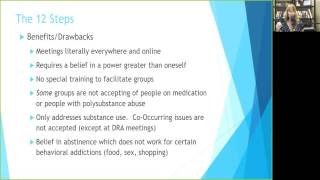
Hi everyone, and welcome to today's presentation on self help and support groups. In this presentation, we're going to examine some of the most common self help organizations, compare and contrast their benefits and drawbacks, and identify cultural or personal variables that may make one group or approach preferable for another. We're going to start out with the 12 steps. One of the things that's really important to Understand is the 12 steps is everywhere. It's multinational, it's available, it's available online. So if someone is willing to participate in a 12 step program, that's great. 12 steps are also widely recognized and accepted by courts, probation officers, places like that. So if someone is in recovery or needs to be in recovery, it's strongly suggested that they at least examine the 12 steps. So what is the 12 steps? Basically, it's a group of people who have not been formally trained, a group of peers who are in recovery who have identified 12 principles that they think lead to happy, healthy living. And in reality, in many ways, it kind of does. So let's take a look at it. We admitted we were powerless over alcohol or our addiction, and our lives had become unmanageable. By the time someone gets to the point of having an addiction, whatever that behavior is is causing them clinically significant stress. So yeah, they are powerless at this point over what's going on in their life. They need to do something different because continuing to do what they're doing right now is going to continue them on a path they don't want to be on. Came to believe that a power greater than ourselves could restore us to sanity. Now, some people take issue with that thinking that it refers exclusively to God, and it can be a God of our understanding, or in some cases, good, orderly direction or planning it out. A power greater than ourselves means getting outside of the present moment and not focusing on immediate gratification. But where do we want to be? What are our ultimate goals? We made a decision to turn our will and our lives over to the care of God or good, orderly direction as we understood it. So whether it's a higher power, whether it's a being, whether it's an entity, whether it's an organization, whatever the case may be, we've decided to say, I'm going to reach out to you and I need help, or I'm going to use you to help format my direction for where I'm going. We made a searching and fearless moral inventory of ourselves, which means people take a look and they get honest about who they are and what they've done. But also the good things about who they are and what they've done. They admit to themselves and to another human being the exact nature of their wrongs. So this is a time of saying, all right, let's wipe the slate clean. For some people, if you're Catholic, maybe that means going to confession. Otherwise it may mean finding a confidant, finding a sponsor. The 12 steps does use sponsors to help people walk through these steps. We know that addicts, regardless of what addiction they have, and generally most of us, we have blind spots. There are things that we don't want to see. So a sponsor is geared to help people see those blind spots and keep them on sort of the right path, or at least the 12 step path. We were entirely ready to have God of our understanding remove all of these defects of character. So basically it's saying, let's take good, orderly direction to keep it as secular as possible. We're ready to look at our ultimate goals and figure out what we need to do differently in order to achieve them and quit doing the things that are going to sabotage ourselves. We humbly asked him to remove our shortcomings. Now, if you're talking about a higher power, obviously that's more of a relationship. But when you're talking about good, orderly direction, then we look at what's going on and say, all right, I've got to suck it up and admit that I need to do something differently. We made a list of all persons we had harmed and became willing to make amends to them all. Now, sometimes this isn't possible. People have passed on. People don't want to have you in their life anymore. So figuring out how to do that, make direct amends to such people wherever possible, except when to do so would injure them or others. Sometimes making amends, sometimes saying you're sorry, sometimes baring your soul is more for your benefit than for their benefit. So it's important to consider what the ultimate ramifications are going to be when you go to make amends. Is it going to hurt the person more? Sought through prayer and meditation to improve our conscious contact with God as we understood Him. Again, mindfulness and meditation, we want to maintain our awareness of how what we're doing and what we're feeling is getting us closer to where we want to be. And those are some basic principles of acceptance and commitment therapy that you can look at when we get to that course. But that's one way you can look at it. For people who are atheist, agnostic, or not really comfortable embracing the higher power Concept and having had a spiritual awakening, we carry this message to others and practice these principles in all of our affairs. Spiritual awakening can mean an awareness of where you want to be, an awareness of who you want to become, a self actualization, if you will. Or it can be becoming in greater contact with your higher power and sensing a greater meaning. It depends on the person. It doesn't really matter in the course of recovery as long as whatever they're doing is meaningful to them. When we talk about the 12 steps, we talk about the steps that we just went through, but each step has a spiritual principle underlying it. And when I said earlier that these steps really are not harmful to people, this is what I want people to take away from it. Step one talks about honesty with self and others. When I work with clients, usually their first 30 days is getting honest with others and then starting to get honest with themselves. They can tell people, you know, I've done all these wrongs. But a lot of my clients have a hard time being honest with themselves. Not about what they've screwed up, because they're really good at owning up to that, but being honest about the good things that they've done and the things that they bring to society. Step two and three kind of go hand in hand. Hope and faith. If you don't have hope that anything's going to get better, then what's the point in trying? So we want to establish hope. We want to see that light at the end of the tunnel. Faith is the understanding that if we change our behaviors, if we do the next right thing, everything is going to start to improve. Courage is what it takes to do that. Moral inventory and really start working the steps or start making changes in your behavior. Integrity is looking at, okay, what I'm doing takes a lot of courage. It's hard work, but I need to make sure that everything I'm doing is in line with my values and principles. A willingness to do these behaviors, even when it's uncomfortable and it's not always pleasant, Doing the next right thing is not always fun. You don't always get that immediate reward. But having a willingness to look beyond that temporary pain for the greater good is important in recovery. Step seven moves us to humility. Accepting that we're imperfect beings. But that's okay. Self discipline. Doing the next right thing and staying cognizant of what we're doing, not living mindlessly. A love and compassion for others. Caring about what's important for them, not just what's important for me. It's not all about Me perseverance. Life is going to get tough. It doesn't matter if you're working the steps or not. Sometimes life hands you lemons. And the willingness to persevere in the face of adversity is vital to sustained recovery. Step 11 talks about spiritual awareness and becoming more aware of who we are and what we are, what we contribute and where we want to go from here. Then finally, step 12. They say in order to keep it, you've got to give it away. We learn a lot more about ourselves and about anything when we teach it. So if we bring this message to other people, if we help people learn how to work the steps or recover or set goals or do anything, we're going to reinforce that knowledge in our own mind and it'll keep it in the forefront of our own mind. Now, I said earlier that the 12 steps is everywhere. It's international, but it's also online. And one place people can go online is in the rooms.com and in the rooms is available 24 7, 365. So whenever I'm working with a client who is working the steps and they tell me, you know, well, I couldn't go to a meeting or I just couldn't get there, I need a meeting. But you know, I don't really feel like leaving the house. That's not an excuse. You can go online and you can get into a meeting. The 12 steps does not necessarily compete with coaching. Sponsors are there to help people specifically walk the steps. And the 12 steps specifically applies to addiction. And what we're going to learn throughout the coaching curriculum is that co occurring disorders, most people who have addictions also have mental health issues and both need to be addressed because if they are clean and sober, but they are dreadfully anxious and just miserably depressed, they're not going to stay clean and sober for very long. So we need to figure out how to help them help themselves. Sponsors are excellent social supports for people in recovery. So we want to encourage people to find like minded individuals to convene with, you know, as much as they need to. My uncle used to go to a meeting every morning before work and every evening after work. His friends were there, his social support was there. So that worked for him. It doesn't work for everybody, but I really encourage people to try out meetings and to try multiple meetings because like I said, they're not developed and they're not held by people who are trained in hosting a 12 step meeting or trained in the 12 step principles. They're held and facilitated by People who've worked the steps. So that means that you're going to have a lot of variation between meetings. Some are going to be really good, some are going to be really not so good. Some are going to mesh with the way you think and others won't. So it's important to reach out and figure out where you're at. Try a few if it really doesn't work, I suggest trying some of the meetings online on in the rooms.com just to see if you get a different feel before you completely abandon the 12 step philosophy. Benefits Meetings are literally everywhere and online. Unfortunately, it does require some willingness to accept this belief in a higher power or a power greater than oneself, even if that means good, orderly direction or the big picture. There's no special training required to facilitate groups which can be a positive or a negative. Some groups are not accepting of people on medication or people with polysubstance abuse. I've heard reports of people who have opiate abuse going to an alcoholic meeting and they've been told this is not the place for you, you need to go to na. And they've gone to an NA meeting and they're like, well you're an alcoholic, you need to go over to aa. So then they don't feel accepted anywhere. Those groups are not the norm. Those groups are there though, so it's important to help people understand that they need to look around. They do only address substance abuse, so any co occurring disorder issues really aren't talked about and are discouraged in most cases from being talked about, except for at DRA or Dual Recovery Anonymous meetings. Unfortunately, DRA meetings are really difficult to come by and it requires a belief in abstinence, which doesn't work for certain behavioral addictions such as eating, sex and shopping. Encouraging people to embrace the 12 step philosophy in their recovery even if they don't fully work the steps, if they're working a different program, I think is a really good adjunct to what you're doing. Encourage them to look at the 12 steps, see what it has to offer, take what works and leave the rest. Smart Recovery is a cognitive behavioral approach to recovery from addiction and to a certain extent, mental health issues. Again, it really only focuses on the addictive behaviors. A lot of that is because when you start addressing the mental health behaviors, it gets really cloudy, really muddy as to whether you're doing treatment or support. Smart Recovery is based on four to build and maintain motivation for change to help people identify triggers for and deal with urges to manage their feelings, thoughts and behaviors that lead to urges, cravings, and to live a balanced life. Smart Recovery recognizes that it's not just about working and sleeping and going to meetings. It's about having fun. It's about enjoying life and seeing the big picture of what recovery is all about. Smart Recovery is in person and online. There's about 1800 in person meetings available worldwide. The online meetings are also good. It uses a motivational interviewing and cognitive behavioral approach to assist people with trained facilitators. So in order to be a facilitator for Smart Recovery group, people have to go through a process so they learn techniques of motivational interviewing. They learn techniques of cognitive behavioral interventions to help people address their urges and maintain their motivation. Again, it really only addresses addictive behaviors, although what they teach can be extrapolated by people to mental health. It does not require the belief or acceptance of a higher power though. So for people who are really stymied by that concept of a higher power or the use of the word God of our understanding, Smart Recovery is definitely a very legitimate option and has received a fair amount of recognition not only in research as being effective, but also again by the court systems which a lot of our clients have some experience with. Celebrate Recovery is kind of our newcomer on the scene. Celebrate Recovery is a Christian based recovery program. The eight principles of Recovery that Celebrate Recovery presents are based on the Beatitudes Realizing I'm not God, I don't have all the answers. Believing that God exists and he has the power to help me recover. Choose to commit all my life and will to Christ's care and control. Examine and confess my faults to myself, to God and to someone I trust. You see how this has some parallels with the 12 steps? Voluntarily submit to any and all changes God wants to make in my life and humbly ask him to remove my character defects. Again, a strong parallel with the 12 steps. In this case, we are speaking of the Christian God. Evaluate all my relationships, offer forgiveness and make amends. Reserve a time with God for self examination and yield myself to God to be used to bring the good news to others back to the service and giving it away. One thing, one term that Celebrate Recovery uses is hurts and hang ups. So they deal with a lot more than just addictions per SE. As the 12 steps have evolved, they've evolved into having a 12 step program for just about everything, including uncontrollable emotions, codependency, etc. However, it still is sort of in its infancy with dealing with some of those things where the person cannot completely abstain. Celebrate Recovery generally follows the 12 steps, adding scripture references. Unfortunately, it's only available in face to face settings. Now it's available in about 20,000 churches, but it is in a church and it is only face to face. And they've been very adamant about the fact that it will not go online. It encourages people with all types of hurts and hang ups to attend meetings. It also requires trained facilitators and it is only limited right now again, to face to face celebrate. Recovery is pretty prominent and is gaining acceptance by a lot of courts, probation officers, those sorts of things. In my mind, whatever works for a person is what we're going to work with. So I don't give as much credence to what the courts say work. I want to know what's going to work for my client. Depression and anxiety support groups are out there and you really need to go and look specifically at your locale to find out where they are when they meet. The Depression and Bipolar Support alliance has a lot of meetings available nationally. The Anxiety and Depression association of America also has a lot of meetings available nationally. You can also go to the United Way. Just Google whatever your town's name is and United Way information and referral. And you can find out about a variety of other support groups that are in your area for suicide survivors, for grief, for medical conditions. Most of us clinicians, when we start a support group, will let the United Way know. Because support groups are a cost effective way for people to access treatment and also access people, other people who are sharing the same issues. Peer recovery programs are an economically viable adjunct to traditional therapy. Most peer recovery programs don't charge anything, but they pass around a donation basket. So a lot of people feel required or obligated to put money in the donation basket. Sustained recovery is achieved by giving back. And it normalizes what's going on for newcomers by being with others who've been there. They've been down at rock bottom. They've experienced what this person is experiencing. There are a variety of options, from secular to Christian for people to choose from. Many principles that are presented in addiction recovery support groups apply to maintaining recovery and preventing relapse from mental health issues. Getting honest with yourself about your wants and your needs. That doesn't just apply to addiction. That applies to mental health as well. It also applies to relationships and a whole host of other things. Having hope and faith. That doesn't just apply to addiction. You see what I mean here? A lot of these tools can be extrapolated. It's vital to have a support system of some sort. Otherwise the client will become dependent upon the counselor and or the coach. This is not only unhealthy for the client and the coach, but it's also unethical. We are, as clinicians or coaches, obligated to not create a dependency. We want to teach clients how to live the kind of life they want to live eventually without us. You know? And when I say eventually, anywhere from six months to two years, but definitely no longer than that. I hope this provided some good information about recovery support groups, and if you find out about any more that are available, please feel free to email me@supportce.com.










