Revealing the 5 Main Influences in Effective Clinical Supervision
Dr. Dawn-Elise Snipes breaks down five core influences on clinical supervision: philosophical foundations, descriptive dimensions, supervisor and supervisee development stages, and contextual factors. She walks through practical examples like handling role-play resistance and measuring progress, plus contracting techniques supervisors can use right away.
Questions this video answers
December 1, 2017.
AllCEUs (allce.com).
counselortoolbox.
Since 2006.
This episode was pre recorded as part of a live continuing education webinar on demand. CEUs are still available for this presentation through all CEUs. Register@Allce.com Counselortoolbox you.
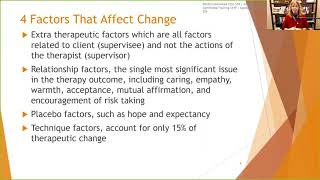
I'd like to welcome everybody to today's presentation on the five main influences in clinical supervision. Now you may be thinking to yourself, well, five main influences we're going to be in and out of here in two shakes of a lamb's tail. It's not quite that easy. Five big influences with a lot of sub influences we're going to talk about. But I would encourage you to think about again, your clinical supervision that you went through, as well as if you are a supervisor, how you're providing that and how some of these things that we're talking about actually apply to what you do with your supervisees. So we're going to explore several influences, the philosophical foundation, the descriptive dimensions, the supervisor's stage of development, the supervisee's stage of development, and contextual factors, including personal characteristics of the setting and the environment that impact clinical supervision. You know, think about if you are a school counselor and you're getting supervision at the school and you're working with students, providing school counseling or providing counseling in the school, how will that be different? How will that affect the supervisory relationship as well as the client and clinician relationship versus being in a mental health clinic versus being in residential? What things are we going to be looking at? So I encourage you to first think about how do you believe change occurs? Do you believe that if you clear that path, providing unconditional positive regard, people will naturally move forward to do you believe that we need to address cognitive issues? How is it that change occurs? Do you believe that we need to work on enhancing motivation in order to help people change? What are crucial variables in training and supervision? And you know, I kind of gave you a hint about some of mine. The things that I think are crucial. Motivation is a big one. Not just motivation to get their license, but motivation to learn and a curiosity in order for somebody to really want to go out and figure out what's the next bit of information I need to be a better therapist to this particular person or group of people with this particular diagnosis. How do we measure success in supervision? How do I measure whether my supervisors and my supervision is successful or not? And I typically, you know, you all know that I tend to be very cognitive, behavioral, behavioral. So I do measurable objectives and we look at how far have you progressed? What milestones have you made in reaching your goals and things like that. But there are multiple ways of measuring success and supervision. You can also include something like a five point Likert scale. And ask your supervisee how do they feel the relationship is going or you know, whatever, how do I contribute to success and supervision? And we talked a lot about that yesterday. Being available, affable and able are three big things. We need to be emotionally and physically present. We need to have the skills to help this particular clinician work through these particular issues and enhance their clinical skills. And we need to be friendly and open so supervisees aren't thinking, feeling like they're going to the principal's office every time they come in for supervision. I remember one of my first supervisors, great man, very Socratic in his approach to things. And sometimes it drove me a little bit batty, but I learned a lot. And we were doing client evaluations one day and we were going through and he was reading me off the client evaluations and I was tallying everything and clients evaluated their, the staff members on a scale of 1 to 5 on several different dimensions. And we got to mine on one of them and there was one, this one particular client who just really did not like me. And you know, there was nothing I did that was right in this person's view. And I froze. I like had a little mini freak out for a second. And I remember Mark just kind of sitting back in his chair and grinning and stroking his chin. And he's like, why does this bother you? I'm like, well, clearly I did something wrong. And he's like, no, clearly you did something right. And I stopped and I looked at him and of course he wasn't going to elaborate unless I probed a little bit further. Ultimately his perception was that, you know, especially in substance abuse treatment and co occurring, if you're pushing buttons, if you irritate clients sometimes, then you're actually doing your job. You're pushing them past their, their comfort zone. Now if you irritate a lot of clients a lot of the time, then there's something to talk about. But if there's one or two clients, especially in substance abuse treatment where good 50% of our clients were involuntary, then you know you were doing your job. So he just kind of laughed. He said that just indicates you were there and holding people accountable and making them do stuff they didn't want to do. And I was like, oh, okay. And we had a similar instance when we had supervision one time before we had an accreditation survey come in. People were freaking out, but the entire staff was just going bonkers. Because we were going to have this accreditation survey. And Mark finally sat back and he's like, what are you also stressed about? Those people that are coming in are paid to find problems. If they don't find problems, then it doesn't look like they're doing their job. So that's what they're paid to do. You're paid to do what you can in the best interest of the client. Have you been doing that? And everybody was like, well, yeah. And Mark said, well, then there's nothing to worry about. Anything they come up with, you know, if we have to write a corrective action, we'll write it. But it's not the end of the world as long as you have been ethically serving your clients. And that's how he was about everything. You know, you could go to him and you could say, I screwed up. And he'd look at you and go, okay, well how you gonna fix it? Instead of losing his cool and like, making you feel like the world was gonna end. So I use him as a good model of supervision in, you know, a lot of different ways. We want to look at what learning objectives do we have for supervision. Our supervisees are going to have certain learning objectives. They're going to want to develop certain skills, they're going to want to enhance this, they're going to want to learn how to work with this particular population. And that's fabulous. I want supervisees to come in with, again, that curiosity and desire to learn and realization that they don't know everything. But what learning objectives do I have? And again, you've heard me talk before. A lot of my objectives center around the documentation, center around consistency and administrative stuff, because a lot of that is not emphasized in clinical training programs. So when they come into supervision with me, a lot of times they're learning lot of documentation and stuff for the first time. That's not my only objective. But I merge my objectives with their objectives and we create a nice, well rounded development picture. And what techniques will we apply to measure and ensure learning objectives are met? Direct observation, obviously you can have a rubric. Motivational interviewing is great for that. If you go on the SAMHSA website, they actually have one created. So when you watch somebody's interview or counseling session, you can go through the rubric and make hash marks every time they use a particular skill. And that's one way you can identify if someone is using techniques and becoming more proficient in using those techniques. I add to that talking with the clinician afterwards about how it felt when they used those different techniques and obviously observing the client and seeing how the client responds to those techniques. Because just throwing out a technique if it's not done effectively isn't going to help the clinician. So there are a lot of different ways we can measure success and progress and improvement. Documentation is the same way. I have a scoring rubric I use when I go over assessments, progress notes, and discharge summaries. So what are some of the factors that affect change? Extra therapeutic factors. Are all those factors related to the client or the supervisee, depending on which relationship we're talking about, and are not the actions of the therapist or the supervisor? So when we're talking about supervision, the extra therapeutic factors are all those factors related to the supervisee, what their training is, their cultural background, their education, their theoretical approach, all that stuff. And those are the extra therapeutic factors. Relationship factors are the single most significant issue in the therapy outcome and in the supervision outcome. You know, we need to make our supervisees feel comfortable enough to be vulnerable, to take chances, to take risks, to learn, to ask questions. We have to provide in supervision, not just in counseling. Caring, empathy, warmth, acceptance, mutual affirmation, and encouragement of risk taking. So we're modeling again, we talked about this yesterday. We're modeling in supervision what we want them to be doing in counseling. Placebo factors affect change in supervision as well as in counseling, such as hope and expectancy. If a supervisee comes to you and they've heard through the grapevine that you are just an awesome supervisor, then they're going to have a lot of hope and expectancy for what they're going to get out of it. And they may hang more on your every word, if you will. Not that I'm saying that you want them to do that, but sometimes they will put you up more on a pedestal. I had one supervisor, not a clinical supervisor, so to speak, that was that way. I mean, he taught a couple of my classes. He was the supervisor of the crisis center. And the man could listen to a dialogue and come up with the most beautiful paraphrases and most captivating insights that you'd ever heard. It was just like, I want to be like him when I grow up, when I get to be a therapist, I want to be like you. So placebo factors can play a role if you've got a reputation. It can also play a role on the negative if you got a reputation for kind of being a hard nose. I worked with someone who had that more of that reputation, and people didn't want to go there. They Were intimidated about going to supervision with that particular clinician. And technique factors do affect change how we teach, what we teach, how we supervise. But it only accounts for about 15% of therapeutic changes in supervision or in counseling. So a lot of it has to do again with helping the supervisee feel encouraged, supported, accepted, you know, and not intimidated. So supervision is impacted by the layers that I mentioned earlier. The philosophical foundation, descriptive dimensions, supervisor stage of development, supervisee stage of development, and contextual factors. So the philosophical layer, what is that? It is the basic belief about how we know what we know and what motivates people and how people change. When I was in intro counseling, this was our first assignment. We had to write a paper that basically was our philosophy of mental health and mental illness. So we needed to explore and explain. And I find it's helpful to have supervisees go through this because a lot of times they haven't actually articulated it to get it out there and figure out what is their philosophical approach to treatment. Where do they believe all this comes from? The first question is how do you know what you know? And that's a one that gives people a lot of pause. They're just like, I just know it. Did you read it? Did somebody tell it to you? Is it a research study from somewhere? How do you know this? And it encourages people to look at what they know and challenge it because they don't. We don't want people just getting online and reading the newest technique and saying, oh, this sounds like it would be great to use with a client and not looking to see whether it's actually effective, whether it's research based, whether it's yada, yada. So we want to say, how do you know what you know? Encourage them to do some research and make sure that they are providing accurate and effective information. Where does mental illness come from? And this is. That's a loaded question. If you're talking about everything from addiction to schizophrenia, you know, there could be a lot of things in there. And if somebody just comes and says that there's a lot of biopsychosocial influences, that is a wonderful one sentence summary. What does that mean? What are the biological influences that as a clinician you're going to look for? How does somebody's social environment and social relationships, how does that affect their mental health and mental illness? So I want them to really tell me more specifically, how do they think this stuff comes about and what are the protective factors that they think happen or need to be in place for people to be mentally healthy and to Recover. What do you believe motivates people? So are they motivated by money? Are they motivated by greed? Are they motivated by love? Are they motivated by. And you know, going from a strict behavioral standpoint, you know, a lot of it's going to depend on that person, but we have to figure out what is rewarding to that person and then how change occurs. Is it something that you just kind of force somebody to do? Is it something they've got to learn? Is it something that one morning they'll just wake up and go, you know what, I don't want to do it this way anymore. I want to do it another way so we can talk about that. And when I do group supervision, I will have my new supervisees share their essay on mental health and mental illness. And we will answer these questions together and we'll talk about them and we'll present different ideas and concepts and you know, nobody's necessarily right or wrong. I just want everybody to start hearing different perspectives. Now. The descriptive layer has 10 influential symbolic, structural, replicative, counselor and treatment, information gathering, jurisdictional, relationship and strategy. So we're going to go through those real quick. The influential layer determines whether the client and supervisee are influenced at an affective or cognitive level. So thinking about the Myers Briggs, we're talking kind of like thinkers and feelers here. Are people motivated more by logic and reason and facts, or are they motivated by compassion and what makes them feel better and happier and loved and all that kind of stuff? So the next question with a supervisee, and you know, I'm listening for it as a supervisor to figure out how to influence my supervisee, but I want them to listen for it in their, in their clients. What does it sound like if a client is being influenced at an affective level? What does it sound like if they're being influenced at a cognitive level? And you know, I've worked with emergency service personnel for many, many years and a lot of them, not all, but a lot of them, tend to be more influenced at a cognitive level. So we'll talk about things in terms of reactions and facts and things. They don't like to talk about feelings as much. But then I'll have other people who come in who really like to talk and use a lot of emotion focused words and they tend to be motivated by what makes them feel happiest versus, you know, what may be the best choice. So if you're working with a supervisee who's cognitively influenced, help them see why or determine which interventions are going to be the best Choice. If you're working with one that's more influenced, an affective level, help them choose the interventions that are going to help their client feel happiest or feel more inspired or empowered. Choosing your words carefully, are you typically influenced an affective or cognitive level? So knowing how you're influenced is really important. I tend to be somewhere middle of the road. Unfortunately, I'm not, you know, one or the other. I think more often than not, I tend to be influenced affectively and, you know, I want to help anybody who comes. And, you know, yeah, they may not be able to pay. Oh, well, that doesn't go over really well with the big boss. And then, you know, when you're in private practice, you got to pay the bills. So that's more the cognitive side, though, going, well, I need to have money to pay the bills. The affective side is going, but this person is here and motivated and wants help. So know how you're influenced, and you've got to figure out how to make that work. If you and your supervisee are not influenced by the same things and you can do it, it's just being cognizant. And how do you keep supervisees motivated who are influenced at an affective level? So you want to focus on how are they feeling? What is their sense on the improvement of their clients? How do they feel about coming to work? How do they feel about how they're defining themselves as a clinician? If they're more cognitively focused, you'll talk more about the goals and progress towards their goals and objectives. The symbolic layer deals with whether latent or manifest content is addressed in counseling or supervision. So we're talking about, do you focus on the seen or the unseen? So when sue gets frustrated with a client, it manifests in a lack of attention and irritability. She just starts getting restless, looking at the clock, looking at her watch, can't wait to get out of session. So do you help sue learn to deal with her frustration and identify it as possibly a projection? You know, she's projecting onto the client her frustration about the fact that the client's not making progress, or she's feeling the client's frustration and irritability and restlessness because the client is stuck for some reason? Or do you teach sue that you know what, you're going to get frustrated? There are days that you're just going to feel like you're not making any progress, but you've got to learn how to control how it manifests in order to create that warm, empathic environment. For the client so they don't feel like you're checking your clock every five minutes or do you do something else completely. But it's important to figure out, you know, how, what exactly are you going to focus on and how are you going to address it. So this last one, if you teach her that, she's going to get frustrated, but she's got to control it. That's more technique oriented, that's more teaching oriented, that's more cognitive. Whereas, you know, dealing with the frustration is a projection, is more dealing with the unseen content and you know, talk about what's going on. The structural layer describes whether therapy and supervision are spontaneous or planned. And we went over this yesterday. Please don't be too spontaneous. You want to have something semi planned. You can have daily brief supervision. And to the best of my knowledge, no states are opposed to that as long as you're getting the required number of hours per 15 clients or whatever. And we used to do this where I worked from an administrative perspective. At the beginning of every shift we would have a handoff meeting so the group who was leaving would meet with the group who was coming on. We talk about what was going on 10, 15 minutes out of there. And you know that that was helpful. If you are working with a supervisee, you can have them drop in at the end of the day and maybe do a 15 minute session on, you know, what happened today, yada yada. There are benefits and drawbacks to that because you can, certain clients can fall through the cracks, certain clients can get more attention and you may miss some of the administrative and ethical and bigger picture stuff by doing short episodic stuff every day. Or you can have weekly hour long supervision. The downside to that is if something comes up on a, on a regular basis or maybe you're in a residential or maybe you're working with a client who is a very or not a client, a supervisee who is a very new counselor and needs more support and more encouragement. Once a week for an hour may not be enough. They may need a little bit more hand holding going through it. So you know, talking with your supervisee about what's going to work. Obviously, even if you're doing weekly hour long supervision, you're going to want to be available the other four days a week or however many days that they're seeing clients in case they do need to touch base and run something by you. But we want to encourage them to try to solve the problems and bring them in mass to the supervision session just like you wouldn't want a client calling you every single day, going, oh, this is what happened today? How do I deal with it? You want them to kind of save it up and bring it to session so we can process everything that happened that week. The replicative layer refers to the extent to which supervisors see observed interactions as representations of isomorphic processes, which is basically, is the person. Is the supervisee doing in session with you, in supervision, what he or she does in the counseling session with the client? And in real life, is this something that. What's the word? Traverses multiple different settings? Or is it something that this is the way the supervisee reacts with you, but not with anybody else? So you want to look at how replicative is it, you know, and when we're in counseling, we typically think of it as a little microcosm. And we're seeing how the supervisor, the client, reacts to us as clinicians. And we're expecting that that interchange is similar to what he or she does when with their friends and when they're not in counseling with a supervisee, again, we expect that they're reacting to us similarly to how they would react in a session and. Or, you know, outside of a session. The counselor and treatment has to do with whether training and personal therapy are viewed as related or unrelated activities. There are a lot of colleges that require clinicians to go through a certain amount of counseling themselves. A. So they get the experience of being on the other side of the couch, so to speak, and. Or so they get some insight into some of their own personal issues. It's rare for somebody to go through clinical supervision for two years or three years and not have some personal issue come up and kind of get in the way that they need to deal with. So it's important to help clinicians realize that treatment may be something that they need to look at. Information gathering contrasts indirect methods of obtaining information with direct observation of therapy sessions. So indirect methods include process notes. So when a supervisee leaves session, they write down pretty much verbatim what they remember happened, what they said, what the client said, how the client reacted, and the entire session. That can be pretty lengthy, and it takes supervisees a lot of time to do so. I typically don't require it of every single session because that's just overwhelming. But it's one way that some supervisors do gather information. You can get supervisee reports, whether it's on a weekly basis when you're in supervision, or on a daily basis, especially if they're new and they need more hand holding and they're Just giving you a verbal report or even they may go into a session and maybe they're a little antsy about it. Having them come talk to you, call you, whatever, right after the session in order to process what happened can be helpful. And client interviews, a lot of times we forget the clients, oh my gosh. But clients can give us a lot of feedback about what's going well, what's not going well, what's awesome, what could use a little bit of work. We're not in there with the supervisor, with the supervisee and the client all the time, but the supervisee and the client are. So if you're only getting the supervisees half, it's like doing marriage counseling and only talking to one person in marriage, you're only getting half the picture. So it's important to do client interviews occasionally. That's not always possible, but it is definitely helpful and it provides immense amounts of information. I remember, you know, in the residential units that I worked in, the clients were always there. So they periodically come down to my office or I would see them in the day room or whatever and they'd pull me aside and they tell me about how awesome such and so counselor was doing or how great it was to have them as a counselor. And it was good to be able to get that feedback. And in treatment centers we often get regular feedback from clients at the end of treatment. One thing that I instituted in a clinic that I started was weekly feedback. When we ran an IOP program and at the end of the week when we did treatment plan reviews, the client was also given a sheet in order to evaluate how treatment was going. It wasn't just the therapist, it was how's treatment progressing? Do any of your treatment plan problems need to be addressed, etc. It was short, you know, they yes, no 1 to 5 Likert scale sort of thing. It wasn't anything that took them a whole lot of time, but then they turned that in and it was easier for me as a supervisor to keep up on how well my clinicians were melding with the groups and if we needed to do anything differently programmatically and or in supervision. So you can get client interviews by doing surveys. You don't necessarily have to have the client there in person. Direct observation can be live through a two way mirror. One way mirror. I never get that right. You can potentially co facilitate a group. One of the places that I used to work, there were always three clinicians in an office and that's just the way it was. So we would be doing counseling sessions and you would have other clinicians at their desk doing paperwork. And everybody who came through the facility realized that that's just kind of just the way it was. And the clinicians that were in the room were bound by confidentiality and everything. So it wasn't a big deal. But when I was a young supervisee, my supervisor shared an office with me and he would be over working on his stuff at his desk and supervising kind of as, as informally as possible. And he was able to see and hear what was going on and then we would talk about it after the session was over with the client. So there are multiple ways to do live observation. You can also do video observation. Video is so much better than audio alone because we know that the preponderance of our communication comes from our non verbals. So it's important for clients to try to or supervisees to try to get clients to sign a release to do video taping. I found in many cases when there's resistance to doing videotapes, it's more on the part of the supervisee than on the part of the client. So allaying the supervisees fears about that is also helpful. Jurisdictional relates to who is responsible for care. There's the client out here, whose responsibility is it to make sure this client is getting their needs met? Is it the client's responsibility to stand up and go, hey, not getting my needs met? Well, you know, theoretically we'd like to believe that all of our clients were empowered and they'd be willing to do that, but that's just not the case and it's not fair to put all that on the client. Is it the supervisee's job to make sure that the client is getting the best care possible? Well, yes. However, the supervisee may not know what they don't know. So they may think they're doing a bang up job. And you as the supervisor with more experience and breadth of knowledge may go, oh, there's so much more that can be done. So basically, jurisdictionally, it's everybody's responsibility to make sure that client is getting the highest quality of care. And we want to enforce that in the supervision relationship because if we don't, then the supervisee may think that it's all on them or it's all on the client. Rarely do they think that, you know, the supervisor should be taking control of things. But it's important that everybody has a stake in the process. The relationship layer determines whether the counselor or supervisor functions at a facilitative or hierarchical role. I think most of the time, we try to function at a facilitative role. You know, there are sometimes, like we talked about yesterday, especially if you're an administrative supervisor, there's going to be some hierarchical stuff. And by virtue of the counseling relationship, there is no way to have it be completely facilitative. There's always going to be a power dynamic. But leveling the playing field as much as you can, empowering the client, empowering the supervisee as much as you can to take charge and responsibility and be willing to state their needs is really important. The strategic layer highlights the teaching of theory versus technique. So theory teaches why you do these things. You know, if a client comes in and they're struggling with depression and they have a lot of negative thoughts, then we want to help them address those negative thoughts and silence the inner critic. Well, that's great, but we don't know how to do it. That's just a theory. It's like, okay, so now how do I do it? The technique teaches how. So we want to kind of blend the two. Because if you just give somebody a technique, you give them a worksheet and say, here's the ABCs of cognitive behavioral. Have all your clients complete them. The therapist may know how to complete that and have their clients complete it. But to what end? What's the purpose? What's the function? What are we working towards? So they need to understand what they're doing, how to do it, and why they're doing it. What is this technique going to help with? You know, if the doctor gives you a prescription for an antibiotic, and he says, you know, here, this will help you get better. Well, that's why I'm going to take it. Great. You know, I do want to get better. But if he doesn't tell you how often to take it, you're looking at it going, is this once a day, every four hours? You know, how do I do this? Because I want to feel better. So we need both. The stage of development includes both the supervisor and supervisee. You may have a supervisee who has been in the field for, you know, a year and a half. They're almost the end of their supervision. So theoretically, they're at the end of their supervisee development. Doesn't necessarily mean that they're into their counselor development, but they're at the end of the supervisee phase, if you will. And we also want to look at the supervisor, because you can be somebody who has been in the field for 20 years, and you have an immense breadth and depth of Experience to share. And you've been supervising for, for 15 of those years. So you've got a lot of information to share. You're very solid in your identity as a supervisor and how things go and yada yada. But you can also have supervisors and supervisees at the other end of the spectrum who are brand spanking new. And the supervisee just got out of college, the supervisor just got certified as a supervisor, and you're both trying to figure out your identities, how the process works together. So there's a fair amount to look at there and we're going to talk about that more in next session when we talk about forming, storming and norming, which will sound similar to group therapy, but they're the stages that we go through in development. Briefly, forming is when you're starting to form your identity and figuring out who you are. Storming is when you're trying to individuate and create your identity separate from the college, separate from the supervisor. And norming is when you're kind of settling in and you're identifying and solidifying who you are as a clinician and or a supervisor. The contextual factors has five categories. We want to look at training, how and where it occurs. Where do you believe training occurs? Do you believe that supervisees should have homework, that they should do case preparation? I do, because I have to do homework in case preparation for clients as well as for supervisees. So I think it's important that supervisees kind of get that from jump and they realize that you don't want to be training while you're in session. There's a time and a place for training and learning skills. In client sessions. You're going to learn what works and how to present it. So we talked about this yesterday. A lot of times we'll introduce new techniques and we'll role play them in supervision first until the supervisee is comfortable with them. At a certain point they're going to have to try it on a real life client. So this is when the learning takes place in session. The first time they try it on a real life client, they may put it out there and then it falls flat and they're like, oh, that didn't go so well. So then you can, as a supervisor you can process what went well, what didn't go well, what they might need to do to make it go a little bit better. So they're learning how to present the information and how to modify it for each different type of client that they're seeing. And training occurs in supervision. Sessions through modeling and experience. So the supervisee is experiencing and is learning by watching you. They're watching you help them grow, which is what they want to take and model in their sessions. Hopefully at least parts of it they'll learn through direct instruction. A lot of group supervisors especially will have a segment that involves direct instruction at each supervision session. Teaching a technique or a theory or information about a new research finding, and then role playing. As we've discussed before, it doesn't even need to necessarily be on a new technique. It could be a session that was taped and you watched it and the session went really poorly. So you say, okay, let's try to redo that session and see if we try some of these new techniques or try some of these things we talked about and do this thing a little differently, how it might play out. When clients, when supervisees have a session, go really poorly with a client, Sometimes they are intimidated to go back in to session with them. So it's important that we role play with them and help them kind of get their confidence back and not feel like they're going to fail again, because that'll just kind of set them up for failure. Philosophy is another contextual factor. Your philosophy of counseling, recovery, mental health and training is one part of it. But then the supervisees philosophy, as we talked about at the beginning of class, is another part. And they don't have to be the same, but you have to be willing to look from each other's perspective. If you're working with a marriage and family therapist and you're a clinical social worker, you know, you come from two theoretical, different theoretical standpoints. Doesn't mean you can't work together, but it means you have to understand the other person's philosophy. And as a supervisor, you know, especially in that example, it would be incumbent upon you to understand if you're supervising a marriage and therapy marriage and family therapist, it's incumbent upon you to know the techniques, skills and philosophies of marriage and family. Demographic characteristics will also affect things ethnicity. Whether you want to think it does or not, it does. You know, our culture, our ethnicity is going to affect interactions in some way, Most likely, at least with some supervisees. Socioeconomic status. If you are working in a facility and you're working with a supervisee who may come from a lower socioeconomic status and may feel maybe they're the first person to ever go to college, let alone graduate school, and they're kind of trying to feel their way around because they're the first one to do this. You know, being cognizant of that and conscientious and encouraging of them. Age plays a big factor. Not only the fact that, you know, people who are older tend to come from a different generation and have different approaches to things. One woman who worked at a clinic that I used to work at, oh, golly, I think she's in her mid-80s right now and she's still working and she's still supervising and she's still licensed. She's smart and sharp as a tack, but her perception of things, I mean, think about it, 80 years ago, she was counseling, back in the 1950s, well, maybe 60s. Her approach to things and her knowledge different than somebody who may be graduating from graduate school right now. Does it mean either one is wrong? No, but they're going to influence each other. And there can be some transference issues between supervisor and supervisee based on age, or if supervisees have issues with authority figures. You know, you just want to pay attention to what is it about you and your situation and your environment that influences the supervisee for better or worse. You know, it's not a problem unless you don't recognize the influences. Settings, rural or urban, have very different effects on relationships, have very different effects on supervision, have very different effects on even the problem solving seen. So supervision in a rural clinic may be a little bit more laid back. The clinic people may show up in jeans versus an urban clinic where everybody's dressed in, you know, business suits and heels and everything is run on the clock and that sort of thing. A different atmosphere, whether the setting is a clinic or you've got home based therapy. So if the clinician is typically going to homes and the only time they come in to see you is in the clinic, then they're probably going to act a little bit differently in the clinic than they do in a client's home. And if the setting is a school, again, it's just going to be a little bit different. You want to think about how is the setting impacting supervision? How is the setting impacting my supervisee? How does does my supervisee feel in this setting? You know, some people will go, you know, if they're from the big city and they come and they went, go to a little rural community mental health center. They may feel really out of their depth at first, trying to get used to the different culture. So it's important that we educate them and help them find their, find their groove, if you will. Clinical issues also affect the contextual layer. If you're dealing with people with substance abuse, if you're dealing with people with schizophrenia. If you're dealing with people with mood disorders, there are different issues that are going to impact the supervision session. If you're dealing with someone who has borderline personality disorder, that's going to require whole different set of supervisory skills than if you're working with someone who has, you know, run of the mill generalized anxiety disorder. So being aware of the clinical issues that are being presented, that's going to affect supervision how often the depth, the techniques, all that kind of stuff, and burnout, prevention. So when we're thinking about supervision, we're thinking about creating an environment. You know, yesterday we talked about the fact that we need to make sure that supervisees are prepared not only clinically, but also that they can do clinical stuff. They have the skills and tools, the theoretical background, they can do the administrative work that they need to do, they can do the evaluative work that they need to do, and they can do the ethical work that they need to do. So it's important when we do supervision that we're constantly asking questions about ethics, that we're constantly encouraging client supervisees to look at the ethical implications of what they're doing, what they're suggesting, to make sure that they're not crossing any ethical boundaries. If we don't look at our work supervisors or supervisees, if we don't look at our work on a regular basis, it's really easy to start getting loose with our ethical mores. So we need to constantly ask ourselves, is this in the best interest of the client? Beneficence, non malfeasance, fidelity, all that stuff. So we need to look at the clinician, the supervisee from the big picture, not just skills or not just creating somebody who can implement skills and tools. You're creating an independent practitioner who can use those skills and tools to enhance the lives of their clients. The philosophical foundations, the basic beliefs about how we know what we know. So encouraging client supervisees to reflect on this and encouraging them to pay attention to what motivates people and how people change, because it differs between clients. One of the things that I ask a lot of my supervisees, especially the new ish supervisees, who are still in their forming stage with each client, I say, what's motivating this client to be here? What's motivating them to reach this goal? What are their goals so we can have a conversation and keep that in the forefront of our minds, that we need to keep the supervisee motivated, the client motivated. By the same token, we need to Keep the supervisee motivated. And when we create the individual development plan, I asked them, you know, why did you get into counseling? Why is it that you selected this particular clinic? What particular issues do you like working with? Not that that's all you're going to get, but what motivates you to come to work every day? Because that's what's going to keep them coming back. That's what's going to keep them interested and enthusiastic, and that's what I can use, and that's what I need to monitor. If what motivates them is seeing people have that aha moment, if what motivates them is seeing people go from struggling to being happy, however they define that, then I need to make sure that I'm bringing that to the forefront of supervision at every session. You know, how is it that you helped somebody take a step forward this week? So they see that, you know, they may have had a couple of clients that took a couple steps back. That's normal. But which the clients took the steps forward. Remember yesterday I said, encourage supervisees to keep a progress journal, or whatever you want to call it. At the end of every day, they write down two or three good things that happened that day, two or three things that they did well. So they can reflect on that when they're having a bad day and they're like, I just can't seem to make any progress with any of my clients. Well, we know those are cognitive distortions, but they can look back at that and go, you know what? Most days I do pretty well and I make progress. Today just happened to be a big old hiccup. The therapeutic supervisory process can be described in terms of what influences and changes behavior, what you focus on, the latent or manifest content. So how do you help people handle what's going on in session? Do you tend to be more spontaneous or planned in your supervision? That is, do you meet every day so it's real regular, or is it once a week for an hour, and there's really not a whole lot of room in between? Is therapy or supervision a replication of what that person does in their outside life? Is that what you believe? And if so, okay, so if they're doing splendidly in therapy and supervision, then we expect that they're probably doing splendidly in life. If they are struggling, if they are sleepy, if they are cranky, if they're biting everybody's head off in supervision, or heaven forbid, with clients, then we can assume that's what's going on out there. And we need to address it. Likewise, you know, sometimes it's just. It's a bad, bad fit, and sometimes it's not replicative. It's more of a transference issue that we need to address. We need to help counselors see that supervision and therapy can be related, gather information both from direct and indirect sources because they both influence supervision. And direct observation is great, but we also need to get it from the client's perspective in order to get that third dynamic. We have our perception, we have the supervisee's perception. Now I want the client's perception so we can put it all together and figure out what this really looks like. Jurisdictional. Who's responsible for client care, and how do we empower each of those people, the client, the counselor, and the supervisor? Is the relationship facilitative or hierarchical? And some people prefer a more hierarchical sort of relationship. I know when I did group supervision at the university, it was definitely much more hierarchical with the professor taking the lead. And if it's that way, that's fine. But you have to recognize how that influences the supervision process, what it brings, what it may hinder, and then strategy. What do you teach and how do you teach it? How do you teach theory and how do you teach technique, and how do you make sure that you're teaching both? So you answer the big W's. Who, what, when, where, why, and how. Where is not as important. But you want supervisees to be able to identify, who would I use this technique with, when would I use it, why would I use it, and how do I implement it. Other things that influence supervision include the stage of development of the supervisor. If you're a new supervisor, you're still trying to find your identity and find all the tools that work for you. You're still trying to figure out your rhythm and individuate from your supervisor. You're working on developing your supervisory contracts, you're working on developing your schedules, you're working on develop your techniques. That's cool. If you are in the middle stage, you're individuating more and you're starting to set boundaries, and you may become a little bit more rigid. So if you're individuating, that's great. It's a process you've got to go through, but you've got to recognize how that might impact supervision. And once you've individuated and you've found your identity as a supervisor, that's wonderful. How does that again impact the supervisory relationship with a counselor who is either fledging, individuating or fully solidly individuated and defined as a counselor. Other things to consider in the supervisory relationship include your personal characteristics, just like we would consider in any counseling relationship. How does who I am and my beliefs and my experiences and all that stuff influence my perceptions and how the client perceives me and how the supervisee perceives me? And how does the setting or environment impact how the supervisee perceives me? If you're the administrative supervisor and the clinical supervisor, that could potentially. Well, it will impact the supervisory relationship. If the person believes that their job rests on you believing that they're doing an excellent job, then they may be less likely to share when they think they've made a mistake. They may be less likely to take risks, or on the opposite side if you're their boss. Anything you say they may do without questioning as much as they would if it were more of a facilitative relationship in an environment where you didn't have control over their fate, so to speak. So there's a lot of stuff to consider, but when you really stop and think about it and kind of drop back, most of it is really similar to all the stuff we really need to consider when we walk into a counseling room with a client. We want to look at how do we create an environment that is encouraging, nurturing, warm, and all that stuff that can facilitate growth? Okay, are there questions? Passive resistance to role playing, or even active resistance to role playing is not uncommon. So when you create your initial contract, it's important to kind of lay out, and we're going to talk about that. I think in the fourth session, it's important to lay out for the supervisee what types of activities are going to be expected of him or her in session, whether it's in individual or in group. Talk about the fears, talk about their anxieties, talk about why they may not be thrilled with it. But if those expectations are set out at the beginning and they're in the contract, then it's easier to hold the supervisee accountable. If they continue to be resistant, you have the option of. Of encouraging them to find another supervisor. If for some reason you're having a hard time with doing supervision with them, but most likely, if they understand from the beginning, and then if you figure out what's motivating this passive resistance, what's motivating them to not want to do this, and you address that, then they'll do it. They may not be happy about it, but you can get them to do it. It's kind of like helping somebody go up and do a speech in front of 700 people. You know, they may be apprehensive about it, they may be scared out of their wits. And it takes time. When we were going through training for the crisis center back when I was in college, we would break up into groups of 10 and we would spend the entire evening doing role plays. And, you know, the first few times you did was really intimidating because you had everybody sitting there looking at you, and the person who was playing the client was the facilitator. And you knew they knew the answers and they knew what to say. So you A lot of times people were afraid of looking stupid. I know I was, you know, I was like, oh, what if I say the wrong thing? Eventually you got over it. But it was important to address those anxieties. Any other questions? Alrighty, everyone. Have an absolutely fabulous rest of the day and I'll see you tomorrow. You. If you enjoy this podcast, please like.
And subscribe either in your podcast player or on YouTube. You can attend and participate in our live webinars with Dr. Snipes by subscribing@Allce.com Counselortoolbox this episode has been brought to you in part by allce.com, providing 24. 7 multimedia continuing education and pre certification training to counselors, therapists and nurses since 2006. Use coupon code counselortoolbox to get a 20% discount off your order this month.










