SAMHSA TIP 59 Improving Cultural Competence Part 1 of 3: | Counselor Toolbox Episode 142
Recorded CE webinar (part 1 of 3) by Dr. Dawn-Elise Snipes summarizing SAMHSA TIP 59. The presentation defines core assumptions about cultural competence, distinguishes race, ethnicity and culture, describes a five-stage continuum of organizational/clinician cultural competence (from destructiveness to proficiency), and reviews how culture shapes communication, family roles, health beliefs, and treatment fit in behavioral health/substance-use settings.
Chapters
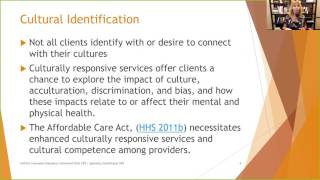
This episode was pre recorded as part of a live continuing education webinar. On Demand CEUs are still available for this presentation through all CEUs. Register@Allce.com Counselortoolbox you I'd like to welcome everybody to today's presentation on improving cultural competence, which is based on SAMHSA's tip 59. In your class there is online there is a link to SAMHSA's tip 59 if you want to read it. You can actually order the hard copy for free from SAMHSA should you want to. It's a great tip and I will be putting out an on demand class that is 15 hours based on that tip at the end of next week once I have all the lectures recorded. So just so you know that that's kind of out there if you happen to need more multicultural for renewal. In this particular section, and this is part one of three, we're going to define assumptions about cultural competence, define race, ethnicity, and culture, and explore the problems with limited cultural competence. So we're really starting at the very beginning. It's going to be sort of a throwback to your multicultural counseling when you are in graduate school. But there's a lot of reminders, there's some, a little bit of new stuff, and I'm going to try to make this as relevant to your current practice as possible. So really quickly I'm going to read this slide. You know, I typically don't read to you, but first assumption is that counselors will not be able to sustain culturally responsive treatment without the organization's commitment to it. There are some things you can do, but if your organization is encapsulated, you're really going to struggle to provide interventions and provide treatment options to people who are not of the same cultural background or of the majority cultural background. So they may, and we'll talk about that. Assumption 2 An understanding of race, ethnicity and culture, including your own, is necessary to appreciate the diversity of human dynamics and treat all clients effectively. We need to understand the individual. We need to understand what their belief systems are. Assumption 3 Incorporating cultural competence into treatment improves the therapeutic decision making and offers alternate ways to define and plan a treatment program that's firmly directed toward progress and recovery. In substance abuse treatment, for example, we talk about changing people, places and things, and one of the traditional recommendations is to remove yourself from people who are still actively using, especially abusing substances. Now, if your family of origin happens to fall in that category, you know it's not necessarily culturally appropriate to say, well, you need to just kind of Back away from the family for a while. So we need to figure out what perspective our clients are coming from and help them define what recovery looks like for them and communicate with us about what interventions are going to be most appropriate. Assumption four, Consideration of culture is important at all levels of operation, individual, programmatic, and organizational. That's one that we'll really talk about a fair amount today. Assumption 5. Culturally congruent interventions cannot be successfully applied when generated outside a community or without community participation. As a Caucasian female, you know, I can't just read a textbook that's written by another Caucasian female and design an intervention that I think would be culturally appropriate for an African American youth who's, you know, 17. He comes from a completely different cultural background, a completely different set of experiences. So it's important to understand that we need to have input from people from the different cultures and communities. So we need to ask, what is it that guides your beliefs and your expectations? Assumption 6. Public advocacy of culturally responsive practices can increase trust among the community, agency, and staff. If clients believe that when they come to your agency, they're not going to be pigeonholed into this one size fits all treatment, they're going to believe a little bit more that you may be there to help them and less in the fact or the belief that you're there just to bill insurance. So we really want to look at extending what we do in our community or in our clinics out to the community so people understand that we are not perfect, but we try to be as respectful as possible of cultural differences. It's important to understand, though, that not all clients identify with or desire to connect with their cultures. So just assuming that someone of a different or even your own culture wants to espouse those beliefs and thoughts and everything else, that doesn't necessarily work. There are a lot of people who reject mainstream culture, even if they are in mainstream culture. So we don't want to assume that they are ready to connect or want to connect with that culture of origin. We also, you know, want to be sensitive to the fact that they may have defined their culture already. So instead of saying, well, you fit into this nice little neat category, ask them, you know, what is your culture think about? A lot of the youth today, you know, they are very, very different. Culturally responsive services offer clients a chance to explore the impact of culture acculturation, which is basically forcing people to fit into mainstream culture, discrimination and bias and how these impacts relate to or affect their mental and physical health. Now, if they're not ready or willing or have Any desire to connect with their culture of origin, then this may not be an avenue that you necessarily want to go down. But it is important for us as clinicians to at least understand on a meta concept level how or the experiences or the biases that this person may have experienced. Now, whether they want to make that a treatment issue or not, that's going to be an individual decision. But we do need to have an awareness of what people of certain races and ethnicities experience. Health and Human Services Protocol 2011b in the Affordable Care act necessitates enhanced culturally responsive services and cultural competence among providers. The link to that is in your class. We're not going to go there right now, but there was a real strong push with the Affordable Care act to encourage clinicians and organizations to become more culturally aware, to reduce cultural disparities in not only the presentation of problems, but people accessing treatment. We want people to feel like our clinics, like our organizations, are welcoming problems with limited cultural competence. It's a significant barrier that can translate to ineffective provider consumer communication. If I am communicating exclusively from my perspective, this is the way I think it should be. I'm not hearing what the client has to say. And I would hope that by the time we all got out of graduate school, you know, this is kind of common sense, that we want to hear the client's perspective. What do they think is causing their problems right now? What do they think recovery looks like? What do they think is the most effective approach to treatment? A lot of clients have done some research. Some, some haven't. And that's okay with my clients. When we're getting oriented or organized, you know, I ask them what they think would be the most effective approach. I tell them, you know, my philosophical approach to counseling, but I can be a little bit flexible. But then I ask them, what do they think? And if they say, I have no idea. I don't know what cognitive behavioral is. I don't know what, you know, humanistic is. I just. I need to start feeling better. I'm like, cool. So as we talk, you know, I may suggest you trying some things, and if it doesn't sound like something that would feel comfortable to you or that aligns with your values, let me know. That way I won't suggest it again. And we can help hone what treatment options or what interventions might be most effective for you. If we're not communicating well, we may delay the person getting appropriate treatment at an appropriate level of care. Sometimes clients, you know, if you use the ASAM or the Locus or any of those placement tools, they may recommend a certain level of treatment that may not be appropriate for that client for a variety of reasons. If there's a residential program you're trying to refer someone to, we need to make sure that that's going to work for them and that the program itself is culturally responsive. Limited cultural competence can also translate to misdiagnosis, not understanding what's culturally appropriate and acceptable in certain situations, lower rates of treatment compliance because clients feel misunderstood. It's like I keep telling you that I don't feel comfortable in group, and you keep sending me to group. Why? Clients feeling judged in substance abuse treatment, for example, there is an emphasis in many clinics on 12 step approaches. And if clients don't embrace 12 step approaches, the message that is either overtly or covertly communicated can be one of, well, you are not ready for recovery if you're not ready to work this one program. So we want to make sure that clients don't feel like they're judged for saying, you know what? That doesn't work for me. I want clients to feel empowered to say, that doesn't work for me. But this might. And clinicians making inappropriate treatment recommendations to groups, to support groups. Some people don't feel comfortable either. Culturally. Well, stick with culturally here, with going into groups and putting all of their private stuff out there. Other people are not able to sit for long periods in group because of maybe mental health diagnoses. But we want to make sure that we're making the appropriate recommendations that's going to be a good fit for the client. And when we do that, we're going to have better outcomes. Culturally responsive practice reminds us that the client's worldview shapes his or her perspectives, how things should be. What do they expect? Do they expect that if you do good, good comes your way? Do they expect that no good deed goes unpunished? What things do they strive for? What's important in their life? Is it money, success and power? Is it a happy, healthy family? What is it? And we need to ask the client themselves, and I'll give you a little tip and tool for that in a minute. What are their beliefs? Do they believe it's a just world and if you do bad, bad things happen? That karma thing. Why do they think things happen? What are their beliefs in terms of spirituality? What are their beliefs about other people and mainstream culture? Do they think that in large part the mainstream culture is not so good? Any behaviors surrounding, and I just put the term addictive here as a general term, addictive behaviors. But what are their cultural behaviors surrounding alcohol, illicit drugs, sex, gambling, eating disorders, to name a few. Some cultures embrace alcohol. Some cultures use alcohol or certain drugs in part of their spiritual rituals. Some cultures use alcohol as part of their just family rituals. So it's important to understand what alcohol use means to that person so we can define in terms of that person's culture, at what point does it become harmful? Illicit drugs generally have a more common theme about what's appropriate and what's not. But there are a lot of different cultural conceptualizations about what kind of sex is appropriate. Gambling, is it okay? Is it not okay? Is it something that you do for recreation? How much in the terms of losses is okay? Beliefs about illness and health. So is it your fault if you get sick? Is it God's punishment? Is it a natural progression? That's the only term I could come up with. Sometimes you're just going to get sick. We want to look at the approaches for Eastern medicine versus Western medicine. There's been a great upsurgence of people looking towards Eastern medical approaches and comprehensive approaches. There's alternative approaches to treatment not only for medical issues but for mental health issues. So what's the client's belief? What do they think will help? There's been a lot of research on a lot of the Eastern approaches. There's been a lot of research on tai chi. There's been a lot of research on acupuncture. So let's ask the client what's going to help them? What's their culture's perspective on seeking help? Airing dirty laundry or it's great to reach out for support. How do they feel about participation in face to face versus virtual treatment? We talked about that on Tuesday. The fact that a lot of and I've learned since then that is called Generation Z. People who were born mid-90s to mid to late 2010 or whatever they're called Generation Z because they grew up pretty much from the time they were in preschool with a mobile device in their hand. And they're a lot more comfortable communicating online. And Leo Law enforcement or military because of the law enforcement and or military culture. And they're different cultures but they do share some similarities. There can be a great stigma associated with seeking help. Being aware of that. Recognizing that some clients will be more likely to attend and participate in treatment if it's individual versus group and possibly if it's virtual versus face to face. So there's less risk of breaching their confidentiality. And the elderly and I mentioned this in prior classes. My grandmother is 87, and she was raised very much that you don't tell people your stuff. You get a stiff upper lip, and you just do what you got to do. She doesn't believe in whining or complaining, as she calls it. She's like, this is just the hand God dealt me, and I've got to deal with it. Which I can hear her perspective sometimes. It's frustrating because I can see her struggling. But I also understand that it's not comfortable for her to go outside of the family and ask for help, and especially uncomfortable to go into any sort of support group. That's not always true. There are a lot of people who are from her generation who do attend certain support groups, bereavement support groups, and a variety of different things. So it's important not to assume that just because somebody's in a certain age group or a certain race or ethnicity that they are going to reject a certain intervention or accept a certain intervention. Let's ask, what are their counseling expectations? Law enforcement and military. This happens to be one of my specialties, so they come up a lot. But a lot of times law enforcement and military have this bias that counseling is going to be largely ineffective, especially if it's provided by somebody who is not flexible, former law enforcement or military. And accepting that, I mean, I'm not going to try to argue with them and tell them that their beliefs are wrong. Being culturally responsive to them as much as possible, recognizing their heightened concerns about confidentiality, you know, being able to maintain a career in law enforcement or military and the criminally involved is another example of people who may have different counseling expectations. They've seen a lot of their peers go in and out of counseling, whether required, involuntary or voluntary. And obviously, clients who are involuntary tend to benefit less than clients who are there because they want to be. But the people who are criminally involved may expect that counseling is geared towards pushing them into this mainstream culture and communication. How open do they feel comfortable being? Not everybody's comfortable talking about feelings. And when I work with cops in military, we talk about feelings in terms of the F word because they're not comfortable using feeling words. In general. Some are great with it, but a lot of law enforcement and military prefer to use more descriptive terms like, I feel like I got kicked in the gut or I couldn't catch my breath. I'm not going to force them to say so. What you're saying is you were scared. I'm not going to try to force them to use my language. I'm going to use their language. So the continuum of cultural competence. Stage one is cultural destructiveness. And I want you to think about your own practice, your own organization as we go through these and kind of figure out where you are and likely there are certain aspects of your practice and or your organization that are at different levels. And that's cool. Part of this class is to help people survey what's going on and figure out what they may want to look at addressing. So cultural destructiveness is stage one. At the organizational level, the organization negates the relevance of culture in the delivery of services. It's a one size fit all. You just come in, you do your thing. From the clinicians level, counselors hold a myopic view of effective treatment. Effective treatment means you meet these goals, you're clean and sober for 30 days. You haven't had a suicide attempt for two weeks, whatever the standard. And that's one of the reasons why it just drives me absolutely batty when I see standardized treatment plans. And if I go into a clinic and I do an audit and five people have the same treatment plan, especially in electronic health records that use dropdown menus, it just makes me want to like scream because we don't know that the client's view of effective treatment was available in those dropdown menus. Cultural incapacity is stage two. So hopefully we've moved past that. The organizational culture may be biased and clients may view them as oppressive. An agency functioning at cultural incapacity expects clients to conform to generalized services. So at this level they realize there are cultural differences. But the organization's like, you know what, it's cost effective to provide it this way. And this particular approach works for the majority of people. So this is what everybody's going to do, which you can see how it could be oppressive to people who aren't comfortable in group, to people who aren't comfortable doing certain activities. From an individual level, counselors ignore the relevance of culture while using the dominant client population and or culture as the norm for assessment, treatment planning, and the determination of services. Again, in incapacity, you've recognized that culture is an issue, but you're just not paying attention to it. You're saying, I have a treatment program here and you can come, you can participate, but you've got to fit into our way of doing things. Instead of looking at little things you might be able to do to make it more welcoming and to make it more comfortable for people of different cultures. For example, instead of having, if you have an elderly client in your group who's not comfortable putting all that stuff out there for the whole group. But for whatever reason, the treatment program is set up. Maybe it's a residential program. They have to be in group, okay? So that client can sit through group and take notes about things. And when the clinician asks questions of the group, that client can write down their answers and responses to it and then discuss it with the clinician and individual later. So you're not disrupting the whole organization, because sometimes it's just not doable to conform to every single person. If you've got 85 people in the house, but you're tailoring and you're saying, you know what? This works for you. And I've had a client that had a really bad tic disorder. We did the same thing for him. As soon as he would get stressed, his tics would just kick off to the point that he couldn't hold a pencil, to the point that he couldn't speak, and it was very uncomfortable for him. But once he got comfortable enough being in group, he could write down his responses, his observations, and then he could talk about it with his clinician later. So he was still benefiting from the treatment program. Another thing you could do is record group meetings and let the client watch the group meeting or the psychoeducational part of the presentation independently. Stage 3 Cultural blindness. @ the organizational level, the core belief that perpetuates cultural blindness is the assumption that all cultural groups are alike and have similar experiences. So we're assuming that anything we do is we know what the impact is going to be. For example, I worked with a clinician who did a trauma group. And, I mean, he was. Is an extraordinarily talented clinician and does a great trauma group. However, at the end of every group, he would turn off the lights and they would do sort of this ritualistic grounding activity and holding hands. Now, for a client who has been a victim or is a survivor of ritualistic abuse, that would, like, freak them out. So being aware that even if somebody is in substance abuse treatment or mental health treatment and appears to fit in certain cultural groups, they have individual differences. So we need to recognize that at the individual level, counselors uphold the belief that there are no essential differences among individuals across groups. There are no essential individual, essential differences among, you know, people who have had more of an oppressive experience versus the mainstream culture. Likely you're going to have people in your culture, in your groups who are of different cultures, and not all of them are from mainstream. So we want to think about That I had a client that I worked with in a very rural area, African American gentleman, probably, I think it was about 60 at the time I was working with him. And in the treatment program we were in, it was known at the forefront that it was a 12 step treatment program. And we can talk about the cultural encapsulation there. But anyhow, he came and we started talking about support groups and the 12 step groups that were in that area. He would have been the only African American in the group. And he's like, no, I'm not going there. Not that he couldn't benefit from the philosophy necessarily, but there were other factors that would prevent him from feeling comfortable and being able to get much out of the group. So we had to look for other things like the online groups@interooms.com asking clients again what they feel comfortable with. Cultural pre competence organizations at this stage begin to develop a basic understanding and appreciation for the sociocultural factors in the delivery of care. When you have people from different backgrounds, how does that affect them? If you've got a manager and a line worker in the same group, one who's typically been a supervisor and one who's typically not been, how does that affect the dynamics of that interaction? How does that affect the dynamics of the treatment group and also an individual? What sociocultural factors are in effect? If they are coming and seeing your clinicians, which is one of the reasons in CARF and JCO accreditation, they want to see that your staff is a relatively reflective representation of the cultures and people you serve. At the individual level, counselors acknowledge a need for more training specific to the population they serve. If you work, for example, with an LGBTQ population, but you don't know enough about it, you realize that your lack of knowledge is causing problems with probably providing effective treatment and helping them deal with certain issues that may be specific to that culture, such as coming out. So at stage four, you're recognizing that there's more to it, and by not having this knowledge, you're not being as effective as you could be. But you don't have the knowledge yet. Stage five, you're competent and proficient, so you're aware of the importance of integrating services and things that are congruent with diverse populations. And that goes for everything from the way you decorate your waiting room, your lobby, to how people interact and the representativeness of your staff. And at the individual level, recognition of the vital need to adopt culturally responsive programs, practices. So as clinicians, when we hear a client talking to us because they have different cultures, different beliefs, different backgrounds, we're able to go back to management and say, I am hearing that this particular thing makes clients uncomfortable and so we can talk more about that. So I'm hoping you figured out kind of or started to get an inkling about where your organization may be and where you may be in terms of cultural preparation. I know that with certain cultures I am pretty fluent and educated, and with other cultures I am not. So if I were working with a client from that culture, I would certainly need to seek supervision and in order to provide effective and ethical services. So we're going to move on to race here. Race is a social construct that describes people with shared physical characteristics. The perception that people who share physical characteristics also share beliefs, values, attitudes, and ways of being can have a profound impact on people's lives, regardless of whether they interfere, identify with the race to which they are ascribed by themselves or others. So that's a lot of garbledygook for. If you have people that are of a certain racial background, we can't assume that they share the beliefs, attitudes, and ways of being of that race. But we also want to realize, like I said earlier from a clinical standpoint, that even if they don't ascribe to those the mainstream culture may have imposed and assumed that they did so, they may have experienced some biases, some discrimination, some oppression as a result. Racial categories also don't easily account for the complexity of multiracial identities, which is expected to grow to 20% by 2050. And even the research is pretty sparse on multiracial identities and culture. Many subgroups of white Americans have very different experiences when immigrating to the United States. So we don't want to just assume that every white American that walks into your office has the same experience, Whether they're first generation Americans or they've been here as long as they can look back on their family tree, they are going to have potentially different experiences as well as where they came from. The racial designation Black, however, encompasses a multitude of cultural and ethnic variations and identities, including African, Caribbean, African, Bermudian and West African. So again, not just assuming that because somebody has certain physical characteristics that they believe, think, and, you know, have these certain rituals or traditions, we can't just assume that African American culture embodies elements of Caribbean, Latin American, European and African cultural groups. Now, you're not going to be tested implicitly on this. It's just for you to be aware of. And for example, Asian Americans comprise about 43 ethnic subgroups speaking more than 100 languages and dialects, I had no idea. You know, I knew they were diversity, but I didn't know quite the extent of it. Native American is a term that describes both American Indians and Alaskan natives. There are 566 federally recognized American Indian or Alaskan Native tribal entities. That's a lot of, you know, different belief systems that we need to be sensitive to. You're not going to know all of them. You're not going to have, you know, 666 different cultures and have all that knowledge. You're going to know the cultures of the people who are in your locale. And if you don't, if you're not familiar with the culture of a client being upfront about it and saying, you know, I'm not familiar with that particular culture, help me understand, educate me, and, you know, kind of go with me on it, if you will. Because Latinos can belong to a number of races, the Census Bureau defines them as an ethnic group rather than a race. And I find that interesting because there's a bunch of diversity in African American, Asian American, and Native American. So why don't we have the ethnicity diversities there? But that was my question, not one that was posed in the tip. Ethnicity refers to the social identity and a mutual sense of belonging that defines a group of people through common historical or family origins, beliefs, and culture. It differs from race in that groups of people can share a common racial ancestry, yet have very different ethnic identities. This is because ethnicity is explicitly a cultural phenomenon based on a shared culture or family heritage, as well as shared values and beliefs rather than physical characteristics. So where you come from, your socioeconomic status, a lot of things are going to go into shaping the cultures that you ascribe to and will make ethnicity a lot more diverse. In some ways, culture is not a definable entity that people belong to or don't belong to race or community. People belong to multiple cultural groups with each of its own set of cultural norms. So thinking about the cultures that you belong to, and I'm talking about you, not necessarily your clients right now, you know, there are certain cultures that you belong to depending on what your religious affiliation or spiritual affiliation is, depending on what your family affiliation may be. So we want to look at what cultural groups the person ascribes to, even to the extent of, you know, I'm a mother and, you know, as a parent, that's kind of its own little culture right there. The word culture can be applied to describe the ways of life of groups that are formed based on age, such as baby boomers you know, when you think of baby boomers, you have a general idea of what they grew up with and some of their ideals, main notable things that happen during their, their lifetime. When you think about millennials, you have a concept that comes to mind now this. You may not be 100% on target with it, but you do have some sort of notion of what's going on. And the same thing for generation X&ET. Socioeconomic profession. Lawyers, therapists and factory workers, for example, are all very different professions. Lawyers have a certain culture, they talk about certain things, they have their own language. If you've ever read a page of legalese, you know they have their own language. As therapists, we have a different approach and view of the world. Going back to your belief systems and what you expect to happen and your expectations about therapy and factory workers, for example, may have a different approach. My grandparents worked in factories all of their life, you know, and going to work and working on the line and doing certain sorts of things and being compliant, reaching deadlines, quality control, those were things that were imperative to them. Whereas it may not be the same, they may not have the same culture in a different activity like sales at, you know, some sort of store. So understanding that there are certain cultures we need to pay attention to. Socioeconomic status does impact culture. And people tend to have certain beliefs, values and experiences based upon their socioeconomic status. Sometimes somebody commented, sometimes I feel when working with college students and the drug culture, you have to have people explain terms to you. And oh yeah, I mean, I've worked in substance abuse treatment and co occurring for 20 years and they still come up with these slang terms that I'm like, okay, back it up for me. Same is true if you're working with somebody with a gambling addiction or, or who grew up. My husband and my son are both super computer people and that's what they do. And they start talking about ISPs and port this and port that. They have their own language. And I'm just sitting there going, english, please. So we do need to partly be willing to ask and go, you know what? I don't know that that's not part of what I'm familiar with. And a lot of times our clients are very happy to explain it to, but sometimes I feel kind of stupid going, what exactly are you talking about? So I back it up and help have them explain it. So we're on the same page. Disability, one example I'll give you. And I know I have to keep moving people who are deaf or are hard of hearing have a certain culture. And a lot of people with hearing disabilities are extremely proud of their culture. So suggesting that every person who has a hearing impairment wants a cochlear implant is taken as very offensive to people in that community. Just kind of being aware of how mainstream culture would say, well, of course you would want to fit more in with us. Whereas they are very proud of the deaf community. Your geographic location affects things. New York City, if you grew up in New York, you have a whole different way of doing things than people who were in Nashville or even people who were in Clarksville, which is a primarily military based rural town. And membership and self help and support groups. So this gives you an idea, and this doesn't even touch all of the different cultures, but we do want to understand the different aspects of people's life that influences what they believe, what their goals and values are. Cultural identity describes an individual's affiliation or identification with a particular group or groups, and usually it's groups. It arises through the interaction with individuals and cultures over the life cycle, and it changes across the lifespan. You know, when I was in high school, I wasn't a mother. Now that when I was in college, I became a parent. People who are in college are college kids, and we even use that term to describe them sometimes. But understanding that each time they have a major life shift or are exposed to something else that they choose to embrace, then they may have to figure out how to fit that cultural identity in with the ones that they already have. Or they may have to abandon certain cultural identities, and that causes a lot of stress. Think about high school. I mean, for a lot of us, high school was really rough because that's when we were trying to figure out where do we fit in. Elements that constitute a culture, your identity development. So if you're in a culture, you have an identity and you say, I am a college student, I am a mother, I am, you know, I'm a runner. There's a huge, you know, culture around just running itself. What are your rites of passage are, if there are any? What's the role of sex and sexuality in that culture? And not all of these have to be present for it to be considered a culture. But all of these things can influence culture. Images, symbols and myths, religion and spirituality. Where does it fit into your culture? They're finding that we're in a period that some authors are calling post Christian. And so they're looking at Generation Z as your first official post Christian generation. So what does that mean and how does it impact belief Systems and treatment and all that kind of stuff. How do they view use, power and authority? Do they view it well? Do they feel oppressed? What is the role and use of language and how is it communicated? Is it oral, face to face? Is it text messages? Is it non existent? What happens? Are there important ceremonies, celebrations and traditions and what learning modalities are used? How do people in this culture acquire knowledge and skills to fit with this culture? For example, in the running culture, there are certain magazines that all of us read and so we can talk about the article in May's episode, in May's edition of Runner's World or whatever, understanding that there is certain literature, if you will, that may be common to those cultures, patterns of interpersonal interaction. How much do you share? How much do you not share? What are your assumptions and prejudices, stereotypes and expectations? What are the rewards and status systems? What about migration patterns and geographic location? There tends to be for the homeless population, for example, there are certain patterns that in the winter, certain groups in the winter they spend in Florida and then they all kind of travel, not necessarily together as a group, but they all end up in, for example, Michigan during the summer in sort of the same place. And they meet up again. And that is, that's their culture, that is their sort of extended family. What are the concepts of sanction and punishment, social groupings and the perspectives on the role and status of children and families? How do they establish trust, credibility and legitimacy in that particular culture? What are coping strategies for mediating conflict or solving problems? So really thinking about when we're asking clients who are struggling with family members or struggling with communicating with other people, what does your culture say about communication and how do you feel? How do they view the past and future and their individual place in the world and what history and other past circumstances have contributed to their current economic, social and political status within the broader culture? Culture can be seen as a frame through which one looks at the world. A repertoire of beliefs and practices that can be used when needed. A narrative or story explaining who people are and why they do what they do. A set of institutions defining different aspects of values and traditions. So, you know, right now we have the government institution and we have the religious institutions and the educational institutions, and a series of boundaries that use values and traditions to delineate one group of people from another. So we want to speak with clients about their worldviews and gain knowledge about them in order to make ourselves more effective as clinicians. Cross cutting things, verbal and nonverbal communication, appropriate personal space and Eye contact, social parameters for and displays of physical contact. Not everybody's comfortable shaking hands, not everybody's comfortable with hugs. But some people, that's culturally appropriate. How do they feel about the use of silence? Is it time to gather thoughts? Or is it an uncomfortable period where you're kind of wringing your hands going, well, say something. What are their preferred ways of moving? Do they have specific gestures? What's the degree to which arguments and verbal confrontations are acceptable? And what kind of formality is expected in communication, including eye contact? My kids are in martial arts and their grandmaster is South Korean. So trying to learn and understand his culture in terms of what's appropriate to kind of open with. And you know, over the years I've watched how he responds to others and how others respond to him to figure out what's a good way of communicating so as not to be inappropriate or insensitive. The relative importance of nonverbal messages varies greatly from culture to culture. High context Cultural groups place a greater importance on nonverbal cues and the context of verbal messages. So the use of a phone or technology assisted measures may not be really good with this group because they rely and they use so much context. You may miss a whole lot even more than you do with mainstream culture. Most Asian Americans come from high context cultural groups in which sensitive messages are encoded carefully to avoid giving offense. So reading those non verbals is going to be really important. African Americans are between Asian Americans and white Americans in their level of context and communications. But remember, just based on race, we can't assume that that's how our particular client feels. If we only listen to the literal messages of words, we can miss the actual messages, such as paying attention to what's left unsaid or the way something is said can be more important than than what is actually said. Although avoid assuming that a client has a particular expectation solely based on their race, ethnicity or cultural heritage. Individuals from many white European cultural groups can be uncomfortable with extended silences, but Native Americans, for example, place a great emphasis on the value of listening and find extended silences appropriate for gathering thoughts or showing openness. As Americans, a lot of times we're so busy formulating our response that we quit listening before the other person's even stopped talking. Latinos often value genuine communication in relationships and business dealings and initially engage in small talk to evaluate the relationship as a prelude to addressing serious issues. So if you're working with a client with a Latino background, if they try to, if they don't delve right into it, you know, it's not necessarily that they're being evasive or resistant or whatever you want to try to label it as. Culturally, it's more appropriate to kind of get to know someone. Which is why when doing intakes, you know, I don't sit there with my nose in the intake the whole time. I usually sit down and spend the first five or ten minutes getting to know the client and then telling them ahead of time that while we're doing the intake, I'm going to be taking a lot of notes. So I'm not trying to be dismissive and I start with the easier stuff first and then move down into things like trauma history as we go. Asian Americans can be put off by a communication style that's too personal or emotional and may lack confidence in a professional whose communication style is too personal. So again, stepping back and thinking clients who have been Asian American that you've worked with, what has been your experience? Some cultural groups are more comfortable with a high degree of verbal confrontation and argument. Others would prefer balance and harmony and really don't want that confrontation to come in there. In many Native American and Latino cultural groups, cooperation and agreeableness is valued. So if there is going to be a confrontation, if the client, who happens to be of Latino descent or Native American descent or what culture starts becoming treatment non compliant, we want to look at making a win win situation. Whereas other people, other cultures, it might be more appropriate to call them in and go, you're not doing what you said you were going to do in the treatment plan. I'm wondering what's going on with you. That would be way too confrontational for some people. Geographical factors have a significant effect on clients culture. Coming from a rural area, even if they're from different ethnicities, clients can have a great deal in common. Lake City, Florida is just outside of Gainesville and it tends to be very rural, lots of farmland. Same thing in Lebanon, which is just outside of Nashville. So we have a lot to talk about. They understand what I'm talking about when I start talking about my chickens. Whereas somebody from the city looks at me and says, you have a chicken in your bathroom. I'm like, yes, ma', am, I certainly do. It's sick. Needs to be in under care. Individuals from the same ethnicity who are raised in different geographical locales can also have different experiences. So just because you're both from big cities doesn't mean you're going to have the same culture or values, such as New York versus Nashville or New York versus Miami, where lifestyle is a Lot different in all three of those places. Concepts and attitudes toward a family are culturally defined and can vary in a number of ways, including the importance of particular family ties. So we don't want to tell people to cut ties with some. That's not going to work with their culture. If that doesn't work for them, we need to figure out how to help them, you know, work it out. And obviously we don't necessarily ever want to tell them to cut ties, but depending on the issues, if that comes up, we need to be sensitive how inclusive to be in the family who comes to family sessions. And just because insurance mandates family participation doesn't necessarily mean it's culturally appropriate. And they always have that clause in the level of care guidelines that says unless it's clinically contraindicated. And if it's culturally contraindicated, then it would be clinically contraindicated. Possibly. We want to look at how hierarchical the family is. Is it a maternal led family system or a paternally driven family system? And how are family roles and behaviors defined? Is it your typical warden Drun Cleaver, or is it a two family working household? How does that fit together? In some cultural groups, family is limited to the nuclear family, whereas in other groups, the idea of family typically includes many other blood or marital relations or even just good friends of the family may be considered uncles, aunts, whatever. So we don't want to limit ourselves. Especially when you're working with teenagers who have been homeless. They may have put their family in the dust, their biological family, but they live with a group of other teens who is now their family. So we need to really be open minded to how we define family. Socioeconomic status in the US is related to occupational prestige, education and income level. So we know that people who have typical blue collar jobs may feel or may be oppressed. Not, not saying everybody of high SES is judgmental of people with low ses, but we do know that it can happen and vice versa. There are feelings about each, each end of the spectrum that may be present, not necessarily so. Again, just be aware, look for it. If it's there, it may become a treatment issue. If it's not, then it won't. Socioeconomic status affects culture by a person's ability to accumulate material wealth. How comfortable and stable can they be versus how stressed or they are about whether they're going to put food on the table, their access to opportunities, you know, can they go to a Ivy League school versus do they need to go to a public school? Or maybe they can't afford college at all and their ability to use resources. There are many forces at work that pressure a person to alter his or her cultural identity to conform to the mainstream culture's concept of proper identity. People may feel conflicted with their identities, wanting to fit in with mainstream culture while wanting to retain the values of their culture or religion. And like I said earlier, they're looking at and hypothesizing that Generation Z is the first post Christian generation. But if a client was raised in a very strong Christian family but they want to fit in with Generation Z, they may have difficulty negotiating that sorting through these conflicting expectations can be an important part of the recovery process. It's important to know that many studies have found that increased acculturation or pressure to conform to that mainstream culture are associated with higher rates of substance use disorders and mental health issues. That seems obvious. Attitudes towards sexuality in general and towards sexual identity or orientation are also culturally defined. Each culture often determines how to conceptualize specific sexual behaviors, the degree to which they accept same sex relationships, the types of sexual behaviors considered acceptable. Now I put a link to a guide, a Provider's Introduction to Substance Abuse Treatment for Lesbian, Gay, Bisexual and Transgender Individuals. Even if you do mental health treatment, not substance abuse, it's a really good guide that was put out by SAMHSA that will delve into this very complex topic. What are their perspectives on on mental health, physical health, illness and healing? Do they believe you have to be mentally, physically and spiritually healthy to be healthy? Or are they all independent? How do they determine health and illness? Who's able to diagnose and treat an illness? Is it a licensed clinician? Is it a pastor? Is it a group elder? Who can do that? And what are the appropriate and acceptable remedies? Counseling? Prayer? Going to church There are a lot of different approaches to recovery and healing. There are complex rules about which members of a community or family can make decisions about health care across cultural groups. It's not always the identified patient can make their own treatment decisions. It may be a family decision or the decision of a parent. Even if the person is an adult, any mental disorder or symptom is only considered a disorder or problem by comparison with a socially defined norm, which is where misdiagnosis can happen a lot. In chapter five of this tip, it talks a lot more about each one of these Religious traditions or spiritual beliefs are often important factors for defining individual's cultural identity. The American Religious Identification Survey and there's a link to it so you can go look at it. It's A really cool survey reported that 47% of the respondents who identify culturally as Jewish were not even practicing Jews. So it's understanding that just because someone identifies by it doesn't necessarily mean they hold all the values. Religion is organized with each religion having its own set of beliefs, practices designed to organize and further its members spirituality. Spirituality, on the other hand, is typically conceived of as a personal matter involving an individual search for meaning and doesn't require affiliation with any religious group. So when you're talking to clients about what their religion or spiritual affiliation is, I usually put both out there and let them kind of open and guide the conversation in a way that's comfortable and meaningful for them. Some clients don't like talking about that at all, especially in the beginning. So they may go, no, not going to go there. That's okay. Culture, race and ethnicity are not the same thing. Culturally responsive services take into account the needs and preferences of the individual based upon the cultures to which he or she identifies. It's important to not culturally assign a client based on race, geographic location, religious orientation, et cetera, because not all clients want or choose to identify with their expected cultures. Increased acculturation is associated with poor mental health outcomes and culture can have a huge impact on treatment compliance and its effects, including individual therapy approaches and modalities that are appropriate, the appropriateness of group therapy appropriate in degree of family involvement and the degree of fit between the therapist and the client. The Cultural Orientation Resource center has a lot of resources for you if you work with a culturally diverse population. Again, there are links to that in your class. If you enjoy this podcast, please like and subscribe either in your podcast player or on YouTube. You can attend and participate in our live webinars with Dr. Snipes by subscribing at allceus.com counselortoolbox this episode has been brought to you in part by allce.com, providing 24. 7 multimedia continuing education and pre certification training to counselors, therapists and nurses since 2006. Use coupon code counselortoolbox to get a 20% discount off your order this.










