Succeed in Your E-therapy Practice With These Treatment Strategies
Dr. Dawn-Elise Snipes covers how to run e-therapy safely and legally. She walks through platforms like email, video, and chat, explains HIPAA and encryption requirements, and addresses netiquette, safety planning, and integrating remote care into your practice.
Questions this video answers
Yes — CEUs are available through AllCE.com for this presentation.
counselortoolbox
SAMHSA TIP 60 (Technology-Based Therapeutic Tools in Behavioral Health Services).
AllCE.com (multimedia continuing education since 2006).
Chapters
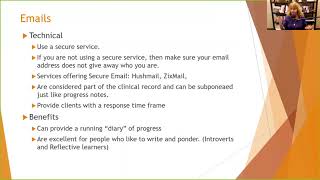
This episode was pre recorded as part of a live continuing education webinar on demand. CEUs are still available for this presentation through all CEUs register@allce.com counselortoolbox you. Hi everybody and welcome to today's presentation on clinical principles and treatment modalities for Etherapy. In this presentation, we're going to review the different modalities and most common usages of E therapy and counseling. We'll identify some potential clinical and ethical issues which are covered in other courses in the certification track, but we're going to kind of touch on them today and we'll learn at least three unique ideas for doing online counseling and talk about what treatment structure can look like how you might be able to integrate Etherapy into your practice. Even if you don't want to do it exclusively for this, it's going to be helpful if you review the online Handbook for Mental Health Professionals as well as go to the website www.netlingo.com in order to learn some of the Guess what? Net lingo it's going to be important that you know your little acronyms and stuff so when people are typing in shorthand, you're not looking at it going what in the world is this person talking about? Because that will slow down the conversation flow if you're constantly having to look up things. So what modalities are available? A lot of people think video and that's it. And that's all they think about when it comes to online counseling, electronic counseling. But there are a lot of different modalities that you can use. You can use emails, blogs, secure forms, forums, chat rooms, IMs and tweets, video chat, Second Life, and the good old telephone. And we're going to talk about each one of those and not each one of the or each one of these is not appropriate necessarily for counseling per se. Sometimes it's pushing out a positive message to people. So you can if you have a Twitter account, for example, you can tweet a positive message for the day, and your clients can choose to subscribe or follow your Twitter account if they want to. They don't have to, but that is one way of communicating and keeping things coming out, as well as touching multiple clients at the same time. So you can send out a morning message to every single one of your clients to remind them to do their daily mindfulness activity or whatever. So tweets, as I said, this is a great way to push out positive thoughts for the day. It's a great way to let clients know if you're going to be out sick and you know the office is going to be closed or it's going to be closed because of inclement weather or something. But you know, really think about ways you can use it to provide those little snippets, those little golden nuggets that clients can use each day. Either a positive quotation or a cheerleading statement or some sort of a reminder about something to do in order to improve their health and wellness. I've used this for morning focus meditations and evening roundup meditations. So I've sent out a tweet to all my followers saying don't forget to do your morning meditation or your evening one. And they have those meditations handy. And you know, I typically use fillable PDF forms for clients who are exclusively virtual. If you see a client say once a month or once every couple of weeks face to face, you may have them fill out the old fashioned paper kind and bring them in. It depends on your client and depends on you how you're going to do that. But that's a way to make sure that people are remembering to do their assignments. You're prompting them. It's not secure, as I said. So don't use any phi. Don't congratulate anybody and say, you know, way to go Sally Smith for graduating. No, that's a huge violation. But it is important. I mean, you can send out a message that says to all the people who are graduating from the depression management group this week, you know, I just want to say a great big thank you. No Phi is going out, but it is expressing congratulations and your appreciation for them participating. It's a good way to get the word out about your approach. If you tweet things. If you're a solution focused therapist, you may tweet solution focused questions or concepts from solution focused therapy. Or if you're a cognitive behavioral therapist, you may put out a tweet about a particular irrational thought or cognitive distortion and how to address it. I mean, 140 characters doesn't give you a lot, but in today's society, people are really looking for mini nuggets, something they can read and ponder while they're going to the bathroom or while they're walking from their car to the office. They're not looking for something that's going to take them 20 minutes to read. And remember. Tweets are not a therapy approach. You're not going to use it to interact with clients. You know, this is not where you're going to do your support. You're not Going to have clients tweet you about problems that they're having that would be completely inappropriate and a violation of hipaa among a whole bunch of other things. It's a method for you to get information. It's kind of a one way thing to get information out and then clients can respond if there's a response needed through a secure format such as, you know, sending you an email, a secure email or whatever if you're prompting them to do something. Emails, emails. Use a secure service. It's important to make sure that you're not using Google or Gmail or Yahoo or aol. You need to have a service in which the email provider has signed a business associate agreement. And that doesn't mean they said, yeah, we're HIPAA compliant, no problem here. Well, that's great. But HIPAA says and the HITECH act say unless they actually sign a business associate agreement with you, it doesn't count. They are not HIPAA compliant and neither are you. So you need to use a service that is HIPAA compliant. Even if you are using a secure service, make sure your email doesn't give away who you are. You don't want to have it at substance abuse counselor@doc snipes.com you know, that would just give away somebody's privacy to anybody who happened to be able to access their email. If for some reason you don't use a secure service, I can't think of any reason that you would want to do that. But again, you need to make sure that your email address doesn't give away who you are and do not use any patient identifying information in the email. So, you know, maybe you do educational seminars and you're sending out information about an educational seminar. That's one reason you may not use a secure service. Now if you're sending it out to people who are current clients of yours or past clients of yours, then Phi and HIPAA and all that other stuff still count. So you need to use secure email. If you're just sending out people who you've never interacted with before, then you don't need to worry about the security. If it's an announcement of an educational presentation or you know, a new group opening or something. You do need to be aware of spam laws in your local and jurisdiction and nationally. What has to go into an email in order to make it legal and compliant from so you don't get hit with violation of anti spam laws. Certain services do offer secure email. Hushmail, Zix Mail. What's the one that we Use. I can't think of the one that we used to use right now. But there are a lot of different services, Lux I, that's who we used to use, that offer secure email and they provide you a business associate agreement. Emails are considered part of the clinical record and can be subpoenaed just like progress notes. So it's really important that, number one, you keep the emails. Number two, you maintain the privacy confidentiality. Number three, you have a backup. So if your email server goes kaput, you still have that information somewhere because it's part of the clinical record and you want to store those emails in. I generally store them in the area with progress notes unless it's an activity. So you want to pay attention to where you're storing it, storing hard copies of the emails or copies of the emails in your electronic record. Because the standard for producing progress notes is a lot higher than the standard for producing intake information and other stuff that's in your chart. So you want to make sure that you know highly sensitive information. It takes a lot more to get it subpoenaed and provide clients with a response time frame. If you're going to use email or any method for that matter of electronic communication, let clients know that I will respond within 24 hours or I'll respond within two hours. The timeframe should be shorter for things like text. If you are supposed to be online and available for text messaging, then you need to let them know that you'll respond within 20 minutes or whatever your guidelines are. But that way the client doesn't get upset, start to feel abandoned, start to freak out. The benefits of emails are that they can provide a running diary of progress and are excellent for people who like to write and ponder, like introverts and reflective learners. And you can use emails in so many different ways. You can have people write it like a diary. You can have an unstructured diary where they just, you know, write. You can have a structured diary where they answer certain questions every single morning and every single evening. You can have them do certain activities and email them to you. So email is a way. Basically think of it as a method of getting information from a client. You can have them do a digital collage and email it to you. That's still an email. It's still something that they're sending to you via email. So email is a method of sending the information to you. So don't just get locked into. It has to be a conversation because there's so much more you can do with email. Also email them information if you find a booklet or you create a booklet on depression management or a worksheet that you want them to do, you can email that to them and they can either email it back to you or you can email it to them as a fillable PDF and then that will automatically email back to you. Many electronic health records will allow. They'll communicate with fillable PDFs, so when they email it back, it goes directly into their patient record. So that's something to consider. But it's really not that big of a deal to import an attachment into most other electronic health records. Drawbacks to email. You can miss a lot when you don't see the rate of responding. So if you don't see somebody increase their typing because they're getting really upset about something or because they're really happy, they're just typing like crazy. Or if you miss errors in typing or see an increase in errors because they're typing so fast because they're angry or excited, you're not going to necessarily pick up on that. You just see them typing and then not typing and then typing and then not typing. And sometimes that'll go on for a while and you'll. Well, I guess that's more with IMing. With email, you don't even get that. Email gives patients time to go back and edit, which may remove some of the underlying meanings. They start to edit themselves, they start to second guess themselves. Sometimes it can be awesome because they can start to learn to put a filter on some stuff. But sometimes you don't want them to filter stuff. So it's important to think, are they going to send me this or are they going to try to edit it to make it grammatically correct and everything, which can take some of the underlying meanings out. Obviously, email is not appropriate for patients in crisis because it's asynchronous. It is not happening with you at that point in time. You may choose if you've got a client who has been in crisis but is now stable, you may choose to have them email you morning check ins, you know, or something so you know how they're doing each day. You may choose to do that. But remember, if they're in crisis, they need, you know, obviously interaction right now formats. Like I said, you can use a diary that's sort of freeform or structured worksheet completion, such as CBT worksheets or relapse prevention worksheets. You can give them questions to ponder like the miracle question or what are 10 strengths that have helped you to survive until now. You know, whatever works for your client and activities to do, like digital collages. Or you can have them go and find three websites that provide information about whatever presenting issue they have or good nutrition for depression or something and encourage them to do that and then send them back to you so you know what they're reading, you know what they're seeing. Now blogs I mentioned. And again, this is not going to be a blog that's out there for everybody if it's something the client is writing. But if you're writing the blog, it can be a way to provide information to a group of people. You know, if you specialize in anger management or relationships, Google really likes content. So if you're putting good content on your blog, more people are going to find is not secure or HIPAA compliant unless you make it that way. So if you're just communicating one way, putting information out there and then saying, you know, if this sounds like it's you, contact me and here's my phone number or something, that's one thing. If you are wanting to interact with the patient, it has to be secure. It's an excellent activity to inform patients about conditions, you know, depression, postpartum depression, ptsd, new treatments and new programs you may be offering. Because blogs get crawled by the bots like Google and Yahoo and Bing more often than a static HTML page, blogs can be an excellent opportunity for patients who have something to say to the world. Now, this isn't where they're going to be spilling their phi, but if they want to raise awareness about breast cancer or domestic violence or date rape or whatever it is, if they want to start their own advocacy campaign, this is one way they can feel empowered to start getting their message out there to the world. Secure blog formats now, if you're going to have a client do a blog for you where there's going to be personal information, you're going to have to have it behind firewalls and secured and all kinds of stuff that your tech staff is going to have to get involved in. So let's just say that ahead of time. But it can be really wonderful. Clients can do a video blog or a vlog, which can be used for daily check inside. Excellent for addictions, eating disorders, major depression, generalized anxiety. Because they're doing a blog, they're saying, hey, this is me, this is how I am. You know, you get to see them, to see how they're doing, get an idea of whether they've bathed, all that kind of stuff. And they get to talk. You know, they don't have to sit there and think about what they're typing. Many youth really prefer a vlog format as opposed to a printed format, you know, text of some sort, because they're so comfortable talking, you know, on FaceTime or whatever. It's not a big deal for them to do it. So they have to have a little bit of technology savvy here in order to record it and upload it to a secure server that you manage. But it's possible. You can have them do a blog with pictures. You know, some people aren't into the words thing, but you can have them find pictures or memes that can be used as a means of creative and therapeutic expression. If there's a particular theme like courage that you want them to focus on, have them find 10 pictures that symbolize courage to them and maybe talk about a sentence, why each one represents courage. It can also be created like an online scrapbook with pages for what means the most to me, my goals, my accomplishments, and about me. And this works really well with teens, but it really works well with just about anybody to help them kind of organize in their mind what's important, what gives me a rich and meaningful life, and what direction am I going. And a text blog, you know, obviously one that's just using words, can be used as a running diary. It can be used as an opportunity for people to tell their story if they want to. But again, this is just between you and the client. And it's behind your personal secure firewalls. And in order to make it HIPAA compliant, nobody else has access. You have to have password protection on it and everything. Again, that's in the HIPAA class. But just be aware that there, the opportunity for what you can do with digital communication is pretty much limitless. You just have to have a really good IT guy who can make sure everything is encrypted. If you do do blogs and have clients submitting blogs to you, they must be regularly checked. You don't want to have somebody putting in entries for 10 days and then finally get to it. You need to make sure that you're going to check that blog, preferably every single day. If they're doing daily entries, you need to do daily reviews, and you need to set rules for appropriate use of the blogs. This is not to be used. When you're in crisis. This is not to be used. There are certain passive aggressive, threatening behaviors that they may do to get attention or whatever. There need to be very clear guidelines about what's acceptable in a blog, and if they Violate that, what's going to happen, which, you know, you quit using that as a modality. Certain behaviors that are persistent, the person may end up not being appropriate for etherapy and counseling. So it's important to set those ground rules ahead of time. Forums now, these are kind of going by the wayside, but some places still use them and they can be really helpful. They're a good place for people to ask questions to a group and let the group provide answers. So forums are asynchronous. You post a question and then you come back a little while later and see what responses there are. And they must be moderated. You know, you can't just turn a forum loose and go, you know, good luck. You can have public forums on your website for people to communicate about depression or anxiety or, you know, supporting a teen who is struggling with being bullied or whatever. Make sure it's moderated. And obviously if the people in that public forum are not your clients, you know, those are just the general public. JOHN Q. Public if you want to have a forum for your clients, obviously it still needs to be secure, encrypted, behind a wall, yada yada. But it is a place where clients can provide support to one another. Moderation needs to occur, preferably three or four times a day with forums, if it's an open forum, just to make sure that nobody has expressed any suicidal ideation or become antagonistic or flaming or anything like that. Appropriate forum behavior must be communicated and maintained, and there has to be a sense of safety, just like there is in group therapy, that if some somebody habitually violates those rules, they won't be able to participate. With forums, group members can all see each other's responses and comment or learn from one another. So this is a great place not only to learn about depression management, for example, but also to learn about communication and basically playing nice in the sandbox. How do you say things? How do you interpret things? Because things online get interpreted, misinterpreted even more often than things in real life. So, you know, helping people learn how to navigate and survive and communicate effectively within the digital world is another benefit of forums and chat rooms, which we'll get to more than some other modalities. It's imperative to be clear about appropriate behavior in the forums. If you don't have something nice or constructive to say, don't say anything at all. And you know, this is not a place for borderline behavior. Obviously we're not going to say exactly that. You're going to spell it out A little bit more. This is not the place for, you know, getting angry and lashing out at people. If you've got an issue with something, they say, how do you handle it? So there are going to need to be ground rules. You can use secure forms and worksheets in order to get information quickly, such as intakes. 80% of the intake forms that I do, the client needs to fill out anyway. Or the client could fill out, you know, their name, their date of birth, where they grew up, yada, yada, yada, and they can do it in the comfort of their own home. Even if you are seeing them face to face. They can complete secure forms from the comfort of their own home, have it submitted when they hit enter. It gets submitted to your electronic health record, and then you can spend more time in your face to face session actually talking to them about clinical stuff. Oh my, what would happen? You can also do, if you're working in an agency, you can do your orientation online and they complete a little form at the end that confirms that they've completed orientation. And, you know, informed consent to a certain extent can be done online. If you are. If you only do one particular type of therapy, you can also get the client's. We can review and worksheet information, you know, any kind of information you want to get from the client. You could get it through email, but you could also create secure forms and have them fill those out and submit it to you. It looks more gee whiz. Clinically, it really doesn't matter. It can be used as an adjunct to therapy for people who like using workbooks. So some people really like those. Fill in the blank workbooks. Okay, well, let's do it. Give it to them. Let's let them have a workbook kind of format so they can fill it in. Yes, it takes time to develop on the front end, but once you get that worksheet developed, you've got it. Henceforth and forevermore, if you decide not to use the fillable forms, you can make the worksheet and save it as a Word document and then they can open it as a Word document and fill it out. Or you can make the worksheet and save it as a PDF. They print it out, they fill it out, they scan it in and send it back to you. Most people prefer the Word option because a lot of people don't even have scanners anymore. But you know, there are options for doing that. Instant messaging is a mainstream communication method for the younger generation. It can be done using mobile devices. But again, you have to make sure whatever app you're using is secure, encrypted, HIPAA compliant and you have a business associate agreement signed with that app developer. It can provide real time text based interaction or it can be kind of asynchronous. I mean, once you start IMing with somebody, ostensibly you're going to continue IMing with them for 15, 20 minutes or maybe longer, but the first time they send you a message, you may not get it for 15 or 20 minutes or something. So it's not one of those things that you want to encourage people to use if they're in a crisis, but it is something you can use if you have a standing 2 o' clock appointment or whatever. There are a lot of ways you can use IM if you have a secure encrypted HIPAA compliant method of doing so. Non verbals that you can see in emails as well as instant messages, the color, font and size of text. You know, if somebody bolds something and makes it red, you're going to get a different feeling from it than if they have it, you know, normal and black. Or if they make it italicized and bold, that communicates that something's important. The emojis, they use any GIFs that they may include any. And again, the speed of response and error rate. Like I alluded to before, you know, with a lot of IM programs, you can see when somebody's typing and you may see them typing and then it goes away and they type and it goes away and they type and it goes away and you figure you're getting a dissertation and then they send you something and it's like four letter, four words and you're like, okay, what was it that you didn't send me? So just like with email, people have the opportunity to edit what they're saying. This can take some of the spontaneity out of it if you want to. You know, think Freud. You don't get the Freudian slips because they have the ability to edit those out. But you know, you can get some information. You need to set boundaries with text messaging though. You don't want somebody text messaging you throughout the day, you don't want somebody text messaging you at 11 o' clock at night. You don't want somebody text messaging you for whatever reason. You know, there has to be clear boundaries and rules about when do you use text messaging, what's appropriate for text messaging. If you're in a crisis, what do you do instead of text messaging? And as I said earlier, it's important to Know the lingo. You need to know all of the, not all of them, but the majority of the acronyms that the people that you work with typically use. My mom for example, uses far less acronyms than I do and I use far less than my daughter does. So you know, if I'm working with a teenager, I'm going to have to brush up on, you know, what I'm using. Video chat is the next best thing to face to face. It can connect patients and clinicians at a distance. Now it is vital to know most states have now jumped on the bandwagon and said you must be licensed in the state in which you practice, in which you reside. Okay, you know that's a no brainer, we know that. And, and you must be licensed in the state in which the client resides. So if you are work, living in Tennessee like I do and working with somebody in Florida, you need to be licensed in both states. If you're not, you're technically in some states they've already put laws on the books that have made it a misdemeanor. In other states it's just an ethical violation. But you do need to be aware of that. You must complete video chat on a secure connection from a provider who's provided you a signed business associate agreement. Have I said that enough? It's important. That's why I keep saying it because I still on a daily basis run into clinicians who say I'm using this service that's secure. Well that's great. Is it HIPAA compliant and do you have business associate agreement? What's that? Okay, no, that doesn't work. You have to have a signed business associate agreement provided the Internet connection is adequate. Video chat provides really good non verbals and that is a big if. There are still places I still have dial up out at the farm you so the lag time and people who use cable or not cable but satellite Internet services have a really bad lag time. So the time between they say something and you get the information, there's going to be a lot of lag and there may be lag between what you hear and what you see. So the verbals and non verbals may be out of sync. So it's really important if you're going to do video chat to recognize the limitations that you may be experiencing experiencing. And it may not be appropriate to do video chat if the limitations are too great. Drawbacks to video chat, you have to have a backup plan for Internet issues. If your Internet goes down, if there's a bad storm if for some reason your upload and download speed are crap and you're not going to be able to do a video chat, how do you handle that? How do you notify the person that your Internet going to be down? I mean if the Internet's down, you're not going to be able to send an im, you're not going to be able to send an email likely, unless you can get to somewhere where they've got public WI fi or something and you can send an email from your mobile phone or whatever the case may be. You have to have a backup plan for software issues. Every once in a while they'll put push out a software update that is going to make the software go kerplunk. And it could be a software update for your video chat software or it could be something like a Microsoft update that doesn't play nice with that particular piece of software and you can't get it to start. Well, that's another crucial thing. So how do you notify the client and how do you handle it if you can't do a video chat? Do you reschedule? Do you call on the phone? I generally have backup, good old fashioned telephone. If I can't use my cell phone, I have a landline. So I've got three levels that a backup I can work with. If there are firewall issues, maybe the person wants to call you and have a session and they're at work and there's a firewall and you can't get through the video through the firewall. Well obviously they're probably not going to go to their IT department and go, hey, I need the firewall unblocked so I can do counseling on my, on my lunch hour. But you can also have firewall issues where you are at. So if you're working at an agency or even in private practice and you have a group that you're working with and they have firewalls set up to protect client data. You may need to have your IT person unblock a certain port so you can get video out and do video chat and power issues. You know, occasionally the power goes out. Most places that we work we have redundant backups on the power. But every once in a while something happens and it may not always be on your end. It could be on your client's end. If their Internet goes down, if they start having software issues, if their computer blows up or the cat pees on their laptop or the power goes out, how are they going to handle it so they can still connect with you because you don't want them to stand you up. You don't want to have a no show and you don't want to fail to provide services for them. So they need to know if I can't do it this way, what backup can I use in order to make sure that I can be present for my session. Second Life has kind of disappeared, but it's still worth mentioning because I hear it occasionally. It's appealing due to the ability for people to use avatars. It does not meet HIPAA security standards in any way, shape or form. It has had incidents of being hacked and losing user data and does not provide subtle non verbals. You know, you have this little avatar moving around. It also can reinforce a fantasy Persona in those with an unfavorable or unstable self esteem. So there are a lot of reasons that Second Life feels pretty icky in terms of using it for counseling now if you are going to use it. You know, I've heard of clients or clinicians who've tried to use it in order to help somebody deal with social anxiety and learn to improve their communication skills. Well, that's all well and good, but again, it is not secure. So it's important, you know, if you can get something like Second Life and install it on your own server so people can interact that way, that would be a HIPAA compliant way of doing it. And phone. Most people are comfortable talking on the phone to a certain extent. I really hate it, but if I've got to do it, it's not intimidating at all. It requires a high amount of concentration on the therapist's part to stay focused and listen to what the person is saying. We tend to be as clinicians, we tend to be very visual and look at those non verbals and interpret things. So stay, staying present with the client on the phone for an extended period can be challenging. You can use cell phones and landlines, cell phones. You know, this is one of those exceptions where you don't necessarily need to have a business associate agreement. Data is minimally available when it hits the cell towers and it has a very low risk of being hacked or breached. So somebody tapping into your cell phone conversation is no more likely than somebody tapping into your landline conversation. So one thing we didn't talk about was chat rooms. And chat rooms are a synchronous way of communicating. You can either have video chat or just text chat, but it is a way to have people get together in a group and discuss things that are going on. One of the ways I use it, I do a psycho Educational online chat group group session. The first 15 minutes of psychoeducation, the last 45 minutes is chat. You know, it's time for people to apply what they've learned, ask questions, talk about what's going on. Chat rooms can also be less formal and it can be more like a support group. When people get together every night at 7 o', clock, they know they can log in and talk with some of their peers. But it is synchronous, which means it happens at the same time. It needs to be moderated. So a therapist needs to be in there. Especially if you're calling it any kind of counseling. But if it's something that you are sponsoring, promoting, you know, anything like that, just for ethical reasons, to make sure nothing bad happens, you want to make sure that there's a licensed person in there. Just having an open chat room for your clients to randomly attend that's not monitored is not safe for so many different reasons. So chat rooms can be great, they can be a great source of support if you've got that kind of time. And obviously you can bill clients for that. If you want to bill it as like a support group or aftercare where they pay a weekly or a monthly fee in order to be able to access this chat moderated chat room each night at 7pm Eastern Standard Time or something, you know, you can do something like that. You just need to be creative. Think about what you would like to do in a face to face setting. It can be translated to digital. It's just you have to be a little creative. When you're working with electronic counseling, you need to above all do no harm. So you want to evaluate clients appropriateness before launching into it. Not every client is going to be appropriate. Clients who are in crisis, clients who have borderline tendencies, you know, are likely not going to be appropriate. Clients with low cognitive functioning are likely not going to be appropriate. So you know, you want to pay attention to that. If they're not comfortable with computer technologies, if you're working with somebody who's older, who has difficulty checking their email, they're not going to be as comfortable and it may not be an appropriate medium for them. You want to make sure to develop a safety plan at the outset because whether they live 20 miles away or 200 miles away, but in the same state, of course you aren't going to be able to attend to a crisis like you would if they're sitting in your office. So what is the safety plan? If they live 200 miles away and you want to make sure that they have a face to face therapist there that they can go to or they're aware of the crisis counseling services that are available in their area so they can actually connect with a tangible counselor in the event of a crisis and be aware of appropriate referrals in each person's area. You know, you know the referral sources in your little neck of the woods. But what about, you know, I live close to Nashville, so if I were working with somebody over in Knoxville, I would need to know what resources are available for them over in Knoxville and develop relationships with those providers. So when I make referrals, we already have a standing relationship and it's a warm referral and it goes all smooth and hunky dory. Pay attention to netiquette and master the lingo. So some more things on above all, do no harm. Evaluate the appropriateness. Can you and the patient type? My old boss was brilliant, but he still thumb typed. Even on the computer he would still single finger hunt and peck type. That's not an efficient method of doing interactive synchronous text chat or something. And if the patient can't type or you can't type, it may be a frustrating endeavor and not cost effective. Even if you're doing email communications, you can look into video or phone counseling. If you still want to look for an electronic means of providing services, figure out if the condition is appropriate for that level of treatment. Depression, substance abuse, eating disorders, anxiety, ocd, agoraphobia, all of these have been treated using electronic counseling. And if you go to SAMHSA tip 60, which is, which we'll talk about a little bit later, you can learn about all the different ways that electronic counseling has been used and been used with these particular issues. So it's not necessarily as much about what the issue is, but the severity of the impairment the person is experiencing if they are, you know, in jeopardy. If they are in crisis, online counseling, etherapy may not be appropriate. Develop a safety plan like we talked about. Identify and make appropriate referrals. Ensure confidentiality and privacy of their protected health information. Make sure that your computer has a fully encrypted hard drive, not just the folder that their stuff goes into, because there are all kinds of other folders that stuff gets stored in. The whole hard drive needs to be fully encrypted. You have to have a password. Obviously if it's encrypted, you're going to anyway in order to log into your computer, a password that nobody else has so you know that you're not sharing a computer with your kids and they can log in and see your client's information. Ensure your communications are encrypted in transit point to point as well as on your computer. So once you hit send whatever hubs it stops at on the way to your client, is it encrypted point to point or does it become unencrypted and can it get intercepted? If it can, then it is not HIPAA compliant. Little bit on Netiquette in general, all caps means you're yelling and overuse of exclamation points also means you're yelling and being very aggressive. So don't use either one of those. You know it's very aggressive and off putting. Try to use italics, different colors, fonts and font weights to emphasize ideas. You can see the difference in these two sentences. This is awful exclamation point I'm totally over it versus this is awful. And awful is in all red, italicized, underlined I am totally in all caps over it. That communicates, you know, more feeling to it, but it doesn't cross the line into being completely aggressive. It's more of a sense of the person is exasperated. Paraphrase what you're hearing, just like you do in counseling and check your understanding before you get offended. You know, somebody may say something and without the benefit of the non verbals or knowing what they were thinking, knowing what they meant, you may misinterpret it. So check it out with them before you get offended or before you start freaking out that they're suicidal or whatever you want to check in with them. You know, what do you mean by that? If you're communicating via email, return emails in a timely fashion no later than 24 hours. So if somebody emails you, you will respond within 24 hours and add responses within the person's email to you. So, you know, just like when I was a professor, I used to go through and make comments on people's papers. You know, if clients are asking questions or if they're sending me something, I'm going to make comments sort of in the margins. I usually use a different color font so they can tell what I've added when I respond to them. That way they're not having to look back and forth from my comments to what they said. You know, it makes it a lot easier when you're in chat rooms. You know, the live interaction, no lurking. Which means don't just sit there and not ever say anything that's creepy. Say hello when you come into the chat room and say goodbye when you leave so people know that you're coming and going. If you are co facilitating, you may leave before your co facilitator. That's okay. When you are closing down after a chat session, you know, make sure you say goodbye to everybody. If you step away, say be right back as appropriate. Don't walk away for extended periods of time. But if you're supposed to be in there moderating and you have to walk away to go to the bathroom or answer the phone or whatever it is, that's cool. But let people know that you're walking away. That way they don't ask you a question and then you don't respond. Or somebody says something inappropriate and you don't respond and they start feeling unsafe in the chat room. If you use private messaging for side conversations, you know, make sure you have a, that clients have a way to block those. So if somebody starts harassing them, they can block them and report them to you. If you want to have a side conversation with a client who is in that chat room and you want to use private messaging, you know, that's okay. So you're going to have to set rules about who can use private messaging, what it's to be used for, etc. You know, sometimes in a chat room, you may need to basically pull the client aside, have a little private message session with them, and go, you know what, you're seeming kind of aggressive today. You want to clue me into what's going on. And in order to modify the behavior without having to ban them or do something like that, which would make them feel really bad, you know, it'd be like akin to kicking them out of group. You know, you probably don't want to do that. You want to figure out what's going on with them. And as I said, ensure the rooms are moderated. It's great if you've got a busy chat room to have two moderators. That way, if one has to go on a side conversation with somebody, the other person can continue to moderate the group. If you're IMing, never have multiple private chats going at the same time. Just don't do it too easily. You can say the wrong thing to the wrong person. You can miss things because you're trying to concentrate on two or three different conversations. It is clinically inappropriate and ethically inappropriate. Respond quickly. If somebody IMs you, you know, don't say, okay, I'll get, get to it and get to it in 20 minutes. If they Im you, you know, respond to them. If you're in a conversation with Them, you know, respond to them. It drives me crazy when I'm in the middle of a conversation with somebody and I ask them a question and then I don't hear from them for like an hour. I'm like, where did you go? We were like in the middle of talking. If you have to step away from a chat for some reason, tell the client that you're going to be right back or you need to leave for some reason. Don't just drop out and go, you know, they won't even notice. I'll go eat dinner and I'll come back and whatever. That's not okay. And from the video standpoint, Netiquette says, and ethics say, ensure you have a signed business associate agreement with the provider and conduct therapy in a private room. Don't conduct video chat therapy with your clients in the middle of your living room when your kids are walking around behind you. Remove distractions. Don't have your dog coming in and jumping on you or whatever. You know, treat it as if it were a therapy session and the person was like sitting there with you. Give them every respect and element of privacy you would if they were sitting right there with you. And, you know, make sure that your family members know you're doing counseling right now. So don't just poke your head into my room. Lock the door if you can. Treatment structure With Etherapy, you can use email, instant messaging, phone or video only. That can be your sole means of communication with the client. Now remember, when you're getting releases of information informed consent, you can use certain signature services that, you know, like I use with my Realtor when we bought our house and stuff. It is possible to do that. But for releases of information, it is best to have an original signature, an actual signature. So the person needs to snail mail you the release of information. You can use email, im, phone or video. You know, electronic means in addition to weekly or monthly face to face sessions. So you're connecting on a regular basis, but once a month, for example, you're meeting face to face. Or maybe it's somebody like DBT emphasizes ongoing coaching throughout the week. Maybe it's somebody who needs a higher level of care. So you're communicating electronically throughout the week and you have one weekly face to face session. You can also communicate via email, IM or phone most of the time and then have a weekly or monthly video chat. So there are a lot of different permutations you can do. Which one do you choose? Well, you want to look at cost both for you and for the client because some of the cost is going to get passed on to the client. If you have to have this involved provider video setup or whatever. And quite honestly, you can do it pretty inexpensively through some of the providers that are out there. Just ask ahead of time. Before you sign any contracts for payment, make sure that they will provide you a signed business associate agreement. Look for time effectiveness. How often can the person get to your office? If they live 30 miles away, they may not want to haul their butt to your office every single week. So they may prefer three out of every four weeks you do video chat and once they a month you do face to face. Ask for patient preference. Some patients would prefer to do to use one modality over another. And then, you know again, for acute issues like crisis, medication changes or impending triggers, you may need to, in addition to seeing them through your normal, you know, once a week sessions, you may also want to communicate them with them via email once a day so you can check in with them, see if there are any side effects or whatever's going on. Or you may choose to say, no, I don't feel comfortable doing electronic communication right now. You really need to come in so I can lay eyes on you and see how things are going. That's going to be an ethical decision that you make with each individual client. There's no hard set in stone formula. Part of it is because it's how you use electronic communication. Is it an adjunct, a supplement, something to provide a little bit extra between sessions, or is it the session itself? Neat techniques and tricks. Have people review their emails for chat logs or chat logs for patterns or improvements. So if you've been chatting with them on a, you know, on an IM app, have them go back and review that and review like the past conversations for the past three or four sessions to see if there are any patterns in what they're talking about. Use information documented in email or chat logs as evidence when confronting a client. Now, I'm not huge on confronting clients. I generally do something like, you know, you're telling me that you want to stop smoking, yet, you know, you keep buying cigarettes or you haven't filled your prescription for your nicotine replacement patch for a month. You know, I'll use that evidence that I've gotten. You know, I can go back and look and I can go, you know, what is telling me that this person is not ready to make a change and I will just present it matter of factly. You know, what you're saying and what you're doing. I'm confused. You can have Clients do a video tribute to someone who's passed away or to a relationship that's ended or whatever. Have someone do a blog or email in the words of someone that they've lost. So what would mom have said about this? Or have them write a letter to mom. You can have them tweet commitments or statuses. Now this is obviously not HIPAA compliant, but if they want to make their commitment to something public, you know, to elicit social support, they may say, you know, I am going to start training for a marathon, you know, great, so they can start getting social support. Obviously we don't want them tweeting private information because you know, it's going out to the blogosphere. Have clients research things like three famous people who've encountered similar situations. Have them research information about depression, temperament, cognitive behavioral therapy, you know, anything that applies to their treatment plan. It's on the Internet. So have them research it and find information about it. Now encourage them to stay off of diagnostic websites because they can like really freak themselves out. But you also may give them certain websites to go to so they're not randomly coming upon some website that's going to cause them to think that they've got, you know, brain cancer or something. Have them Google resources for coping with whatever the issue is with the loss of a parent, with moving mom into a retirement home. Have them do research on how nutrition and or exercise can help them. They can learn different hobbies. I taught myself to crochet through YouTube. They can find local clubs and social groups and meetups online. So if you want to help them expand their social support network and the list just goes on, you know, have them empower them to find out what resources are available. Empower them to use the Internet for the knowledge that's there. You can use TIP 60 using technology based therapeutic tools in behavioral Health services. It's a free publication by samhsa. You just go to samhsa, the Substance Abuse and Mental Health Services Administration. You can order the tip for free. You can also read it online. You can read it as a PDF. They have dozens more tips, tricks, tools, ways that things have been used, research that's been done on electronic therapy. So if you're interested in using this, I highly recommend reading it. It's not overly technical, so I won't say it's a fun read, but it's an interesting read. Online counseling and etherapy make it possible for patients to access services more easily with greater confidentiality because they're not seen walking into your office with experts who are not accessible in person. So, you know, sometimes there's an expert at the University of Tennessee and that my client might benefit from having access to, and they can access that person virtually, whereas driving to Knoxville from here wouldn't be practical. Remember that in most states, the therapist has to be licensed in the state in which he or she practices and the state in which the client resides. Etherapy electronic counseling appeals to the younger generation and those who are very visual. A lot of people who grew with mobile devices in their hands are much more comfortable typing something or interacting virtually. Just like any other new modality, Etherapy has its own techniques, language and netiquette, so it's important to know what those things are. And it will be important for Etherapists to stay in tune to the evolving regulations regarding online services because it's becoming tighter. There are more states that are requiring a special Etherapy certification in order to provide etherapy services in addition to being licensed or certified as a mental health professional. If you enjoy this podcast, please like and subscribe either in your podcast player or on YouTube. You can attend and participate in our live webinars with Dr. Snipes by subscribing@allceus.com Counselor Toolbox this episode has been brought to you in part by allce.com, providing 24. 7 multimedia continuing education and pre certification training to counselors, therapists and nurses since 2006. Use coupon code counselortoolbox to get a 20% discount off your order this month.










