Triggers and Cravings Counseling CEUs for LPC, LMHC, LCSW, Addictions and Substance Abuse Counselors
Dr. Dawn-Elise Snipes explains how drugs trigger 2 to 10 times normal dopamine release, causing the brain's reward system to downregulate over months or years. She covers the neurobiology of addiction, the four-phase addictive process, and how classical conditioning makes environmental cues trigger relapse. Cue-change and counterconditioning are presented as relapse prevention strategies.
Chapters
Hi and welcome to today's presentation on triggers and cravings brought to you by allce.com a leading provider in continuing education and pre certification training for counselors throughout the United States. So today, one of the things we're going to start talking about is changes in the brain and limbic system and prefrontal cortex and all that stuff. Stuff that most of us vaguely remember from physiological psychology, but we're going to break it down and only focus on a few little topics here. So the limbic system is basically our reward center. When we do something that aids in our survival, like eating or exercising or sex, the limbic system rewards us by releasing dopamine. So woo hoo, we got love dopamine. The other thing that happens, or when we use substances, it also releases dopamine, but this is an artificial release, which means the brain gets this substance in its system and is like, whoa. And it will release between 2 and 10 times the regular amount of dopamine released from a pleasurable activity. So you understand why in experiments with mice that when they press a lever, they get cocaine. They'll continue to press that lever till they die. They'll ignore food, sex, water, sleep, whatever, which is kind of sad. But it's important to realize that two to 10 times, that's a pretty wide ratio. So that helps us understand a little bit why some people can take it or leave it. And some people take it and they're like, whoa, I want some more of that. So the stronger or the more dopamine that's released, the stronger the reaction, the stronger the reinforcement. This gives the user a sense of a rush or a high or extreme pleasure. Prolonged use of a substance leads the brain to stop producing as much dopamine as it naturally does. Because you've, you're taking this substance and it's causing this flush of dopamine to go into your brain. And your brain's like, oh, there's plenty of dopamine, I don't need to produce as much. We find the same thing in people who abuse opiates. Not the limbic system thing, but when people take opiates, their brain quits producing the endorphins that help make the pain go away. Your natural numbing chemicals. So when people start coming down off of opiates, everything hurts. And it hurts like 10 times worse than it did for them before they started abusing opiates. The brain has to kick back into gear and go, oh, I'm not getting this anymore. We see this with a lot of different drugs so it's important to realize that if the brain gets used to having a certain amount artificially inserted into the body, it will compensate to maintain homeostasis. We've talked about that before, about maintaining balance. It knows it needs X amount of dopamine. So if it's getting dopamine dumped at a higher rate than normal because they take the medication or the drug and it causes a release of dopamine into the synapses and the brain goes, woo hoo. And the person goes, so anyway, see, that's my little reward center. We need to help the person understand that it takes time for the brain to go, oh, I need to make more. And kind of like most of us, when we haven't done something for a while, it kind of sits there and scratches its head and goes, make dopamine, make dopamine. I remember how to do that. I did that about 20 years ago. Takes a little while. And when I say a little while, 18 months, two years, depending on how much, how long, what drug, etc. And the person's just natural reboundability, if you will, or resilience. So the limbic system, again to recap, is our reward center. When we take the drug, it causes the brain to release the dopamine into the synapses and the brain is able to use the dopamine. Okay, so what we need to remember is it takes a while for the brain to kick back into gear and start operating at full capacity once you stop using. The other part of the brain that we're going to talk about today, and these are the only two parts is the prefrontal cortex. And there is an excellent article, New Medications for Drug Addiction Hiding in Glutamagenic Neuroplasticity. I have a hard time saying that. It's on the Internet. The reference is right there on the slide. I would highly recommend reading it because it was an interesting read. Although you've got to take it sentence by sentence if you're not a neurochemist or neurobiologist. But it's a really awesome, awesome article. Anyway, the prefrontal cortex allows the individual to play, plan and execute goal directed behaviors as a function of changing internal needs. So this part of our brain says, all right, I'm going to think I'm hungry, so I should eat, I'm tired, so I should go to sleep. All these things that we make decisions about every day. We get a cue, we respond. A lot of that's happening in your prefrontal cortex. Imaging studies implicate disruption in multiple regions of the prefrontal cortex or, or PFC in persons with addictions. So we say, hmm, what does that mean? And there are four major sections of the prefrontal cortex. And we're not going to go into the different divisions right now. It's in the article. But each one of those sections is responsible for a little bit of a different part of this decision making. So disruption in these areas may lead to inflexible behavior when faced with conditioned q. So if you are offered a drink, you must drink. It's an inflexible behavior. You can't say, well, you know, that didn't work out so well for me the last time. Okay, this is what we're talking about when we talk about triggers and reconditioning. So we need to help the person understand that right now their brain is being kind of stubborn. We can work with that disruption in inhibitory control that results in impulsivity and impaired decision making. What does that mean? That means you don't have a filter. You see it, you want it, you do it. Instead of going, hmm, good orderly direction, let me think. Is this really the best choice for me right now? Instead your brain's going, I want it, I want it now. I want it, I want it, I want it, I want it, I want it. Reminds me of an episode of the Munsters that I watched one time when Herman Munster got really upset because he wanted something and he was jumping up and down and he fell all the way down into grandpa's lab. But I digress. And an impairment in internal awareness and error detection. Internal awareness. Pretty self explanatory. We know that most of our clients have an impairment in internal awareness. They can't tell if they're angry, hungry, sleepy, whatever the emotion is, they know, they feel, they don't feel right, or they feel like they want to drink. And feeling like you want to drink is not a feeling. That's a reaction to a feeling, an error detection. Error detection means I don't know what's going on. I think I'm hungry, so I'm going to eat now. If the person's hungry and they eat, then they're satiated and they stop. If the person wasn't hungry and they eat, then they're still not feeling so well, but they can't detect the error. So they're like, well, maybe I'll try something else, but I'm not sure what's going to work. And they don't learn from those errors. So we really need to help people stop, figure out what it is they need and want. Try to fulfill that need or want, if appropriate, and then evaluate at the end. Did that work? A lot of us do that kind of naturally. But people with impaired decision making and impairment in internal awareness and error detection, they don't. It's just a lot of. It's a jumble. It's very confusing. Stop, think, evaluate. As I was saying, a lot of times there are neuroplastic changes that are triggered by repeated drug use. There are actual changes in the brain that occur. Can they be undone? Some say yes, some say no. The cool thing is that our brains are able to learn workarounds. So if you fry one circuit, it can work around to another. You just have to really build that bridge and build that connection in your brain. Learning it over again is not something that you can learn in a group on Tuesday and have mastered by Wednesday. So you have to help your brain adjust. Kind of like learning to walk all over again. For people who've been in car accidents or had strokes. All right, moving on. So the American Society of Addiction Medicine defies addiction. And as a primary chronic neurobiologic disease, it's in the brain, it's in the biology. Factors influencing its development include genetics. So people may have a predisposition. Remember we said that the Reward is between 2 and 10 times the normal amount of dopamine excreted. Well, you know, people who have a genetic predisposition, they may tend to react more strongly. They may tend to get more of the eight times dopamine release. Important to be aware of. They also may have predispositions for anxiety, depression, and other comorbid factors that we often see with addiction. That people are trying to self medicate. Psychosocial factors, mood disorders, environments that are not conducive to healthy thinking or healthy living, supportive or unsupportive, significant others, and other environmental issues like living in a crack house, working at a bar, being surrounded by alcohol all the time. Engaging in activities with people where alcohol use is expected. I know when my daddy used to go play golf, they always stopped at what was called the 19th hole, which was a bar. At the end, the expectation was you were going to drink while you were playing golf and you were going to drink after the golf game. Either to forget how badly you played or to celebrate how good you played. So either way, you were going to drink. There are a lot of factors that go into it. You can have a genetic predisposition and not tap into it. If you have a genetic predisposition to be highly Reactive to cocaine and you never use cocaine. Well, problem solved. Psychosocial things. We can help people identify mood disorders. We can help people learn coping skills, communication skills, relationship skills. Learn how to develop healthy, sober, sane social support systems. Try saying that three times. There are a lot of things that we can do to mitigate people's risk factors, but it's important to know that it's not just one thing. And we really don't even know what combination, if there's any magic combination, actually causes addiction. But we know there's a lot of factors implicated. Addiction is also characterized by behaviors that include impaired control over drug use, using more than you intended, or using for a longer period of time than intended. Compulsive use. Even though you know it's going to cause you problems, you do it anyway. Continued use despite harm. You have diabetes. You know it's going to make your diabetes worse if you use, but you do it anyway. You drink. You know you've already got two DUIs, but you drive home anyway. Craving. Self explanatory. When you're craving, you're really thinking about that particular thing that you want. Whether it's gambling, craving, going and playing a hand and getting that win, or whether you're craving drugs or you're craving food or you're craving sex, there's a lot of things to crave. That craving motivates your thoughts and your behaviors in people with addictions. So the addictive process has four main phases. Introductory phase. Remember I said before, if you've got a genetic predisposition to cocaine, but you never use it, problem solved. In the introductory phase, you're hey, introduced to it. The maintenance phase, you're using more frequently and it's starting to cause some problems. Disenchantment. The problems intensify and disaster is what most of us call bottom. So let's look at those more in depth. One of the things that we need to understand in these different phases is conditioning. Certain things come to what we say, elicit certain behaviors. Where I went to college, the University of Florida, it was a joke that we commonly had that you would drink if the Gators won, celebrate the victory, you would drink if the Gators lost. You know, console each other, and you would drink if the Gators weren't playing, because what else was there to do? So not only were the people involved sort of setting the tone and saying, this is what we do. Join us. But it was also just one of those things. It was Saturday afternoon. It was when the Gators usually played. So what do we do on Saturday afternoons. It's not go to a gator game. It's drink. So understanding that certain things trigger certain behaviors. Think about a lemon, a really, really sour lemon. I love lemons. Love sour things. As you think about lemons, you'll probably notice that you'll start salivating, because that's what you do when you bite into something sour. Think about Pavlov's dog. He would hear a bell, and that bell would indicate to him that meat was coming. And he would see the meat, smell the meat, start salivating, and eat the meat. Eventually, he just had to hear the bell without the meat being present, and he'd start drooling. Conditioning, Classical conditioning involves things like drooling and respiration and heart rate that are not necessarily in your personal control. They're automatic behaviors. When people get excited, their eyes dilate. It's not something you can choose whether you're going to dilate or not your pupils. Classical conditioning says that things that cause these behaviors are conditioned that way. So if you see something that excites you, your pupils may dilate. And that's kind of a tell for some people. Respiration may go up when you get scared, fight or flight. The body says, ooh, I need more oxygen because I'm going to have to get the heck out of here. So your respiration and your heart rate go up. That's classical conditioning. Now, what it is that frightens you or makes you angry is up for debate, and we'll talk about generalization later. There are some things that we're naturally afraid of, but then there are other things, like spiders that some people are conditioned to be afraid of. And other people, like me, pick them up and they're like, oh, aren't you cute, you little spider? Whatever, I'm weird. Operant conditioning is focused on voluntary behaviors, like picking up that spider. I haven't had negative consequences. I happen to think that little buggers are cute, especially jumping spiders. So I'll pick them up and I'll look at them, and I'll move them outside if they happen to get in my house. That's a voluntary behavior. I'm like, oh, spider in the house. Need to move it out. Eating is another one that most of us can relate to. I have a huge bad habit when I walk into the house. I walk in, shut the door, put my bag down, put my keys in the drawer, walk into the kitchen and get something to eat. I didn't even bother to figure out if I was hungry or not. But it was a habit because all those cues lined up to say you're home. What do you normally do? As soon as you walk in the door, you eat. So we're just going to do that sort of mindlessly using drugs. Again, this is a voluntary behavior. You're choosing whether or not you're going to use and when. Certain things are in the environment that are normally associated with drug using. Hypodermic needles, pill bottles, alcohol, whatever the case may be, that cues your brain and it's like, oh, okay, I know what goes on here. When we see this, this is what we do. So part of relapse prevention is helping people change those cues or counter condition those cues. We're going to watch a little segment from the Big Bang Theory that talks about operant conditioning so you can kind of see how it works in, if you will, a positive light. Are you finished?
Well, thank you. How thoughtful. Would you like a chocolate?
Yeah, sure. Thanks. Oh, sorry, Sheldon, I almost sat in your spot. Did you?
I didn't know this.
Have a chocolate. Thank you.
You're here a lot now.
Oh, am I talking too much? I'm sorry. Zip. Thank you.
Chocolate?
Yes, please. Good night. Oh, hey, Kim. Yeah, you know what? Hold on. Let me take this in the hall. You'll never guess who they got to a place you look for.
Okay, I know what you're doing.
Really?
Yes.
You're using chocolates as positive reinforcement for what you consider correct behavior.
Very good. Chocolate.
Sheldon, you can't train my girlfriend like a lab rat.
Actually, it turns out I can.
Well, you shouldn't.
There's just no pleasing you, is there, Leonard? You weren't happy with my previous approach to dealing with her, so I decided to employ operant conditioning techniques, building on the works of Thorndike and B.F. skinner. Yet, by this time next week, I believe I can have her jumping out of a pool, balancing a beach ball on her nose.
No, this has to stop now.
I'm not suggesting we really make her jump out of a pool. I thought the bazinga was implied. I'm just tweaking her personality. Sanding off the rough edges, if you will.
No, you're not sanding Penny.
Are you saying that I am forbidden from applying a harmless, scientifically valid protocol that will make our lives better?
Yes, you're forbidden.
Bad Leonard. You know, using positive reinforcement techniques, I could train that behavior out of her in a week. No, if you let me use negative reinforcement, I can get done before we go to bed.
You're not squirting her in the face with water.
No, of Course not. We're talking very mild electric shocks, no tissue damage whatsoever for. Oh, come on. You can't tell me that you're not intrigued about the possibility of building a better girlfriend.
I'm not.
Penny's qualities, both good and bad, are what make her who she is.
You mean like that high pitched, irritating laugh?
Yes.
You wouldn't prefer a throaty chuckle?
You're not changing how, Pen?
No, that would be incongruous. I was going to lower the whole voice to a more pleasing register.
Sorry, guys. That girl is freaky.
Come again?
Freaky.
Freaky.
Yeah, freaky.
Have a chocolate.
Thank you.
Well, I'm going to make some warm milk and then turn in. I trust if you two are planning on engaging in amorous activities, you'll keep the decibel level to a minimum.
Of course.
Thank you.
You are so good.
Unbelievable.
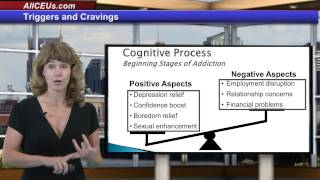
Okay, well, I hope you really enjoyed that segment. And we're going to move on. So, cognitive processes. We're talking about the beginning stages of addiction. And this particular graphic takes a minute to actually wrap your head around The. The positive aspects of use outweigh the negative aspects. Depression relief, confidence boost. Boredom relief. A sense of sexual enhancement. There are a lot of things that people would say, oh, that seems like not such a bad thing. Negative aspects, minor employment disruptions. Sometimes you can't go to work because your hangover is so bad. Relationship concerns. You may not be able to remember what you did with whom. Financial problems because you're spending too much on your addiction and not making work. So we've got the beginning stages. You can see that all the things are coming into play to make quite a storm. As we move into disenchantment, the positive aspects no longer outweigh the negative aspects. Addiction is social currency. If you want to be my friend, you're going to drink with me or use with me or bring the dope or whatever it is. Occasional euphoria. That same high, you're not getting it again. So you're chasing that initial high relief from lethargy. Yeah. You can potentially medicate yourself into not feeling so tired all the time. Does that mean that your body is not exhausted? No, it just means that you're faking it. Negative aspects are starting to outweigh these positive aspects. You may start having nosebleeds and infections. If you're using needles or snorting, you may be in financial jeopardy. You're using a whole lot more. I've worked with clients who've had 16, $1500, $2000 a week. Habits, relationship disruption, significant others generally don't take too well to that when you're spending more on drugs than you are on all the bills combined. Family distress. As this problem gets worse, not only are you having financial problems, but you're also starting to hide your use because you don't want anybody to take it away from you. So you're holding onto that and you're going, okay, I got this. She won't know if I just have a drink or if I just do a line here and there, which leads to secret keeping and lying and suspicion and all kinds of other problems which aren't conducive to a healthy family relationship and impending job loss. Because this addiction, whatever it is, has really taken front and center focus for you. You think about it when you're at work, you're either recovering from it. When you get to work, you're thinking about it while you're at work. You are trying to figure out how you're going to get your next fix, you're leaving work early to go get that fix you are using on the job. There's a lot of things that are going around because you don't care about anything else now, right now, that pleasure is what's keeping you going because nothing else is really giving you pleasure anymore. So stimuli or triggers and generalization. Engaging in a behavior that produces a dopamine release produces a reward. So you're likely to do it again. Let's say sex. You know, that's one that most people can understand. When that happens, you're like, okay, that's not so bad. Might do it again. Generalization occurs when a reminder for the behavior occurs in different settings. So maybe normally you're having sex at home in the bedroom, but you go to a party and people are all over each other. That triggers your brain to go, oh yeah, I remember that thing. Want to go there again. Generalization occurs. So you're like, oh, I like those parties. Then you start seeking out places aside from just home and in the bedroom. The very vanilla method that people are doing sex and having sex. And you start thinking about it all the time and thinking about where you could do it, where you could get away with it. So generalization has occurred. Pretty soon it's hard to go anywhere without going, hmm, I wonder. So the conditioning process has started. Now, let's talk about drugs. Initially, mild to moderate conditioning you use at parties. Friday nights when you have friends over, you use with friends if you've got extra money burning a hole in your pocket in intimate situations. Or if you're depressed, make that pain go away. Make that stress go away. Just avoid it for right now. Okay, so you've got some mild to moderate conditioning going on, saying if you use this drug, all of these things are going to be okay. And when you see those friends, what do you do? You use responses. When you go to parties, you think about the drugs or the alcohol. On a Friday night, you're getting off of work. What are you thinking about the drugs or the alcohol? When you're with certain friends, what are you thinking about the drugs or the alcohol? See where I'm going here? Okay, there's mild physiological arousal when you start thinking about those drugs or alcohol. Remember when I talked about earlier about thinking about a lemon and you would have a mild increase in your salivation? Or if you think about something that is frightening to you, you have a mild increase in your respiration and your heart rate. Same sort of thing here. There's that anticipatory, oh, goody, goody, goody, goody, goody. Eager anticipation of use. So that's more the thoughts that go along with the physiological arousal and the obsessing about the drug. So cravings start to approach and you have occasional use. Now, sometimes you can be like, oh, yeah, I'd like to have a drink, but I've got other things going on. You're still making decisions, you're still valuing other things in your life. Things are still okay as the cravings become stronger, as the conditioning becomes stronger. It's not just Friday nights anymore, is the whole weekend. Might as well. You don't have to go anywhere. Friends. More of your friends are involved in using. And you have stopped spending as much time with friends who don't use because you think you have a lot more fun when you're using. Stress. Stress is a new one. And a lot of the stress is caused because you're drinking, but you don't really see that yet. So stress is another reason you use. After a bad day, go to the bar, have a few drinks. Boredom, there's nothing else to do. Might as well. Anxiety. If you've lost your job, then unemployment, you don't have anything to do. You're bored, you're stressed out because your finances are going in the crapper. Might as well have a few drinks to take the edge off. And loneliness. Your best friend in the world, Jim Beam. That's the friend or whatever you want to say, the companion that you can always count on being there. So it sometimes makes people feel as if they're Less lonely, you start thinking about the drugs a whole lot more. Because the whole weekend, as opposed to just the weekdays, more friends are using, you're stressed out more often. You're really starting to think about drinking or this drug a whole lot more because things are starting to go on a downhill slide. And all those reasons that you used to begin with to relax, to feel better, to be around friends, they're all starting to intensify a lot more and revolve around drug use. So you're using a whole lot more frequently now. And now when you get to the overpowering cravings, any feeling makes you want to use, you're happy, you want to celebrate, you drink, you're sad, you want to cry in your beer, you cry in your beer, you're anxious, you want to take the edge off because you feel like you're going to crawl out of your skin. You have a drink. So any feeling, you figured out that if you drink, it takes the edge off and it's become associated with different things. When you're happy, you surround yourself with lots of other drunk, happy people, so it feels like you're happier. During the day, you're awake, you're feeling these negative feelings of stress and being overwhelmed and loneliness. So you want to drink. At night, you try to go to sleep, and all of your thoughts and all of your anxieties and all of everything else starts flooding your mind. So you want to have a drink. When you're unemployed, you're trying to find a job, maybe not trying to find a job, you're angry about getting let go from your job, there's a lot of resentment, There are a lot of negative feelings going on. So you want to drink. If you're not unemployed and you're at work, you may start to see work as an imposition because it's cutting out of the time that you can guess what drink. So you have some automatic use and obsessive thoughts about when you're going to drink, how you're going to drink, how you can sneak it in here, how much you can do without getting caught, what you can do here. So there's a lot of manipulation and minimizing and denial and blaming, and all those behaviors start coming out now. So let's talk about how our thinking changes. Remember how we talked about the different stimuli that would sort of say, hey, why don't you have a drink? Well, so we see our little stick man here, and he's got a lot going on for him. Or I guess she. She's got a Boyfriend, she plays sports, she's involved with her family, she likes cooking, going to work, exercising, she has her girlfriends. There are a lot of things that are going on that are really positive and interspersed in there. Occasionally she uses, But as she starts to use, she figures, oh, that's really good. So she starts limiting herself more to activities that she likes but where she can also use. And then pretty soon she doesn't even need the activity, she just wants to use. So as we talked about earlier, there are progressive phases of addiction. Introductory maintenance, disenchantment, and disaster. During this stage of recovery, you hit disaster, you hit bottom, you're like, okay, I can't do this anymore. Sick and tired of being sick and tired. Then you've got to start up the hill. And the Jellynic curve, you can Google it, it's awesome. We also have it in some of our other videos on theories of addiction will help you really chart out what that curve looks like for people. So the first one to two weeks is your most significant period of withdrawal. The body is used to having that chemical in it and when it doesn't get that chemical, it freaks out. So the first one to two weeks generally are unpleasant. In some cases, depending on how much you've used and what you've been using, it can be life threatening. So if you have a patient who is using alcohol or benzos especially, please make sure that they are in a detox facility so they can be monitored for physiological effects of the detox after that first one to two weeks. And anybody who's worked in residential facilities know that most of the time people don't stay in detox more than three or four days. So their first week or two in residential, they're still in a fog. There's a huge fog there. So a lot of what we want people to do is maintain their motivation, get up, get to group and, and try to start taking care of their basic needs for living, eating, sleeping, drinking, drinking water, that is, and getting kind of back into the rhythm of a healthy lifestyle. The honeymoon is the next four weeks, which for most people, if they're in residential, they may still be in their honeymoon phase when they discharge. Some people stay through their honeymoon phase regardless. The honeymoon phase is just that. That's what some people call the pink cloud. We're going to talk about that more in a minute. The wall is when it really gets tough. It's when that pink cloud goes away and you're like, oh crap, I really am not liking this right now. And readjustment is when those Coping skills and tools and new people, places and things are all starting to kick into place. Think about the last time you made a New Year's resolution. You're trying to change a behavior. It wasn't easy. It takes at least 28 days to change a simple habit. This is far more than a simple habit. This is not a habit. So you have people who are having to let their body recover, let their mind recover, repair their relationships, figure out kind of who they are and where they are because sometimes they don't remember. There's a lot of stuff going on. So don't expect people to get out of residential after four weeks and be fixed. Encourage them to understand that while it's great to feel happy and motivated about doing the next right thing and it's okay to experience the pink cloud, don't let the cloud come out from under you and fall to the earth at 1,000 miles an hour. So withdrawal lasts for one to two weeks. There's craving. Your body's going, hello, I need more of that because it doesn't produce it as much anymore. Depression, low energy, difficulty sleeping, increased appetite, or sometimes decreased appetite and difficulty concentrating, or some of your primary, primary depressive symptoms. Let's think about why that occurs. For most addicts, the body's exhausted, it's been running overtime, it hasn't had a chance to repair, it's been dealing with toxins, it's ready to take a break. And there's also a lot of other social stuff and emotional stuff going on in that person's life as a result of their choices that can really lead them to be angry, resentful, depressed, anxious, irritable. So expect it. If you don't see it, you may want to ask yourself what's going on with that person. Not necessarily that anything's wrong, but you do want to kind of do a check in. The honeymoon lasts about four weeks. Increased energy, enthusiasm, optimism. People think they're cured. I got this one kicked. Family members often view this as the beginning of a relapse. I've heard that before. This is the third time through rehab. You always get out, you always say it's going to be different and within a month you're back on the bottle. One of the things we have to work with family members is understanding that yes, that's true. In the past that has been the pattern. So we can either create a self fulfilling prophecy or we can figure out how to help Jim Bob choose a different path this time. And it often coincides with the discharge from residential, unfortunately and here's my little outtake on our mental health system right now. A lot of times people will go to detox, they'll go to residential because they needed residential, and then they'll discharge and only go to meetings. Now, 90 and 90 is good, but a lot of people don't make 90 and 90. They're doing pretty good to make nine and 90. So we really need to emphasize that people need to step down in their levels of care. Think about when you left home to go to college. You went from being under mom and dad's rules, having a curfew, doing this, that and the other, to a free for all. That's why a lot of freshmen flunk out the first year, because they can't handle that transition from complete structure to pretty much no structure. Discharge from residential is very much the same. In residential, we can sort of protect people in a little cocoon from life. They're not getting the overdue bill notices. They're not getting knocks on the door with warrants. They're not getting the boss that's always chewing on their butt. They're not getting those things. They're able to focus on them and then they get out and they have to focus on other people, other things. They have to deal with life on life's terms. And sometimes they kind of feel like a fish out of water. So step down from residential to IOP is certainly recommended. Maybe not for the full 90 days, but at least for a month. Get your land legs and then look at stepping down to less intensive treatment. The wall lasts about 12 to 16 weeks. Remember I said this is where it really gets tough because the energy is down now. The grind has worn you down. All those little stressors that happen every day have worn the person down. So they hit this wall and it's like, oh, I don't know if I can do this anymore. Depression, irritability, low energy, loss of enthusiasm. Again, the person is worn out and the body's going, hello, we need a break. So we need to help people when they start hitting that wall, figure out how to take care of of themselves in order to minimize drains on their energy and in order to maximize whatever happiness and pleasurable activities they can engage in that are healthy, they can be easily overwhelmed. These coping skills that they learned in treatment are great, but they're new at applying them. So really working on applying the coping skills, figuring out that whole step. One thing about training, trying to change the things we can and accept the things we cannot change, that's the one that kicks most People in the butt. Not the only one, but that's a biggie. The body and brain are still recovering from the effects of the substances. If you break your arm, it doesn't get better in two weeks, it takes several weeks. And to be fully mended and all that, it could take a couple of months. Well, why would you expect something you've done for 15 years would get better any faster? So there's a high risk of relapse. When people start getting worn down and getting frustrated, they start asking themselves, well, what's the point? I don't know that I can do this. They start questioning whether they can take it. The stress, the anxiety, the anger, whatever. Meetings are great at this point in time, lots of meetings, because other people can give them the sane, sober social support they need. So readjustment, you get through the wall and you're like, okay, I got this. It's not the pink cloud anymore, but I got this. Eight weeks or longer. This is when you're really formalizing those relationships with your new people. Places and things. The person in recovery and the family begin returning to a more normal lifestyle. Not everything revolves around John getting to his morning and evening meetings. After extended abstinence, the person in recovery and family members begin working on marital, emotional and psychological issues that will strengthen the family. Now let's talk about that for a second. You have to deal with some of the emotional issues in treatment because if you're self medicating, if you're hiding from the feelings, if you're trying to make the pain stop, then you're not going to stay sober unless you figure out how to deal with that. However you want to help the person get to a steady state. You don't want to start digging at these deep wounds in early recovery. Let them get their coping skills under control, figure out how to deal with life on life's terms. Then we can start dealing with the hard stuff. Relapse issues for people in recovery. People, those people that trigger you for some reason or another. Generally there are people we can't control, or people we feel judged by, or people who are angry or people who use or people who are just generally not healthy. Places. Wherever you used to use your old stomping grounds, there are other places that may trigger you. They may not necessarily be your stomping grounds, but places that if you go to, even before you hit that threshold, you're like, oh, I need a drink. Those are places you need to avoid for a while. Find other places to go, more neutral places. Things, things will trigger you, you see hypodermic needles. You see, one of my patients talked to me when we were in residential because we had the little packets of sugar. And every time he shake down a packet of sugar, it triggered him because it reminded him of shaking down a packet of cocaine. I'm like, oh. So we switched in the facility to the little things where you would pour it out. But that's a thing that we hadn't even thought of. And the facility had been running for two decades before I even came on board. Times. Morning, lunchtime, after work, Friday evening. There are a lot of times that people may habitually use. So you need to figure out what to do during those times so you're not thinking about using activities. This is a huge part of recovery, learning how to have fun, clean and sober. One of the biggest challenges for people who, you know, like I said, where I came from, watching gator football kind of equated with drinking. If you're watching gator football, your mind says, I'd like to have a beer or a drink or whatever. So you have to counter condition that and learn to have fun watching football without drinking. Feelings. If you drink when you're happy, you drink when you're sad, you drink when you're anxious, you drink when you're mad, then you need to learn to do something else. Otherwise you're not going to be able to feel feelings without wanting to use. So you need to find alternate, equally successful solutions to dealing with those feelings. Lack of self care. You're not sleeping, you're not socializing, you're not managing your stress. Those can all lead to issues of relapse, not taking medications as you're supposed to. And my favorite, control, alt, delete. Trying to control things that you cannot control. Angry, lonely and tired. All of those things will lead to deleting sobriety. In summary, addiction causes changes in the brain, in the reward center, as well as in your decision making areas. Using produces feelings of escape or euphoria which become associated with people, places and things, among other things. When exposed to those people, places or things, people may begin to have cravings. When faced with unpleasant emotions or situations, people may also have cravings. Recovery involves creating new associations and developing new ways to feel good and deal with stress. Thank you and have a wonderful afternoon.










