Understanding Children's Reactions After a Disaster
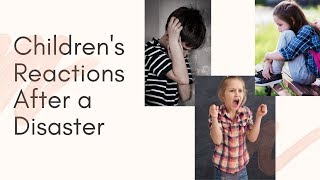
Dr. Dawn-Elise Snipes explains how children process disasters and what caregivers can do. Kids pick up anxiety from adults and media, so modeling calm matters. Validate their worries, keep routines steady, limit disaster coverage, and use brief daily check-ins to help them feel safe again.
Chapters
Hey there, everybody. And welcome back to this last video in the series on coping after a disaster. In this video, as promised, we're going to be talking about children's reactions after a disaster. I'm your host, Dr. Donnelly Snipes. Children learn from their parents responses as well as what they see and hear in the media. Depending on the age of the child, they may understand more or less of what they see or hear, but all children are going to understand pictures and all children are going to be sensitive to parental reactions or caregiver reactions. So if you are wound up, if you are distressed, if you feel like you are out of control, then children are going to pick up on that and they are going to feel like they, they need to be out of control. They're going to feel scared because you are their protectors. Does that mean you shouldn't feel anxious, angry, depressed, out of control? No. You know, you're going to feel how you feel. And remember, feelings are normal and natural. But it's important to do what you can to address those feelings instead of holding them and nurturing them. You know, you can really, you can feel anxious and then sit there and watch the news all day long and really nurture that anxiety. I have seen people do that with the stock market over the past week. Instead of seeing what it is at open and seeing what it is at close, they have it on their other screen all day long. And instead of feeling a little bit anxious for a minute when they're looking at what it's at, they're constantly on this roller coaster with the stock market building their anxiety and their what ifs all day long. We need to be able to set some boundaries with how much we perseverate on the negative. We need to model healthy coping skills for our kids. Is it healthy to sit there and perseverate and look, stare at the same destruction and chaos for hours on end? Is that going to solve anything? Probably not. I can't think of any situation where it would. But you know, I'm not going to say there's never a situation because I'm sure somebody would write a comment in the videos. But most of the time perseveration doesn't do anything but ramp up our threat response system and make us feel worse. Children have difficulty differentiating what happened 100 miles away versus something that's happening in their backyard. And I know this is on the news statewide, nationally. You know, this was a big stinking deal. And children that are seeing this in other places may not understand that this Happened in Nashville, which is 300 miles from where we are. Children may not understand, you know, what causes a tornado and the fact that there's not even rain in the forecast tonight. So you know what, you can go to bed and you can be, you know, pretty certain that there is not going to be another tornado tonight. As caregivers, we need to educate them and help them understand how they are safe, where they are and when they are. You know, in this moment, you are very safe. Tonight, when you go to sleep, you are very safe. And this is why children may be fearful of new situations. New situations are typically anxiety provoking for anybody, especially children when they are already anxious and stressed out. Adding something else onto that, it evokes a lot more fear and anxiety. They're saying in their own way, I can't take anymore. I'm having a hard enough time coping with life on life's terms. I can't take a new situation. That's just too much demand on me. Try not to put kids in new situations right now. If, for, you know, the worst happened and you were displaced and you're staying with relatives now or you're staying in a shelter, these are new situations. And it's going to be important to restore as much normalcy as possible to what's going on and talk with your children to make sure that they feel safe and they know what's going on and why it's happening and that it wasn't their fault. Even things like tornadoes, kids can think are their fault. If they had a mean thought, if they were mad at you and something bad happened, they may think that they brought that on, on to you, onto the family. Not saying that they do, but they may have that thought. So we want to ask them, what are your thoughts about the situation? What concerns you about the situation? With really little kids, it's. It's important to simply make sure, you know, like 2 years old, it's important to simply make sure that they feel safe and they feel nurtured. Going back to that consistency, we need to be consistent with them. Holding our rules like we always do. What was wrong yesterday is wrong to do today. What was right yesterday is right to do today. I loved you yesterday. I loved you today. Making sure that our messages remain consistent is really important. Checking in with them, not treating them totally different today than we did yesterday. Being responsive when they are anxious, when they are, as one of my best friends would say, decompensating, it's important to recognize that and be responsive to it. A lot of times when children start acting out, start acting confused, forgetting things, not acting the way they normally do, it is a sign that they are under distress for some reason. And it's important for us to be responsive to them, set boundaries, make sure they feel safe, and help them figure out how to solve the current situation. We need to be attentive to them. Sometimes they're not going to tell us what's going on. We need to understand that behavior is a form of communication. When children do something, we need to ask ourselves, what are they trying to tell us with their behavior? A lot of times children don't have the words to tell us exactly what they're feeling or thinking. That's just far beyond their scope. Remember their experiences. Their 2, 5, 7, 9 years on this earth pale in comparison to our 20, 30, 40 years on this earth. So they may not have any frame of reference for what is happening right now. They may not understand. They may not have the words to identify, you know, chaos. That's a weird word. So you may want to talk about what chaos is and help them understand that there are ways that they can control certain aspects of chaos. And there are things that they can do when they're feeling anxious to help themselves feel better, like tell you that they're feeling anxious or tell you that they're worried about something and you will be consistent to hear them and responsive to their needs. You won't tell them, oh, that's stupid, or, don't worry about that, honey, they're worried. So we need to hear their worries. And we need to help them understand if there isn't anything to be worried about. We need to help them understand why instead of just telling them, don't worry about it, and dismissing them, we need to validate how they're feeling and say, okay, let's take a look at this. They may fear separation from caregivers, friends or their pets at this point in time because, you know, something bad happened and other people got separated from things they cared about and they don't want that to happen to them. And they may not want to let their dog out of their sight. They may not want to let their parents out of their sight. We want to communicate with them clearly about their level of safety. And if we're dropping them off at school, for example, about how they're safe at school and that we will be back and work with them in understanding this situation, understanding that, you know, teachers, for example, are well aware that children are not going to be on their A game for the next couple of weeks. Probably even after they come back from spring break, which is normally, you know, a challenging time in the classroom. They may also have some anxieties that are still stemming from this disaster because a lot of children are going to have to finish out the school year in an entirely different school because their school was destroyed. Children may have fears of going back to school because they're worried that when they're at school there's going to be another tornado and the last one destroyed their school. So if it hits when they're at school, they may be killed. Kids are going to, may think like this. We need to understand what their anxieties are about going to school, what their anxieties are about separating from people or animals and help them notice when we go out that we come back, you know, maybe even keep a log. You know, you. We left and we went to the store for two hours and we came back and Fluffy was still home and fine and sleeping in her dog bed. Point out the contradictory information that helps them point out the information that helps them feel safer. When we are stressed, our brain is programmed to notice the negative and to notice the threat and ignore the positive because it's a whole lot more, it's a whole lot worse if we miss the big stuff. Kids, when they're in that stressed out frame of mind, are noticing the negative and they're missing the safe aspects of the environment. They're missing the things that are going well, they're missing the things that they do have control over. So it's important for us to help them balance the things that are not going well and validate that. Yeah, those exist right now, I get you. But balance those with the other things that are going right and any information that, any facts that don't support their fearful thoughts. Regressive behavior is common not only in kids, but in some adults, but definitely in kids. You may start seeing more baby talk, you may start seeing more thumb sucking, more whining, you know, things that you thought that they had outgrown 10 years ago. You may start seeing a little bit again. This is a communication that they feel vulnerable right now, that they are wanting structure, that they're wanting support. When they were young like that, you took care of them, you were much more in tune and, well, maybe not in tune, but you were much more involved in their day to day activities. You were probably making their meals and picking out their clothes and doing that kind of stuff. And now with all this stuff that's going on, with all this chaos, they may feel overwhelmed and may not feel like they have the energy to do those things. They may want to be taken care of again most of the time, if not all the time. They're not going to be able to articulate this. They don't even realize what they're doing. We as caregivers need to recognize recursive behavior as a way that children communicate. That may need a little bit more intense nurturance right now because they're feeling vulnerable. Speech difficulties sometimes happen when there is some sort of trauma. And if they don't go away in a few weeks, you want to consult your pediatrician, most of the time they will remit. Sometimes when people become stressed, they start to stutter more. They have more difficulty stringing together their words. And that's the result of again, of those brain chemicals that are flooding your brain when you're under a lot of stress. And that threat response system is activated. That keeps us from being quite as intellectual or cognitive, if you will, as you know, maybe we normally are. Children, just like adults, may have appetite changes. They may not be hungry. That threat response system has everything going on high speed. So they may not have an appetite, they may have diarrhea, they may have stomach cramps. That's not unexpected. We do, just like with adults, want to make sure that they are getting proper nutrition, to make sure their body has the building blocks to stay healthy and make the hormones and brain chemicals it needs to to support emotional and physical recovery. But don't be too critical, especially in the immediate aftermath of a disaster, about eating your brussels sprouts, because that just may not be in the cards right now. Irritability and aggression are common in children as well as adults. Children tend to have fewer coping skills and fewer skills for tolerating distress. So when they experience distress, they are more likely to be outwardly communicating that aggress. They're more likely to be verbally or physically aggressive. Get out of here. You know, get out of my room. Instead of using their words, we want to help them understand that that's not okay and develop alternate tools to put in place. If you go online, I have several videos on emotion regulation and distress tolerance skills. Our YouTube channel. Or you can just go online and search for distress tolerance skills. And there are a bunch of handouts that will come up that provide really easy to use mnemonic devices to help you remember different things that you can do when you're stressed and you can. I've created some infographics that are geared specifically towards children that can be printed out as posters and Hung in the dining room or in the classroom so kids can remember what other options they have besides acting out aggressively. There may be competition with siblings for attention during this period. What is this behavior? Communicating? This behavior is communicating. I need to know you still love me. I need to know you still notice me. I. I need to know that you will be responsive to me if I am having an emergency. And by being competitive with siblings, it is a survival mechanism. They want to be the ones that are in the lead group of the pride that is running from the hungry lion. We want to make sure that our caregivers are going to be there for for us. And sibling competition is one way that that happens. Another reason for competition with siblings for attention may also be to distract parents. Sometimes when caregivers are upset, certain children feel like if they act out, if they draw the attention to them, that the caregivers will quit fighting or the caregiver will quit being unhappy. You know, focus on me here, over here. Take a look at this. And one way to do that is competition with siblings in your particular family. You need to ask yourself, what is this behavior communicating? What is the benefit to my child doing this right now? What are they trying to get? And is there a better way that I can help them achieve that same goal? Just like adults, children may have night terrors. Since children have difficulty differentiating real from fantasy, especially young children. And they have difficulty differentiating what's happening now from what happened in the past after a disaster. Because of news coverage and all of the changes to their routine, it may feel like this threat is ongoing, which can keep them more on edge and can keep that threat response system ramped up, which will increase the chances that they're going to have nightmares. Helping children focus on take five minutes. Ten minutes is a long time for children. Take five minutes each day and just talk for that five minutes about the good things that happen that day. That's one way to help them turn their attention to the positive. Again, not saying that the negative didn't happen, but balancing the negative and helping them notice the positive to balance it out so they don't feel like it is such a unkind, uncaring, dangerous place out there. Five minutes each day. You can do it at dinner. Make sure dinner time at dinner. All we're going to talk about are the positive things that happened today. We can talk about the stressful things before dinner, after dinner, whatever, but during dinner, we're going to focus on the positives. That encourages them to focus on the positives. Notice the positives and encourages the brain to dump those calming chemicals in response to the messages that they're thinking about at that time. And finally, weather fears can be a big issue for kids after a natural disaster that involves weather. Next time there is a storm, next time there's a thunderstorm, they may for months now, especially if they experienced significant loss themselves, they may for months be terrified that it's going to happen again. So we may, as parents or caregivers, consistently have to have this discussion with them about, all right, we're going to have a storm tonight. Now remember, let's look at how bad this storm's going to be. Let's look at how safe you are. Let's go over our safety plan. If the kid wants to have a routine that you go through to ensure that the child feels safe and recognizes that this situation, this weather storm, is different than the one that happened that caused the tornado, make sure they recognize that what's happening now is not the same as what happened in that disaster. I hope this gave you some tips and tools to help you understand children's reactions and maybe start dealing with them a little bit. There is so much that we could go over to address any of these issues that I've talked about, but really, right now, most people are in a state of crisis and too much information is totally overwhelming. So I just wanted to give you some actionable nuggets that you could start using in order to begin the recovery and rebuilding process.










