Understanding Diagnosis Part 2 Happiness Isn't Brain Surgery Episode 30b
Dr. Dawn-Elise Snipes (Happiness Isn't Brain Surgery podcast) discusses eating disturbances as symptoms of anxiety and depression. She outlines primary causes — neurotransmitter imbalances (low serotonin, norepinephrine), hormonal signals (ghrelin, leptin), circadian/sleep disruption, nutrient deficiencies, thyroid dysfunction, and habit/self-soothing — and gives practical, mostly behavioral interventions (food diaries, "practice the pause," distraction lists, sleep hygiene including caffeine timing, hydration, plate/portion strategies, brief use of meal replacements, consult with doctors/nutritionists). The talk emphasizes reasonable, sustainable changes rather than perfection and references accompanying worksheets/handouts on Docsnipes.com.
Chapters
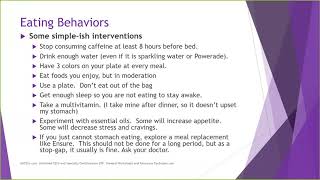
Welcome to Happiness isn't Brain Surgery with Doc Snipes. This podcast was created to provide you the information and tools Doc Snipes gives her clients so that you too can start living happier. Our website, Docsnipes.com has even more resources, videos and handouts, and even interactive sessions with Doc Snipes to help you apply what you learn. Go to Docsnipes.com to learn more. Today, we're going to continue talking about understanding symptoms of anxiety and depression. We'll identify the causes, function, and interventions for eating disturbances. Now, whether you're angry, anxious, or depressed, a lot of people look to food for comfort. But people also sometimes eat out of habit. And sometimes they eat because their body is out of whack. It's not sleeping when it's supposed to, or you're not getting quality sleep, so your eating and fullness hormones are out of whack. So we're going to look at some of those causes and what to do about them. So basically, we're talking about eating too much or loss of appetite. We're not talking about specific eating disorders. We're just talking about general, you know, I'm eating all the time, or I just can't seem to stomach anything, or I don't have the desire to get off the couch to make anything. This can be caused by an imbalance in the brain chemicals that help you feel motivated to eat, such as norepinephrine and serotonin, or like I said, some of those other hormones like ghrelin and leptin, getting out of whack. So your body doesn't know when it's hungry and when it's full. There are five primary causes of overeating your body needing the building blocks sometimes. And I know it's true for me if I haven't been getting enough water, for example, and that's not necessarily a building block, but it's a necessary thing to have. I will crave iceberg lettuce. I will crave salads. And it can be the middle of the winter and I will start craving salads. And that tells me that my body's indicating I need more water in my system because iceberg lettuce is like 90% water. So your body could need the building blocks. So you're having cravings for food that are designed to help you get the minerals or vitamins that you need. So that's an important thing to look at. You want to look at your nutrition, go over it with your doctor or a nutritionist to make sure you're eating a healthy diet, you could have low serotonin. And low serotonin can lead to feelings of high anxiety and in some people, depression. And sometimes when you have low serotonin and you're feeling that way, you eat for comfort. Think about American society. When do we eat? We eat when we're bored. We tend to eat to feel, to feel happy. We eat at celebrations, we eat at funerals, we eat at holidays. And a lot of times food is associated either with comfort or with happiness. So people will gravitate towards those. Additionally, when you eat high fat or high sugar or or both foods, your body naturally increases the levels of serotonin in your body. So your body may be saying, your serotonin is low, I need more. I'm going to make you eat some or make you crave some of these things. Which is again why I said in the last presentation that some people, especially those that are prone to anxiety and depression, may not do well on very low carbohydrate diets because that takes out the high sugar, ish kind of foods. And carbohydrates are a sugar, whether it's a complex carbohydrate, which is a complex sugar, or, you know, something like sucrose. And a lot of times you can meet that need with a complex carbohydrate. You don't. I'm not saying when you feel this way, go out and eat a candy bar and you're going to feel better. You May for about 30 minutes and then you're going to crash, probably. But it's important to recognize if you're craving these sorts of foods, you may want to look and see how your mood is doing and whether you might be embarking on a depressive episode. It can also be because your circadian rhythms are out of whack. Like I said earlier, ghrelin and leptin are your hormones that tell your body when you're hungry and when you're full. And those are kind of reset or set, if you will, by your pattern of being asleep and being awake, because it helps set your cortisol and everything else. So it's important, it's vital to make sure that you're trying to get good quality sleep and preferably at roughly the same time. If you are a shift worker, this can be a little bit challenging. But if you're struggling with depression or anxiety, it may be worth it. It may be important to you to try to stabilize your shifts a little bit. And in the presentation on sleep quality improvement, I talk about A lot of things you can do if you're a shift worker to help improve your quality of sleep. You also may eat just out of habit or self soothing. I've told you all before, I have a bad habit of coming in the door, setting my stuff down in the foyer table and going straight to the refrigerator. I don't even think am I hungry or are we going to be eating dinner in 45 minutes? I just go straight to the fridge and I've started to stop that habit. But I won't tell you that I'm perfect with it. And some people look for, they get in the habit of eating when they watch TV or eating when they're walking around, or eating when they go to the movies, even if they're not hungry. It's just, it's what you do when you, you know, are watching TV or at the movies. Other people may eat to self soothe. It's what they do when they're stressed. They may reach for a pint of ice cream or for me, it's peanut butter. Love my peanut butter. And not that that's a good habit, but I know if I start craving peanut butter, it's probably, I'm probably stressed and I need to check out what's causing the stress. But some people will eat for that reason. And thyroid issues can also cause you to overeat or under eat. Especially if you have hyperthyroid. Your thyroid is going too fast or you have too much thyroid hormone. You may eat more and still not gain weight. But I've also known people with hypothyroid not enough thyroid hormone to help them. They gain weight, but they feel like they're hungry all the time. So how do you cope in the past when you have not had an appetite or have been eating to self soothe, how did you deal with it? And there are a lot of things that you can do, such as not keeping the foods in your house that you typically use to self soothe, forcing yourself to note your food in a food diary before you eat. Generally, I'm lazy and I hate doing those things. So if I have to do that, you know, if I know that that's one of those things I'm holding myself accountable for. I'll think twice before I just randomly eat because I'm like, you know, that's a lot of work just for a scoop of peanut butter. And how do you deal with the stress if you're self soothing? You need to ask yourself what helps me feel better besides food? Or what's going to help me feel Better in this situation to soothe my anxiety or anger. Do I need to call a friend? Do I need to go on a walk? Take a bubble bath? Write in a what works for you? How can you make sure you're eating a generally healthy diet so your body has the building blocks it needs so you're not having these weird cravings that you know lead to overeating or eating additional calories that you really hadn't allotted for. And what can you do to ensure you're eating due to hunger and not distress? So one of the first things, like I said, is identify the foods you generally eat in order to self soothe. And those are generally usually high fat, high sugar or very sweet artificially flavored things. So you want to look at those and consider not keeping them in the house for a little while. Not to say that you can't eat them. When you go out to dinner, you can have dessert when you, you know, there are things you can do to portion it out a little bit, but you have to go through some effort and you don't want to have it just like immediately right there at your beck and call. What can you do to prevent non hunger eating? And there are a lot of tips and tricks for this. My grandmother used to brush her teeth as soon as every meal was over. And that the mint in toothpaste tends to satiate your appetite so you don't want to eat again. Plus mint combined with most things tastes nasty. You can for me, if I if the kitchen is clean, if the kitchen is quote closed, I don't want to go in there and make another mess because I like to have the kitchen clean when I wake up in the morning. So if it's already clean, I don't want to have to do more housework. You can practice taking 15 before you eat. So if you have a desire to eat and it's not meal time, force yourself to do something else for 15 minutes. And then if you're still hungry after that, or if you're still craving food, then you can reassess what that's about and maybe choose a healthier option. Instead of a candy bar, maybe choose an apple or a pear. And what can you do besides eating to distract yourself from your distress or self soothe? You may not be able to solve it right then, but what can you do to distract yourself? For me, it helps to get out of the house. You know, go out in the backyard, pull some weeds, play with the dogs, or get on my mobile device and play Scrabble or checkers or something. Else that's going to occupy my mind so I'm not thinking about and perseverating on the food that I want to eat. I need to just completely change my thought pattern. Keep a list of things you can do besides eating to distract yourself because when you're in that phase that you just, you want to eat everything in the cabinet, you're not going to be thinking, well, what else sounds appealing? Keep a list and force yourself to, you know, pick one thing and try it or a couple of things and if one doesn't work, try the next one. Another thing to help remind yourself to do these distraction activities is to keep them available. I crochet, so I keep my crochet yarn in a basket next to the sofa. I also keep my mobile device with me pretty much all the time. So that helps because it's right there and it reminds me, oh, I've got this other option available. If you have to go down to the craft room and get everything out, you may go, eh, that's too much effort. So make it easy for yourself because eating is very rewarding. So if you have to go through too much effort to do whatever the alternative is, you're probably not going to do it. So make whatever it is rewarding, something interesting and make it as easy as possible to do. Some other simpleish interventions. Stop consuming caffeine at least eight hours before bed. Now what does this have to do with eating? Well if your sleep is out of whack, then you're going to probably your body's not going to know when it's hungry and when it's full. And some of us eat to stay awake. We think, well maybe I'm tired, maybe if I get some sugar in my system I'll wake up. You know things that we've been taught over the course of our life. So let's get that sleep improved. If you drink caffeine six hours before bed, you know, at 6pm it is still in your system at midnight and fully in your system half of it is gone at midnight. So what does that mean? That means that if you drink coffee at noon, you drink it with lunch, then half of it will be gone by 6pm and some more of it will be gone by midnight. I go to bed at like 8:30, so I need to make sure that I quit drinking caffeine at like 10am so it doesn't disrupt my sleep. Because having caffeine in your system keeps you awake, keeps you more stimulated so you don't get quality sleep even if you Go to sleep. And if you wear a tracker, a fitness tracker that monitors your sleep, you can look and see how well you're sleeping, how much of your time was in deep sleep versus the other stages. And you really want to shoot for, as those things monitor it, about three hours of deep sleep a night. And if you're not getting that, you want to look at what might be causing that. Drink enough water. If you are dehydrated, you're probably going to crave certain foods. And dehydration also leads to confusion and depression and low energy and other symptoms. So drink enough water, even if it's sparkling water or Powerade or something, as long as it doesn't have sugar and caffeine in it, it's better than nothing. Try to have three colors on your plate at every meal. This will help ensure that you're getting the nutrients that you need. You know, look at it. Look at it as maybe a protein and two vegetables, or a protein, a vegetable, and a fruit. Or, you know, if you eat grains, then a protein, a vegetable, and a grain. But you want to have food from the different food groups, and you don't want to get too. A lot of people found that the old food pyramid was just too complicated. 6 to 11 servings, 3 to 5 servings, this and that. Just too much. So a nutritionist that I work with suggests to a lot of her patients to make sure they have three colors on their plate. And that helps ensure that you're getting food from each food group. But it keeps you from having to go through all the complicated. How many servings of this did I have? Gyrations. Eat foods you enjoy, but in moderation. If you're not hungry, then having foods you enjoy may kind of wake your palate up a little bit. If you're eating too much, eat in moderation. Use a salad plate instead of a dinner plate. That way, it tricks your brain into thinking that you're more full. And also three colors. The more colors that are on your plate, your brain thinks there's more food there than if you're just eating a plate that's the same color, all the various shades of light brown. So cute little tricks there you can use. Make sure to eat in moderation. Another trick she taught me was when you fill your plate, you know, if you dish out your own food, dish out as much as you want, and then put half back, because that'll leave you enough room to go back for seconds if you want them. But most of us, our eyes are way bigger than our stomach. And if we eat half of what we thought we were going to, we find that we're pretty full. Get enough sleep so you're not eating to stay awake. Talk with your doctor before you start taking a multivitamin. But it may be helpful to take a multivitamin. I take mine after dinner so it doesn't upset my stomach. But, you know, that's between you and your physician. You can experiment with essential oils. Some will increase appetite, some will decrease stress and cravings. You don't have to put them on you. As a matter of fact, I recommend you don't. I recommend you use either a diffuser or the little tart things that you can plug into the wall. You can also get little sprays. I put mine in a little spray bottle that's meant for like, cosmetics or whatever, and I mix the essential oil with vinegar so I can just spray it really easily in the room. And it makes a nice, nice smell, but I don't have to touch it. The benefit of essential oils, or a huge part of the benefit of essential oils is from the response in your nose receptors. It's not from being absorbed into your skin as much. So essential oils can be really helpful even if you just breathe them. If you can't stomach eating, talk with your doctor about exploring a meal replacement like Ensure. This usually is not done for a long period, but sometimes it's done as a stopgap because people are just, you know, they're having a hard time even getting out of bed, let alone taking a shower and eating a good healthy diet. So sometimes that can be a stopgap. Eating disturbances can be caused by a whole variety of factors, including sleep rhythm disruption, causing imbalances in hormones, low levels of serotonin, which can produce high levels of anxiety and or depression and comfort eating. And it can also produce cravings. You know, if you have low levels of serotonin, your body wants to balance it out so it will produce cravings for food that may increase serotonin naturally in your brain. And it can also be caused by nutrient imbalances. So if your body can't make the serotonin because you're not eating enough protein with tryptophan. And don't worry about it, just eat good proteins, you'll get it. But if you're not eating enough good proteins, your body cannot make serotonin. If you're not eating enough magnesium, calcium, iron, there's a bunch of vitamins and minerals that are involved in the production of serotonin, then your body can't make it, which means it'll be low. You may have cravings. So nutrition and sleep are really, really important. And I don't want you to think that you have to go gangbusters on nutrition and eat this perfect diet, you know, a la Michelle Obama. What I want you to look at is what is reasonable for you and what is going to help you start feeling better. Work with a nutritionist, work with a doctor, but remember to include foods that you like not to exclude unless there's a medical reason. A lot of nutritionists recommend that you don't exclude your favorite foods like chocolate or pizza or whatever your favorite foods are. You just have to have them in moderation. As soon as you start saying I can never have this again, you are more likely to set yourself up for a binge on it. Interventions for sleep for for eating disruptions or disturbances Normalize your circadian rhythms. That's your eat sleep wake cycle. So circadian rhythms are not just about sleeping, it's about telling your body when to secrete cortisol, when to be hungry, all that stuff. So if your sleep's out of whack, it's going to be a problem. Eat a relatively healthy diet. Rule out thyroid and other hormone problems which may be causing causing you to be hungry all the time and gain weight, or causing you to be hungry all the time and eat all the time and lose weight. Develop alternate self soothing behaviors and keep a list of them handy. So when you feel like you want to stress eat, you can choose something else. And you've got to find a way to practice the pause is what I call it because you know, it's pretty second nature if it's for a lot of people when they're stressed to go straight to the kitchen and start eating. You need to put a pause in there between getting stressed and eating when you say is this what I really want to do? And that's where keeping a food journal on the counter and forcing yourself to write in it before you eat before can help you really ask yourself, am I hungry? And there are some suggestions on the worksheets that accompany this video for things to put on your food diary, including why are you eating, are you hungry, are you stressed and are you craving any particular things? Salty, sweet, particular foods. That way you can maybe identify patterns and show your healthcare team so they might be able to help you figure out better ways to help you maintain a healthy appetite. Not overeat, not under eat and practice mindfulness to address instead of eat your feelings. So like I said you practice your pause. And then some people will start practicing mindfulness and saying okay, what's bothering me? And instead of even looking at why am I craving this food? They will journal or do some other activity to try to figure out what's triggering that desire to eat and, and cope with it right then. But mindfulness is basically the act of asking yourself right now in this moment, what do I feel, what do I need and what do I want? Because sometimes your needs and wants are not the same. Maybe you want a hug but or you need a hug but you're wanting to eat brownies. So how do I feel, what do I want and what do I need that makes you check in with yourself so you can better meet your needs. If you like this podcast, you can subscribe on your favorite podcast app. You can join our Facebook group or you can join our community@docsnipes.com and access additional resources.










