Understanding Diagnosis Part 4 Happiness Isn't Brain Surgery Episode 30d
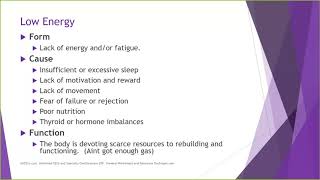
This podcast episode (Happiness Isn't Brain Surgery with Dr. Dawn-Elise Snipes) discusses symptoms, causes, function, and practical interventions for low energy (fatigue, lack of motivation) and agitation. Dr. Snipes contrasts agitation (motor restlessness, more common in anxiety) with lack of energy (more common in depression) and reviews causes including sleep problems, lack of reward/motivation, reduced movement, fear of failure/rejection, poor nutrition, and hormonal/thyroid imbalances. She explains the adaptive function (energy conservation) and offers behavioral and environmental coping strategies: movement ("try 15"), hydration, sunlight/vitamin D, pacing and self-compassion, identifying drains (social, mental, physical, environmental), goal-setting and small wins, accountability partners, boundary-setting, and practical tips to start tasks (bribes, breaks).
Chapters
Welcome to Happiness Isn't Brain Surgery with Doc Snipes. This podcast was created to provide you the information and tools Doc Snipes gives her clients so that you too can start living happier. Our website, Docsnipes.com has even more resources, videos and handouts, and even interactive sessions with Doc Snipes to help you apply what you learn. Go to Docsnipes.com to learn more. We're going to continue talking about symptoms in this section we're going to talk about the causes, function and interventions for lack of energy as well as feeling agitated. We're going to kind of combine both of them together and when you feel a lack of energy, you know, it's the I just really don't have the energy to get up and make food or take a shower or even get out of bed some days. And it can feel like you're carrying a hundred pound knapsack on your back. I mean, it can feel a lot harder to do simple things like just walk across the room. Agitation. A lot of people think of it as meaning irritability and, you know, crankiness, which it can, but agitation. We're really talking about your movements. So if you are bouncing your leg incessantly or you can't see to sit still, that could be another symptom of anxiety or depression. Agitation is usually more prominent in anxiety and lack of energy is usually more prominent in depression. But you can see the two of them co occur. So don't just assume one or the other. So what causes this? Insufficient or excessive sleep? If you're not getting enough sleep, you may just move, be agitated, sort of in order to stay awake. Now that doesn't necessarily mean you're depressed or anxious. It may mean you're just trying to stay awake. If you're sleeping too much, you may not have a lot of energy and a lot of get up and go doesn't necessarily mean you're clinically depressed. It could mean that your body is not getting the quality sleep it needs. So you're sleeping a lot but you're not feeling rested. Lack of motivation and reward can also cause a lack of energy and fatigue. If you are doing things and you just don't see a benefit, you're going to work every single day and you just can't seem to get ahead. You're going to the gym every day and you're not seeming to see any progress. You do stuff around the house for your family and they don't seem to appreciate it. Whatever it is that you find as a reward or and the stuff that you. For the stuff that you do, if you're not getting the rewards, if you're not getting some positives out of it, you're probably not going to have the energy or motivation to do it. So you're just going to. It's going to be more rewarding to sit on the couch and watch tv, for example. So you want to look at is my lack of energy due to sort of a lack of motivation because just nothing seems to be rewarding right now. And you want to look back at that first symptom that we talked about and the lack of pleasure in things. And that can be a cause of lack of motivation. But sometimes, like I said, it's situational. You're doing stuff right now and you just don't seem to be getting ahead or making the progress you want. So you're getting frustrated. And that's a sort of a social, behavioral cause. It's not necessarily meaning that you are angry, experiencing depression. A lack of movement can also cause a lack of energy or fatigue. They say a body in motion tends to stay in motion and a body at rest tends to stay at rest. Well, if you've ever been on bed rest or been sick for a week or so and you get up and you start trying to get back into your routine, you may realize it seems like it's a lot harder. You get fatigued and exhausted a lot easier, especially if you've been on bed rest or whatever for a couple of weeks. So look at your movement levels. Have you suddenly changed and gone from, you know, when I have a project or we're getting ready to launch a new product, sometimes I'll work for, you know, two, three weeks and I won't go to the gym. I just come in, I sit at my desk, I work all day long, I get up, I go home, you know, do what I need to do around the house and with the kids, and then repeat the next day. Not recommended. Just saying. It's what I do. So I can speak from experience. And at the end of that period when I go back to the gym and I start, you know, gardening again and doing some of those other things that take a lot of physical energy. Wow. I get tired really easy. And mental energy is still energy. So if you've been sick or you've been out for a while and you get to work and maybe you don't have a physically demanding job, maybe, you know, it's more mentally, mentally draining, but you still may find that, you know, after two or three Hours, you feel exhausted. Your brain uses a lot of blood sugar, your brain uses energy. So it's important to remember that if you've been out of the rhythm for a while, your body's probably down, downshifted and it's not used to using that much energy right now. So you will feel fatigued more easily. Whether it's because you're not moving as much or because you're not thinking as much, you're gonna need to build back up into it. Be compassionate with yourself. You know, if you're getting back, you've been on, you know, maybe had open heart surgery or something and you're getting back to work and you know, maybe work for a couple of hours and then give yourself permission to take a break, take a rest, and then start again. And you may have to do that a few times a day until you get through the whole day. As you get your wind back, so to speak, you'll be able to eliminate some of those breaks and work straight through a lot easier. But be compassionate with yourself. Fear of failure or rejection can also cause a lack of energy. If you're always worried about what other people are going to think, or if you're going to fail or succeed, then it's important to pay attention to that because that underlying anxiety is exhausting. It is totally draining to constantly worry about others opinions or how things are going to turn out. Poor nutrition can also cause lack of energy. Your body needs the right building blocks to make the neurotransmitters you need for motivation to fuel your muscles and everything. So if you're not eating well, you may find that you feel fatigued. Thyroid or hormone imbalances. Yep, it keeps coming up, doesn't it? Can also cause a lack of energy or fatigue, especially low levels of estrogen and testosterone and thyroid hormones. What is the function of low energy? Well, your body is devoting scarce resources to rebuilding and functioning. It ain't got enough gas to do all this other stuff. It's saying, all right, I only have a certain amount of energy right now, so I am going to focus it on what is most necessary to survive. And going to the gym or going to the grocery store, that's not making the list today. Be compassionate with yourself. Recognize that your body's trying to tell you you gotta pace yourself a little bit. Life is a marathon, not a sprint. So how do you cope? Ask yourself again. Instead of reinventing the wheel, think of what you already do. What besides caffeine helps you get energy? Deep breathing can help. When you oxygenate your blood. It can help you get energy. For some people, being outside getting some sunlight will help sort of recharge their batteries. A vitamin D deficiency is also linked with depression as well as low energy. So make sure that you're getting enough vitamin D, which is our sun vitamin. What drains your energy? So we've already looked at what helps you get energy, what you've done in the past. Make a list of those things and try them out when you're feeling kind of sluggish. For me, if I get outside, especially if I get outside and get my heart rate up, I generally feel a lot better. If I just sit inside all day, I tend to feel even more sluggish. What drains your energy? Once you know how to build it up, you also want to figure out how to keep it from getting drained. You know, how can you put the stopper in so you're not losing energy in the process of trying to gain it? You don't want to be working against yourself emotionally. What drains your energy? If social networking, if getting on Facebook or whatever, or Instagram or whatever it is drains your energy, it causes you stress or anxiety or irritability, consider removing that when you already feel like you have low energy, or limiting the time you spend on it, even when your energy is not low, so it doesn't drain your energy. I found it's better for me to limit my social networking time to no more than an hour a day. Mentally. What drains your energy? What thoughts do you have that cause you stress and anxiety and angst? Whether it's a negative internal critic constantly telling you that you're not good enough, or stuff that's going on in the world and politics and finances and relationship issues and other things you think about. So what thoughts do you have that drain your energy? Because you want to take those thoughts and kind of harness them and say, all right, I have this thought now, what can I do about it to improve the next moment? If I am concerned that you, you know, politically we're in a bad place and that a new nuclear war could start, you know, then I'm going to say, what do I do to address that thought? Do I start stockpiling in case there is some sort of international crisis so I have enough food and water to get me through six months or whatever, you know, the sort of the prepper mentality. If I have this mental thought that, you know, I'm not good enough and everything I do seems to fail, well, then I want to look at what things have I done that have succeeded what are the reasons I'm good enough and work on self esteem issues? Because holding that thought and just continually telling myself I'm not good enough is just going to kind of beat me into the ground and that's going to suck my energy dry. So I need to figure out how to get rid of that thought or what to do so I can let that thought go and feel like, okay, I've got that issue resolved. Physically, what drains your energy? You know, when I was sick, I wasn't working out as much, I wasn't out in the garden as much. And when I started feeling better, you know, I wanted to go back to the gym and just jump right back into my old life. And that didn't happen. I found that I had to choose. I could either do gardening or go to the gym, but I couldn't. I didn't have the energy. I didn't have the ability at that point because I had been down, downshifted. I didn't have the ability at that point to go running and work in the garden without causing myself a relapse into my illness. So it's important to look at physically, what are you doing that's draining your energy? Housework can be draining, shopping can be draining. You know, what are you doing socially? What drains your energy or who drains your energy? My husband's an introvert and my daughter actually is too. So the two of them going into somewhere where there's a lot of people, where it's crowded, especially if they're expected to be social, is exhausting. It's not that they don't like other people, but that many people in a small space drains their energy. It's exhausting for them. They prefer, you know, small groups, two or three people at a time. They're cool. So think about for you what, socially, what social environments and what people suck your energy. You know, there are certain people in my life, love them to death, but they can be an extreme drain on my energy levels because it's always, you know, gloom and doom. So there. I limit my contact with them sometimes, especially if I'm already having a low energy day. But I also, you know, set boundaries on our relationships. So when we get on the phone, I don't end up on the phone for three and a half hours. It's like 30 minutes and off. And that helps me still engage with them because they're important to me, but set a healthy boundary so I don't end up just completely depleted for the rest of the day. And environmentally, what drains your energy? For me, it's clutter and dirty floors. I am a fanatic about floors, but when I look around and I see clutter everywhere, it's just. I feel exhausted, I feel oppressed, and I prefer. In our house, we call it flat surface itis, which is an inflammation of all the flat surfaces. And I've got teenagers who are homeschooled. It happens. Things build up on every flat surface. And that has to be. That has to go away by the end of the school day because it bugs me to have piles of stuff on every flat surface. And that since it bugs me, that's going to be something that. It's not a huge stressor, but it's one of those slow drains on my energy. It's kind of like if you have a garden hose and you put a nail hole in it, it's not going to be a huge leak, but it's going to slowly drain the energy. When you felt lethargic or low energy in the past, how did you help yourself feel better? What else can you do? So make a list of those things. Other simplish interventions. Get up and move around. Try doing 15, which is, and I say this for a lot of different things. Try 15 means do something for 15 minutes. And general, you'll find once you start moving around, you feel a lot better and you keep going. But if you can move around and get your blood going for 15 minutes, you may feel better. And whether maybe you just go outside and walk, walk the dog or whatever you do, stay hydrated. Dehydration is implicated in low energy and confusion and difficulty making decisions and other things because you're not thinking as clearly, but it is implicated in low energy. So make sure you're hydrated. Increase motivating chemicals by having some successes if you're feeling unmotivated, if you're feeling like things just aren't panning out for you, whatever you do, set yourself up for some successes. Look at your goals and see if maybe you can make some smaller goals that you can achieve and focus on successes you've had in the past. Get an accountability buddy, whether that's your roommate or, you know, your workout partner or your neighbor down the street, somebody who can help you get up and kind of get moving. My husband will do that. Sometimes if I have particularly low energy, he'll be like, why don't you, why don't we go out and walk around outside? And, you know, thankfully, I don't experience that a whole lot anymore. But there was one job I had. I would come home, and I would basically just sit there and all but drool on myself for the rest of the evening. I was so exhausted. But if he helped me get out and, you know, we walked around on the farm or I started pulling weeds or something, I kind of get my second wind. And it would help a lot. Identify any fear or depressive thoughts that may be dampening your motivation and your energy, and try to think the opposite. It's not always easy, but sometimes fake it till you make it. So if you have an internal critic that keeps telling you you're not good enough, talk back to them and tell yourself, yes, I am good enough. Thank you very much. And here's why. Think about how you get motivation to do something when you don't have any. And sometimes things. You have low energy already or you'd rather spend your energy on something else. But things like laundry or going to work need to be done. So how do you make that inviting? How do you increase your motivation? You might set a reward. If you get all your tasks accomplished for the morning, then you can go to your favorite restaurant for lunch or whatever it is. I work for myself. So once I get my tasks accomplished, I get to go home, which keeps me from dilly dallying and helps me be a little bit more motivated. And how do you get started on a task when you don't want to? I would say try. Doing 15 is always an intervention, but sometimes I'll bribe myself. I'll be like, okay, let me make a cup of coffee. And then I'll get started on this task. Because everything goes better with decaf. But it's going to be different for different people. You might have something else that you do that helps you get in that mindset to get started on a task. It.










