Vulnerability Prevention and Validating Environments | Borderline Personality BPD Part 3
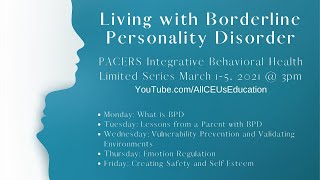
Dr. Dawn-Elise Snipes explains how to create validating environments and reduce vulnerabilities that trigger emotional reactivity in borderline personality disorder. She breaks validation into five steps: mindful awareness, nonjudgmental acceptance, emotion regulation, support, and examining context. Managing sleep, nutrition, pain, mood, and relational needs prevents the physical and emotional vulnerabilities that intensify BPD symptoms.
Chapters
Foreign. Welcome everybody. Today's presentation of pacers Integrative Behavioral Health. We are continuing to talk about living with borderline personality disorder. Today we are talking specifically about vulnerability prevention and validating environments. I AM your host, Dr. Donnelly Snipes. So let's talk first about creating validating environment. When we live in an, an environment where someone has borderline personality characteristics, or if we have borderline personality characteristics, the environment may be very invalidating. We may regularly feel like we're being told that our feelings are not correct, that our feelings are overblown, that we, our thoughts are wrong as well. So when we create validating environments, one of the things that we're doing is creating safety. And when we feel safe, it reduces our stress, which frees up energy so we can deal with life on life's terms. I made the analogy yesterday of thinking about yourself kind of like a pressure cooker. And when there is already heat on, on the pressure cook, it doesn't take near as much to blow the top off as it does when there is no heat in the pressure cooker. And what we're doing by creating validating environments is we're turning down the heat. That way you've got more room to move, more energy to deal with life. How do we create safety and validating environments though? Well, it's going to be a little bit different for every single person based on your experiences and your preferences. But it's be to going, going to start with a mindful awareness of your thoughts, wants and needs. Becoming aware of what's going on inside of you, acknowledging it and accepting it non judgmentally. That is the first step in creating a validating environment. Being able to acknowledge and adv and, and validate your own thoughts, wants and needs. You want that non judgmental acceptance and validation of your thoughts, wants and needs by you. You know you want to do that for yourself. But ideally you want to have people in your environment that can similarly non judgmentally accept and validate your thoughts, wants and needs as real, as accurate as what they are in the moment. Now, are they necessarily the most helpful? Well, maybe, maybe not. But the way you feel is the way you feel and then you can take steps in order to address that feeling. So the next step, once you have identified your thoughts, wants and needs, accepted it non judgmentally, is to use your distress tolerance skills and your emotion regulation skills to get out of that wise or get out of that emotional mind and into your wise mind. We need to turn down the heat little bit so we can get out of the Adrenaline haze. And we can step back and look at the situation in its totality without feeling like we must react impulsively right now. So distress tolerance and emotion regulation skills are really important when we start feeling overwhelmed. Support and responsiveness to assess and address those thoughts, wants and needs. So this is the next step. Become aware, accept it non judgmentally. Develop those distress tolerance and emotion regulation skills. Acknowledging, you know, if you're angry, if you're scared, if you're terrified, acknowledging that and saying, okay, this is how I feel right now. Using your skills to be able to take a step back and say, okay, why do I feel this way? Am I safe? If not, what do I need to do to get safe? And if I am safe, if what do I need to do to improve the next moment? Which is where we come to support and responsiveness. We need people to be supportive and sometimes we need them to help us, you know, take that next step to be responsive, to figure out, okay, what can I do to improve the next moment? Some tools that can be helpful include examining the facts for and against your feelings and urges in the present context. And that is so important in the present context. What was threatening or devastating or even true in another relationship or at another point in time may not be accurate in this situation, but you're projecting stuff from the past onto this situation now. You may be perceiving it 100 accurate, but you may not be. Which is why it's important to be able to step back and evaluate. Are my thoughts, feelings and urges valid, accurate and helpful in this present situation? And you know the answer is yes, they're valid. But are they accurate and helpful? Explore how past events shaped your automatic reaction to present events. So maybe you're in a relationship with somebody and they've started being more withdrawn lately and you start having a whole lot of anxiety about that. It's important to look at what's going on in this situation, at this con, in this context, at this time. Maybe in prior relationships that indicated that the. The. Your significant other was cheating on you, getting ready to leave, whatever, okay, is that true in this relationship? What are the facts supporting that in this context? What other explanations might exist for your partner's behavior in this context? They could be acting withdrawn or seeming withdrawn because they're exhausted because they're working on a new project at work or something. So it is important to examine the facts in the current context and recognize that past events often. We often project those onto current events in order to help us anticipate what's going on, but it's not always accurate. We don't want to hold people responsible for the actions of others in our past. We, we can learn from that. We can use that to rule out situations that may be less safe. But it is important to judge each situation on its own merits. Once you've determined what's going on in this present context, then identify helpful responses. What things could I do to improve the next moment and help me move towards the life that I want and being the person that I want? And that can be really challenging if you're in that emotional mind, if you're in that adrenaline haze, which is why it's so crucial to be able to use your distress tolerance skills to step out of that a little bit, to downregulate and get into your wise mind. And that is one of the reasons or that you point out that fact. Finding inside an invalidating environment is hard, which is why the whole point was you need to create a validating environment that's characterized by mindful awareness of your thoughts, non judgmental acceptance and validation in yourself as well as from others in that validating environment, and then moving on to distress tolerance and problem identification. The next thing that we're going to talk about is vulnerability prevention. Again, we're turning down the heat a little bit in our pressure cooker by eliminating unnecessary stressors. By addressing unnecessary stressors, making sure you get enough sleep is really important. Your body activates your threat response system when you are sleep deprived, which can make you more aggravated, irritable, more likely to respond impulsively. So sleep quality sleep is important. Nutrition is important. The your body makes all the neurotransmitters and hormones. It needs to help you regulate your mood by the foods you eat. So you need to eat healthfully and minimize those stimulants. Because, because stimulants are going to contribute to agitation and pain. When we're in pain, it does activate our stress response system, which can make us more edgy. But generally, just anytime we're in pain, a lot of times people tend to be more impatient, maybe more frustrated, maybe more irritable. So addressing some of these physical vulnerabilities that make you more likely to respond to situations with extreme reactions or respond negatively to situations is really important. Affectively and cognitively paying attention to your mood if you get up and you're in a God awful mood, well, knowing that is really important because if you know that you're grumpy, then you can take steps to prevent it from getting worse. You can figure out okay, I need to buffer myself from, from these sorts of things today so I don't end up devolving into a much worse mood. Recognizing that, but also taking steps to improve your mood by identifying opposite emotions. What can you do that can help you experience opposite emotions? You can feel happy about certain things in life and be stressed about certain things in life at the same time. And that's what Hayes talks about when he talks about living in the and it is possible to be stressed out over your relationship or over your finances or your job or something else, and grateful and happy about other things in your life that are important to you. Being aware of your attitude is also important. A lot of times when I'm in a negative mood, I also have a negative attitude. In substance abuse recovery. A lot of times we call this stinking thinking. And it's important to pay attention to your cognitions. How are you thinking about things? Are you seeing the glasses half full or half empty? Are you seeing the sky as cloud, partly cloudy or partly sunny? And that can be really obnoxious sometimes. But it is important to embrace the fact that our perception of things and the way we approach things can impact our feelings about those things. Radical acceptance and is really also can be very helpful in vulnerability prevention. Recognizing that in any given moment, life is what it is, and it's not necessarily good or bad, it just is. And the goodness or the badness, a lot of times are interpretations that we put on that along with recognizing that in. In any moment life is what it is, it's also constantly changing. Every moment is an opportunity to improve. Every moment is an opportunity to change. So examining what it is in the current situation that you like and keep that going and what it is in the current situation that you don't like, and ways that you might be able to address that in a meaningful fashion. Environmentally, paying attention to sights, smells and sounds can be really important for vulnerability prevention. Look at your environments, at home, in your car, at work, and identify sights, smells, and sounds that may trigger distress and anxiety, grumpiness, grief, depression, any of those dysphoric moods. And this when, when I talk about sites, sometimes it's pictures, sometimes it's, you know, just disarray. Other times it is maybe not being able to see entrances or exits. So being aware of what you need in an environment in order to feel safe, in order to be as relaxed as possible for you, really important. And then adding triggers for happiness can also be really, really important. Because if we eliminate the stressful triggers, well, that's, that's great. But then we're left with kind of a void unless we put in triggers for happiness. You know, most of us don't want to sit in a room with completely barren walls and no color. So think about what can I put in my environment to make it a sanctuary? Not only am I removing distress, but I am adding things to make it as comfortable and relaxing as possible for me. I love the sound of running water. So I have an indoor fountain at my house that I keep going and that trickling is very calming to me. Some people, it drives them crazy because it makes them have to pee. You know, everybody's a little bit different. But knowing what is most relaxing for you and relationally identifying what you need in your relationships to feel supported, accepted and safe. And this goes back to creating that validating environment. If you don't know what you need, then you're going to have a hard time creating a validating environment. And when you're in an invalidating environment, it's very stressful. So you're going to have that underlying current of negative energy going on. So reflecting on what do you need from other people to feel supported, accepted and safe? What do you need them to do and what do you need them to not need do? And, and it recognizing that even little non verbals can be very triggering for people. I know there are a couple of looks that my mother used to do, you know, and as a little kid there were, they were scolding looks and, and now when other people do them, it just drives me up a wall. So I know, I recognize that that came from the past and that I'm projecting that the present. But identifying that and, and recognizing it is important. I need, I need in order to feel supported, people who are there and able to validate my feelings without necessarily having to fix the problem. You know, I need people just to acknowledge that hey, you're devastated right now and I can say, yeah, let me tell you all about it. So those are the things that I need. And it's important for you to figure out what you need from other people and then to tell them, don't expect them to read your mind because they're not going to. And then while you're doing that, also identifying people and behaviors that prevent you from feeling safe, maybe that is people who don't respect your physical boundaries, you know, if they're too huggy, touchy, not necessarily in trying to be inappropriate, but some people were raised in cultures and families that were very touchy and they hug all the time and hold hands and for other people that's not comfortable. So understanding what types of behaviors from other people prevent you from feeling safe, what characteristics in other people prevent you from feeling safe and then addressing some of those things. There may be characteristics of people in the present that remind you of dangerous people or unsafe people from the past. So whenever you see people that remind you of the past, it triggers your anxiety. So that may be an issue that you need to work on, you need to address in therapy in order to process whatever that unsafeness was so it doesn't keep re triggering you in the present and re triggering you when you're, you know, at Walmart or the grocery store or wherever. So recognizing again how the past impacts the present, doing as much as you can to create validating environments both in your own head, where you are non judgmentally accepting and validating of your feelings, thoughts, wants and needs in the moment doesn't mean you have to act on them. But you're saying this is how I feel and this is valid. Then taking steps to down regulate, to re regulate using distress tolerance skills so you can get in your wise mind and make decisions about how to handle situations and then preventing as many things as possible that might make you more vulnerable to to extreme reactions. And that includes physical vulnerabilities like sleep, malnutrition, pain, and affective and cognitive issues like what your mood happens to be. You know, sometimes we just wake up on the wrong side of the bed. The environment and relationships. Are there any questions specifically about how to create validating environments or prevent vulnerabilities to help you feel less distressed and free up some of that energy? Now there are a lot of videos on the YouTube channel that talk about vulnerability prevention and dialectical behavior therapy skills. And I really encourage you to watch those because they go much more in depth into each one of these topics. But there are, you know, this is a time where I can answer really quick questions if you have any before I sign off. Alrighty everybody. Well, thank you for being here today. I really appreciate it. Please, if you haven't already done it, remember to subscribe and click the like button and share this video and I will see you tomorrow. Next week we are going to be talking, talking about all things cannabis and CBD and mental health. Have a great day.










