Budgeting De•mys•ti•fied | #FDBudget
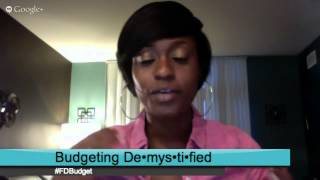
In this live Google Hangout webinar, personal finance coach Dominique Broadway (founder of Finances Demystified) introduces herself, shares her background as a former financial advisor and self‑described "financial therapist," and outlines the session’s agenda. She explains that budgeting, though often dreaded, can be simplified by focusing on two "magic numbers" – expected monthly income and total monthly expenses – and demonstrates how knowing these figures reveals why a budget may be unbalanced. Broadway then reviews a suite of free, technology‑driven tools: Mint for transaction categorization, Ready for Zero for debt‑paydown tracking, and Credit Sesame/Karma for continuous credit‑score monitoring, offering practical tips for each. She describes the range of services her brand provides, including one‑on‑one financial coaching, newsletters, community events such as happy‑hour and brunch finance talks, upcoming financial retreats that integrate coaching across life domains, and speaking engagements. The webinar includes an interactive component via comments, Twitter (@MsFinanceCoach), and the #FDBudget hashtag, culminating in a giveaway of a 15‑minute discovery call followed by a one‑hour deep‑dive financial review for a selected attendee. The session closes with instructions for replaying the webinar, contact information, and encouragement for participants to take actionable steps toward financial control.
Chapters
Hello everybody. I know no one can talk back, but I'm gonna give people a couple more minutes before we get started. Um, yeah, before we get started. Alright, I guess we can go ahead and get started. It's almost 7:35. Thank you so much everyone for coming out this evening, or virtually coming out, and checking into the Budgeting Demystified webinar. I'm so excited to have everyone here, and I am super excited and hoping that all the technology agrees with us since this is the first time I'm doing an actual on-air Hangout, even though I do a lot of meetings via Hangout with my clients. So if there's anything not working properly, please let us know. You do have the ability to comment on the event screen, and if you want to ask any questions, you can tweet me @MsFinanceCoach, that's MsFinanceCoach, or you can use the hashtag #FDBudget, so it's like finances demystified. By budget. So before I start off, I have some really exciting news I'm excited about and nervous about at the same time, so this might be some video preparation for me, but I was asked by eHow to shoot like 13 instructional videos this Thursday, so I'm super excited about it. So as soon as those are out, I'll definitely let you guys know. Let me turn the camera on me. Wait for it. Okay, hello! Alright, so just that screen. So yes, I'm super excited about the eHow videos, so hopefully this will be some, I don't know, I guess it will kind of show you how my eHow videos will be. So I'm pretty excited about that. There's a lot of great things in the pipeline for For me, and Finance is Demystified, so I'm so excited that people like personal finance like me. So, to get started, we're gonna just go ahead and kick off with the webinar. Like I said, if you have any questions, please answer down there in the comments section. Tweet me @MSFinanceCoach or use the hashtag, which is also right there, #FDbudget, and I will answer your question. So let's go ahead and get started. So as we know, budgeting is a topic that everyone hates but wants to understand, but it can be really complex at times. So what we're gonna do, just kind of start off with who am I, because not everyone here knows who I am. Basically, I am Dominique Broadway. I am a personal finance coach. I also do financial planning, previously a financial advisor managing money, and now I focus more specifically on financial planning and personal finance coaching. I'm also the founder of Finances Demystified. I consider myself a financial therapist in helping people understand why they have the relationships that they have with their money and trying to break down any traumatizing stories or whatever it may be that have helped them or created the relationship that they have with their money. I'm a Bowie State in Maryland University alumni. I was recently nominated as one of the top financial advisors in the US for millennials. I am a foodie. I am a rooftop connoisseur. So if you are in DC, you may see me sitting on a rooftop sipping a signature Finances Demystified cocktail. I am also a personal finance nerd, geek, whatever you want to call it. It's my passion. And at heart, I am and have always been and will always be an entrepreneur. Over here, just some of the cool places or other companies that have recognized me for thinking that I've done something great. So that's just a little bit about me before we delve into the budgeting part. So what you're gonna learn today. Today you're gonna learn how to set up realistic budget, the best free tools to manage your money, how to identify where your money is going every month, who should be on your financial team, and how you can take action to take control of your money today. Okay, so when you're first creating your budget, and this is, you know, people always say, you know, I've started working on my budget, or I made this budget and I have no idea where my budget is, or I made it in January and now it's September and I haven't kept up with it. So, you know, when you're creating your budget, the first thing you need to do is figure out what your magic numbers are. And there's really two real magic numbers. The first one is what is your total expected income each month? And the reason I said expected income is for some people who are entrepreneurs, your income can vary month to month. So it's really important to take the time to do some projections to figure out what your income will be. Knowing what your income is is very important. You have no idea how many times I meet with people and I say, "How much do you make?" They're like, "Um, I don't know. I'm not sure." So it's hard to know how much you can spend if you don't even know how much you're bringing in each month. So you always need to know how much you're bringing in each month with and without overtime or whatever it may be. The other magic number is your total expenses. That's another number that's very important. You should always know how much it costs to keep you running every single month. Like, I know how much it costs to keep Dominique Broadway up and running, you know, and looking somewhat decent every single month. So those are two very important numbers that you should know. Even once you get these two numbers, you know, you can usually do the math automatically and say, hey, I bring in $4,000 a month and my expenses are $4,500 a month, there might be an issue. So even just doing something as simple as determining your two magic numbers can be a very critical and crucial step in taking the first step to really understand your budget. As simple as these two numbers are, they are really one of the biggest factors and main factors that can really help to demystify your budget. As soon as people realize, and when I work with my clients and I show them their current budget versus their proposed budget and they see how much they're actually spending each month, it usually automatically clicks. So like, whoa, this totally makes sense why I can't save or why I am not spending or why I have a shortage every month. So on to the next slide, which is about tools and technology. And if anyone knows me, they know that I am a technology geek. I'm super, super into technology. I— these are some of my favorite tools, and I can actually go back to this screen. But one of the main ones I'll talk about first is mint.com. And everyone knows I love Mint. I think it's a great tool. But the problem is when people use Mint They— most people that I've met have heard of Mint, have signed up for Mint, have linked their accounts in Mint, but they never go back. Why? Well, Mint isn't the easiest software in the world to use, but with a little help and assistance, it can be used and really help you to keep track of your budget. That's one of the main reasons I like Mint. So when you're first setting up your budget, you're determining your income, determining your expenses. The next— key thing is to figure out where your money is actually going. And instead of sitting down and counting, okay, I went to Starbucks 10 times, I went to the dry bar 5 times, I took my boyfriend out to eat 4 times, you can actually just plug everything into Mint and it will categorize it for you. You have to play around with it a little bit to make sure they're not categorizing your Starbucks run as an oil change, which it sometimes sometimes can do. But if you upload your transactions onto Mint, you will be able to actually see where your money is going. Like I said, that's another great indicator. So there's plenty of times I'll meet with clients and we'll look at their Mint and they've actually spent $200 at the liquor store in 3 weeks. They're like, what? That's crazy. That doesn't seem realistic. And I'm like, well, it's totally realistic. We're not pulling these numbers out of nowhere. You know, you went to a few dinner parties, you brought everyone a bottle of wine at each party or whatever it may be, and it totally adds up. So Mint is a great tool that you can use to kind of really identify where your money is going every single month. Some other, some of my other favorite tools that I love is Ready for Zero, which is a great, great tool. And you guys probably haven't heard me talk about this one as much. They're a newer tool, but basically what it does is they allow you to upload all of your, excuse me, upload all of your debts into their software, and basically what they'll do is help you kind of create a strategy to pay down all of your debts. They will even give you the ability to send you a reminder to pay this debt. They'll help you track your progress as you're doing it, and we all know that progress Progress tracking is one of the key ways to make people stay on top and on track to reach their goals. Just like as you're losing weight, when you start seeing those pounds coming off, you're like, okay, this is working, I see the progress. A lot of times with personal finance, it's a little bit harder sometimes to track the progress, so a lot of people will give up or just not stick with the budget that was originally proposed. So Ready for Zero is great for keeping track of your debt pay down plan. The other two at the bottom here are Credit Sesame and Credit Karma, and these are two, another two really cool free tools, and basically what they do is just help you track your, keep track of your credit score. You know, just like, hey, someone says, hey Dominique, how are you? I tell them my age, I should be able to, you know, kind of blurb off my credit score at the same time. So, you know, watching your credit score or viewing your credit, your credit report once a year is not enough. There's just so much going on with fraud and just everything else. You want to make sure that everything on your credit report is accurate, and these two apps can really help you do that. They give you the ability, like I said, to have access to your credit score at all times, but it also gives you the ability to get alerts if anything changes in your credit report, anyone views your credit report, or if anything that's not normal occurs. Alright, so that's technology. So I guess I can talk a little bit more about the services that we offer and how we help people to reach their financial goals and to keep track of their budget. So some of the things we offer: financial coaching, obviously that's what I do, offering, you know, helping people to to create their financial plan. And also, you know, what's different with financial coaching, it's more hand-holding, having those weekly calls and biweekly calls and making sure that you're staying on top of your budget and sticking with the goals and plans that are in place. Other things we offer is newsletters with tips. One of my biggest babies is the Finance is Demystified Happy Hours, which I started almost a year ago. Ooh, maybe I should have a year celebration. Yeah, so I started those a year ago, and people actually actually like to talk about personal finance over cocktails. Who would have thought that? So we do the happy hours, the brunches, we do a lot of other pretty cool unique events like we have the financial fitness coming up and a lot of other really cool events as well. We also do a lot of speaking to schools, higher education universities, churches, anyone that needs financial literacy, we're there to talk. And one of the newest things that's coming soon, which I'm I'm also very excited to announce is financial retreats. At these retreats, what we're gonna do is allow people to come, have one-on-one finance coaching, meet with a life coach, meet with a relationship coach if needed, meet with a career coach, and really tap into every part of your, your well-being, because it's not just about money, although money definitely has a close relationship with everything else that we do. So as we said earlier in our email, we're going to select one winner and basically from this webinar, and what they're going to get is a 15-minute discovery call where we'll kind of just figure out what, what your overall issue is, and then they'll have a 1-hour discovery meeting where we will sit down and go through, review all of their financial information and actually also, you know, basically determine what the problem areas are and then actually develop an action plan for them to to actually take action to fix all of these problem areas. And then we'll also have follow-up calls to make sure that the winner stays on track with their goal and their action plan. So let's see. So that's kind of just some of the basics that we're going to cover with budgeting. I don't know if anyone has questions right now and I can go to the other screen and see. See. But if there are any other questions that you have about budgeting, since we kind of just touched on the surface of demystifying your budget, you can always call me, tweet me, email me, uh, what else can you do? Facebook me, all those different types of ways that you can reach me. So let's see if there are any questions, or if you have any questions, you can See, let's flip back here. So if there are any questions on budgeting or any of the tools that we talked about, let's see, you can put them right there in the comment section. I hope I'm pointing in the right place. Let's see. Yes, I did. So does anyone have any questions before we kind of end the webinar? And if any— and if for some reason, yo, anyone missed this, this— I'm sorry. If anyone missed this webinar, which kind of just goes over the basics and, you know, of budgeting and really just some key tips on demystifying your budget, they can always come back and replay this webinar, so if anyone misses it, don't worry about it. But if there are any questions, you can go ahead and put them in now, and I'll give you guys a couple minutes if you want to put the questions into the— what is this called— the comment bar on the Google Hangout page, or if you wanted to tweet anything in. Check. It's clear. Alright, well, if there's no questions right now, um, what we'll do is select one of the winners from the webinar, and we will, um, go ahead and send you an email with how you can Take advantage of your prize. And if you want to schedule a 15-minute discovery meeting to learn more about demystifying your budget, you can always, like I said, send me an email. And I'll put that information back up. You can tweet me or call me. No one calls anymore. Everyone just emails. So anyway, there's my information. If you have any questions, You can still submit them here on the Google Hangout page, and I'll come back and answer them here, or you can always tweet me. So hopefully everyone enjoyed the webinar, and hopefully you feel or have learned about some cool tools that can help to further demystify your budget. So that is all for today, and I look forward to hopefully speaking and helping each of you get closer to reaching your financial goals. And— oop, okay, bye!
More from Dominique





Wealth doesn’t start in your bank account… it starts in your mindset. Before the money grows, befor


Inflation Won't Drop, Jobs Are Slowing Down, and the Fed Can't Fix Both #economy #reality



