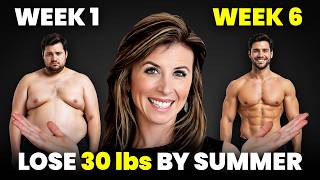
In this 20‑minute YouTube presentation Dr. Ashley Lucas (PhD in sports nutrition, registered dietitian, founder of PhD Weight Loss) explains why traditional "eat less, move more" advice fails for men over 40 and offers a biology‑driven system for dropping 30 lb by summer. She reframes weight loss as a metabolic problem, not a will‑power issue, and identifies three core drivers of stubborn fat in middle‑aged men: insulin dysregulation, chronically elevated cortisol, and loss of metabolic flexibility. For each driver she provides concrete actions: prioritize high‑quality animal protein (40‑55 g at the first meal, protein‑fat snacks throughout the day), eliminate rapid‑spike foods and liquid calories, build meals around protein, fiber and healthy fats, and keep insulin “switch” off. She recommends moderate daily movement (30‑minute brisk walk) combined with intentional strength training (compound lifts) rather than long cardio, and stresses adequate sleep for testosterone and cortisol balance. A supplement, GlucoCut Plus, is introduced to stabilize blood sugar and protect lean muscle. Dr. Lucas also promotes her personalized PhD Weight Loss program, citing that over 12,600 clients have collectively lost more than 480,000 lb using these principles. The talk ends with a call‑to‑action to visit her website or the video description for more resources.
Chapters
If you're a guy who's done everything right, you cut back on food, you push through workouts, maybe even tracked your calories, and you're still looking at the same darn 30 extra pounds that weren't there 5 years ago, I want you to stop beating yourself up. The advice most men are following for fat loss was built for a completely different body than the one you're actually living in today. Eat less, move more model, the long cardio sessions, the crash diets, cutting carbs for 2 weeks and then quitting because you feel absolutely terrible, none of that was ever designed around what actually happens to the male metabolism after 40. And if you've been grinding through that cycle for years, you know, the one where you're losing some, gaining it back, losing some, gaining more back, that's not a character flaw. It has nothing to do with you. It's a system failing you. You're not lazy. You're not broken. This is not a willpower problem. Something a lot more specific is happening inside your body. And once you fully understand what that actually is, Dropping 30 pounds by summer stops feeling like a punishment and starts feeling like a system, like a process that's totally manageable and feasible. I'm Dr. Ashley Lucas. I have a PhD in sports nutrition and chronic disease. I'm a registered dietitian, and I'm the founder of PhD Weight Loss, where to date we've helped over 12,600 people collectively drop more than 480,000 pounds. And I say that not to impress you, but because I want you to know that these are patterns I've watched repeat themselves in real people. For many years, thousands of times. And one of the most consistent patterns I see in men specifically, they come in convinced they just need to try harder, more discipline, more gym time, like two a days, right? Fewer calories, becoming vegan, vegetarian. And what I have to show them gently but very, very clearly is that trying harder with the wrong strategy is exactly what's keeping the weight on. Here's the reframe that could change everything for you. Your body is not your enemy. Your metabolism is not broken. What's happened is that your biology has shifted—your hormones, your insulin response, your stress chemistry—and the strategies that worked in your 20s are now working against you. Your body is doing exactly what it was designed to do given the signals it's been receiving. The goal isn't to punish it into submission. The goal is to change the signals. Let's talk about what those signals actually are so you can do something about it. There are 3 primary systems driving stubborn fat storage in men, especially the belly fat. It's insulin regulation, cortisol patterns, and metabolic flexibility. When these 3 things are out of balance, it does not matter how disciplined you are, the fat is not going anywhere, and it's going to start to continue to pile on in the belly, the chest, the throat, the head area. And you're going to be at increased risk of high blood pressure and sleep apnea. So let's start with insulin. I want you to think of insulin like a switch. When it's elevated, that switch is flipped to fat storage. Your body in that state is actively pulling energy into the fat cells. It's not burning it. And here's what frustrates most men I see— that switch doesn't care how many miles you ran that morning. If insulin stays elevated throughout the day from the way that you're eating, from blood sugar spikes, from constant snacking because you're starving, fat burning slows to a crawl. You've probably heard this before: you can out-train a bad insulin environment when you're young, but after 40, you really can't. There's no way around it. Now let's talk cortisol. You know, most people hear stress hormone and think work anxiety, and yeah, that totally counts. But for men trying to lose fat, cortisol is also being spiked by the things they're doing in the name of weight loss. What I mean by this is when you're eating too little, when you're training too hard without recovery, you're going to the gym twice a day and not eating enough to support that, when you're sleeping 5 or 6 hours because life is full. Every one of those things is a biological stressor, and when cortisol stays chronically elevated, your body's going to hold on to fat, especially around your gut. Not to punish you, but because that central fat right around the belly is actually the most accessible energy fuel reserve. Your body is protecting you. When you think about it, that's actually very remarkable, but it is absolutely working against your health goals. The third piece is metabolic flexibility, your body's ability to shift smoothly between burning glucose or sugar and burning fat. A metabolically flexible body taps into fat stores really efficiently. A metabolically inflexible body, which describes most of the men I see, is stuck running on sugar. When the sugar runs out, you crash, you crave more carbs, you feel foggy, irritable, hungry, low sex drive. The fat just sits there because your body never gets the signal to actually use it. When these three systems are dysregulated, no amount of effort overcomes the biochemistry. But when you address them directly, the body becomes remarkably cooperative. If you're listening to this and you're thinking, this is exactly what's been happening to me, that's not a coincidence. That's precisely the pattern we're built to address at PhD Weight Loss. We identify where your metabolism has gotten stuck, and we build a fully personalized customized plan to restore it. We take out all of the guesswork. You don't have to extremely restrict yourself. You don't have to go to the gym for 2 hours a day. You don't have to really go to the gym at all. You should head to myphdweightloss.com to learn more if something like this would be of interest to you, or click the link in the description. So what does it practically look like to drop 30 lbs by summer working with your biology instead of against it. The single most important lever is protein. Not as a side note, not as a supplement, as a structural foundation of every meal you consume. The goal is real whole animal protein. Eggs, one of the most perfect foods available to us. Red meat, even the fatty cuts are okay. Chicken, fish, turkey, these are all foods that signal your body to preserve lean muscle while you drop fat. And that matters enormously because When men lose weight without adequate protein, a significant portion of that weight is actually muscle. Less muscle means a slower metabolism. A slower metabolism means fat loss grinds to a halt. You'll hit plateaus, and then the weight comes back faster when you stop whatever diet you were on, and now you're actually fatter than you were to begin with because you lost muscle and you gained back only fat. Not good. Practically, what you want to do is aim for about 40 to 55 grams of protein with your first meal of the day. Now, the true amount of protein you you want to consume depends on your goals, your unique body, but this is just generalized guidelines. Think about 40 to 55 grams of protein with your first meal of the day, again depending on your body size and other specific things unique to you. That first meal sets your blood sugar, your hunger hormones, your energy up for the entire day. Eggs with full-fat Greek yogurt, eggs alongside quality meat— that is a first meal your body can actually use. One of my husband's favorite meals is some ground beef with some over-easy eggs, and he puts a little bit of butter on top and heavy cream in his coffee. You can match that effort at dinner. A protein-forward last meal will support overnight muscle repair and helps to regulate appetite the next morning. Whatever is left is going to get distributed across lunch and a mid-afternoon snack, and that snack matters more than most men think. If you are dropping weight and you skip that afternoon snack and you walk into dinner ravenous, When that happens, your body doesn't know what to do with a massive influx all at once, and a significant portion of what you eat gets stored instead of used. So for this mid-afternoon snack that you are not going to skip, it could be hard-boiled eggs with some salt, quality deli meat with some mayo. I like Primal Kitchen mayo. You could put some avocado wrapped up in it. A lot of people ask me if nuts are a good snack. If weight loss is a goal, I don't love nuts as a snack because they are so easy to overeat on and they're not super filling. I could eat an entire bag of macadamia nuts and go into dinner and not be even phased by whatever, 2,000 calories worth of nuts. So if you're like me, I would consider keeping nuts and nut butter out of the mix during the high weight loss phase. But ultimately, you want some kind of protein and healthy fat, something that keeps blood sugar stable and sets you up for a calm, controlled dinner. I'll hear from so many men before they start their PhD program, they won't eat throughout the day. They get home from work, they snack on all of the kids' food, all of the kids' snacks, and then they go into dinner. They eat a big dinner, and then they just can't stop eating throughout the rest of the night. Or maybe they don't eat throughout the rest of the night, but their metabolism is so slow, even just that amount— the snack before dinner and dinner— keeps piling weight on their body. So if this is you, you are not alone. So next, you want to get insulin under control. This means stepping away from the foods and drinks that spike blood sugar fast. Liquid calories are a major one for men. This is juice, even if it seems like it's healthy. Those green drinks usually have the most sugar in them out of all. Sweetened coffee drinks, even the new Starbucks drinks that have protein in it, if they add a lot of sugar in it, it really doesn't matter. Any kind of sweetened drinks, energy drinks, alcohol, especially beer, which is, by the way, essentially liquid bread for your belly area. Processed carbs, constant snacking between meals, Every spike is keeping the fat storage switch turned on. Instead, now you're going to build meals around protein and fiber. Non-starchy veggies alongside your protein. Healthy fats like avocado, butter is a healthy fat, tallow, olive oil, the fat in quality cuts of meat that you love. All of this fat slows digestion, it extends fullness, and it keeps insulin from spiking. This is the combination that flips the switch from storage to burning. Now, you guys, movement does matter, but not the way the fitness industry sells it. Long, exhausting cardio sessions are not your friend. Excessive training without adequate recovery raises cortisol. It elevates cortisol and tells your body to hold the belly fat right where it is. What actually works is consistent, moderate daily movement. I suggest a 30-minute minimum brisk walk every single day. It's so powerful. And then combine that with intentional strength training. Lifting heavy builds and preserves muscle, which is the engine of your metabolism. More muscle means more fat burning around the clock. And for you guys, the more muscle you have, and especially when you're doing resistance training with compound movements like deadlifts or squats, it actually enhances testosterone levels. Next thing that actually also does enhance testosterone levels is sleep. Poor sleep tanks your testosterone, spikes cortisol, it wrecks insulin sensitivity all at once. Quality sleep is not optional if you want the belly fat to respond. It has to be a main part of the protocol. If blood sugar instability feels like a big part of your pattern, if you feel things like afternoon energy crashes, if you feel cravings that feel out of control, if you have difficulty staying full, I want to mention and bring up GlucoCut Plus. I developed this supplement specifically to stabilize blood sugar, support your body's natural full signals, and to protect lean muscle during fat loss. I actually have a few friends who are into lifting heavy and really putting on significant muscle, and they love GlucoCut Plus. It helps them to preserve muscle while cutting fat, and there's no stimulants in it. It is designed to work with your body, not to override it. If something like this you think would benefit you, you should check it out. Dr. Ashley drashleylucaswellness.com. There's also a link in the description. Use code ASHLEY10 to get a special discount for listening to this episode. So here's what I would love for you to carry out of this. Your body has not turned against you. It might feel like that, but it has been responding. It's responding actually very intelligently and protectively to the inputs it's been receiving— chronic stress signals, blood sugar chaos, inadequate protein for most of you, not enough recovery. Your body did exactly what it was supposed to do with all of that. Now what you're going to do is change the inputs, and as a result of that, the body's going to change its response. And this isn't a theory, this is just how biology works. 30 pounds by summer is totally possible. It is absolutely within your reach. It requires you working with your physiology, not grinding against protein at every meal, stable blood sugar throughout the day, smart sustainable movement with real recovery. These aren't going to be extreme measures, but they're going to be the conditions your body actually needs to feel safe enough to let the fat go. When these conditions are met, your body knows exactly what to do. It was designed for this. It wants this. You just need to give it the right environment. Take a look at this video right here if you want to learn about healthy breakfast options for dropping weight. Remember, you've got to step up to make the change. Lead with your heart, train your mind, and do not negotiate with your body. I'll see you next time.