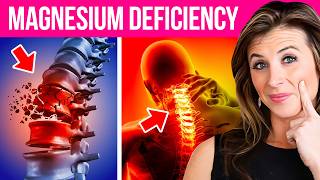
YouTube video by Dr. Ashley Lucas explaining magnesium deficiency: prevalence, symptoms, testing limitations, dietary sources, and supplement recommendations. Key claims: ~60–70% of U.S. adults do not meet daily magnesium needs; magnesium supports 300+ enzymatic reactions and affects energy, nerve/muscle function, hormones, blood sugar, blood pressure and sleep; common deficiency signs include cramps, numbness/tingling, palpitations, fatigue/brain fog, headaches/migraines, constipation/nausea, tremor/weakness, and poor stress resilience. Testing: serum magnesium is insensitive (<1% of body magnesium); RBC magnesium better reflects tissue stores (target ~5.8). Supplement and dosing notes: RDA ~400 mg/day; functional practitioners often recommend higher doses; excess magnesium causes diarrhea, nausea, cramping; different magnesium forms suit different goals (glycinate for anxiety/sleep; malate for energy/muscle pain; threonate for cognition; citrate can loosen stools). Product mentions and promotions: Algaecal 'Magnesium Relax' (blend of citrate, malate, bisglycinate, plus vitamin B6, zinc, adaptogens) promoted with a launch-week 20% discount then 10% thereafter via author link; Dr. Ashley also promotes her own electrolyte product containing ~150 mg magnesium. The video includes a call-to-action for PhD Weight Loss and links in the description.
Questions this video answers
About 60–70% of adults (U.S. population claim).
Around 5.8 (RBC magnesium units as stated in the video).
5.5 (RBC magnesium).
Recently ~800 mg/day; at times up to about 890–900 mg/day (combined forms).
About 400 mg/day (as the commonly advised RDA).
Chapters
Are you feeling tired or crampy or.
Maybe just off lately?
You might be low in magnesium and not even know it. Research shows that about 60 to 70% of adults are not meeting their daily magnesium needs and are low in total magnesium. I'm Dr. Ashley, and in this video I'm going to show you the hidden signs of magnesium deficiency, why it is critical for your health, and the best foods and supplements to help you restore your levels. So, like I said, research shows 60 to 70% of Americans are not getting their daily magnesium needs and they're deficient in magnesium. That's because of many reasons. One, our soil is depleted, so our food is not as nutrient mineral rich as it used to be. We have high stress levels, which makes us burn through magnesium pretty quickly. And there are certain medications that increases magnesium burn as well. Basically, our modern diets, modern lifestyles aren't just supporting our body in the amount of magnesium that we need. Magnesium is such an important mineral because it powers over 300 enzymatic reactions in the body, energy production, nerve and muscle function, hormone balance, blood sugar regulation, blood pressure and sleep, like lots of important things. Now, low magnesium can create ripple effects. It can reduce your ability to tolerate stress. It can help to increase anxiety levels. It can make weight loss harder and increase your cravings. And it can increase your risk of insulin resistance, developing type 2 diabetes, and developing blood pressure. Now, there are certain people who are at higher risk of being low in magnesium and experiencing deficiency and symptoms associated with it, like women, people under chronic stress, athletes just because they're burning through so much, those on diuretic medications. If you're on a ppi, which is to help heartburn and gerd, if you take birth control pills, or if you've got gut issues that impair absorption. Now let's talk about the warning signs around low magnesium. Eight flags that you could consider. Look into your own symptoms and see if these might correlate or be similar to what you're experiencing. One would be nausea and constipation, headaches or migraines, nighttime leg cramps. Now, something important to think about. If you're experiencing muscle cramping. If you've got muscle cramping and it's more during exercise, you're likely low in potassium. If you've got cramps that are outside of exercise, then it's likely a magnesium deficiency. A magnesium deficiency. Another flag would be numbness or tingling in your hands or feet, weak weakness or tremors, heart palpitations, fatigue or brain fog and just heightened anxiety. Or again, poor Stress resilience, meaning if something happens, it's just very hard for you to bounce right back. Now, if you feel like this is overwhelming and having a meal plan customized to you, making sure that you're getting adequate vitamins and minerals would be helpful for your weight loss journey, then you should check out PhD weight loss, because that's exactly what we do. We'll help you create a customized meal plan guiding you on exactly exactly what, when, and how much to eat. We'll take out all of the guesswork. Most of our men drop about three to three and a half pounds a week. Most of our women two to two and a half pounds a week. With no medications, no injections, just how you eat, when you eat, and how you think about food, it is kind of like a miracle. If something like this would interest you, just go into the description and click on the link for my PhD weight loss.com to learn more. All right, so let's talk about the type of foods that are magnesium rich. Now, eating these foods can be helpful. However, it's important to realize that, like I mentioned earlier, our soils are depleted of vitamins and minerals. So even if you eat a lot of these foods, you're likely going to be still low in the mineral. So specific nuts like almonds and cashews, seeds like pumpkin, flax, chia seeds, leafy greens, if you can tolerate them, like spinach and kale, avocados and then yogurt and milk have higher levels of magnesium than other foods. Now, testing for your magnesium levels is kind of tricky. I had muscle cramps and muscle twitches throughout my body, and I thought, gosh, maybe this could be from a magnesium deficiency. And I went into my regular doctor and they tested my serum magnesium, and it looked fine. And I thought, you know, something is still just off. So I started working with a functional medicine physician, and they had me test my RBC magnesium. This is your red blood cell magnesium. And it showed that I actually was defic mentioned in magnesium. So let me tell you the difference between the two. A serum magnesium test only tells you what's floating in your blood. And less than 1% of your body's magnesium is floating in your blood. So the serum magnesium test is not going to tell you anything. Instead, when you get this RBC R B as in boy C magnesium test, it's a lot better because it measures the amount of magnesium stored in your red blood cells, which is a much better reflection of your true tissue level. So if you're like me and you suspect a deficienc this is the test to ask for and a good level to reach is around 5.8 or so. I will tell you that I have always taken magnesium because of the reason I just shared with you. But in the last four or five months, I've been experiencing some migraines and so I thought, gosh, I just really need to increase my magnesium. I've been taking about 800 milligrams of magnesium a day and just got my RBC tested and I'm at 5.5. So I'm still still lower than I should be despite eating well and taking that much magnesium. So for me, it's likely the burn rate that I just burn through magnesium really quickly. So if we talk about supplementation, because we know for me personally and I'm like a lot of you, eating well and still not having adequate magnesium, what kind of supplementation should we take now?
So we've been talking a lot about.
Magnesium today and you now know if.
You didn't before, that over 300 processes in the body are regulated and enhanced by adequate magnesium levels. Every heartbeat, every nerve signal, every bit of energy you make depends on magnesium. And yet, like I've said before, 70% of Americans or so are deficient and not getting adequate levels, especially as we age. Research shows that supplementing with the right forms of magnesium can improve your sleep quality and lower stress and can even help to boost resilience.
That's why I'm so excited about my.
Partner, Algaecal and their new supplement called Magnesium Relax. It blends highly absorbable citrate, malate and bis glycinate, plus vitamin B6, zinc and calming adaptogens for broad support without the.
Gut issues that you get from magnesium oxide.
This is the magnesium I recommend. Now, if you are listening to this on a podcast platform, go to the link algaecal.info forward/doctorashley lucas to grab yours now or head on over to YouTube. If you're watching this on YouTube, just go into the description and click the link around Al ja cow and you can grab yours. And you want to do that now because during launch week you will get 20% off and after that you will get 10% off. Any time with my link. You just have to use that link to get the discount code. All right, now let's dive deeper into why magnesium matters so much for your health.
It's really important that this is not meant to be medical advice and you want to make sure sure that you check with your doctor before you shift up any of your supplementation or if you're considering adding magnesium, always check with your doctor. Especially though, if you've got diabetes, if you've got afib, if you've got high stress, you're going to need more magnesium, very likely. And there are all different types of forms of magnesium out there. So the best form of magnesium depends on what you're trying to treat. So magnesium glycine is good because it's gentle. It's great for anxiety and for stress and for sleep. Magnesium malate is good, and it specifically supports energy and muscle pain. Magnesium threonate is good because it's the only type of magnesium that is shown to cross the blood brain barrier. So it's good for memory and focus. And this is the type that I take from a migraine perspective. Actually, I take all the different forms because I figure, hey, what's going to go into one area or another that needs it? So I take a bunch of different forms, getting up to about 890, 900 milligrams of magnesium a day. And then magnesium citrate is a pretty common form, but it will cause loose stools if you're constipated or you're having issues that way. It could be a good form to take. Natural calm. Natural calm is a good type of magnesium citrate. It's a powder. You can add it to hot or cold water and this will help to loosen those tools if that's the aid that you need. The recommended daily allowance of what we are advised to take is about 400 milligrams a day. Although a lot of, like, more functional medicine, physicians will suggest increased amounts, again depending upon the individual. Now, if you're taking too much magnesium, it will cause diarrhea, nausea, cramping. It can cause some medication interactions, which is why you want to check with your doctor and start low and increase as tolerated. Now, I think magnesium is so important, especially when you're on a weight loss journey, because again, weight loss is healthy and great and it's a stressor on the body. The body's going through a process and it needs additional support. This is why I created Dr. Ashley Wellness, specifically my electrolyte plus mix. I incorporated magnesium, about 150 milligrams into this product with potassium and chloride, all the important vitamins and minerals needed to support the process of dropping weight and keeping it off, to support the thyroid, to support the adrenals as you're going through the process. So if you think something like this would be helpful to you, go into the link in the description for drashleywellness.com and you will get a special discount for being a YouTube viewer. All right, you guys, if you have any questions about the important topic of magnesium, please drop it in the comments below. I will be here to answer. Now, if you found this helpful, check out my video right here. How to lower Cholesterol fast. And I'll show you exactly how to protect your heart and your metabolism naturally. See you in the next video.