Weight Loss Secrets of the 1980s
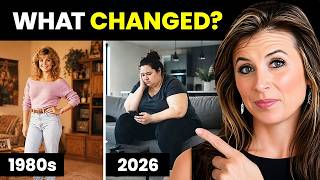
In this YouTube episode Dr. Ashley Lucas (PhD nutritionist, RD) contrasts the 1980s environment with today’s food and lifestyle landscape to explain why obesity rates have tripled in the United States. She argues that weight gain is not a will‑power problem but a physiological response to a dramatically altered environment. Lucas outlines seven key shifts that have made weight loss harder: (1) loss of structured, sit‑down meals leading to constant grazing and chronically elevated insulin; (2) portion inflation that forces the brain to finish larger plates; (3) the near‑ubiquitous presence of high‑fructose corn syrup, which drives fatty‑liver disease and blunts satiety signals; (4) a steep decline in non‑exercise activity thermogenesis (NEAT) as daily movement has been replaced by sedentary work and commuting; (5) the low‑fat craze that replaced dietary fat with refined carbs, destabilising blood‑sugar and hormone balance; (6) food‑delivery apps and 24‑hour availability that turn food into constant entertainment, overwhelming willpower; and (7) modern sleep disruption that raises cortisol and hunger hormones. Lucas reframes the problem as an environmental mismatch, then offers practical actions—eat real meals at set times, control portions, restore healthy fats, increase daily steps, protect sleep, and limit constant snacking. She promotes her PhD Weight Loss program and a supplement, GlucoCut Plus, as structured support for women seeking metabolic reset. The episode ends with an encouraging call to recreate the healthier conditions of the 1980s using today’s technology and resources.
Chapters
We're gonna go to the 1980s. You know, big hair, neon leotards, Jane Fonda's workout tapes, and women who somehow stayed slim without obsessing over every single bite they put in their mouth. If you remember your mom, your aunts, your older sisters during those times, you've probably wondered, how did they do it? Like, why does it feel so much harder now for me? This is exactly what we're going to unpack in this episode and If you want to hear me clearly, if your body has stopped responding the way it used to, this isn't a discipline issue. This isn't because you've gotten lazy or weak at all. Your body has not betrayed you. Might feel like that, but it hasn't. Your environment has changed underneath you, and we're gonna walk through exactly what shifted so you can stop blaming yourself and you can start understanding what's actually going on. So as I go through each one of these aspects, I'd really like you to take a minute, maybe have a piece of paper out, a journal, and write down what really resonates with you. Okay, that's a message that this specific pattern might be showing up in your life. Now, if this is one of the first episodes you've heard from me, I'm Dr. Ashley Lucas Lucas, I'm a PhD nutritionist, a registered dietitian. I'm the owner and founder of PhD Weight Loss, where to date we have helped over 13,000 people collectively drop more than 480,000 pounds nationwide. My goal with this channel is to give you the information that you need to create real sustainable change in your own life. Alright, so let's dive in. Before we get into what was different, I want to put a few numbers in front of you because I really find that this matters. In 1980, the obesity rate in the United States was around 15%. Today it's over 42%. 42%! That's nearly a tripling in just over 4 decades. Researchers estimate the average American is now consuming roughly 500 more calories per day than we did in the late 1970s, and most of those calories are coming from foods that didn't even exist in your grandmother's kitchen. Restaurant portions have grown by anywhere from 25 to 50%. I mean, can you believe that? That's massive. And the food on the grocery store shelf today is a fundamentally different product than what was on the shelf in 1985. If you go back and your grandparents, your parents say, you know what, I ate that food when I was younger, maybe they're talking about Snickers, they're talking about Triscuits, whatever it might be. If you were to see a box or a label of what those foods included, what the ingredient list was of those foods, same foods, versus today, it is completely different. Our foods have maybe 20+ items in the ingredient list, whereas before it was 4 to 5. So when you find yourself wondering why your body responds differently now, I want you to really hear this. Your body is doing exactly what it was designed to do. It's responding perfectly and predictably to an environment that no human biology was ever built to navigate. Now, it's really important to understand that this is not a willpower problem. This is a physiology problem. And once we understand that, we can actually do something about it. So if we think about it, what changed between then and now? Let's break it down. Number 1, they ate real meals at real times. In the '80s, 3 meals a day was simply the norm. Breakfast, lunch, dinner. People sat down at a table together to eat. There was no walking around with a coffee in one hand and a granola bar in the other. There was no all-day grazing. There were no Zoom meeting lunches, which I definitely participate in. I eat while I'm doing Zoom meetings. Not good, I know that. There was no constant snacking on protein bars and pretzels and energy drinks between every meeting. Food was a meal. It went together with a meal, sitting down, usually with community.. It wasn't a background activity that ran in the corner of your life all day long. And this matters more than you might realize. You know, when you eat all day long, your insulin levels stay elevated all day long. Your liver is in a state of storage rather than burn. Now remember what I always tell our clients at PhD: when insulin is chronically elevated, your body cannot effectively burn fat. It is locked away in storage mode. In the '80s, people had real uninterrupted hours between meals where insulin was able to come back down, and that allowed the body to actually be able to shift into fat-burning mode. That alone, before we even talk about food quality, made a huge difference. So I want you to take a step back, think about what I just said. Are you a grazer? Are you eating in a way that's not mindful? Think about what your patterns and your lifestyle habits are when it comes to food timing. And mindfulness around eating. Number 2, portion sizes were dramatically smaller, right? A bagel in the '80s was about 3 inches across and around 140 calories. Today, a standard bagel is 6, 6 inches across, and it's like 350 calories. A serving of soda used to be 6.5 ounces, and now the standard is 20 ounces. A muffin, a muffin used to be the size of a hockey puck, and today it is the size of a small softball. A cup of coffee was a cup of coffee, not a 24-ounce dessert with caramel syrup and whipped cream on top and the Frappuccino and the foam and all the sugar. Now, we're not eating more because we are somehow hungrier than our mothers were. We're eating more because the portions in front of us are physically bigger and our brains are wired to finish what's on the plate. A lot of us come from the clean plate club, right? And the food environment is doing the heavy lifting in the wrong direction. These hyper-palatable, highly addictive foods, and then bigger servings of it. Oh my gosh, really, really hard. Okay, number 3, high fructose corn syrup hadn't taken over the food supply yet. High fructose corn syrup existed in the '80s for sure, but it had not yet infiltrated every single product on the grocery store shelf. By the '90s and into the 2000s, it was in salad dressings, bread, yogurt, pasta sauce, deli meat. Really, it's, it's in everything. And here is why this matters so much, you guys. High fructose goes straight to the liver where it contributes directly to fatty liver disease. It also bypasses your normal hunger and fullness signaling, which means that your brain just doesn't get the message that you've had enough. So you keep eating and eating and you eat some more and it's going straight to the liver. Now you have fatty liver disease and you're thinking, what the heck is going on? You know, women in the '80s weren't fighting that battle in their kitchens. It just didn't exist. The signaling between their gut and their brain was largely intact because the food that they were eating actually still spoke a biological language that the body could understand. I don't know if it's exactly like this, but I don't know, taking a fish and feeding it dog food, like the fish doesn't really know what to do with the food that's not for its species, right? We're eating food that isn't meant for us as a species. Now, if you're sitting here and you're listening to this and you're thinking, Dr. Ashley Lucas, this is explaining so much of what I've been feeling, I want you to know you're not alone. This is exactly why I built PhD Weight Loss, to help women restore their metabolism in a world that has stacked the deck against them. We do the heavy lifting, we give you the customized plan that works for your body, we give you the structure, we take out all the guesswork, we provide you the support and the accountability so that your body can finally feel safe enough to let the weight go. Now, Now, if this resonates with you, you definitely should head over to myphdweightloss.com. You can check out the link in the description if you're watching this on YouTube, and one of our nutritionists, who are amazing, will walk you through how the program works. Number 4: In the '80s, they moved without calling it exercise. Now, you might be thinking, but Dr. Ashley, the '80s was the era of aerobics and step classes and Jane Fonda. They were exercising all the time. And yes, for sure, that culture existed. But the bigger truth is that the movement was simply baked into daily life in a way that it isn't anymore. People walked to their mailbox at the end of the driveway instead of having packages dropped at the door. Like, these little things matter. They mowed their own lawns. They cleaned their own houses top to bottom every weekend. They walked to the grocery store, or at least they walked across the parking lot. They got up off the couch to change the TV channel. They didn't sit at a desk for 10 hours and then sit in traffic for another 2 for a long commute. Now, this is called non-exercise activity thermogenesis, or also known as NEAT, right? NEAT stands for non-exercise activity thermogenesis. What it is, is it's the number of calories you burn just living your life, like fidgeting, standing, walking, carrying, climbing stairs, folding laundry and carrying it upstairs and back down, gardening, all of these things. NEAT has dropped significantly since the '80s, and for most women, that decline alone accounts for hundreds of calories of movement that just quietly disappeared from daily life, right? You don't need to add an hour of cardio to your day to make up for it. You just need to put movement back into the cracks of your normal routine the way that it used to be. I highly recommend some kind of pedometer, some kind of tracking, and getting your steps back up to maybe 8,000, 10,000 steps a day. I have a treadmill under my desk, and I raise up my desk and to walk throughout the day, getting outside and moving your body, whatever you can do to kind of get some of that non-exercise activity back into your life. Number 5: full-fat dairy and real foods were still normal. The low-fat craze was just starting to ramp up in the late '80s, but for most of that decade, whole milk, real cream, real eggs— they were still in the fridge, right? Real butter was still on the counter. Margarine was just coming into play. Cream went into coffee. People weren't terrified of fat the way that we became terrified of it in the '90s. And here's the thing your body wants you to know, is telling you: dietary fat keeps you full, it stabilizes blood sugar, it gives your body the raw materials it needs to make hormones. When we stripped fat out of the food supply and we replaced it with sugar, refined carbs, processed versions of the whole food we set off a metabolic catastrophe that an entire generation of women is still trying to dig out of. If you have spent the last 20 or 30 years afraid of butter, probably afraid of egg yolks— they seem to go hand in hand— maybe afraid of full-fat yogurt or cottage cheese, I really, really hope that you hear me. That fear was sold to us. It was not based on any science that your body actually runs on. So if you are eating egg beaters instead of the real whole egg, I want you to consume the, the version that actually came from the earth. Fat-free cream, Coffee-Mate instead of real cream. You know, think about that. Think about when— sit down and think about the foods that you eat that are processed version of real food forms. Okay, number 6: food wasn't entertainment and it wasn't everywhere all the time. There was no DoorDash, no Uber Eats, no food delivery apps, no 24-hour drive-throughs on every corner. If you wanted ice cream at 10 o'clock at night, you'd have to actually leave the house, get in the car, and go find it. Most ice cream shops were actually closed by 9. Friction was built into the system. You had to have a plan, you had to cook, you had to be intentional about your food. Today, every craving is one tap away from your front door. 24 hours a day, 365 days a year. The food companies aren't competing with each other anymore. They are competing with your willpower, and your willpower was never designed to fight that battle on its own. This is not a moral failing on your part. This is just engineering. You're dealing with biochemical engineering and engineering of Big Food to get you this hyperpalatable, highly addictive food at any time that your body craves it. All right, number 7, sleep was actually protected. There were no smartphones glowing on the nightstand, no infinite scroll at midnight, no blue light blasting your eyeballs at 1 in the morning. Most people went to bed when the TV signed off for the night, which if you remember actually happened. Sleep was sacred, and for most women it was uninterrupted except for probably when their kids needed them, right? Which still is the case, but now we have so many more interruptions. Now, this is why this matters so much for your weight. Poor sleep raises cortisol. I've talked about this a lot. Elevated cortisol drives belly fat storage. It also increases hunger hormones the very next day, especially the cravings for sugar, refined carbs, and high-calorie foods. The modern sleep crisis is one of the most underrated drivers of the modern weight crisis. Whenever I am dealing with a client at PhD Weight Loss where they say, oh my gosh, I'm doing everything right, I look number one at sleep and then at stress. And when we fix that, the weight starts to fall off again. Women in the '80s had this on their side without even thinking about it, right? They had more protected sleep. Now here's where I want to bring this home. None of this is about going back to 1985. We can't undo modern life, and frankly, we wouldn't want to, right? There are a lot of wonderful things that have come along in 2026, but what What we can do and what we need to do is recognize that your body isn't broken, your willpower isn't the problem. The environment has shifted underneath you, and your biology is doing exactly what it was designed to do in response. Your body never makes a mistake. Once we understand that, we can actually start putting the right signals back in front of the body, one piece at a time. Now, this is why I also created GlucoCut Plus. So many of the women I talk with inside PhD Weight Loss are dealing with blood sugar swings, crashes, metabolic chaos that women of the '80s simply didn't have to fight, right? The food supply changed, the signaling in the body has changed. GlucoCut Plus was designed to support healthy blood sugar regulation, to support your body's natural GLP-1 response, and help calm the cravings and energy crashes that keep so many women stuck. Now, if you'd like to learn more, head over to drashleywellness.com. I'll also make sure to include the link in the description here, and use code ASHLEY10 to get a discount. All right, ladies, so here is your takeaway, and I want you to really sit with this one. Your body is not failing you, it is responding, and it is responding exactly the way it was designed to do to an environment your biology was never meant to navigate. The women of the '80s weren't doing anything magical. They were not better than us. They weren't more disciplined. They weren't blessed with better genes. They were simply living in a different world. And the beautiful news is here, This is very encouraging and positive, actually, is that you can recreate the conditions of that world, an even better world, with all the benefits that we have in 2026 with AI and programs to support the body. And you can do this right inside your own home starting today. You're going to focus on eating real food, sitting down for your meals, giving your body a chance to feel safe. Put your phone in another room when you go to bed. Walk more, maybe cook a little more if you can, if you like that. Take fat off the no-fly list, add it to the good list. Stop snacking all day long, no more grazing. Put back together what modern life has quietly pulled apart for us. None of it requires you to be perfect. It just requires you to give your body different signals than the ones the modern world keeps shoving in front of it. And if you are tired of fighting your body and you're ready for real structured support, you can find us You know where to find us at myphdweightloss.com, or if you're watching this on YouTube, head on into the description to find the link. And remember, you've got to make the choice. You've got to step up to make the change. Lead with your heart, train your mind, and listen to what your body already knows. I'll see you next time.
More from Dr.





If I Was Over 50 & 30 Pounds Overweight, This Is Exactly What I'd Do to Burn Belly Fat


