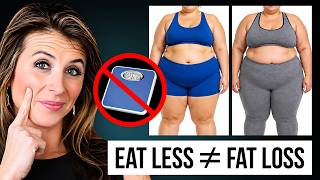
In this educational YouTube episode, Dr. Ashley Lucas, a PhD‑level nutritionist and registered dietitian, explains the physiological consequences of severe calorie restriction (under 1,000 kcal/day). She begins by prompting listeners to recall personal experiences of extreme dieting, emphasizing that any weight loss plateaus, fatigue, or weight regain are not personal failures but the body’s adaptive survival response. She outlines three core biological reactions: (1) metabolic downregulation, where the brain reduces thyroid output and resting metabolic rate by 15‑25 % to conserve energy; (2) muscle catabolism, where lean tissue is broken down for fuel, further lowering basal calorie burn; and (3) hormonal disruption, including elevated cortisol (stress hormone) that preserves visceral fat and impairs sleep, suppressed leptin that drives cravings, altered thyroid hormones, and sex‑hormone changes that affect mood, sleep, and body composition. Dr. Lucas connects these mechanisms to common symptoms—fatigue, dizziness, brain fog, cravings, and weight regain. She then presents a recovery nutrition framework: consistent adequate protein, healthy fats, fermented foods, non‑starchy vegetables, and regular meals/snacks to signal the end of famine, restore hormone balance, protect muscle, and enable sustainable fat loss. Throughout, she highlights electrolyte depletion as a frequent side‑effect of low‑carb, low‑calorie diets and promotes her own product, Electrolyte Plus, detailing its composition (sodium, magnesium, potassium, zinc, vitamin C, chromium) and its role in supporting adrenal function, blood‑sugar regulation, and immune health. The episode ends with typical YouTube calls to action (comments, reviews, product discount codes).
Chapters
I wanna start today by asking you to do something a little bit uncomfortable. I want you to think back to the lowest you've ever taken your calories, the most restricted you've ever been. Maybe you were doing a program that put you on 800 calories a day. Maybe you went lower than that on your own because the program wasn't working and you didn't know what else to do. Maybe you've never counted a single calorie, lucky you, but you know in your gut that there were long stretches where you were running on almost nothing. Maybe black coffee in the morning, something small at lunch, trying to hold out as long as you could before dinner. I know that's what it was like when I was dancing professionally. I was starving all the time, always hungry, and never really eating to support my body. Now, I want you to think about what happened when you did that. Did the weight come off? Maybe for a little while, maybe even a significant amount at first. But then did it slow down? Did it fully stop? Did the exhaustion set in? Not just like physical tiredness, but a kind of bone-deep fatigue that made it hard to concentrate, hard to show up the way you wanted to, hard to feel like yourself. And then think about it. Did the weight eventually come back? Sometimes quickly, sometimes with extra. Now, if that story sounds familiar, I want you to understand something deeply before we go any further. What happened to you in that experience was not failure. It was not a lack of willpower or a commitment issue. It was your body very likely doing its job with extraordinary precision.
If weight loss has left you with headaches, Fatigue, dizziness, or muscle cramps? This might surprise you. I'm Dr. Ashley Lucas, and one of the most common issues I see during weight loss is underhydration at the cellular level. When carbs drop, your body loses electrolytes, and water alone doesn't fix that. That's why I created Electrolyte Plus to support hydration, energy, your adrenal function, and blood sugar stability during weight loss and maintenance. This is hydration designed for real life, not just workouts. Visit DrAshleyLucas.com, use code YouTube10 for 10% off your first purchase or 20% off your first subscription order with free shipping. Plus, enjoy a 30-day money-back guarantee.
Back to the show. Today I'm going to explain exactly what happens to your body physiologically when you eat under 1,000 calories, because Once you understand it, I believe it will change the way you relate to your body entirely, and that ultimately is my goal for you. Now, I'm Dr. Ashley Lucas. I'm a PhD nutritionist, a registered dietitian. I'm the founder of PhD Weight Loss, where we've helped over 12,800 people to date drop more than 480,000 pounds nationwide. I have spent over a decade in clinical practice watching this pattern repeat over and over again. Intelligent, highly motivated, deeply committed people who restrict harder and harder and get less and less in return. Now, they're not failing the diet. The diet is failing them. So I want to talk about the biology. When your calorie intake drops significantly, let's say 800, 700, 600 calories a day, your body does not recognize a weight loss program. It has no context for your intentions. When it recognizes a dramatic reduction in incoming fuel and when it responds the way it has been programmed over hundreds of thousands of years of human evolution to respond to that signal, it prepares to survive. Now, the first response is a metabolic downregulation. And what I mean by that is your brain monitors how much energy is coming in and adjusts how much energy you burn to match that. It does this by reducing thyroid output. It does this by lowering the temperature you run at slightly. It slows the metabolic rate of your organs and it decreases what's called your resting metabolic rate. Your resting metabolic rate is the number of calories your body burns simply to keep you alive and functioning. Now, research has documented metabolic adaptations of 15 to 25% with chronic restriction. So what that means is that you are burning significantly fewer calories at rest than you were before you started the diet. You basically have a slower engine and that slower engine stays with you, right? It doesn't snap back the moment you start eating more. Like it can take months of strategic refeeding to actually restore it. Now, the second response is muscle catabolism. When there is not enough incoming energy and protein to sustain all of your tissues, your body prioritizes your vital organs. It's being smart, and it begins to break down muscle for fuel. Now, amino acids from your lean mass are pulled into circulation. They're converted, they're burned for energy. This is why people who lose weight on very low-calorie diets often look smaller, but they look softer. Same with GLP-1s. They just make you eat less and people are dropping massive muscle with the fat and they look really significantly older as a result and a little bit softer. Now, for these folks, they have lost both fat and muscle that used to give the body its shape and its tone. Now, this is really important. And even more importantly, they've lost metabolic tissue. Every pound of muscle lost is a further reduction in your resting calorie burn that makes the cycle continue to propagate and deepen. Now, if you've been through this more than once, if you've lost weight and regained it, lost it and regained it, and you feel like each cycle is harder than the last, that feeling is totally accurate, by the way, and it has a biological explanation. Your muscle has been depleted across those cycles. Your metabolism has adapted. Downward. Now, this is exactly what we repair at PhD Weight Loss. So if you're listening to this on a podcast platform, you need to come find us at myphdweightloss.com. If you are watching this on YouTube, the link is waiting for you in the description, so head over there to check that out. Now, the third response to the body when we chronically restrict calories is a hormonal disruption, and this one is often the most insidious because people don't connect it to their eating. Now, when you restrict severely, cortisol rises. I have a ton of videos on cortisol. So if you're interested in learning more about cortisol and you want to do a scientific deep dive with me, just head on into the description and we'll make sure to include a link. Cortisol is your stress hormone, and from your body's perspective, famine is a form of stress, right? A serious one. Elevated cortisol sends a clear signal to your fat cells and it tells them, hold on, preserve, something bad's happening, don't release it, I'm gonna need it later. And interestingly enough, cortisol is particularly protective of visceral fat. It actually helps you make more of the visceral fat, and that visceral fat is like kryptonite. You do not want it on your body. The visceral fat, by the way, you guys, is the fat around your belly and in and around the internal organs. You do not want this visceral fat because the body treats that as high-access emergency fuel reserve. So even if you're eating almost nothing, your body is actively resisting letting go of that fat that you most want to be gone. Now, this is not broken biology. This is exquisitely functional biology. It's operating exactly as intended. Now, I want to stay with cortisol for a second because this connection is so important. When cortisol is chronically elevated from restriction, it also disrupts your sleep. And now, you know, poor sleep then further elevates cortisol the following day. Then elevated cortisol suppresses recovery. It increases inflammation. We know that inflammation is the root of all diseases and it makes blood sugar harder to regulate. So you end up in the cycle where the restriction that was supposed to solve the problem is actively perpetuating it. Now you feel worse and worse while trying harder and harder. Now, if this resonates with you, please hear me. You are not doing it wrong. It's the approach. It's the approach itself that is the problem. Cortisol elevation also disrupts leptin. Now, leptin is the hormone that tells your brain that you have adequate stored fuel. And it's safe to burn fat. It tells you you are not hungry anymore. So when this hormone, when leptin drops, hunger is going to go up. Cravings for high-calorie foods intensify because your body's like, I need as many calories as quickly as possible. And your brain begins to override almost everything in pursuit of food, like it has one focus, and all it wants to do is have you focus on consuming consuming high-calorie, energy-dense foods like the donut, like the pie, like the pizza and the beer. So now I want you to understand that when you have breakdowns in your quote-unquote willpower or you feel like you are lacking discipline, you understand that these are not moral failures. It's a result of dysregulated hormonal signaling. Now beyond cortisol and leptin, severe restriction affects your thyroid hormones, which governs your metabolic rate, as well as reproductive hormones Now, in women, estrogen and progesterone can shift significantly with chronic undereating. This will affect mood, sleep, your cycle regularity, and body composition. In men, testosterone is suppressed. These are not minor side effects. This is massive. These are system-wide signals that the body is under threat. Now, here's what I want you to understand as a whole picture. When you eat 600 or 800 calories a day, you are not just creating a calorie deficit. You are activating a full biological emergency response that slows your metabolism, that breaks down muscle for fuel, that elevates cortisol, that suppresses fat burning, and increases hunger and cravings to a level that no amount of willpower can permanently override. You are fighting your own survival system. Your survival systems are older and more powerful than any motivation you can generate on a Monday morning. So how does this work? What does work? Well, the answer is consistently and counterintuitively to most people, eating more. But within eating more, eating differently than you're used to. Adequate protein at every meal, you guys, to protect and rebuild your muscle. Healthy dietary fat to slow digestion and stabilize blood sugar, enough total calories distributed throughout the day to tell your body that famine is over, that there is enough, that it is safe enough to release stored fat rather than to hoard it. Fermented foods to support the gut microbiome that regulates hunger and fullness hormones. Non-starchy veggies for fiber and those very important micronutrients to support your mitochondria. Now let me make this concrete because I do find that people really need to see it. Breakfast that centers 2 to 3 eggs, real food, instead of what I used to do a lot, I will say, a protein bar, maybe a smoothie, uh, maybe black coffee until noon. This is not going to support your body and get it out of survival mode. You want a real first meal with protein and fat and some veggies. And I know here I'm even talking to myself Maybe some fermented sauerkraut on the side to support the gut. Lunch built around quality animal protein over greens with a real dressing. Olive oil is what I'm talking about here. Not fat-free, not low-fat, because fat slows digestion and helps you stay full. A mid-afternoon snack. Do not skip your mid-afternoon snack because you just want to save calories because you're not super hungry. I cannot stress this enough. If you skip your mid-afternoon snack, you're gonna be in trouble later on. When you have a mid-afternoon snack, it prevents you from arriving at dinner in a state of desperation where every good intention goes out the window. I want you to be so successful when you enter into your dinner meal. So a good snack might be something like a full-fat plain Greek yogurt with berries, maybe some hard-boiled eggs with salt. Do not skip the salt. Maybe some bone broth if you like that, add a little bit of butter on top, it's delicious. And then you want to go into a dinner that again centers protein with veggies and healthy fats. This is not a starvation approach. This is a generous nutrient-dense, it's a strategic, it's, uh, intentional fueling. Now this is the opposite of what most people have been told to do when it comes to weight loss. Now, When these pieces come together, something shifts in the body that restriction alone can never produce. Cortisol starts to come down, leptin starts to normalize. So you're going to feel like you've actually eaten. The metabolism begins to recover. Muscle is protected, which is super important. Cravings quiet down, not because you're white-knuckling through them, but because the blood sugar and the hormonal environment that was generating them has totally changed. You know, it's really interesting. If you go to our website, myphdweightloss.com, and you read some of the stories, you will see people over and over and over again talking about how they're not hungry, how their cravings have gone down, how they feel liberated from food. This is because we're actually feeding people more. Now, fat loss happens not as an act of force, but as this biological consequence, a really fun consequence of a body that finally feels safe. Now, something worth knowing as you move through this recovery process, one of the things that can go sideways quickly when the body has been under restriction and has been stressed a lot is electrolyte imbalance. Your adrenals take a hit, your hydration suffers, and, and together those two things contribute to the fatigue and the brain fog that makes everything a bit harder. So I made a product. It's called Electrolyte Plus, specifically with this situation in mind. Now, it's not just sodium and magnesium, potassium. It has that, of course, as well. But it includes really high-quality patented forms of zinc and vitamin C for immune support and adrenal support, because we have to support the adrenals when we are dropping weight. It also includes chromium to help with blood sugar regulation and cravings, and it's something that the majority of our PhD weight loss clients use. And if you are a client at PhD weight loss and you're not using it yet, you need to because it's going to help your metabolism repair, and you will find that you feel better during the process of dropping weight. If you are on a GLP-1, you must be taking an electrolyte. So even if you don't go the Dr. Ashley wellness route, um, you should find an electrolyte that you love. If this specific electrolyte interests you because it has been made specifically for folks who are dropping weight or maintaining weight loss, you should check it out. Go to drashleywellness.com. The link is in the description. Use code ASHLEY10 to get a special discount for being on this YouTube channel and on this podcast with me. Now, if this episode resonated with you, a review on your podcast platform goes a huge way. I really appreciate you listening. If you are watching this on YouTube, please drop your comments below. If you have questions, if you had feedback, I want to hear it. Remember, you've got to step up to make the change. Lead with your heart, train your mind, and do not negotiate with your body. I'll see you next time.