What to Eat for Breakfast to Lose 20 Pounds in 30 Days — Backed by a PhD Nutritionist
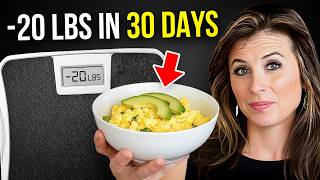
A YouTube episode by Dr. Ashley Lucas (PhD nutritionist, RD) explaining how the first meal of the day can switch metabolism toward fat-burning or fat-storing. She argues high-sugar, high-carb breakfasts without protein/fat/fiber spike insulin and promote fat storage and metabolic dysfunction, while breakfasts with ~30–40 g high-quality protein, healthy fats and low-glycemic carbs support satiety and fat loss. She gives example meals (eggs with avocado and veggies; full-fat Greek yogurt with berries and nuts; protein smoothies; savory leftovers), lists foods to avoid (most cereals, many oatmeals, fruit juices, sweetened yogurts, granola, bagels, sweet lattes), and mixes personal history, mindset coaching, and promotions for her PhD Weight Loss program and supplements (Dr. Ashley's Electrolyte Plus; Glucocut Plus).
Chapters
What if I told you that the way you're eating your breakfast is the actual reason why you can't drop that last £20 no matter how hard you try? The truth is, the first meal of your day actually flips this biological switch that either allows your body to burn fat for fuel for the next 24 hours or for you to store it like it's that big of a deal. So today I'm going to break down exactly what to eat for breakfast, to lose up to 20 pounds in 30 days and finally feel energized and can control and have this level of fullness throughout the entire day.
Hey, really quickly. If you're interested in hydrating yourself optimally and want to do it in an efficient and effective way, I created an electrolyte plus mix just for that. It's called Dr. Ashley's Electrolyte Plus Creative.
I know.
And it's crafted with essential electrolytes, vitamins and minerals for maximum absorption. With patented forms of zinc and vitamin C, it supports immune and adrenal function. Plus chromium picolinate regulates healthy blood sugar levels while helping to curb those cravings. Say goodbye to headaches and fatigue. Visit DrAshleyWellness.com and use code ASHLEY10 for 10% off your first purchase or 20% off your first subscription order with free shipping plus enjoy 30 day money back guarantee. Now back to the episode.
Welcome to the Dr. Ashley Show. I'm Dr. Ashley and I am a PhD nutritionist and a registered dietitian. I'm also the owner and founder of PhD Weight Loss and Nutrition where we have to date helped over 11,000 people drop more than £480,000 nationwide. My goal with this channel is to give you the information you need to create positive change in your own life where you can drop this weight and keep it off long term. Now, when I was a professional ballet dancer, I tried every diet under the sun. I was vegan, I was vegetarian, I ate fruit only. Like I remember, for two weeks I only ate watermelon because for the sport, for dancing, I had to drop a specific amount of weight to be considered for a role. I did terrible things to my body by the way that I ate for years. I didn't eat any dietary fat. I thought fat fat was how we got fat. So I would have deli turkey with spray butter on it and then for a snack I would have that instant fat free pudding that somehow solidifies like a science experiment in front of your eyes with some fat free Cool Whip on it and oh my gosh, My body struggled. It could never hit the weight that it needed to. I am way leaner now than I ever was during my ballet career and I do not fear fat. I do not fear food. I am full pretty much all the time. My husband says that I am just like a natural GLP1 factory. My body just makes it because of how I've trained it and how I eat it and how I live my life. And that is my ultimate goal for you. I want you to be able to flip this switch in your body where you're able to burn stored fat for fuel, because that's how you are able to let go of the food noise and the food chatter. That's how you're able to consume healthy fats and the foods that actually give you life back. That's my ultimate goal. And I have experienced my own challenges when it comes to weight and metabolic dysregulation and have been able to get it back. And I know that you can too. Now, if you feel like this has just been a constant struggle, this weight gain, weight loss, you seem to yo yo. You can't seem to figure out what foods actually support the body. You feel like you're eating healthy and just not moving on the scale, then you should definitely check out PhD weight loss. I have created this program from my own challenges and experience, and I'm so grateful for the opportunity to have positively impact thousands of lives and get people out of the spiral, the yo yo and the constant struggling with their weight and their mindset around their body. So if you're listening to this on a podcast platform, please go to myphdweightloss.com if you are watching this on YouTube, head over into the description, click the link to learn more. And we are here for you. And I would be so excited to hear your journey of success. So when we talk about the importance of breakfast, I want to clarify a few things. Now, I don't believe that breakfast is the most important meal of the day. This was actually a marketing slogan that Kellogg came up with in 1944 to sell his breakfast cereals. By the way, and I'll talk about this a little bit later, breakfast cereal is one of the worst breakfasts that you can eat. So if you are listening to this and you eat breakfast cereal, I want you to let it go. I know we might be like addicted to it. It might be so hard because it's connected to us with some type of emotion, but I promise you, it is not serving you. It was not created to serve your body. So if you are listening to this and you eat cereal for breakfast, let it go and you'll thank me later. Maybe you won't, maybe you'll hate me later, but it still is going to be the best move for you. There's actually a story around Corn Flakes where it was created for a bunch of men who were in like a mental health institute and they wanted to reduce their, like, virility and their energy. And so they gave them corn flakes to basically like castrate them energetically. So you don't want to eat Corn Flakes if you want to have energy and vitality and vibrancy. So anyway, breakfast is not the most important meal of the day, but what you eat in your first meal is very important because it sets the tone. I know that's kind of confusing, but what I'm saying here is that you don't have to eat right when you wake up if you don't want to. Now, if you are a PhD weight loss client, your nutritionist has given you the perfect recipe and protocol for your body. So if they have told you to eat at a specific time, which likely they did, then you want to keep that. You don't want to go back to them and be like, Dr. Ashley on this episode said that I don't need to eat breakfast at 8am like my meal plan says, follow your meal plan. That is right for you. You are not hungry in the morning and you're not a PhD weight loss client and you feel like you forced yourself to eat at 7am Then maybe your body's telling you that you do not need to eat or right at 7am but the first meal you do eat, maybe it's 11am, maybe it's noon. You really want to focus on the combination, the type of foods you're consuming and still not eat cereal. Because again, it's going to either flip on or flip off the switch to burning fat for the rest of the day. If you eat foods in that first meal of the day that are higher carbohydrate high sugar, without especially without protein or healthy fats or fiber, it is going to mess with your blood sugar rhythm for the rest of the day, it's going to spike your blood sugar and your insulin levels and then you're going to have this compensatory crash and you're going to be on this roller coaster of unsteady and unstable energy for the entire day. That means cravings, that means hunger, that means binging. Later in the day, you might think that your binging later in the day is not associated with the first meal that you ate, but it likely is. Now, I want you to realize that the body can only tolerate one to two teaspoons of sugar in the bloodstream at any given time. Now, that's actually not that much sugar. So if you were to consume, let's say, Raisin Bran with some skim milk and a banana, one of the worst breakfasts you can consume, by the way, that's gonna give you 19 plus teaspoons of sugar. Now, the body needs to mount a response to that. It needs to get the sugar out of the blood because it's toxic when there's that much sugar in there. So what it does is it tells the body to release insulin, it tells the pancreas to release insulin. And I want you to imagine that insulin is like a key. And what happens is that insulin, that key travels around to your muscle cells and it tries to open up the cell. So that sugar that you just consume, that's in the bloodstream, can flow in and your muscles can use that for energy. Now, what happens over time is we become insulin resistant. And I want you to think of insulin resistance like these cells forming a callus over them. So now when insulin goes around and travels around and tries to open up the cell, it just bounces off the cell wall and your cell is left stuck shut. So now this sugar has nowhere to go, right? It's stuck in the bloodstream. The body doesn't like that, needs to solve this issue somehow. So now what happens is the sugar flows into the liver and the liver needs to get it out, right when it's overflowed with all this sugar, so it starts to convert the sugar into fat and you get fatty liver. That's why we can totally reverse fatty liver by how you're eating and what your lifestyle is like. But now, if we follow this process, now you've got fatty liver, and now the liver is filled with sugar and it's filled with fat. What's it going to do? Well, it has to eject the fat somehow and ejects it into your bloodstream as LDL and vldl. Now you've got elevated LDL and VDL in your lipid profile. When you get your basic lipid blood panel and your doctor says, oh, no, you've got high cholesterol and high ldl, you need to eat less fat. It makes no sense, right? It doesn't make any sense at all. But now you can see how the body gets stuck in this fat storage mode. Right. Storing fat, gaining fat weight is actually a protective mechanism against having too much sugar in the blood, against becoming pre diabetic and type 2 diabetic. When you become pre diabetic and type 2 diabetic, it just means the body can't keep up with it. And it's converting this excess sugar into more stored fat to try to get it out. Right, it's trying to get it out of the system. So now you understand kind of the biochemistry, the metabolic insult that we can create when we eat a certain way, specifically that first meal of the day. So what do we want to do instead? Well, the framework is when you are crafting your breakfast or your first meal of the day, about 30 to 40 grams of protein and high quality protein. When I talk about high quality protein, I mean from animal protein. If you can do it. This could be chicken, it could be pork or beef or seafood, or a Greek yogurt or cottage cheese or eggs. I'm sure I've missed some, but those are some ideas. This is going to trigger your muscles to start building, which we want, and it's going to trigger fat burning. So the stuff that we have stored as fat, we can open up the padlock, so to speak, on those freezer stores of fat and start bur freezer stores for fuel. Healthy fats. You want to make sure that you eat healthy fat and you now know that fat's not going to make you fat. It's just going to help you stay full. It's going to tell your brain that you've been fed. It's going to help stabilize blood sugar levels and then focus on low glycemic smart carbs. These are carbs that have more fiber, they have less sugar. They're going to help to support the slow and steady energy and give you the nutrients that your body needs. Here are some eggs with avocado and veggie, a full fat or low fat plain Greek yogurt with berries and some nuts on top. A protein smoothie with a base of an unsweetened almond milk, frozen berries, some protein powder. You could throw some spinach in there if you want to, and maybe some avocado oil or MCT oil. Or you could have a savory breakfast. If you're eating a savory breakfast, it's likely pretty much in line with this fat burning breakfast formula. That could be like chicken and veg, or it could be leftover fajita meat with some avocado on top. I don't know. You can get creative here Breakfast doesn't have to be something that's sweet. If we're craving sweet in the morning, it's likely because we've been knocked out of fat. Burn anyway. Now, if you feel like you're doing everything right, you're eating this way already, and supplementation seems to be something helpful for your body that your body responds positively to, then you could definitely check out my supplement that I've created so specifically to support stable blood sugar levels and preserving muscle mass during the process of losing weight. It's called Glucocut plus, and it is amazing. And my clients who take the supplement seem to find a lot of great benefit in helping to reduce cravings and hunger and stabilize blood sugar throughout the day. So if you are listening to this on a podcast platform, head over to doctorashleywellness.com to check it out. If you're watching this on YouTube, go into the description, click the link and and there will be a special discount code for you. Ashley10 Just enter that at checkout and get to 10% off breakfast. What to avoid we talked about the stuff that you want to focus on and I did allude to. Not even allude. I was actually quite transparent and open on the idea that I do not like cereal. Now, if you must consume cereal, there is one brand that is decent. It's Catalina Crunch decent. Magic Spoon decent. I just don't love it because all of them are so processed. Right? So if you again need a cereal, those are going to be your better brands. But I would prefer to see you eat whole food that like came from the earth without a lot of processing. Other foods that aren't good. Oatmeal, even steel cut oatmeal. I know it's a bummer. We think that oatmeal is great, but especially alone. Especially like we go to Starbucks and we get the oatmeal with brown sugar and raisins on it. Oh my gosh. That is just to spike your blood sugar like crazy. Fruit juice and smoothies made with juice. If you go to a smoothie shop, it's likely a sugar bomb. Even if they put protein powder in it. You manipulate, go in and manipulate that smoothie with what you've learned here. Lowfat or non fat flavored yogurt with fruit on the bottom. Noosa. All these brands. I actually have a video where I rank the best yogurts. So if that's something you're like, oh my gosh, I just love yogurt. I want to know what to eat. Go into the link of this YouTube video here and click on that and learn how I rank those yogurts, cereal, granola, toast, bagels, oat milk, lattes, unfortunately are going to spike your blood sugar pretty significantly, especially if you're not adding some kind of protein and fiber to it. Remember, it's going to be such a huge payoff when you start your day differently. When you focus on savory, protein rich foods, your cravings disappear, your energy stabilizes and fat loss happens so much more effortlessly. I know that making these changes can be a big deal, especially when we are emotionally tied to certain foods. I say that weight loss is a process of letting go, right? Letting go of this excess fat weight that doesn't serve you, the emotions tied to it, potentially. Some of the foods that don't love you back, right? These are the foods that you might say you love, but they do not love you back. It's like this dysfunctional relationship that we just need to be made aware of. And oftentimes we can get into this feeling of deprivation and restriction, you know, like, oh my gosh, I can't have that. We focus on what we can't have rather than what we can when there are likely so many more options that you can have than you can't. But oh my gosh, the human condition is to focus on the 20% that is going wrong. Right. So I often tell our clients at PhD weight loss, what's wrong is available and so is what's right. Right. It's about getting better and not bitter. We could be bitter about the foods we can't eat, but what is that going to do? That's not going to serve us. You don't need to eat less. It's about eating the right type of foods that actually give you the health, the vibrancy, the energy back so that you can enjoy life in your physical form. So it's really interesting when we look at the research behind our mindset and the words that we speak to ourselves and how significantly that impacts our body physiology. The words that you use actually trigger the brain to release specific hormones. So if you tell yourself, oh my gosh, this breakfast sucks, it's not filling, it's not exciting, I want my cereal, I want my steel cut oats and my raisins, whatever that might be, then your body's actually not going to produce the same amount of full hormone than if you looked at that egg and veggie omelette and said instead, oh my gosh, look at it, it's so beautiful. It's so Filling. I'm so grateful that I've got this healthy food and that my body is starting to work for me again. When you speak to your body, to the food in this way, your body's actually going to produce more of the full hormone called leptin, and you're going to be full longer throughout the day. It's pretty remarkable. I love this stuff and it blows my mind. So I want you to remember as you're going through and making these transitions and these changes, what are those positive thoughts that you can have? How can you remember that you're getting better and not bitter? How can you let go of the state of deprivation and restriction? And one for fullness and wholeness and gratitude. One of the things that you could do is write down on a piece of paper what you are grateful for and the positive things. I call it a gratitude shower. If my kids are being grumpy, I'm like, okay, well, what are the top four things we can focus on that we can have gratitude around? And usually they're like, oh, mom, this is so stupid. But I promise you, in the end, they do have a smile on their face. Or maybe they're just doing that for me so that I leave and leave them alone. But this is what I leave you with, is how can we get rid of these sabotaging thoughts? Not rid of them, but how do we help them lose their power? It's our job to weed the garden always up in our mindset. And so this week I encourage you as you making shifts to when you eat your breakfast or what types of food you eat for breakfast, how can you continue to weed that garden and cultivate the type of mindset that's going to serve you moving forward? Okay, you guys, if you are listening to this on a podcast platform, please leave a review. If you are watching this on YouTube, I encourage you to subscribe so that you do not miss another video. Drop your thoughts in the comments below. We are a community here to help support and raise each other up. What are you going to do differently? What are you nervous about? What are you excited about? What has worked for you that might work for someone else who's reading the comments below? All right, remember, you've got to step up to make the change. Lead with your heart, train your mind, and do not negotiate with your body. I'll see you next time.
More from Dr.





If I Was Over 50 & 30 Pounds Overweight, This Is Exactly What I'd Do to Burn Belly Fat


