Dr Gina and Dr Diane Masterclass on Brain Fog and Fatigue
Dr. Diane Mueller and Dr. Gina Datoli break down four main causes of chronic fatigue and brain fog: hidden infections like Lyme and H. pylori, sleep problems including sleep apnea, hormone dysregulation, and impaired toxin metabolism from mold or metals. They walk through patient cases and explain why specialized testing often isn't covered by insurance.
Questions this video answers
January 18, 2024
About 80% of 80-year-olds (quoted in the talk)
$250 (refundable if cancelled within 48 hours)
24 hours
$49 to $1,100 per month (ranges described for follow-up plans)
Chapters
Hey, everybody. Welcome to tonight's webinar. I'm so excited to hear to have you here. So excited to be chatting with you with my friend and colleague and co worker, Dr. Gina. And we're gonna, I'm gonna let everybody trickle in for a moment. Usually on these times when we start right at 5, people will trickle in. So as you guys are trickling in, let me make sure my chat is totally active here. As you guys are trickling in the biggest can you guys could type in the chat for me and I might have to reclaim host for a second. So if you guys could type in the chat for me what's where you're from and what you are hoping to learn tonight. Because we want to make sure that we are really orienting this to what is best for you. So two things, where you're from, what you're hoping to learn tonight. And, and then we can make sure that we are orienting this to whatever is best for you guys to learn. So I'm going to go ahead and launch us off on our, you know, kind of our overview of what tonight's about. And then Dr. G and I will tell you a little bit about why we are passionate about this topic. And we'll get into the nitty gritty of tonight's context on chronic fatigue and brain fog. So we're going to talk about some of the top root causes of fatigue and brain fog. And so common, right, that people come in and they're told over and over again that they're normal or that their labs are generally normal. And it's very common that we see that people are told that they've had everything tested that needs to be tested. Right. And that's so not true from a functional root cause perspective. So when you're going through this material and we're, you're listening to this, one of the things to be listening for is what am I missing? Right? There are going to be some things that you know about. There are going to be some things that you're like, oh, yeah, I've probably had that tested before. But the goal is for us to help find those missing links, right? That's part of what we're doing here tonight. So we really want to make sure. So I would orient in your mind to that. So, oops. That should say we, we will cover one of these five really thoroughly. So we're going to essentially we're going to go through these. We only have you guys for a short amount of time tonight. Dr. Jean and I were just Talking about offline, about how we could actually spend like so much time going off about all these topics. So we're not going to be able to do that because we can't keep you guys here till next week. So we're going to give you kind of that brief rundown of some of the high level things and then basically give you stuff at the end of how you wind up getting more information. So I'm going to turn the floor over to Dr. Gina here. But what I'm going to do here is, is in the chat I'm going to put this link. So if you guys did not get this downloadable handout, then make sure you get this because that is going to have information on it. It's going to help you follow along. And if you turn it in, then we give you a surprise bonus. And go ahead, Dr. Gina, why don't you tell us why you're so passionate about this.
And yeah, so I'm Dr. Gina Datoli. I was very classically educated. I went to the uniformed services, which is a very classical MD program. And then I got into practice and I had 15 minute visits which was enough time for me to say, okay, here's your diagnosis, here's your pill, get out of my office. Which did not work because they would just come back to me later on and need more medicine and they weren't doing any better. And I thought, you know, something's not right here. But I didn't actually do anything about it until I got an up close and personal experience with chronic fatigue. Found myself unable to get off the couch, unable to work. But we'll, we'll talk more about that later.
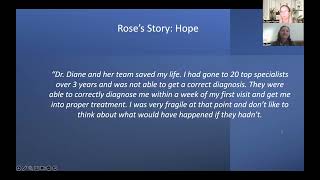
Amazing. Thank you. Yeah, there's like, I, you know, I think we find so much and so many of the people we see at my lying doc, it's like looking for people that have gone through this stuff before and you know, validation and all of that sort of stuff. And you know, like you, it's like I had my own bout with it where so fatigued and I was like memory loss, forgetting where I was living like pain so bad I thought my leg was being sawed off. So it's a huge part of why we're doing, you know, what we're, what we're doing here. So I'm so glad to be working with you and all of this. And you guys, Dr. Gina will share with you, like she said, more of her story here in a little while as you know, just some good information on like how we can recover and the process she took and those sorts of things. So to get into some of the nitty gritty, right? So hopefully you got your worksheet. What we're going to do is go through these one by one. So this is one of your first worksheet answers, which is one of the root causes. Root cause number one. What is root cause number one? And it's chronic hidden infections. And I feel like Covid and that whole, you know, the whole Covid craze, the whole crazy scenario with COVID one of the things that it did when very small, small silver lining and that mess was it did bring a lot more awareness to infections and to the long. You know, it's like the long haul scenario that we talked about, talked about with COVID And Covid is not what I'm talking about here. Covid is something we could talk about in the chronic hidden infection world. But what Covid really did was it started this conversation more in the public that some of us in functional medicine have been talking about for a long time, which is these chronic hidden pathogens. We call them stealth pathogens. And that's because from a standpoint of stealthiness, what these infections are really good at is going and hiding, right? They're good at going and hiding. And when they hide, they hide in our cells. And one of the things that will happen is oftentimes these basic blood work panels that we do are negative because these stealth pathogens will go in and out of activity. So they'll go into this dormant state. State when they're dormant. What tends to happen is people might have a time period, maybe it's a day, maybe it's a week, where all of a sudden they're like, I think I'm getting better. And then all of a sudden they come out of dormancy and you feel really bad again. And this is like the most mindboggling thing when we have this chronic stealth infection. Because what I find people do is they start going through like, well, did I eat something different? Did I sleep different? What did I do different? Was it the exercise? Was it the fact that I had pizza three nights ago? Was it the gluten? And of course, some of those things can be impactful to us, and we want to take those into consideration. But oftentimes it's not those things. That's these underlying types of infections that are coming in and out of hiding. And the other thing that stealth pathogens will do is a lot of them have tails. We call them flagellas in medicine. And with these tails, they will literally basically Think of it as like swimming around the body. They'll relocate. And so in that scenario, you might have problems in one body part one day. And then it's like, it seems completely unrelated because then there's going to be problems in another part, another day. And an area where I see people completely lose their mind on this is, okay, we have a, you know, a headache one day, so we go to see a neuro, neurologist and the next day the headache's not there as much and maybe it's joint pain. So then we end up at the rheumatologist and we're constantly going from like doctor to doctor, chasing sickness symptoms, when there's this fundamental thing that is tying the whole picture together that really gets lost in it. Right? And so then your next worksheet answer is telling you about some of these common stealth pathogens. Like, these are the ones, these are ones that we see come up a lot. This is by no means a complete list, right? These are the top ones that we see come up over and over and over again. So Borrelia, which is Lyme disease. And the thing to know about Lyme disease, if you guys have tested yourself, because I imagine some of you guys have, is that the standard tests on the market are missing lot of Lyme disease. And that's because there's about a dozen species that will actually cause Lyme disease. And the standard tests are only looking for one of those species. So we really want to be careful too. It's like the test comes down to the quality of the test that's done, the fact that the right test is ordered, and then of course the nature of the quality of training of whoever that is interpreting the test. So there's way more to it than just like the test. So what I don't want you guys to do is like read this or hear this and be like, I'm going to go get Lyme tested and think that it's negative. Maybe it is. But you want to make sure you have the right test. So hidden viruses can do this, Bartonella can do this. Toxoplasma. Toxoplasma is a parasite. This parasite is found a lot of different ways. It's cat urine is a common way people get this, but it's also an undercooked meat. And it's estimated in research that 80% of 80 year olds have toxoplasma. And that's because we have so much exposure to it, right? It's, it's not because, oh, immune system's down it's because it's so many exposures over so many lives and eventually anybody, because it's so ubiquitous, it's everywhere in the world. And so the likelihood that we're going to eventually get this is really high. And I've seen situations where people have like constant chronic pain and we treat them for toxo and then all of a sudden the chronic pain just completely goes away. So absolutely want to consider that as well. And then H. Pylori, and H. Pylori is actually just talking to a client about H. Pylori before this call. H. Pylori is super interesting because H. Pylori is one of these things. The common test for it is the breath test. It's not a bad test, but it doesn't always catch H. Pylori. We can also test for it in the stool. So it's good to have check and balances. But H. Pylori, you really want to get this one quantified. And by quantified, like not just telling positive, negative, you want to know the level of quantity that is actually there because there can be certain quantities that are still like under the radar of where you would typically diagnose with somebody as a problem, but they could actually be leading to things like gastrointestinal ulcers or food malabsorption where you're not absorbing nutrients. So H. Pylori, we put this one on here in part because when we're talking fatigue, when we're talking brain fog, we have to talk about nutrients, right? There's so many nutrients that go to the brain to give the brain energy, Choline being one of the major ones. There's so many nutrients that go to the cells to give the cells energy. Magnesium and CoQ10 and carnitine and alpha lipoic acid. So all these things oftentimes people will read online like, I need energy or I need better brain function and they'll put themselves on these things when the fundamental underlying reason they're actually deficient is because of some sort of chronic, hidden, low grade infection. So that's kind of the breakdown on some of the top things. Like I said, there's obviously more infections we can talk about than this, but these are some of the top ones that I want to make sure that you guys are thinking about. And if you've done all these, still consider the fact that there's still plenty more talk or plenty more infections that we can test you for. We just don't have time tonight to talk about every possible infection out there. So this was Our client, Rose. Rose had she. When she came to the office, she was a complete wreck. She was barely functioning. She had to quit her job. She had moved multiple places. She left her state. Where she was from, she was from Texas. And she left her state because of just how she was doing and needing to move to a different environment. And when we first found her, when she first came to the, to the office, the number of different things from infections, from toxins, the laundry list of things, right? And she's like most of our clients that has gone through special after special after. Specialists can't get the right diagnosis, can't find the root cause. And that's why, you know, in part why we're doing what we're doing is because the idea is find, stop the leak, right? Find that plug. And we find that plug by saying, what are the tests that are missing? It's like so many people I find sometimes come and they're like, what do I do to treat brain fog? What is that supplement? And, and there's not a. You can read online and it'll be like, oh, yeah, use this to use this to improve brain function. Use to help with energy. You know, I see the same. The weight loss community is classic for that. You lose that to use that to lose weight. Nothing's going to work unless we actually figure out what the thing is, right? So if you take CoQ10 for energy because you're fatigued, but your body already has enough CoQ10, you're just going to make your urine and stool expensive because you're going to get, you know, you're going to excrete that COQ10 out because you don't need it. That's not the fundamental reason for the fatigue. Fatigue. So so many people come in, are looking for that magical supplement. It's not a magical supplement. It's a magical root cause as a magical test that's going to tell us where that leak is. So that's why we're focused on that for this particular webinar. And then I will let Dr. Gina talk about root cause number two. And I'm not seeing anybody post in the chat. So please tell us, you guys, what you want to learn today where you're from.
Yeah, we love to hear it. So, you know, sleep obviously very important, but what's interesting is that, you know, some of our patients will say, but I'm slee sleeping eight hours a day a night. I should be good. But that's the thing is that sleep quality is very different from sleep quantity. So you know, sleep quality can be impacted by all sorts of things. You know, stress medications, chronic infections, as well as our anatomy. And that is. That's a big problem that we are seeing more and more in our society is it's not unusual nowadays for people to be sleeping with their mouths open or to have sleep apnea, where their throat actually closes up and they don't get enough oxygen. And so their body constantly wakes them up. Because you're not getting enough oxygen, you wake up and then you fall back asleep, and then a few minutes later, it happens again. And some of these people are waking up, like, upwards of 50 to 70 times a night. Well, if you do that, you are not going to feel good, right. And your body's not going to be able to repair from some of these chronic infections. And, you know, Dr. Diane talked about this is a lot of times with our patients, it's not one thing. It does not tend to be just, yep, you've got this and you're good. It tends to be just this cascade before the body really starts breaking down. And sleep is one of those that we see. And it's very interesting in that with sleep apnea, we're seeing it more and more. And there's a few reasons for that. One is our nutrition, one is toxins, and one is it's not cool to breastfeed anymore. And so if infants are breastfed, they're not breastfed for very long. And so the jaw does not develop properly. So if you actually look at pictures, you can actually see from 100 years ago, their jaws are much wider than pictures of people today. It's fascinating. But that is really important because if your jaw is not wide enough and you sleep on your back, your tongue goes back and it blocks that airway. You may not even realize it. You may not even realize that your sleep is so bad. But that can cause all sorts of fatigue and brain fog and weight gain and high blood pressure and all sorts of problems. You know, so that is a really important thing that we make sure that sleep is optimized, that you are getting that REM sleep, you are getting that deep sleep. You know, mouth taping is one of the strategies that we can use. There are also oral appliances that we can do. There's a lot of stuff we can do, but this is I a crucial component, because if you are not treating this, you're not going to get better.
Amazing. And here's your worksheet answer.
I love these tests. We get the right answer. It's great.
Exactly. Exactly. We can't lose. It's so good.
Right?
All right, root cause number three.
All right, so let's talk hormones. Okay, so there are a lot of different kinds of hormones in the body, and the body regulates them very closely. And in our society, they tend to get off. And, you know, there's a reason for that, because we have a lot of toxins in our society, and we have a lot of things in our food supply and our water supply that are hormone disruptors. You know, BPAs and plastics and, you know, now everything's BPA free, but the stuff they replaced it with is just as bad. They just haven't done the studies on it. So, you know, it really causes a lot of problems. And also, you know, we find that those chronic infections are going to impact the hormones as well. So I want to go through some of the. I think it's the next slide. Some of the different types of hormones that are going to be affected here. So you've heard of the adrenal glands. They sit right on top of the kidneys. And the adrenal glands actually produce a whole ton of hormones. There's like 10 of them. But the one you've probably heard of the most, and the one we see a lot as a problem is cortisol. So cortisol is your fight or flight hormone. It's really the hormone you need to get up in the morning. Without cortisol, people, they just can't get up. But what we see is not necessarily strict, just deficiency of cortisol. What we see is dysregulation. So, you know, the cortisol may be high when it's not supposed to be high and low when it's not supposed to be low, or, you know, it may be chronically running high or chronically running low. And this can have a huge impact on energy. It can have a huge impact on sleep. And unfortunately, and as a conventional provider, I can definitely tell you, this is the, the test that we have for adrenal dysfunction, they're not very good. I can tell you if you have a strict deficiency with that test, but I can't tell you more than that. So if you have dysregulation and you're still producing cortisol, I would tell you as the conventional doc, you're normal, you're fine. And that's not true. And so we have specialized tests that we do to really dig into this and find out what is that cortisol rhythm, what's going on there. And stress can really impact this. So, you know, this is another thing we work on with getting the adrenals healthy. And then the next one, sex hormones. You know, we've all heard of testosterone, estrogen, progesterone, dhea, and these are, we see this a lot, especially in perimenopausal postmenopausal women. But men, we also see testosterone deficiency too. And again, we have these hormone disruptors in our environment. And so we are seeing so much more of this that shouldn't be happening. But we also see, you know, medications like birth control are going to be affecting the sex hormones. And, you know, we definitely will see this affect energy. So, you know, that's another thing that we're, we're really looking at. And then sleep hormones. So the one you're probably familiar with is melatonin, you know, and you can take melatonin, you know, over the counter supplements, but the body is very specific in how it releases melatonin. And so, you know, as functional docs, what we like to do is we like to look at the root cause instead of just go, oh, you're not sleeping? Well, here's some melatonin. That's not a great strategy. And it really, it doesn't mimic what the body's actually doing. And so that's important. And then there's another one that's related to kind of some of the infections that we treat. It's called melanin stimulating hormone. And this one can get affected from some of these infections and it can wreck your sleep. So another cause that, you know, nobody's testing for, they wouldn't even know. And, you know, and that could just ruin your sleep and you'd be getting no deep sleep and just not restorative sleep. So, you know, really, really important there. And then thyroid, oh my goodness. I don't know how much, how many arguments I've had with conventional docs over thyroid. So we have, with thyroid, we have the conventional range of thyroid hormone levels and then we have the functional range. And conventional medicine's catching up very, very slowly. But they are catching up. They're starting to lower the thresholds and realize, oh, people don't feel good when they have a TSH of 6. But the other thing that I see is that they will order just a tsh and they're like, okay, we're doing thyroid. Well, that's great, except that I need to know your free T4, which is the inactivated version, or your free T3, which is the activated version of thyroid hormone. So the thyroid stimulating hormone is just the hormone that says Hey, I need more thyroid hormone or I need less. So that's great. But it doesn't always correlate to what's actually happening in the body. We have some people who will have, okay, T4, but they don't convert it to T3, which is the active part. And it's not going to work well. They're not going to feel good. We see a lot of autoimmunity with thyroid and we also see a lot of just really sluggish thyroids. And that's probably those toxins and chemicals in the environment that are making our thyroid. So it doesn't work well. Gut stuff will also make it so the thyroid doesn't work well. So, you know, this, this is really important. And the way we treat it is a little bit different too. I'm, I'm not a huge fan of here's. You know, here, let's let your. Let's let your body destroy your thyroid gland and then we'll give you Synthroid. It'll be great. You know, that makes me crazy. You know, we, we obviously want to treat root causes. We don't want your body destroying itself. And there are ways for us to get your immune system back to where it should be. And so it's not, not doing that. So I think we have a new answer coming up here. We do.
Worksheet answer. Next one is proper thyroid testing needs these three things at a minimum. And I just want to emphasize something you said, because I think this is so important, which is like, like the idea of really getting to that root where it's like, okay, we're talking about thyroid. So many people, it's so easy like to just be like, take Synthroid like you said, and oh my goodness, like, it's, it's maddening because if it's, say, toxic metals that are destroying the thyroid, right? And it's like, well, yeah, you can have Synthroid and maybe your thyroid levels return to normal. A lot of times they don't. But it's not fixing the underlying reason, which is then moving on to another area. From a standpoint of fatigue and brain fog, maybe it's like destroying the brain. Maybe it's destroying the mitochondria, which are the energy producing parts of the cell. So, and, and you guys, I know some of, some of you guys I know probably have been following my work for a while. There's usually one or two people on the call that have. But I wanted to bring Dr. Gina on to make sure everybody has a chance to start getting to know her more, too, because I've been working with her. I think it's been almost like four or five years now since we initially started working together. It's been through a couple different companies. And one of the things that you guys are probably picking up on with Dr. Gina is that it's like the most amazing thing ever, clinically, to have a MD that knows all, like, the good parts of conventional medicine, but also then knows all the good parts of functional medicine and the parts of, you know, where both of these kind of modalities have their limitations. So that's why I wanted everybody to have, you know, start having more of an opportunity to get to know one of my, you know, most exciting team members that I have at my. At my office. So moving on to our next one, our root cause number four and our worksheet answer here is a defect in the ability to metabolize or process toxins. And so whenever I. Whenever I talk about this, the number one thing people think is like, oh, she's talking about the mother effer gene, right? And everybody loves to call MTHFR that bad word gene. In fact, I actually had a conversation about, like, that gene today with patients. It comes up almost every single day when it comes to detox, because what you read online is that you can't detox with it. And that's not entirely true. Like, essentially when we are saying a defect in our ability to process toxins, we are talking about so much more than that one gene. There are so many different ways our body can have abnormalities. So it could be a detox, a defect in our ability to process mold. It could be a defect in our ability to process metals. It could be the folate gene, which is the. The bad word gene, right? The mt THFR gene. There's so many different ways, but the body can have these defects, and the body has check and balance mechanisms. So this, this mother eff gene, right, The MTHFR that people talk about, that its job is to activate folate. So its job is if you take folate from your food, it will activate it into its. Its usable form. And we need that form to detox. But the body does have some backup ways that it can actually do that. So it's not like the only way we can detox. If it was the only way we could detox and somebody had this gene, we need to. We need to detox, right? We got to get toxins out. If we couldn't detox at all, things would get a lot worse. So it's not. It's not, it's not ideal, right? It's not ideal. But there's also so many other picture pieces of the picture with detox. And when I'm really talking about, and we're really talking about the process here of breaking down toxins, there's so many different things. One person we can, we can test for this stuff, right? So there's tests that will tell us, and they're very cool. So they can tell us like very specifically, is it mold, is it glyphosates, if it's pesticides, it's herbicides, if it's plastics, BPAs, whatever it is specifically that we have a genetic anomaly. Like I do not break down most pesticides and I've tested for that. I was suspicious of that because I started noticing somewhere in my teenage years that I could start tasting what I thought, I thought it might be pesticides. I didn't know enough to know at the time, but as I got more educated then I was really sure it was pesticides on non organic fruit, in particular apples. Apples was the first fruit I really noticed this in. And I noticed that at a very young age. I didn't grow up with organic lifestyle in my childhood, but I noticed a very young age, like couldn't handle apples because of this, this very strange taste. And so I got older and started eating organic. Then I noticed like, oh, I can eat organic apples, right? So I tested it and sure enough, that came up on my, my test. So how does this apply to you? What we can do with tests like this that are so cool is it allows us to make lifestyle choices, right? So it's like for me, I know that when I have to prioritize in my life, when I'm traveling, you know, when I'm at people's houses, what I, what I, you know, say, focus on what I choose. I know the things that my body has a harder time with. I know the things that I have to choose in order to prevent the buildup of getting the toxins in there to begin with. So we do want to talk about detox, but we also want to talk about prevention and those lifestyle choices we get to make by lowering those things. Because guess what? These toxins do get into the brain. We actually see links in, in research with certain toxins and things like Alzheimer's, right? So some of these toxins will actually cause plaques, those Alzheimer's plaques. And it's actually thought, you know, one of the theories in some of these research studies is that plaques in the brain, like Alzheimer plaques, that are contributing to the disease actually have an antimicrobial and anti antitoxic type of property to it. So it's the toxins getting into the brain that then triggers these plaques to be formed to trap the toxins. Of course, things go wrong and people end up with dementia. Right. But so a lot of these processes can come from those kind of things. So what do we do about it? Well, when we're working on brain fog, when working on these things, we start working down the chain and go through these layers that we're talking about tonight. You know, anything from the hormones to the mouth tape and the breathing and the tongue to the infections, as well as to these toxins. And so we can do tests to see what are our genetic predispositions, what are the things that are actually built up in our body, and the things that are actually built up in our body, Then we work to get them out. When we understand our genetic predispositions, then we start making better lifestyle choices that are still allow us to be in the world. Right. Because we don't have to get everything out. We don't have to be perfect. We just have to know the uniqueness of our body so that we can choose like, oh, this toxin, probably don't want to do it all the time, but if I encounter it, my body can handle it, versus, like this toxin, if I encounter it, my body has a much harder time with it. So that's where I need to spend my time, effort and energy, that sort of thing. So how do we get tests like this? This is a question that some people ask. So I just like throwing this in here. So unfortunately, and Dr. Gina already kind of started talking about this when talking about like the thyroid and tsh and you might have more to say here in a, in a moment I'll let you, you talk around like the insurance nightmare. Because one of the things that happens, and I see this a lot in, you know, clients we have like, oh, I'll go talk to my conventional doctor to order this. One of the things that can happen when we're trying to get these toxin tests, these infection tests, even a good thyroid test, is that so many times doctors are mandated by insurance company as far as what they can order. So if the insurance won't cover it, if the insurance doesn't support it, or if they're hospitalized, hospital or supervisor doesn't support it, they don't get to order it. Right. So. And most of these things are not covered by insurance. So. And you get these tests a lot of times through people like us. And I wish it was different. Like, I wish we had this world where you could just go to your standard doctor and be like, I want to get the toxin test for toxin, genetic tests. Like, that's hopefully where we're going to get at some point, but that is not where we're at. So it's like something that I think really annoys both patients and clinicians alike. And it's also part of, unfortunately, this nightmare of where we. Where we are. So we get them, and, you know, for better or worse, we get them. You get them through people like us. And so that's your worksheet answer. And then I'm gonna. Before I go into this and into next steps, I think you wanted to talk about a story for us, too, didn't you?
Yeah, for. For toxins, for sure. Yeah. So, you know, Dr. Diane is talking about our susceptibility to toxins, the toxins in our environment. And so I had this patient, and this was a conventional medicine patient, and he comes to me with a year and a half, two years of brain fog, depression. He's got pain all over his body that's just totally random. He's got numbness and tingling. Just bizarre. He's been to every specialist they had. Nobody can figure it out. And he's a pilot, so he cannot medications. He cannot be disabled. He's, like, going to lose his job. This is a big deal. So, you know, the first thing I say to him is, when did it start? And he said, oh, like, year and a half, two years ago when we moved into our new house. And I said, well, does the house have mold? And he said, oh, no, doc, it doesn't have mold. It's a newer house. Oh, okay. And so we went down other paths. We fixed his gut, we fixed his thyroid, we fixed his inflammation. You know, we did all these things, and it helped a little bit, but, you know, he was still having that brain fog. He was still, you know, depressed, and it just wasn't like him. And so I didn't see him for probably a month or so. And then he comes back and he goes, doc, I said, yeah. He goes, we tested our house for mold, and behind our walls in our basement, it was covered in black mold. And I was like, oh, well, like I said, that explains it. And, you know, it's. It's interesting because not everybody is susceptible to getting that buildup of mold toxins. You know, there. Genetically certain people are more susceptible to that than others. But he was very susceptible to it, he almost lost his job over this. Nobody could figure it out. But it was that simple, is that he moved into a house that was a newer house, shouldn't have had mold, supposedly, you know, here in Colorado, and it was covered in molt, you know, and so that's something to really keep in mind is just because you move into a new place doesn't mean it doesn't have mold.
Yeah. And sadly, I feel like that happens way too much of the time because so often. And you know, just to also emphasize for you guys that are listening, because you might hear this story and be like, oh, well, I had the mold inspector. Like, I imagine that guy might have had a mold inspector. Right? Yeah. And the mold inspectors, even the certified ones, because the certified ones are not certified in biological impacts of mold. They're certified on how to read their moisture meters correctly, they're certified on how to take samples correctly. Right. They're not certified on how the toxins, how to look for the toxins that are making humans sick. And like, the really good inside inspectors, what they're doing is they're not just taking air and comparing it to the outside and the inside, they're collecting dust. They're drilling holes behind the drywall. So in cases, you know, like the, the pilot that Dr. Gina's talking about, like, you know, like, that's what's. That could have been probably figured out in the beginning if somebody had actually done drywall based samples where they're taking a little speculum and they're sucking the dust out, but from behind the drywall and they're testing that and you know, these types of things. So it's, it's one of the hardest things I think we have to tell people is like, your house is making you sick. Because fundamentally, our house is supposed to be the safest place that in the world for us. So. And it's like we get attacked by the safest place in the world. There's so much PTSD that really comes from that. So it's super big deal. But even worse than, like, being willing to look at it, I mean, worse than exploring it, is ignoring the elephant in the room, you know.
Big deal.
Yeah, super big deal. So we're gonna talk about a little bit more, you guys. We're gonna answer your questions. We're not done yet. But I do know in these, you know, in these webinars that people tend to, especially this time, need to get to dinner and all that. So, you know, we will give you bonus. But I also want to make sure. That you guys have access to this particular QR code you see on the screen. I'm also going to put this in the chat. Essentially what this is, is this is your new patient information. So the way Dr. Gina and I work is in a team based approach. So that's why we wanted to, you know, do this webinar together too for you guys. So, you know, a lot of times when people do these webinars, it's how do I get this test? How do I find somebody that's going to listen to me? I've seen a dozen different doctors. How do I know you guys are going to find, you know, something different? I can tell you after doing this work for almost 15 years, and you've been a doctor for what, like 20 years now, is that right? Something like that, yeah. So it's like combined total of like, you know, 35 plus years where we're going on here. And I don't see cases where we miss people where, I mean, I don't see cases where people come in and they have all of the tests needed. It has happened maybe once or twice. But you know, what has happened in those once or twice things? It's like, well, that was never treated and that was never treated, and that was never treated. So that first, you know, meeting is really like a discovery meeting of like, let's get you some answers, let's figure out what is happening. And so I do those first, those first meetings and then Dr. Gina takes over from there and then we, you know, talk about cases as they are needed to make sure our brains are, you know, both on this. So you get the best of both worlds. And so that QR code, that link in there essentially is a link for the first patient visit. You can sign up right online. That first patient visit, we do have a busy practice, so we want people that are serious. So that first patient visit is $250. We do take that in advance. So if you book that visit, you'll see my team reach out tomorrow with an invoice to hold your spot. Because we want to make sure we can help as many people as possible. And so we want people that are going to show up. So we take that in advance. If you change your mind, just let us know within 48 hours of your visit. It's fully refundable. We just need to have time to fill that slot again because we can't help people. People don't show up. So that's really the deal there. But. But it is. There are limitations, of course, in One on one care with what we can do. So I definitely spot do go fast. That online booking link will be only active for new patients to book for 24 hours because we don't usually let people book that way. So you basically have 24 hours from this webinar to book that. And of course let us know if you like have questions. You can always email us as well. And, and we're happy that we have a great supportive staff. Everybody's happy to help in any sort of thing. But, but definitely if you're interested, what's going to happen on the visit, Talk about labs, we're going to talk about what you're missing. We're going to put together a treatment plan including how you get labs, what you can do with them, what's been missing and it's really just like a step by step plan. So most people do choose to work with us after that. But even if you don't, you're going to walk away with like oh, here's the lab I'm missing or oh, here's this I'm missing or oh, this is the thing that I never got treated. So regardless, we're going to make that super valuable for you to make sure that you are, you know, you're, you're getting what you paid for. You're really getting value out of your time with us. We hope you'll stay if it's a good fit, but if not, at least you'll have value to, you know, to go on for there.
So.
And then yeah, follow up plans, just so you know, from there because people do ask range generally between 49 to 1100 dollars a month. So we'll talk. They, we have a lot of different ways to work with people. So that's always the goal that after that first visit is to find something that essentially is going to get you where you want in the budget that you have. So that's the other thing to know. There is, of course there's always a follow up plan. But like I said, the goal is to get you value on that no matter what. So before I go on, I want to let Dr. Gina tell you a little bit about, tell us about your history and your story because I think people would really appreciate and give hope and all of that good stuff as well. There's a lot.
Yeah. So my story is interesting. I, when I was in med school, I had six months of just fatigue. But of course when you're in med school, they all the med students think they have everything so they just ignore you. And so it went away. I didn't think anything of it. So seven years later, all of a sudden, I am just so fatigued, I cannot function. And this is. This is weird for me because I am a, you know, Type A, working 80 hours a week, still coming home and cooking for my kids and reading them a story. I mean, like, this is what I would do. And I couldn't do any of it. I couldn't push them on a swing. I could go to the grocery store or I could do laundry. That was all I could do in a day. That was it. I was taking Adderall so that I didn't fall asleep at the wheel. I mean, it was ridiculous. And of course, and I knew this, but, you know, my conventional med docs were like, I don't know what to tell you. You know, I don't know. And so I ended up connecting with one of our colleagues. And, you know, I'd always been interested in functional medicine, but hadn't had a chance to really look into it. And so, you know, went down that path of, you know, let's do these labs. Let's figure out what's going on. And, of course, totally different labs than what my conventional training had shown me. And everything was just depleted. Like, my cortisol was all messed up and depleted. My iron was low. My thyroid was low. My B12 was low. I mean, just. Everything was just a mess, you know? And so we started treating those things. We started working on, you know, diet and exercise, and I got pretty good. I got to the point where it was like, okay, well, I can function. I don't need the Adderall. I'm good. But I was still taking a nap during the day, and it was like, we're missing something here. What are we missing? And so, you know, like we said, I had been working with Dr. Diane for a while, and I said, what am I missing? You know? And she was like, did you test for Lyme? And I'm like, no. Although I went to med school in D.C. see? So we had lots of ticks. They were really gross. Okay? And so we tested for Lyme, and sure enough, it was wildly positive, you know, and so it was like, oh, that's the missing piece. So we had. We had fixed all of the problems that the Lyme had caused, but we hadn't fixed the root cause. And that is, we will find again and again with our patients, is until you get to that root cause, just like my story with the pilot, until you get to that root cause, you can fix the other stuff. And it'll help. You know, you can fix the gut, you can fix the thyroid, it's great. But you're not going to get rid of it until you actually fix that root problem. You know, and I really, we're not going to get into it tonight, but, you know, the Lyme disease is a tough one to treat, but you know, Dr. Diane and I have a lot of experience treating that. And, you know, we get better. You know, I got better. And it just is amazing because, you know, going from, you know, being a doctor and being able to work all these hours to being able to do nothing, not even push my kids on a swing now back to I can live my life again. It's just huge. Huge. Yeah.
Thank you so much. Others, I mean, there's so many. Besides even just like, I think empathy and all that. There's. I think there's so many good points in your story. Like, because even people that I think that come to us oftentimes with Lyme, it's so easy to come with these infections and then like, okay, well, I've treated this for seven years and nothing's getting better. And so sometimes we get this question around like, well, what's, you know, it's kind of back to like, what's the magic supplement? Like, so oftentimes people want to hear about like, this magic treatment for Lyme that's going to be so different than everybody else's treatment. And so much of it, like, we do offer different solutions, but so much of it is exactly what you said around, like, it's not just the Lyme, it's fixing all the underlying root things that the Lyme causes. So I think it's a, it's a two part thing. It's like we want to get to the roots. And the things we're talking about tonight, the toxins, the infections, all these different things, but we also want to get to the, the dysfunction that these things cause. And when we're talking about the symptoms we are tonight and the focus around brain fog, cognitive impairment, fatigue, these sorts of things, it really is like, it's like a both and sort of thing, this whole thing around, like, okay, well, we have to do the Lyme first. We have to do the parasites. There's all the liners, all the parasites are all the mold or it's the thyroid, it's adrenals. It's like, no, it's like just like, just like with your story, you know, it's really, really truly everything. So again, I hope you guys will come and book with us again. What you're going to get is you're going to get promise a, a plan. We're going to go through things, we're going to get a plan. One of the big things beyond a plan you're going to get is hope. Because we help so many people in situations like yours. It's, it's so common. People come in and they'll be like, ah, I bet I'm the most difficult case, like patient you've ever had. Like, my case must be so complicated. Like pretty much everybody we see is that complicated, difficult case. So that's really the sense of hope is like we see people in similar situations get better over and over and over again and an understanding of how to get the help. You need a road map, right? What are the steps? Right. The roadmap is like it's, it's unique and it's a guidebook, meaning, hey, here's the ways that we see things work in the direction and the order we see things work. Most of the time what makes it unique is your body gives us feedback and your body says that's working or no, it's not. And we take a different direction, but we teach you how to do that. So this is one of my favorite stories is I love when we just get people off so many medications. So this, this was a woman, Melissa, and basically, you know, when she lost 35 pounds, she got off four different things including a steroid and a very, very addictive benzodiazepine. Right. Those are super addictive medications. And that was basically, people need to know that they're worth it. People need to know that it is worth it to get their lives back. And we can't put a time or a price tag on that. And this was another patient of mine. So basically I, these are, this is about two different patients. The first was this power walker. It was very simple. He just came into me because every time he would turn one direction, his hip would kind of go out and would bother him and he could turn the other way. You know, he's really into this really fast paced power walking. Like, you know, four and a half, five miles an hour power walking, like practically running. I've tried power walking at that pace. I'm like, this is a little bit crazy. It's real fast from a walking standpoint. Way easier to run. But essentially this, you know, what he was doing is this particular person is like, couldn't make these turns, couldn't make these turns. Hip kept going out and what wind up happening is we started working on the root cause, and we found a gastrointestinal inflammatory connection, figured out the roots. Whoops. That's the wrong spelling of roots. But essentially then I had another patient, and this was another patient. I only saw him one time, and he decided he didn't want to work on the root. He just wasn't in this. And I was actually treating his wife. And his wife told me about a year later that in that one year, this particular, her husband had two hip replacements, two carpal tunnel surgeries, and a stent put in. And on top of insurance, he spent $100,000. So why do I tell this story? Because I want you to be the power worker, not Bill. And it's so easy sometimes I see. It's like sometimes it just feels like this crazy uphill climb, especially when you've been in the middle of it. I know a lot of you that have been listed, that are listening have been in the middle of this for a. Where it's like, oh, my gosh, I've done so much of this already. It just feels like it's never going to end. But we still want you to be the power walker and not Bill. We still want you to say, okay, if we don't spend it, if we don't put time in it, if we don't do it now, it's, you know, it's like, we pay now or we pay later. And unfortunately, sometimes people choose the. The answer that leads them. It's like, now Bill has two carpal tunnel things. He has two hip replacements. He has a stent in his heart, and he's a lot, you know, he's a lot worse off in that way. Okay, so here's the final thing. So now it's Q A. We really only have one question here, which is about checking melanocyte stimulating hormones. So please put more questions in because we are wrapping up now. So we want to make sure we ask. We answer your questions. As far as melanocyte stimulating hormone, it's. This is a complicated thing, right? Because what we see. See in. In like text, right? We see in Texas commonly reference ranges of around 0 to 40. You know, and there's other people in the field that treat mold that say, like, oh, it's better to push this way higher than that, because when we push melanocyte stimulating hormone higher than we see the thyroid turn on and the adrenals turn on and that sort of thing, I tend to think in my, you know, after, like, doing this different ways, and looking at this, I tend to think that oftentimes we really want MSH, like, ideally in like a 30 to 40, kind of that upper end of the range. Because if we're using it in my, you know, from my standpoint to turn on the thyroid, then we probably haven't fixed the root as to why the thyroid is not working to begin with. So I really think it's important to say, why are we pushing it so high sometimes out of that range that, that 30 to 40 is kind of that sweet spot. But then we want to make sure we're doing the work on the thyroid. We're doing all the adrenal work. We're getting rid of the, the metals and the mold. We're doing all these. That we're talking about. So that's really your answer there. Is there anything you want to wrap up with tonight, Dr. Gina?
Oh, well, we haven't really mentioned this, but when we're talking about the msh, you know, the, the infection that really isn't known about in conventional medicine called marpons. And this is a very deep, deep sinus infection with a very resistant staph. And, you know, it causes, it causes the MSH to go down as well as, you know, can cause all sorts of sinus stuff. And it is just, it's. It's very treatable. We can definitely treat it, but it's just nobody knows about it, you know, and this is one of those hidden causes that, you know, people don't even know to look for. And that could be a piece of why you feel fatigued, why you feel brain fogged, you know, and it's just, it's just one of those things I wish more people knew about.
Yeah, me too. I mean, that one's amazing to me, oftentimes for how common it comes up, or even like, it's, you know, it's sibling infection, mrsa, you know, both of them. Two very, very resistant forms of staph that, like. And it's so frequent, right, that we hear things from our patients around, like, oh, well, my doctor said that we shouldn't look for that, like, after it's positive, because there's no point, because it only happen immunocompromised patients. Well, and that even that term, immunocompromised, it's like, well, a lot of people don't have their immune system working as well as it should be. Right. It's not from a true medical standpoint of like, okay, somebody has a terminal illness and it's not immunocompromised to that level. But so many people are immunocompromised these days and are getting infection after infection after infection, so it's no wonder we have these, you know, resistant forms of staff running rampant.
Yeah, for sure.
Anything else you want to conclude with in our time today?
Oh, I don't. I don't know that I have any. Any others? No other questions. Guys are a quiet crowd.
Yeah. Quiet group tonight. That's okay. Hopefully it's because we're answering all of your questions. So, yeah, hope you guys will join us at my lime doc. Hope you guys will, you know, come in and let us help you and figure out how to get out of this chronic disease disaster. And regardless, I definitely hope that we at least filled you with stories of recovery and hope. And there's always answers, there's always solutions, no matter what you've been told. We just have to keep doing the investigative research to find the why. So have a great night. Hope to see you at my lime doc. And take care until next time.
Definitely. Good night, guys.
More from Dr.





What are typical symptoms especially neurological ones for Lyme disease HIGHRES




