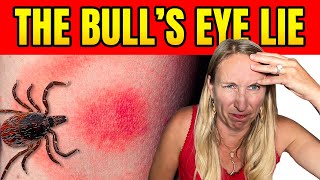
In this video Dr. Diane Mueller (mylymedoc.com) explains why the classic bullseye rash is an unreliable sole indicator of Lyme disease, noting that only about 3% of patients exhibit the target lesion and it can appear in hidden areas like under the scalp. She challenges the misconception that Lyme is confined to New England, emphasizing that tick‑borne infections cross borders and have been spreading for decades. Dr. Mueller critiques the standard two‑tier testing protocol, highlighting a 67% false‑negative rate for the first‑tier ELISA and the Western blot’s limitation to a single Borrelia species, which can miss other causative strains. She outlines a broad spectrum of chronic symptoms that may stem from undiagnosed Lyme—including joint pain, migraines, fibromyalgia‑like pain, chronic fatigue, depersonalization, and more—arguing that chronic illness is typically multifactorial rather than a single root cause. To aid patients, she promotes her book It’s Not in Your Mind, a group program, and a free diagnostic quiz at getwellquiz.com designed to identify potential root causes and suggest tests for discussion with physicians. The video serves as an awareness piece urging viewers to consider Lyme disease even without the classic rash and to seek more comprehensive testing and personalized evaluation.
Chapters
Hey everybody, it's Dr. Diane Mueller Mueller from mylymedoc.com. We're talking today about the bullseye rash, and I cannot tell you how many times people are underdiagnosed for Lyme disease. Now, of course, not everybody has Lyme disease. That would be ridiculous. But we got to get away from thinking that the standard testing is good enough or looking for that bullseye rash is good enough. Only about 30, 30% 3% of individuals with Lyme disease get that classic target lesion bullseye type of rash. And some people are getting it in their hair, right? If you had a rash deep under your scalp and you had a lot of hair like me, you probably would not notice that bullseye rash. So yes, if you have the rash, in some ways, hooray, good for you, because now at least you know for sure that you have Lyme disease, or at least should do the follow-up testing to confirm it, but it's highly likely you have that symptom. But for many people, it can just look like a flu, and it can be self-limiting, meaning it goes away quickly, and you just think you had the flu and you move on. And then years later, you wake up with this chronic joint pain and you don't understand why, right? So we really need to consider Lyme disease in many more situations of fibromyalgia, headaches, migraines, wandering pain, joint pain. Depersonalization, chronic fatigue syndrome, and more. Lyme disease can cause so many different symptoms, and I really am making this video just as an awareness so that if you don't have that target lesion rash, we're not saying, oh, this is not Lyme. We definitely know that it is all over the world. It is not just in the New England states of the United States. Yes, it was discovered in Connecticut. However, As we know, these diseases do not have borders, right? Insects do not have borders. Insects cross and bacteria cross borders. So we can see that there is a spread of Lyme. There has been a spread of Lyme for decades now. Just like any other infection, it does not stay within state lines. So we need to get away from this whole thinking that, hey, just because you're not in a New England state in the United States, that it's not Lyme disease. Also, the two-tier testing is kind of crap that we're doing for Lyme disease. Some people get lucky enough to make it to the second-tier test, but the first tier, some studies have shown that it has a 67% chance of a false negative, and this is what we're doing. This is what we're using. Now, there have been improvements in that first-tier testing, about 10% better, but that's still not better odds, or at least not that much better. Second-tier testing is the Western blot. This is a standard test you might have done by your doctor, but the problem with the Western blot is it's only testing for one species of the bacteria that can cause Lyme. And so if you have another species, this could be missed. So we really want these advanced tests that are looking beyond this standard to say, hey, is there Lyme acutely or chronically leading to various disease processes? So to learn more about this, please do join my group program, or please take the initial step of buying my book, It's Not in Your Mind. I go through all of this and so many more reasons for chronic illness in my book. What I have seen in my 15 years of practice is that there's not just one root cause when it comes to chronic disease, right? We see a root cause that is a single isolated cause in acute things like colds or flus, strep throat, for example, we can isolate a single cause. And even then we can make an argument that maybe there's chronic stress lowering your immune system, or maybe there's a microbiome issue in your gut lowering your immune system. So even then there can be other types of things predisposing you to the acute sickness. But in chronic illness, it's almost always going to be more than one thing because when we're We get sick and our immune system gets out of balance and our hormonal system gets out of balance. We start to accumulate things as the body gets out of balance. Other things come in. So that's all super important to know and recognize. And I hope this has been helpful. Please get my book. I go into so many different root causes. You can also take my quiz. My quiz is free. It's getwellquiz.com. So if you go to getwellquiz.com, com. You can take a quiz, and this was a highly developed quiz by myself and a programmer. And we did this so that you can get— it'll spit out the top things, the top root causes and tests to consider that you might not have talked to your doctor about. So this is to help support you in your mission to bring these ideas to your doctor. I'm like, hey, based upon your symptoms, we should really test for these types of things. Make sure you're not leaving something out. So that's at getwellquiz.com. I hope this has been helpful, everybody. Happy healing. You can do it. Your body knows how to heal. We just have to figure out why and what is stopping it from moving in that direction. All right. See y'all soon.