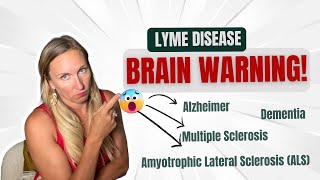
Dr. Diane Mueller (chronic illness expert) explains possible connections between Lyme disease and brain health, suggesting Lyme can contribute to or mimic neurological disorders such as multiple sclerosis, ALS, Alzheimer’s, and dementia. She describes proposed mechanisms (immune-driven plaque formation, bacterial toxins damaging neurons), emphasizes that nerve cells may regenerate and that new therapies are being explored, and urges proper Lyme testing—warning that one study reported a 67% false-negative rate for first-line Lyme tests—and to consult Lyme-literate clinicians.
Questions this video answers
67% (the speaker references one study reporting a 67% chance of false negative for first-line Lyme testing).
Chapters
Everybody, we're talking about Lyme disease and brain health today. I'm Dr. Diane, chronic illness expert, and this is a very, very important conversation. There are a few limited studies that show Lyme disease being connected to a cause of things like multiple sclerosis, als, Alzheimer's dementia. We also see that Lyme disease causes so much brain fog for people, which sometimes can be an early sign of dementia as well. So what's happening here? So, first of all, this is scary. Scary, right? But the good thing is Lyme disease is reversible and we can fix this. So having a diagnosis like Lyme when you have one of those big other scary diseases can actually be a good thing because there's a solution. I want to make it clear that I'm not saying that Lyme disease is the only cause of those things, right. But that we want to consider in these brain disorders, in this neurological world, we want to consider that Lyme disease is part of the cause. Of course, always get proper aid imaging, always with work with your doctor, all those really important things. But we want to make sure that we're not just getting a diagnosis like dementia, for example, and then saying, well, I have my diagnosis work done, when there could actually be a reason behind this. Some of the research is showing for situations such as Alzheimer's, we're now seeing, researchers theorize that Alzheimer's and the plaques that are created with Alzheimer's actually have a immune process behind them. And so the thought is that when we are creating these plaques, it might be due to the immune system of the brain, brain trying to trap toxins or trap infections that have made their way to the brain. And of course, things go haywire and somebody ends up with dementia. But sometimes the process of the disease is a self preservation process. We also know that toxins in the brain and Lyme disease is one of many things that secretes very, very dangerous toxins into our body. At least the bacteria that causes Lyme disease does this. And so these toxins, when they get into our brain essentially will cause our nerve cells to. And that, again, is very scary. But it's less scary than it was years ago because now we know in research that nerve cells can regenerate. In fact, there's some really cool early studies that have been done on animals that are actually showing that certain frequencies of light and sound therapy are actually helping these plaques to eliminate. So they'll hopefully will be more treatments coming down the pipeline of medicine and research that are really looking for reversing these types of diseases. But for now, one of the biggest things to on is finding the root. And if we have brain related disorders, we always want to consider Lyme disease and proper Lyme testing as one of the roots. Remember, there's one study that shows the first line testing for Lyme disease often has a 67% chance of a false negative. So we absolutely always want to consider getting proper Lyme tests and making sure you're working with a Lyme literate clinician that can do so. And if you're interested in getting help and support, remember you can always, always find us@mylimedoc.com and subscribe to this channel for more information in the future. I'll see you all soon.