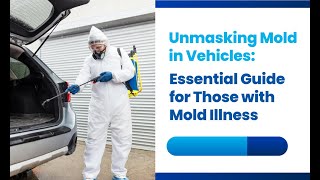
Dr. Diane Mueller explains when to test your car for mold if you have mold illness. Water damage, musty smells, and high humidity are signs worth investigating. The goal is lowering spore counts enough to stop triggering your immune system, not eliminating mold entirely.
Questions this video answers
Dr. Diane Mueller — a physician who describes herself as a mold and Lyme doctor and expert.
Chapters
Common question I get when it comes to mold testing and mold treatment is should you test your car for mold? So I'm Dr. Diane Mueller, I'm a mold and Lyme doc and expert. And essentially this is a complicated conversation, right? Some people are very much of the belief that when working with mold illness, you want to throw every little thing away and test every little thing. Most of the time I have not seen people need to do this down to completely eradicating, throwing every last thing away, including getting rid of the car. Mold can definitely grow in the car. And if you live in a damp and humid place and you spend a lot of time in your car, it's worth considering that there could be mold in the car and test it. But as a general rule across the board, if your car is in a garage, so under a carport, but especially if it's in a garage where it's not subjected to the elements as much, unless you like, like have seen mold or you've had some sort of water damage to your car, I typically do not see that cars need to be tested. Now, if you notice a smell, if your car sits outside, if you drive for Uber, spend a lot of time in your car. In these types of scenarios, you might want to test your car to make sure you're not breathing in the sport pores all day. Remember, with mold illness, the biggest thing is we want to eliminate as much exposure as possible. And if you're in your car because you're driving for some sort of driving service, let's say six or eight hours a day, that's a lot of time if there's mold there. So you definitely want to consider it. I don't find it necessary in all scenarios. And as far as getting rid of your home stuff, I do. I'm definitely an advocate of a lot of the home stuff needs to go. Mattresses, for example, any sort of particle board, those kind of things. But a lot of things can be laundered on high heat with vinegar tea tree solutions like EC3. So a lot of these things can be laundered. And the other thing to remember is we're not looking for anybody with mold illness to live in a 100% mold free environment. It's actually not possible. Molds are everywhere. We're looking for the mold count to be low enough that it's not stimulating your immune system to attack your, not only the mold, but to attack you. So it's really about lowering that spore count. And that's what we want to consider when we're keeping and not keeping. We want to make sure we're getting rid of those like those things that are probably growing and multiplying colonies versus like certain things that can be washed and they just probably have a few spores on them but you can launder them right out, you can wipe them off because they're hardwood and they're not porous woods, those kind of things. So this is a long winded answer to the question about should you test your car for mold and the answer truly is sometimes if there's again if there's a lot of humidity exposure to it, you spend a lot of time in it, if there's been any water damage, if there's any moldy smells, if any of those things are true, probably worth testing your car but otherwise most people don't really need to worry about that component. Please do leave your comments if this has been helpful. Please do subscribe to my channel. Also see you in another video.