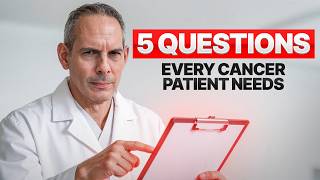
In this YouTube monologue Dr. Dino Prato, founder of Invictus Vita Medical Center, argues that conventional oncology treats patients with a one‑size‑fits‑all approach that ignores tumor heterogeneity. He explains that two patients with the same cancer type and stage can have vastly different molecular markers, leading to ineffective therapies when deep molecular profiling is not performed. Dr. Prato advocates for precision oncology that integrates DNA next‑generation sequencing, RNA transcriptomics, immune spatial profiling, and custom‑built treatment plans (including off‑label and integrative agents) to create an N‑of‑1 strategy. He cites internal 2024 data (35‑fold response improvement, 43‑fold quality‑of‑life boost) and external studies such as iPredict and WINTHER to demonstrate the clinical benefit of molecularly guided therapy. The core of the video is a practical checklist of five questions patients should ask their oncologist: (1) Are you running DNA NGS on my tumor? (2) Are you also performing RNA transcriptomics? (3) What is the plan for my immune system (immunotherapy)? (4) What evidence supports the chosen chemotherapy beyond NCCN guidelines? (5) Are there targeted clinical trials or alternative options based on my mutations? He also highlights systemic barriers—insurance non‑coverage, lack of physician training in molecular targeting, and the profit‑driven nature of standard protocols—while urging patients to demand personalized testing and treatment. The video ends with a call to subscribe and a blessing.
Chapters
What if the treatment you're getting right now was never really designed for you? And the problem is two cancers of the same type and stage are going to have totally different markers. It's called heterogeneity. And when you test for those markers, you can find often that patients are on the wrong medication. So what if one drug target could change your life because it's actually the one you need and it's being missed because no one's looking deep enough? That's the real crisis in cancer treatment. It's that patients don't have the right targets because of lack of testing and custom drug design. And so when you have You can get better care and you can custom make the medicine and deliver it right to the tumor. Many patients are still being treated like a label, a one-size-fits-all, and they're not being treated for their molecular targets. So stay with me because today in this episode, I'm gonna show you why standard of care is often just one-size-fits-all oncology. Really doesn't matter where you go, and it could be missing the boat. And here are the 5 questions I'm gonna teach you that you should ask every oncologist right now, right when you're in the middle of care, so you know you're headed in the right direction. I'm Dr. Dino Prato, founder of Invictus Vita Medical Center. For the last 25 years, my team and I have helped thousands of patients who failed some of the top cancer hospitals across the country. And when we test and we do deeper testing and find their targets and build their custom treatment and their immune system, we find they respond so much better. Now, before you change anything, make sure you're working with a doctor. And so let's get started. So here's the thing patients need to understand. Cancer is not really a disease of tissue alone, but it's about the markers, what's underneath. What's in the DNA, RNA, immune landscape, tumor microenvironment, what's causing the cancer, all these different things. And then this changes the entire battle because once you have this information, your treatment plan can be built directly on your cancer. Now, I've been doing this for multiple decades now, and I can tell you, I just don't know how standard of care oncology still is working in 24 markers— biopsy, tumor markers, and imaging— instead of 1,000+ markers with deep understanding, because that's how you actually get things done. That's how you improve outcomes for patients, hold remissions, better care. That's because we have more information today, but people don't have access to it, and that's what we need to change. So it's not treating the name of the disease and the type of cancer, it's treating the markers. That's the big difference. That's why patients are getting in trouble with care and it fails, because they don't have the markers. And many oncologists are trained in these National Comprehensive Cancer Network guidelines, and they are not trained in molecular targeting. In fact, any doctor we bring onto our team that's already an oncologist, primary care doctor, naturopathic doctor, doesn't matter where they're coming from, when they work in our our precision oncology algorithms, it takes 1 year and 2,000 hours to get proficiently trained on molecular targeting, RNA transcriptomics, DNA molecular targeting, immune spatial biology, immune profiling, and how to custom build the treatment for each patient. It requires deep molecular markers, interpretation, matching, building the right care in the right sequence, and that takes experience and knowledge. That's what precision oncology brings to the world of cancer as we look into the future. And we're moving way beyond because FDA guidance has always reflected the double-blind placebo clinical trial. But there's a new method coming out for fast-track where personalization is going to be the driver, in my opinion. In other words, it's not about treating everybody the same. It's finding what's driving your cancer, what's active in your cancer, what are the right targets for your cancer, what's suppressing your immune system, and then going on off-label integrative agents, combining those to work in your favor so you can overcome resistance, go into remission, and hold it longer. That's going to be the key. Immunotherapy is at the center of this. That's how real precision oncology thinks and operates. And here's why that matters so much. We've entered into an era where some cancer drugs are approved not only by, let's say, tumor location, but by molecular targets. We're moving in the right direction. And the more we personalize that, we move to what I call N-of-1. This is each person has a treatment custom-built to them, not double-blind placebo clinical trials, because everybody is so different. If one— if we know one thing about cancer is that it's unique. Two people, same type and stage of cancer, are going to have different markers, heterogeneity. And until we address that, that means we're going to fail patients. So that's what I've spent my 2 and a half decades on is getting that addressed at a high level, from custom building the medications to testing to delivering the treatments. So we never look at anyone the same. We look at their mutations, we look at their drivers, we look at their immune profiling, their tumor microenvironment, and that way we have the best chance of helping patients. Now, there are several studies that I've mentioned over and over again that kind of already tell us this is working. Of course, our own study done in 2024 where we looked at several hundred patients, and you saw an improvement of 35 times response. 35 times, not 35%. And 43 times better quality of life because of targeting. And other studies like iPredict, which showed 20-plus percent improvement just with DNA markers, or the Winther studies, which showed the same improvement but using RNA, and that wasn't even involving immunotherapy targeting. So we can greatly improve late-stage complex early diagnosis treatments with precision oncology, not because it's another fancy word, but because it involves much more data and much more actionable targets. And that's where the work takes place. You don't have to give high doses when you have the right targets, you can give the right dose to the patient, and then you see the quality of life improve. Patients can go hiking, they can have energy, they can rebound faster because they're not getting all that toxicity that oftentimes they were on the wrong drug and didn't need in the first place, and it suffocated their immune system, stopping them from getting the true response that they needed. So see, this is the key. It's not just the discovery of new drugs and new targets— those are great— but it's putting it all together for each patient. That should be the job of every physician, to be trained in precision oncology. And the difficulty is this: insurance companies are not covering it, and there's a big reason for that. They operate in the, you know, cancer industrial complex. Hospitals just keep producing the same protocols because they're billable, not because they're the best. Standard of care does not mean the best care. It means absolutely that— standard Medicare-covered care is all standard. It's not the best in the world, and that's what patients deserve. So that's what I'm working to, you know, accomplish with our staff and team. But in this education, I want to encourage you as a patient to know what to ask so you're not stuck in the typical only what's available, only what's reimbursable— all those blocks. Instead, you want to ask these 5 questions from your oncologist so you can overcome that. Number 1: Are you running DNA next-generation sequencing on my tumor? Everybody should do that. If you're not doing that, find another doctor. This at least can find smart drugs that can slow things down, buy you time to get immunotherapy on board, because you need to know what those markers are. Now, that's a few hundred markers, and I don't consider that precision, but it's a move in the right direction. And you'll say, why don't you consider that precision? Because you're going to ask question number 2: Along with DNA, are you running RNA transcriptomics? Now we have 1,000+ markers. Remember, the DNA tells us where the car is driving on the road, where the mutations are. The RNA transcriptomics tells us all the escape routes, all the routes that the car is going to go in, and we need to shut those down. That's why smart drugs only work for some time on the DNA. But if you have RNA transcriptomics, now you have 1,000+ markers and you're shutting down all the escape routes, allowing the treatment to work better, meaning you're able to see where the cancer is going to grow, what pathways can be turned on and shut them off. That is absolutely critical in precision oncology. And now we've got two good markers: next-generation sequencing DNA and RNA transcriptomics. Now the third question: what is the treatment for my immune system? That's going to be the key in my clinical experience to long-term responses. Patients are told, well, there's no immunotherapy for you. Immunotherapy is critical. I'm talking about custom-built immunotherapies that help turn cold tumors hot, go direct to tumor, and help patients better respond in so many different solid tumors where treatment isn't there. That's the top 3 questions. Number 4: what evidence do you have that the chemotherapy that you've selected for me is going to work? Did you do any testing? Are you just following National Comprehensive Cancer Network guidelines? Am I just basically the double-blind placebo clinical trial group? Because you don't want to be that. You want more data beyond that to guide you. It doesn't mean that NCCN guidelines don't have a place, but they can't be the full driver without testing. You don't want to be thrown into protocols. You want testing to guide, because if you have testing, you're going to have better responses in my clinical experience, and other studies have proven that. Now, question number 5: are there targeted therapies in clinical trial based on my mutations? And if not, what else can we do? Because sometimes what happens is patients fail care, they're thrown into a clinical trial. I'm personally not a big fan, even though I do think there's a place for clinical trials to be— for the clinical trial to be used exclusively. I like it to be used in combination because where we see the best results is where you have all that DNA, RNA, immune profiling, and custom on/off-label adjuvants that are combined using the smart drugs, using integrative agents, using off-label medications that— but they're all based on targeting. That's the key to precision oncology. So you want to get out of the standard of care and you want to get into precision and of one. That's my goal. So So I hope you understand that this is the key. This— no matter what new drug comes out, new therapy, this is what we need to focus on. This is how we're going to change the game in cancer. Now, over 90% of you watching still haven't subscribed, so please subscribe and get this word out to family and friends so that they know that there's more than the one-size-fits-all. There's precision, and it makes a big difference. I hope you found this episode helpful, and may the Lord bless you on your journey to healing.