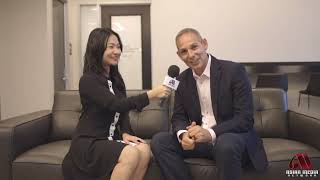
This content was created by Dino Prato, NMD. This content was uploaded by Dino Prato, NMD. This is a YouTube on-site interview/tour titled "Tour of Envita Medical Centers & Interview with CEO & Founder Dr.Dino Prato -Hosted by Elora at AMN" (created 2023-05-13). Host Elora Tran visits Invita Medical Center in Scottsdale, Arizona and interviews founder/CEO Dr. Dino Prato, NMD about the clinic’s 23-year history, precision oncology and immunotherapy approaches, services (oncology, Lyme disease), and its multidisciplinary physician team and training. The excerpt also includes a patient testimonial from Sandy, Invita’s first cancer patient and a survivor, who describes her late-stage colorectal cancer diagnosis, integrative treatment, lifestyle changes, and outcomes. Content is in English and presented as a hosted video segment.
Chapters
I'm Elora Tran with Asia Media Network. And today we are in Scottsdale, Arizona. We'll be touring the Invita medical Center. We'll also be interviewing the founder, Dr. Dean Vino Prato, and his first patient. Sandy, come with me. I'm here with Dr. Prato. He's the founder of Invita. Dr. Prato, can you tell us a little bit about your company and how it came to be?
So I started Invita about 23 years ago and, and it was really designed by just working with a few patients and we were helping them in cancer. And then we got very excited about cancer immunotherapies and targets for cancer. And so along the way we just started developing more and more technology, bringing in treatments from around the world. And of course it started with back then five, 10 people, and today we're 200 people. We have 22 physicians from board certified oncology, two naturopathic and integrative doctors, all working under the system we've developed of helping patients with cancer using genetics, immunotherapy, transcriptomics. So we're working on understanding in more detail how to better treat the cancer, not, you know, going beyond just the standard regimen using the newest data and information to help treat our patients.
I noticed on your website that your company encompass Lyme disease and also oncology and also late stage terminal cancer. Can you talk a little bit about a patient, for instance, coming in who's in a terminal cancer phase? How would that look like for them?
Yeah, so the, depending on what a patient's coming in with. And I think it's interesting that the combination of an infectious disease like Lyme and cancer, where they actually share each other is in the area of immunology. So the immune system can be used to fight an infection. Many cancers are actually started by infection. There's like a series of cancers like Epstein Barr lymphoma, you know, you can have herp, you know, like for example hepatitis C and liver cancer, H. Pylori, stomach cancer. So there's already origins of infections that lead to cancer. So in that area, we've combined the immune system and that type of work to work in both areas. So a late stage cancer patient comes in and runs a series of tests so we can really understand more about their cancer. After we run in depth testing, they sit with the physician and get a better understanding of what may have caused the cancer, what's going on with their immune system, what are the genetic targets, and then based on that, the treatment plan is built and then the patient has the option to proceed with care or ask questions and have the proper expectations set with their physician and to kind of help guide them through the healing process.
You said that there's 22 doctors at the moment. What types of physicians are available to assist the patients?
So we have board certified oncologists, board certified interventional radiologists, board certified radiation oncologists, board certified infectious disease, board certified pediatrics, board certified internal medicine. We have naturopathic doctors, and we have the special license in Arizona called the medical doctors of homeopathy, which has allowed for MDs and DOs to practice integrative medicine in Arizona. A lot of people don't know that Arizona has one of the largest scopes of integrative medicine than any state in the United States. So with all of these doctors, they work in a team practice, and the patient will see the doctor that is most needed for their care or their prescription, and the doctor will follow them and provide the care. And our doctors are pretty amazing people. They're brilliant. It takes them almost one year and 1500 hours to be trained in Invita's precision oncology methods. And the goal is that every patient has the opportunity to have a relationship with their doctor and be guided and supported. So we do our best to treat everybody like a family. We've been doing this for 23 years and our patients are like family to us. We have a relationship with everyone that comes in that door, and that's important to us.
I'm standing here with Sandy. She's the first cancer patient survivor of Invita. Can you tell us a little bit about your journey?
Yes. So I was actually diagnosed in 2001 with a late stage cancer, colorectal cancer. And I had gone to two other cancer institutions and in the US two of the top. And both of them had the same diagnosis, the same prognosis, and the same protocol. And so my husband was kind of searching and we ended up getting meeting another naturopath doctor that introduced us to Dr. Dino Prado at the Invita medical center. But here's the catch. He was 26 years of age. I was the first patient. The first day he opened his doors of his practice of Invita medical center. But you know what? It was what he said to me that caught my attention because I didn't get any hope anywhere else. And he said to me, you know, what you have is really bad. He says, but if you're 100% coachable to what I ask you to do, you've got a shot. And so I went with the long shot. But that meant I needed to work on changing my diet, I need to work on my lifestyle. I started to build up my immune system, and it was just a matter of within a few months that I had stopped by doing my chemo and radiation at one of the cancer centers because they didn't offer that yet at In Vida. But I would go drive right over to In Vida and do my immunotherapy to rebuild my immune system. And that's what works. So hats off to having options and really just being able to make the decisions for your own health. I think it's a personal choice, but I wanted to stack the odds in all my favorite so that I could fight this aggressive form of cancer. And everybody has the same feelings. When you, when you're first diagnosed and you hear the C word, you know, there's so many feelings and emotions. First of all, you're in shock, you're in disbelief. But then you have to kind of pull it together and go, what do I do next? So nobody really has those answers for you unless you know somebody who's been there before. But then you're usually going on the recommendation that they just came from, which is usually the majority of what everybody else does. And I knew that I was 39 at the time, and I didn't really know anyone who had what I had. So it really became the research. Nowadays, there's way more, you know, solutions and options available than there was 23 years ago or 22 years ago. Integrative medicine was not even considered a word back then. So now today there's so many more solutions and options, but it's really, now there's so much information. It's how do you narrow it down and find the best solutions that are for you? That's not only going to knock down your cancer, but it's going to help you realize that you need to re establish your lifestyle, make some life changes, your nutrition, and really build that immune system back up to be pristine enough to the point that it keeps counting cancer at bay forever. So I get when everybody has fear, but I want to tell you, never give up. And don't use. Use that fear to motivate you to find the solutions and the answers because they are there. But don't ever get whatever a doctor tells you. If a doctor tells you, like, you know, there's nothing more we can do, or you've only got six months to live, that's erase that tape. That's probably the best thing I can tell you is that kind of talk is, that's, that's condemning. You don't want to do that. You want to lift that off and have the hope and welcome the possibilities in. Because the fight is not over until God says it's over. So ultimately, you've got a. You've got a buddy that's right there in your camp that wants to see you through it. So you've got to learn to think differently and start using your faith. And once you have that, then you're unstoppable. And the right medicines and the right things that your body needs to get better. Yeah, you'll be able. You'll be just fine. You can get through it, too.
Thank you for joining us today, and we'll see you next time.