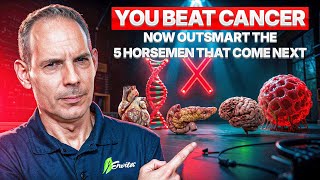
In this single‑speaker presentation Dr. Dino Prado addresses cancer survivors and anyone focused on cancer prevention, warning that surviving cancer often leads to four additional silent killers he calls the “five Horsemen”: heart disease, cancer recurrence, medication overload (polypharmacy), Alzheimer’s/dementia (type‑3 diabetes), and diabetes/metabolic disease. For each Horseman he outlines a precision‑integrative action plan that combines advanced screening, biomarker monitoring, targeted pharmacogenomic testing, and specific lifestyle, nutritional, and bio‑hacking interventions. Heart disease – He advocates coronary CT angiography to detect soft plaque, LP‑IR and inflammatory markers (CRP, ESR, IL‑6) to gauge insulin resistance and arterial inflammation, and chelation or stenting as needed. Dietary recommendations include omega‑3s, virgin olive oil, magnesium, refined‑carb reduction, infrared sauna use, and a cacao‑matcha beverage to improve vascular health. Cancer recurrence – He promotes a multi‑cancer early‑detection blood test (methylation‑based) covering 50‑70 cancers with ~98 % accuracy, followed by imaging, circulating tumor cell (CTC) and ctDNA analysis. Immune support is emphasized via high‑level vitamin D, zinc, mushroom beta‑glucans, and green tea, with inflammatory markers (CRP, ESR, IL‑6) tracked to ensure immune competence. Medication overload – A single pharmacogenomics (PGX) test is presented as a tool to identify drug‑gene interactions, reduce polypharmacy, and guide anesthetic choices. He recommends deprescribing, stress reduction, exercise, sleep optimization, and targeted nutrition to lessen reliance on medications. Alzheimer’s/dementia (type‑3 diabetes) – He suggests APOE genotyping and carotid ultrasound/CT to monitor cerebral perfusion, a cacao‑matcha‑ashwagandha drink to boost brain circulation, and devices such as Avacyn that enhance microcirculation and parasympathetic tone. Regular breath work, exercise, and stress‑reduction tools are also highlighted. Diabetes/metabolic disease – He focuses on controlling refined carbohydrate intake, monitoring A1C, fructosamine, LP‑A1, CRP, homocysteine, and using high‑quality protein, healthy fats, fermented foods, and gut‑supportive strategies. Bone health is addressed via DEXA scans and rebounding, while intermittent fasting, consistent sleep schedules, sunlight exposure, and oxygen‑enhanced exercise are recommended for overall metabolic resilience. Throughout, Dr. Prado stresses that many of these tests and interventions are not routinely ordered by conventional physicians, but can be coordinated through an integrative oncology practice to maintain quality of life and longevity after cancer.
Chapters
You beat cancer or you're working hard to prevent it. Here's what most people miss. As your cancer fades, four more silent killers ride in behind it. I call them the five Horsemen, as other doctors have before. Heart disease, cancer, diabetes, type 3 diabetes, Alzheimer's, dementia. You can start to see these are all related to decreasing our quality of life and lifespan altogether. So left alone, they don't just shorten your life. They'll steal the quality of your life. The good news is you can start outsmarting all of these. You can use these tools every day, and you'll get measurable habits that will help you Prevent these. I'm Dr. Dino Prado. For the last 25 years, my team and I have helped thousands of patients that have failed the top cancer hospitals across the country with precision. Oncology. And today, I'm going to show you the target action plan. What do you do now? You're in remission, or you want to prevent cancer. So today, I'll show you how we can beat the five horsemen with simple but powerful approaches with precision. So don't just chase cholesterol. I think the biggest thing that we see in heart disease is everybody chasing ldl. Don't chase the ldl. We want to find the pimples in your arteries before they pop the arteries feeding your heart. So heart disease kills more Americans than cancer, than all cancers combined. Most heart attacks happen within normal cholesterol levels. It's not just the cholesterol number that's important. So what's the test that I love here? Coronary CT angiography. It's a quick picture. You do an iodine dye, and you take a picture of the heart, and you can find the soft plaque, the unstable plaque, and the calcium scores. The calcium scores are okay. They give you some information, but it's a soft plaque that's dangerous. Those are the ones that can become the widowmakers. So how do we fix those? We first take an image, and if we see something there, we can chelate it. And if it's very bad, we may have to send out to cardiology for a stent or something more. But for the most part, there are tools that we've developed in our pharmacies with precision to help chelate those. The other thing we want to test for is lpir. This is the lab test I want you to focus on. Not so much ldl. It's a strong signal for insulin resistance. Inflammation markers like C reactive protein tells you if your arteries are on fire and inflamed. Lp. This is important because if this is high, that's where you see the young people having heart attacks, attacks in their 40s. So if we know LP is high, that's a genetic thing that we can fix by just monitoring it carefully and getting the treatment people need as they need it. So look, we're already removing the first Horseman heart disease. If you're only offered a basic cholesterol panel, you're missing this. And that's what most people are. The problem with heart disease is we don't scan people, we don't test people. With the right test. The CT angiography to me is better than EKG and other tests because you can get a picture and if you have a problem, then go from there. It's pretty simple to do. Not just LDL testing. Support your arteries with health, healthy eating, get rid of their fine carbohydrates and sugars. As I said before, increase your omega 3s, virgin olive oil, magnesium, use your infrared saunas if you like. Those do all the things to improve your vascular health, your nitric oxide. And I have a recipe that you can follow that I've done. Another episode, this cacao beverage, it helps open your heart, your circulation to your brain and heart. So don't just go after lowering cholesterol, it's going to shut your hormones down. It'll affect your immune system. But eat the healthy fats and get rid of the refined processed foods. Cool the inflammation and stabilize the plaque. If you need chelation, then work with integrative doctor as we have formulas in our pharmacies that help with soft plaque elation. Yes, I know there are not commercial drugs available, but we have seen these help in our pharmacies because they're custom made for the patients. Now let's move to Horseman number two, the second leading cause of death, cancer and reoccurrence. We know a little something about this because we've been doing this for 25 years. The number one thing is we want to screen for all the cancers. We can do that with a simple blood draw. 50 to 70 cancers with 98% accuracy. We can predict if the cancer is there. This is a multi cancer early detection blood test. There's a number of them out there and they work really well. They look for methylation patterns and they look for other data that tells us if the cancer is there. And then if it's there or we see the first signal come back positive, we do imaging. And if we see the imaging come back, we look at circulating tumor cells, CTCs, these are circulating tumor cells. If they've left the tumor and gone into the circulation, CT free DNA and all of this helps us look at if the cancer spread and if you're somebody's already in remission, this is great because it helps us monitor the cancer before it comes back again. So we know something changes how to get on the treatment. So we're looking at the second horsem cancer, how to get rid of it, it's by this early detection and then it's simple treatment. If for example we find an early breast cancer, we just freeze it, we avoid surgery, lumpectomy, mastectomy, we can quickly treat it. And you can watch my other episodes on breast cancer, prostate cancer. Really it's a simple process if the testing is done correctly. And now we've gotten rid of the second horseman. One of the things that you want to do is understand that you need good immunity. And so this is a tip I'm going to give you here. Along the way, get your vitamin D levels up at the highest levels. Don't keep them low, keep them at the highest level. Build your immune system. Z zinc and beta glucans that come from the mushrooms. There's all the mushrooms, Chaga, lion's mane. You can take all of these mushrooms, they're fantastic. They usually come in combinations and they're going to help increase your natural killer cells and clean up the diet, detoxify the body. That'll make such a big difference. You can use one of my favorites, green tea that you take every day, the mushroom beta glucans I just mentioned. So you can track this. You can also look at your inflammatory markers like ESR and IL6 to look and see if your inflammation is out of control along with C reaction protein. So don't just ask if you're cancer, ask if your immune system is operating correctly. But if you do those early screening techniques, we can take care of cancer before it comes back or even a new cancer were to appear. Let's move on to horseman number three medication overload. The number three leading cause of death is over prescription drugs, polypharmacy. You can run one genetic test and it can save you 10 years of life or more. Why? Because if you're on five or more medications, oftentimes you're on long term medications that can be affecting your liver, your kidneys. And if you can't metabolize that well, we can run one test. It's called a pharmacogenetics test. It shows us which medications and your genes can best process and which ones are Fast and slow and some might be building up in your system and harming you. And if you ever needed surgery, you could use the same information to guide the anesthesiologist. So it's very powerful in having a pharmacogenomics test because this is another cause of death in the United States. Instead, we want to clean up the diet, help get patients off these medications, give them exercise, reduce their stress, improve their, improve their sleep, improve their nutrition and give them the right diet and supplements and nutrition to help them. So use that PGX report. Every time you go to a doctor and they're trying to give you a new medication, make sure you can metabolize it. Especially if you're going to use any, any anesthesia or any antidepressant toxicities, it'll pick it up right away. Your DNA will tell you what is the best drugs for you to metabolize. If you have to be on them in the first place, work with a good integrative doctor to get off those medications. All right, let's move on to Horseman number four. Alzheimer's, dementia, type three diabetes. How are we going to protect this? We need to protect the pipes that go to the brain, the carotid and our memory. So we can do this in two simple ways. You can run an APOE test because it' shows increases your risk of having it. So we can monitor you closely. We want to look at the carotid arteries. We can do a CT ultrasound of the carotids and look for risks clogged arteries and improve brain perfusion daily. I love this drink and I've done a episode on this. You can watch this on using cacao, a tablespoon of cacao, maybe a half a teaspoon if you handle caffeine well. Of Matcha. So now you got the flavanols of Cacao. You have the L theanine of Matcha, a pinch of cayenne pepper, a little ashwagandha, Blend it up, add stevia or monk fruit for sweetness. And that's going to improve circulation to the hippocampus of your brain and give you more ability to think clearer, more energy and something very simple that I like far better than coffee to giving your body the huge advantage if you're under stress and stress is affecting your memory or affecting your health in any way. And you can't break it with breath, work and exercise that you do least 30 minutes a day, several times a day. To break that stress, you can use tools like Avacyn. Avacyn is a Device that improves microcirculation and drops parasympathetic stress in that area when people just can't calm that stress on their own. And they need tools to help them almost biohacks. They're parasympathetic and microcirculation. So it'll help improve circulation to the heart, hands, feet, brain, because it increases oxygen just like deep breathing would. So this will help also with brain neurogenesis along with that drink formula I just gave you. Let's get rid of Horseman number five diabetes and metabolic disease. This is refined carbohydrates and sugars especially. This is type 2 diabetes. Good food, high protein, high quality protein, healthy fats. Getting good exercise in the diet and testing the Lp, A1C, hemoglobin, fructosamine. These are the tests you want run. C reactive protein, homocysteine. This will show you both insulin and inflammation which will guide you eat healthy foods. Get rid of the refined carbohydrates and sugars and processed foods that are so prevalent in the American diet really now, all over the world. And bring in the farm to table. Gourmet foods that build your immune system, healthy proteins, healthy vegetables, fermented foods for your gut. This is going to make a big difference. This will help you to lose some weight, feel better and help your immune system through your gut. Remember, 70% of your immune system comes from your gut. So gut immunity is so important. Optimize your vitamin D and zinc and walk and exercise and I will give you my little workout routine which works really well to building your muscle. Get a bone scan, get a DEXA scan. These are important because you'll look at the risk for osteoporosis. Here are tools I like to use every day for longevity rebounding. 20 minutes a day. This will help your heart, your circulation, your muscles. Very simple to do at any age. You don't have to jump, just a movement is very, very powerful. Get that heart rate going and you can feel how you'll develop muscle and it'll help against bone loss. I also weight bearing exercise. I also like using the power plates you can get on those. Do squats, use bands, use weights, whatever works for you. I like using exercise with oxygen, whether it's moving your arms to increase your natural killer cells. But you can do that for 10 or 12 or 15 minutes a day. While you're breathing in through an oxygen mask, you can cycle and that's going to increase your mitochondria and help your VO max. All these things are powerful. These are biohacks because I don't have hours to exercise, but I'm moving throughout the day for mobility, stretch, pull ups, push ups, all those things are very powerful if your body can handle that. But that's going to help give you longevity. I like to use intermittent fasting for patients. If they can do 16, eight, I like them getting off of all the refined carbohydrate sugars, cleaning up the diet, working out everyday movement, Waking up in the morning and going to sleep on time. 10 o' clock at night, or nine every day. Keeping the routine, keeping the sunlight, helping the body be healthy, running the right lab test to screen. This is how we get rid of the Horsemen. Often these tests aren't always run by all doctors, but if you're working with a good integrative doctor, they can run all these. They can manage this. We do this with our patients because we want to make sure they're healthy after cancer or with their family members, because this is how we get rid of the Horsemen. This is how we prevent disease. These are the secrets of staying healthy. Don't wait for the symptoms to tell you what's wrong. Use the data, the right testing, the right lifestyle changes, and this will give you such a better quality of life. I hope this was helpful in giving you real information that you can use to prevent the five horsemen that affects most people's lives. I'm Dr. Dino Prado, and may the Lord bless you on your journey to healing.