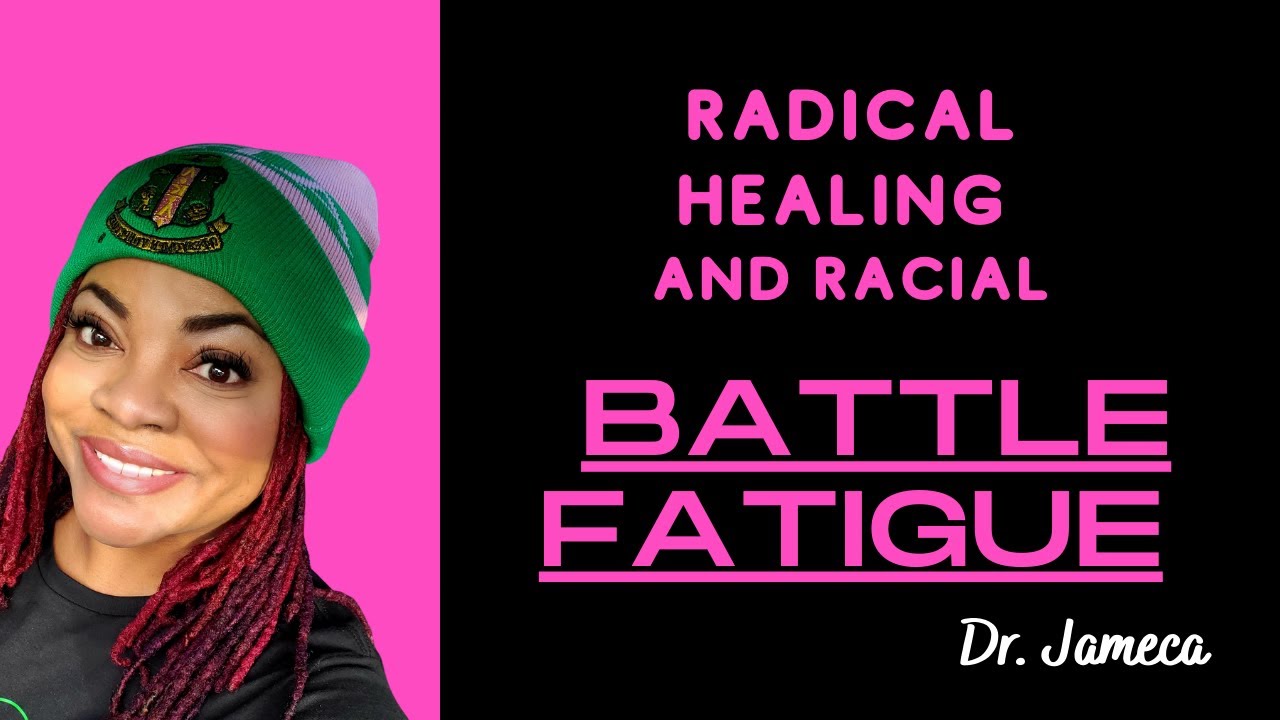
In this video, Dr. Jameca Cooper, a psychologist with two decades of experience, introduces her "30 Days of Radical Healing" series and focuses on the concept of racial battle fatigue—a cumulative physiological and psychological toll caused by chronic exposure to systemic and everyday racism, especially for women of color. She defines the condition, outlines its symptoms (anxiety, depression, PTSD‑like reactions, chronic exhaustion, sleep and appetite disturbances, autoimmune issues), and acknowledges the overwhelming nature of confronting entrenched racism. Dr. Cooper then presents three practical coping strategies: (1) Find joy – distinguishing joy from happiness, identifying personal sources of joy (e.g., simple pleasures, family, creative activities) and deliberately engaging in them; (2) Build community – seeking supportive, nurturing relationships beyond blood ties, such as friends, church groups, sororities, or neighbors, to share stories and gain validation; (3) Activate your voice – moving from victimhood to activism by volunteering, donating, or connecting with organizations (e.g., NAACP, Urban League, Indigenous groups) that align with one’s values, thereby reclaiming agency. She emphasizes that while racism persists, self‑care and proactive engagement are essential for longevity and resilience. The video concludes with a call to subscribe, set notifications for the ongoing series, and engage in the comments.
Chapters
Hi, Dr. Jameca Cooper here. Thanks so much for taking time out of your busy day to watch this video. Hopefully you like the video and subscribe to the channel for more information on radical healing. By now you already know I'm a psychologist and have been practicing for 20 years. I've done a little bit of everything, um, from teaching, research, therapy, consulting, training everywhere. So that is why I decided to have a channel focusing on radical healing for women of color, because I really want to make the people that look like me and have similar experiences to me better. It is hard work being a person of color in this country. It's damn hard work being a woman of color in this country. So there are lots of things that we can do in order to feel better. So we're in the midst of our 30 Days of Radical Healing, And today we are focusing specifically on radical healing and racial battle fatigue. You've probably heard this term before. It really has to do with physiological symptoms and indications that are a direct result of living in, spending time in, and navigating in spaces that are traditionally white spaces in this country. So Another way to say it is racial battle fatigue is a person that has dealt with discrimination and racism, systemic racism, everyday racism on a long-term basis, such that the effect on them, their body, their mind is a cumulative effect and has taken a toll. So what you could see, indications of that could be things like anxiety, shock, Frustration, depression, PTSD-like symptoms. Could be something like chronic exhaustion, fatigue. Um, I could go on and on. It also plays out lots of other ways such as sleep problems, appetite issues, autoimmune issues, lots of different ways. But today what I want to do is to talk to you about how to deal with racial battle fatigue. Fatigue. And there are some things you can do, although I would admit that sometimes it feels like it's overwhelming and that you're fighting or up against a system that will never change and will never recognize you as being anything other than a woman of color and therefore lower on the totem pole, right? But there are some things we can do. There are some things we can do in 2022 to get us in a better place, get us in a better and a healthier mindset, right? The first thing you can do, I'm going to talk about 3 things today, but the first thing you can do is find joy. What is joy? To me, joy is a whole nother level of happiness. So you can get happy, like sometimes for me when I pull in the McDonald's and they give me hot fries, that makes me happy. That's happiness. Joy is when I start eating the fry and I start to, you know, move a little bit and start to feel like, ooh, this is good. Unhealthy, but good to me. That's joy. Joy is the feeling that I get when I see my children. I have a son that's away at college, and when he comes home, what I see, what I feel from him in here is joy. Like, I'm grateful. I'm happy to have my child back, that he's made it back home safely, and you know, that things are going well. That's joy. So joy is a step up from happiness. So where is your joy? How can you find joy? Definitely, If you're a person that works a lot and takes care of other people, it may be difficult for you to identify where your joy is and what brings you joy. For some people, it could be things that they eat. For other people, it could be books that you read and ideas that you learn. Um, it could be the people that are around you, the people that you get to spend time with. That could be what brings you joy. It could be painting if you're an artist or dancing. Uh, if you're a musician, it could be playing your instrument or seeing people's expression when you play music for them. All of those things could be joy. Whatever it is that brings you joy, find those things and do them more. It doesn't have to be a grand gesture. It can be something as simple as watching your favorite television show that brings you joy. I know I just watched the last episode of Insecure last night, and that brought me joy. I was happy, damn near in tears, because Molly getting married, yeah, that did it for me. It made me happy. That's joy. Number 2, find community, right? Find some people that— they don't have to be your family, they don't have to be your blood. Whoever you feel connected to and some warm nurturing feelings for and to, that's your family, that's your community. So maybe those are— these are friends you have. If you're in college, could be your college friends. If you're an adult, could be the people you go to church with, could be the people you're in an organization or a sorority fraternity with. It could be people that are your neighbors, people that you've known over the years that feel the closest to you, and you feel like, you know what, these people know me and they get me. Those people can be your community. But find that community, because what happens when you live in a country where you're always the victim of systemic racism, and for women, you're also the victim of systemic sexism? So living in spaces like these, it makes you feel such a heavy burden of, you know what, I'm never going to get seen as a person that is adequate or equal. I will never be included in certain rooms and meetings and spaces. That can be overwhelming. It can be frustrating. So it's very important to find community and spend time with those people that you feel like are your community. That's what kind of gives you that, that time to relax. Those people understand you. It makes you feel like you're not as crazy as you might think you are, right? We need those people. We need to be able to connect with those people, share stories, get some support. So find your community. Third thing you have to do, and for me, this may be the most important piece of racial battle fatigue and how to heal from it, is activism. Finding your voice. You have to find your voice because If all you feel like you do is be a victim, so I've been a victim of this situation, I've been a victim in this situation, I've experienced this, this has been done to me, you will never feel as though you have a voice in this matter, but you do have a voice. Finding your voice could be a challenge, but ways that you can become involved and be active in the community, be active against or with those issues that you feel like have caused you the most strife in your life. So ways to do that, volunteering with certain organizations. If you know you want to fight, um, social class discrimination, racism, any of those things, you can get involved with organizations that do just that. NAACP, Urban League, et cetera, et cetera. There are lots of indigenous organizations that are working with their own goals, So any of those things, ways to volunteer that makes you feel like, you know what, I'm doing something. I'm just not being here as a victim, but I'm doing something about this. You can donate money. Like I said, you could volunteer. You can connect with them via social media or their websites. And usually on their websites and social media, they give you the steps to how to get involved, how to connect with them, how to become notified of different events and activities and endeavors. That they're doing. That is how you stay connected. That is how you become an activist. That is how you take matters into your own hands. Because the one thing we know for sure is that at least I'm sure in the span of my life, we will continue to see racism and discrimination in this country. We will continue to be those who bear the brunt of it and feel it the most. So In the meantime, the one thing that you have to do, the one thing that you owe to yourself is to focus on yourself because we have to be able to last through this in order to see things get better. We have to be able to continue working. That's my number 3. Remember activism, finding your voice, connecting with organizations, like-minded organizations that have your best interests at heart and you guys share in some of the same goals. So You have to get active, all of these things. Let's review. First one is finding joy. Second one is connecting and finding a community. And the third one is finding your voice through activism. So that's what you need to do in order to combat racial battle fatigue in these here United States of America. I am Dr. Jameca Cooper. Stay tuned for more videos on lots of things, but definitely 30 Days for Radical Healing. Still going on. Join tomorrow. Get notifications set up so that you know when the new videos drop. I look forward to learning more about you. Drop some ideas in the comments. I would love to hear from you. I appreciate you taking the time. Thank you, and I will see you again.