EP07 - Interview with Dion Hinchcliffe
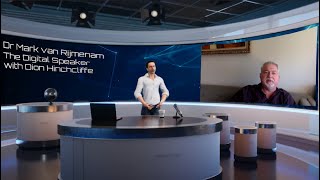
Dion Hinchcliffe on why digital transformation became a C-level priority and accelerated during the pandemic. He expects steadier modernization ahead, with automation, self-service platforms, and work-from-anywhere becoming standard. Watch for AI, quantum computing, and mixed reality, but cybersecurity threats are growing.
Chapters
Hello everyone and welcome to the Tech Journal. My name is Mark Vermenam and I am the digital speaker in this series. I project my digital twin into cyberspace to bring you the latest and greatest from the digital world. I cover all the latest digital news from blockchain and crypto to quantum computing and AI. I also always try to take it a step further and to look into what these digital innovations mean for our personal and professional lives. In today's show we have Diane Hinchcliffe sharing his insights with us on digital transformation. Dayan Hinchcliffe is an internationally recognized thought leader, IT expert, enterprise architect, best selling author, frequent keynote speaker, analyst and transformational consultant. He's a veteran of enterprise it. Dayan has been working for two decades with leading edge methods to bridge the widening gap between business and technology. Dayan has worked with leadership teams of Fortune 500 and Global 2000 firms to drive successful change with emerging digital methods. It's a pleasure to have you on the show. Welcome. Let's just kick right off. You have been working with a lot of large global companies for quite a long time now. How do you see that digital transformation has changed over the past, let's say decades.
So digital transformation has been a C level topic for almost a decade. So if you go back 10 years ago, it was still looked at as something more out of the IT department. The chief Digital officer really hadn't emerged yet. The urgency wasn't perceived as to be there. So it was primarily project level efforts. To say let's, let's become E commerce, let's go into E commerce or let's adopt a digital business model really wasn't profound. About five years ago it began to be taken much more seriously. We began to see companies that were subject to a lot of competitive pressure, they were digitally transforming a little bit more significantly. So if you look at like retailers in the US like Nordstrom is the poster child here. There's a great Harvard Business A case study that showed how the leading companies that were very successful were really fixing their foundation before they were digitally transforming. Whereas those who were struggling tended to do it still tactically and also trying to run fast before they had addressed some of the issues that was setting their current pace for technology change. And there are still lots of industries that were isolated from the competitive pressure. They were viewing digital transformation as something they'll do incrementally over time. Few were doing big bang digital transformations even five years ago. And now if you come to the last year we've had fundamental digital transformation of work so everyone has become pure digital, doing digital everything all the time at work now, you know, except for, of course, if you're like, you know, if you're lucky enough, but if you're an essential worker or still have physical workplace, you still had to. Most of your co workers still were impacted. So everybody digitally transformed when it came to work, and our customers moved. So we also. In the last year, most organizations have digitally transformed a lot of their core, not all of it. They still have. It's such a big project. Everyone still has lots of work to do, but we've done more, had more progress in the last year than almost the last hit 10 years in many organizations because customers have changed their buying behaviors. They want to be serviced at home, they want to be serviced remotely. And businesses had to become much more digitally savvy to reach any of those people because everybody was not going to those businesses anymore. So that's kind of where we are. We've had hasty digital transformation finally to the core. We have more work to do. And in my latest CIO survey, everyone expects that 2021 will be used to refine that and, and get it right and fix a lot of the things they had to do so quickly.
So how do you think that the pace of digital transformation that we've seen in the past years, if companies will be able to maintain that in the coming years as well?
Well, what was fascinating about the digital transformation over the last year was how fast it was. Almost every organization did it much faster than they thought they ever could. It was kind of proved that they could if they really wanted to. So there was so many, you know, concerns that we have to change our culture, we've got to rebuild our skills, we have to hire a lot of different people. Well, we didn't do any of those things yet. We still changed a lot. You know, I had one mortgage company that I worked with, they didn't have digital signatures. They were still using couriers to send papers back and forth. And they were one of the leading companies in the United States when all of this happened. They realized that if they didn't add digital signatures and made the mortgage process fundamentally digital, they were at risk of going out of business. People would just go to a mortgage provider that would give them the digital experience. And they had many compliance and regulatory reasons where they felt like it was going to take a long time to do that. And when it came back and said they could do it in four months, which is still way faster than they thought they could do it, the business came back and said, well, we've got two, two months because that's as long as we can take the loss of business. And they did it in two months. So yeah, we, I think we won't see the same pace, but I think we're seeing organizations that are braver and able and know, they know that they can do it. And now, now there's an imperative that they still can't ignore it. We still have, you know, ways to go.
Well, I think that what is interesting, what happened in the past year is that all of a sudden organizations found out that, hey, now we can actually change and that they can actually change a lot faster than we ever thought about that they could. So as part of this digital speaker series, I often talk about the organization of tomorrow. So you know, what's going to happen in one or two or five or even ten years from now? How do you think that the company of tomorrow will look like and how will it differ from today's organization?
So I'm about to publish some research on this. So for the first time, I'm being asked by organizations about if I was going to fully modernize my digital workplace, what would that look like? Or they'll say, well, if I was going to, if we were going to fully catch up with all of the gaps that we have, what would I be rolling out? What does that look like? And so I've long talked about the broad patterns that we see. One of them is much more self service. That you get the assistance and the education and the learning you need on demand, in the fly, on the fly, in the margins. You'll be able to information that you need will find you instead of you having to find it. We just have a lot more intelligence baked into everything that we do so that we're spending less time feeding and taking care of the machines and more time actually thinking about doing our work and, and the next. Tomorrow's workplace is far more automated than it is today. And we see that in all of our data that there's a real hunger to do more with less and to be able to adapt automation and be able to take all of the menial and rote work that workers do and move that workforce into strategic decision making, into innovation as opposed to actual delivery. We can automate almost everything now. And you know, with things like robotic process automation and low code, just those two alone are creating a revolution in that the average worker is soon going to be able to create a lot of the tools they need and automate a lot of things they need. To automate and then be able to literally automate themselves out of their, out of their menial job and be able to sit back and focus on making major contributions at a strategic level. At least that seems to be the broad pattern. Not all workers are going to transition, but we don't see a mass disruption of work. We've actually never seen a technology revolution that created mass unemployment, that didn't create other demand. Some workers did suffer, but by and large most of them found new jobs but doing something they weren't doing before. So from that standpoint, we're seeing that there's so much automation to do, so much technology. We don't see headcounts reducing at all due to all this automation, where we see a lot more value being created, a lot of opportunity, a lot more change happening. Up until now, organizations haven't been adapting to change as fast as the market has. And this growing gap and automation allow us to come back and close that a little bit. We see new organizational structures emerging. That leaders aren't so much in control as they are influencers of networks of their stakeholders. We see employment changing to more of a gig economy model, but not the negative kind that a lot of people associate with Uber. But I have a report where I'm tracking the mass changes in professional services are getting much more on demand where you can pick the projects you want to be on, the things that make you most excited and most engaged. You can pick those projects and it can be with a, among any, a large series of workers, it's paid very well, you can create a designer career. So a lot of these, A lot of the employment relationships moving to these marketplaces, where you go to the marketplace and get the projects and the work that excites you and you can work from anywhere. One of the biggest changes I've seen is these lifetime employers, large consumer package goods and energy companies that say no, no, the only way you could work for us is if you come into this particular physical office. I now see these big companies saying, well, we're missing out on some of the best talent. We've now been hiring people and they have to work from anywhere. And it's been not just good for us, it's been bad, really good. And so we're now going to open the employment network to anybody to work from anywhere. And that's, that's super exciting to me so that that future is arriving right now where people can work from anywhere and they can increasingly design their career around the work they're most passionate about. And because of work from anywhere they're able, more people are able to do that than ever before. So it's amazing is something like if you look at professional services in the gig economy, you know, so we're talking scientists, application developers, you know, very skilled jobs, they're actually moving to these, these new marketplaces which are just blossoming. I have a new, if you look at my, my gig economy for professional services shortlist, there's a whole cottage industry of large marketplaces that are blooming. So it's an exciting time. I just, I still think most people are not quite ready for it and it's going to be people that are going to be the large impediment for realizing some of these changes.
Yeah. I think if there's one silver lining to this pandemic, it is that companies have figured out that their employees should and could work from anywhere. And I think that for the employees that is of course a fantastic new way of working.
Yes. And we see things like the new Starlink mega constellation that's going to bring very high speed Internet to every single corner of the world, the top of every mountain, every remote island, any boat that you happen to be living on. I mean we really, truly can work from anywhere. Now from a technological perspective too, it's not just an empty phrase. So it's a very interesting time.
Yeah. And you mentioned that you expect the organization of tomorrow to also have different organizational structures. Can you elaborate a bit on that as well?
Yeah. So for a long time I've been trying to understand why certain changes haven't been happening. So a customer experience that's consistent and seamless across every touch point a company has is a very good thing. And that holding a customer closer and more continuously is a good thing that, that we would design for that. But we still have a big gap between the marketing experience, the sales experience, the product delivery and operations experience, the customer care. All is still disjointed because of the way we're structured, restructured in silos for each one of those. And, and, and the marketing department designs a marketing experience. They don't go and talk to sales and, and operations to see how to make that consistent. They just don't. They're trying to optimize that function. They're focusing on making sure the marketing experience is great. So it different and inconsistent and not seamless with all the other functions. So what I have predicted, I said, well, one of the ways we're going to solve this on the customer side and we're also going to have to have the same problem inside internally with the employee and also with our suppliers and partners. Everyone's got this hodgepodge of primitive experiences because of the. We used to optimize for the industrial age where the focus was efficiency. That was the most important thing right Was efficiency or you couldn't even play the game. And now efficiency is kind of built into our system. What we really need is innovation and value creation. Deliver more value to the customer and you have to deliver new things that they don't have currently in the marketplace. So we're three new. The new top level organizing model and I'm starting to see this happen is that there will be a. A C level leader over the customer experience will be a chief customer officer, a chief people officer which we now see that's happening and a chief supply officer. So there'll be three major top level roles and there'll be still probably a CEO that they all report to. But now customer experience rolls up to one person and the entire function has to be consistent. Employee experience rolls up to one person. It doesn't go to HR and IT and legal and compliance and all these other functions. It rolls up to one person who wants to make that consistent. So we're going to design now that we know that experience is the boundary across which we deliver digital value. It's the most important boundary that we have. We're now going to optimize our organizational structures for that. So that's, that's one of them. We're also seeing when I find really successful organizations like a. Some of the names of the companies are VAL is very very successful technology company Zappos, very successful online retailer. We look at The Gore Company, W.L. gore, a very, very successful manufacturer. They tend to have very highly self organizing employee bases where teams come together dynamically around problems that emerge. People, employees are highly empowered which was hard to do before digital technology. You could do it by the way. These are all long lived companies that are at the top of their industry but they're not hierarchically organized or very minimally. Most of the time the highly motivated employees like Valve actually says when you first get hired, you say go around and find something to do and if people value it, you get to stay. And it's very disorienting for employees but the result is you get to wake up every morning and do the thing you most care about. So they get very dedicated, engaged employees who get to do what they really like to do every single day.
Fantastic. Yeah, that's great. And if we have this changing Sea level structure today, but also in the future. What are some of the key technologies that should keep them awake at night?
Yeah, well, the big issue is that truly disruptive change comes only once every 10 or 20 years in a given sector. So one of the biggest changes that happened in my lifetime was the shift away from the command line to the graphical user interface. Suddenly anybody could use a computer. Anybody like my grandmother and your grandfather could use a computer. That was a truly disruptive change. And you know, we see this, you know, with the advent of the Internet was a similar, similarly big one. The mobile device was a similarly big one. But we're going to be going post mobile soon enough. These, these tiny little black pieces of glass fit in our pocket. That's just a stepping stone. So some sort of seamless digital reality is coming. We know Apple's working on it. They're the ones that are probably going to mainstream it. So I'm talking about things like virtual reality, things like mixed reality, but we're not sure yet what that's going to be. Just like very few people can see what was going to come before. So something is going to come and it's going to invalidate a lot of our existing investments in content management and digital experience. It'll all have to be redone again. And so I actually try to advise companies, well, that's coming. We don't know if it's two years or 10 years, but right in that time frame is going to happen. And maybe Apple will do it and it'll be two years or maybe it'll come in from somewhere else and it'll take longer. But it's coming, there's no doubt. And so it's things like that. So, and AI will increasingly get better. Right now we only have what we call soft AI. We can, we can make certain functions really smart. We don't have general purpose AI yet, but when I look at the advances in GPU technology, FPGAs, and especially starting just now, finally quantum computing, which, you know, a lot of people there are, some people believe that's the basis of intelligence, of self awareness, even consciousness is the actual quantum process. So we're about to find all those things out. So this real blending is quite interesting. And quantum itself is going to be highly disruptive because it's going to invalidate a lot of things we're doing around cybersecurity and other things. We're using very large number spaces to make things hard to hack. And quantum can treat all those things like they're regular Numbers. So we're going to have to, we may have to take a step back and reinvent everything that we're doing that's based on all this hard crypto. So like E commerce will break. Our login systems and encryption of all of our connections will break. So there's some interesting disruptions that could happen. That's five or ten years away.
Yeah. I think especially the convergence of technologies. When AI and quantum start to converge, then things are really going to take off. It's fascinating to see what's going to happen in the next 10 to 20 years. I must say I'm super excited about it. But it's also interesting to see what the impact is going to be of this technology on organizations and especially on those organizations who are maybe slower to respond compared to organizations that are fast to adapt.
Well, you bring up a really good point. And one of the biggest trends that is bothersome to me is the relentless weaponization of everything in technology. Because technology is a two edged sword. So it can be used to do very good things. It's a force multiplier. That's why we use it. We can do so much more than we could before. But finally the bad, the bad actors have found it. And it used to be great to be in technology because pretty much only good things were happening. And now I'm being invited to speak at conferences. They want to know, well, tell me about digital ransomware, about hospitals being locked out of their caregiving equipment until they pay out. CIOs losing their jobs, their careers ending because of a data breach. So we're seeing the openness of the Internet is being used against itself in many cases. The fact that we're all connected and this is leading to the thing that they're waving the flag around now is this will be solved through zero trust. Which is an incredibly cynical view. Right. The Internet works because we all said wouldn't be great if we're all connected, if every computer that we have was all connected to each other and became a global brain. And now we're saying we're not going to trust anybody except a predefined list of systems and services. We're no longer going to be able to freely collaborate because we don't trust anybody. Anybody. Zero trust is the, is the mantra right now. So that's the other thing we're also going to have to manage. How do we get to zero trust? But don't lose all the good things that we got from being connected. That's going to be our challenge.
Yeah. And That's a massive challenge that's ahead of us, I think. But, but if we go back to today's world, while you've been working with so many large organizations, what are some of the key drivers of success in any digital transformation process?
So yeah, this is what I really try to put my ear to the ground the last five years or so to say, well, what are the leaders doing? Because most organizations are behind, but some aren't. So what if we look at those that are not? Can we tease apart what they're doing that's different than everybody else? And one of the interesting secrets of the business world is that high performing companies tend to make very confident steps and they do that by waiting. They're often not first. They wait till they bought their risk down and they make a devastating move with the full power of the organization and they don't lose. And I see typically in those kinds of companies you can't, you cannot get a promotion if you've ever had a failure, a major failure and that ensures success. Everyone makes only very competent steps, but they often wait years then until they can make that step. Well, in the digital world, years doesn't work so well anymore. So what we see is organizations that have a strong corporate culture, a unifying corporate culture, but yet tolerate eccentricity on the margins as part of its culture, saying we do things a little different here and we try things and when they fail, it's not the end. And in fact we really encourage that trying. It's the only way we're going to move forward. Another thing is a mindset approach and it's organizations that don't have too strong a culture where they say we have to, we have all the best ideas that are willing to accept ideas from the outside. So this is corporate notion of not invented here, saying well, if it didn't come from us, then it's bad. Well, we see leading organizations are really kind of embracing of external ideas and partnerships and relationships and they do a lot of very interesting things in their communities. They tend to be very networked, strongly networked. Not digital, not from a digital sense, just from a, from a social capital sense with their communities, with other communities. And they gain their strength from that. And so they're, they're, they're cultured in the form of an immune system that throws off everything, right if it's designed. They tend to cultures that absorb the good things and reject the bad things. And that's very, very different. And so the very rigid companies of yesteryear, which, which would you know, didn't have to change much. So they threw off almost everything that came in. They adopt more. So these are really fundamental differences. They're what I call opportunity scanning. They're looking on the horizon, going, what's exciting? And so they're the ones that are more likely to try these new things because they, they're excited by them. They're always looking for this opportunity, whereas these more closed organizations and, you know, and I see that there, you know, there's been a lot of, you know, question just, you know, because I know you're based in Europe about why there's not these, you know, you know, trillion dollar digital companies coming out of Europe. And I think for all the dangers of the American system of, you know, we try, maybe too much, but it does tend to throw off those companies. So we're seeing that changing though, around the world. Everyone's kind of understanding these things. So I think that's good. And I look forward to the world. I think there's that number that the vast majority of the Fortune 500 from the year 2000, I think it's 80% now, are gone. And that's primarily due to lack of digital adaptation. It's going to happen one way or the other. You're going to transform or you're going to be absorbed by those who do.
Yeah. So basically what you say is that as a company you need to have a sort of a combination of an innovative and adaptive culture so that you can innovate, but at the same time adapt. Because if you only innovate and don't adapt, what we get is the codex of this world, and that doesn't work either. So let's look a bit further in the future. How do you think the organization will transform in the next 30 years?
So it's interesting if you'd gone back 30 years ago and said that most companies would make money by selling things over, you know, the, over the Internet, or that, you know, media would, would be almost entirely delivered by new companies that, that put video, you know, over your, through your computer. People would have laughed at you and said, that's not, that's not the future. So 30 years is far enough out where it's almost unrecognizable to us, the things that will be taken for granted by them. So we see, we're starting to see the fundamental digitization of our economies, for example. So, and we can see this in the rise of what is called cryptocurrency is one example of that money system itself is being fundamentally digitized the concept of money, where it comes from, how it's created and how it's tracked in these new open and transparent ecosystems. Most cryptocurrencies have this radical transparency and records are completely open, that's why they work. And then they have scarce various scarcity models built into them so that they're intrinsically valuable. So it's that kind of digital transformation here in the US MasterCard just announced that they're going to allow Bitcoin, which is the leading cryptocurrency, to be transacted over their network using their cards. That's the kind of change where that was unthinkable five years ago, it wasn't even a concept 10 years ago that there would be new digital native forms of money that the major, the mainstream banks would have. So that's, it's that kind of level of change that's coming. I looking at purely digital artifacts now have their own ownership system, right. So like their own, their own digital deeds. So this is called non fungible tokens. And now we're seeing like the Christie's auction house is having its first non fungible token auction of purely digital objects of high net worth. So those are the types of more fundamental changes that will be happening how money and finance will be completely revolutionized by then. Right? It will still be changing, but it'll be, it'll be fun. Our legacy currency systems will probably be fully disrupted by then ownership for a lot of things. I think how governments work, that's the shoe that hasn't fallen. Technology does allow us to govern much more fairly transparently and differently and that hasn't happened but in 30 years I suspect it will. So we're going to see much more fundamental societal shifts around our economies, around our governing systems that are fundamentally digital and oh by the way, we should be a multi planetary species by then. You know, there is a very concerted effort, very determined, very well funded effort to put people on Mars. And we're going to have, we're going to have a new digital planet that will be part of the mix and they're going to ask things like that will drive massive innovation, is driving massive innovations to do things humans could never do before. So I can't even predict what we're going to see. I just know it's going to be very exciting as you said.
Yeah, it's going to be exciting for sure. So I think on that note, it's a wrap for our talk. Thank you for joining us, Diane. It's been a pleasure talking to you.
Yes, thank you for having me.
I have been your host, Mark Veremenom, the digital speaker, and this has been the Tech Journal. Do not forget to hit the like and subscribe buttons and I will see you next time. For your information, download Stay Digital.
More from Dr.








Seamless Communal Events in the Metaverse with Doug Jacobson - Step into the Metaverse podcast: EP17


Dangers of the Convergence of Generative AI and the Metaverse and Solutions to Overcome it
