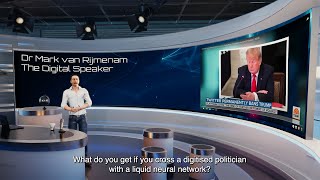
A Tech Journal episode hosted by Dr. Mark van Rijmenam (the "Digital Speaker") discussing two linked themes: (1) the rise of digitally savvy politicians who bypass traditional media gatekeepers — illustrated with case studies of Donald Trump (use of Twitter, eventual ban) and Alexandria Ocasio-Cortez (successful Twitch stream) — and the policy, business-model, and societal implications of direct-to-voter social media; and (2) an introduction to "liquid neural networks," a flexible MIT-developed neural architecture (lead author Rahmani Hassani) that adapts to spatiotemporal inputs and may improve robotics, NLP, video processing, and real-time systems. The episode contrasts risks (misinformation, populist exploitation, platform incentives) with potential benefits (closer citizen-representative ties, adaptive AI applications).
Questions this video answers
Dr. Mark van Rijmenam (the "Digital Speaker").
June 9, 2021.
Approximately 435,000 viewers.
March 2020.
January 2021.
Chapters
What do you get if you cross a digitized politician with a liquid neural network? One slippery lobbyist hello everyone, and welcome to the Tech Journal. My name is Marc Vermenam and I am the digital speaker. I have cloned myself and sent my digital twin into cyberspace to bring the good digital news straight to your retinas. From quantum computing and AI through to blockchain and nanosensors, I take a closer look at what these digital breakthroughs mean for our professional and personal lives. Let's take a quick look at what I'm covering on today's show. First, I'm going to take a look at the new breed of digitally savvy politicians emerging from the ashes of democracy. Will having a Twitch streamer president or an Instagram story Prime Minister make any difference? Or is it more of the same? After, I will be moving away from digital theory and exploring liquid neural networks, what they are and how they are making big waves. And so, without further ado, I invite you to relax, sit back, and get ready for your digital download. As you are probably aware, only a few years ago, Klaus Schwab, founder of the World Economic Forum and regular attendee at Davos, dubbed the age we are living through as the Fourth Industrial Revolution. With a digital explosion whose ripples resonated throughout the world, humanity entered a new era, one which brought with it its own culture, norms, and most importantly, the Internet. Within space of a few years, the Internet became the new TV library, newspaper, loudspeaker concert, and more recently, a new platform for politicians, changing the way these political ones and zeros interact with citizens. We have seen a number of examples recently of politicians beginning to digitalize their messages, but I'm going to take only two as case studies. Former President Trump and Member of Congress Alexandria Ocasio Cortes, the first former President Trump made himself the first sitting American president in history to routinely address the American people and the first president to get banned from Twitter. His use of Twitter represented a symbolic move away from traditional analog media towards new digital media in a way that resonated with the American people and his 88 million followers. The second Cortes represents a new generation of digitally literate millennial politicians. She demonstrated her literacy recently by being one of the first mainstream politicians to twitch stream. Despite having no experience streaming, Cortes Stream caught the attention of 435,000 viewers, with within the first few minutes becoming, in the space of a few minutes, one of the platform's biggest streamers. For those of you who do not know, Twitch is a live streaming platform associated with Generation z audiences what YouTube was for millennials Twitch is to Generation Z Social media will only increase, especially among politicians. But what does this mean for our personal and professional lives? Well, a number of factors come to mind. Gatekeeping, regulations, populists, anarchy, a potential for Western governments to adapt the Chinese approach to online activity, etc. But let's only focus on the two that have been enabled by avoiding gatekeepers and avoiding regulations. As Dr. Sanman Hung, a professor at Zhengzhai University, wrote in 2019, Social media represents a double edged sword from politicians. These platforms offer the opportunity to avoid gatekeepers, but have the potential to cause unintended and perhaps unmanageable consequences. And with US foreign policy being dictated through tweets for four years, he could not have been more right. First gatekeeping up until the 21st century, it was the role of traditional media, and they maintained strict control over who was given a platform from their speech. On one hand, as Dr. Hong puts it, traditional gatekeepers can manipulate and distort the content of a politician's message, seen time and time and again through tabloid media. On the other hand, Eric Goldman, professor and director of the High Tech Law Institute at Tinta Clara University, argues that without the fact checking of traditional media gatekeepers, politicians have a direct channel to lie to the Constitution constituents. This ability to communicate unfiltered with one's following has led to the fake news pandemic, where so many conflicting sources exist, making it difficult for the less digitally literate to differentiate between what's fake and what's not. Due to this digital hazing, politicians with conservative or moderate ideologies thrived on social media over the last decade, bringing us to the point where fast fact checking is now a digital necessity, replacing gatekeeping media with passport control Fact checkers Back in March 2020, Twitter issued its first fact checking warning on a Trump post, which ultimately led to Trump's permanent suspension from the platform almost a year later in January 2021. Since then, all mainstream social media platforms have either created their own or brought in a third party fast. While there are various reasons behind this, arguably this was a preemptive move to rein in their platforms to regulate themselves before governments took it upon themselves to regulate them, something that was first hinted at back in 2018 when Mark Zuckerberg was called before several governing bodies, including the US Congress, EU Parliament and Singaporean lawmakers, to name but a few. If governments were to regulate we we can imagine the Internet becoming much more similar to traditional media. Social media giants would be regulated to act as gatekeepers imposing laws and limitations on what their platforms can and cannot report, including who can and cannot use the platform, similar to the regulations that currently exist for print media. And with the emergence of a new type of digitally literate politicians who have direct access to millions of people, we are forced to face a potential future where governments directly invest and fund digital infrastructure, like we saw in the UK during the last election when free broadband for citizens and nationalization of digital infrastructure proved popular policies. And while total nationalization of any industry might not be the wisest idea, some nationalizing of digital platforms may be necessary. The elephant in the room here is without a steady source of income, most digital platforms are forced to rely on advertising revenue, which according to a Europe based Internet governance advocate and activist, is destroying investigative journalism and serious reporting, meaning digital platforms need to cater to the lowest common denominator and introduce serious issues to clickbait. There are other digital business models such as selling memberships and subscriptions and relying on patrons and crowdfunding. But memberships and subscriptions or paywalls keep high quality news away from the lower income citizens, and relying on patrons and crowdfunding can prove unstable at the best of times. Without challenging my Marxist digital clone to a debate and going too far into the potential class ramifications, I feel it's safe to say that a closer relationship between the people and their representatives, if protected from populist exploitation and sensational clickbait reporting, will only lead to more citizenry focused policy benefiting both our private and professional lives. That was a heavy topic. Now let's change up the pace a little and look at something a bit more tangible, something that is making a bit of a splash. Yes, of course I'm talking about liquid neural networks. MIT researchers recently produced a machine learning system with a new type of neural network. This flexible algorithm neural network reportedly adapts and changes to its conditions, helping researchers effectively dub it a liquid network. The idea for the names comes from an analogy drawn to dropping a stone into a body of liquid. In the same way that the falling stone creates ripples in the liquid, input into the algorithm is converted into spatiotemporal pattern data ripples if you will, empowering the neural network to adjust its parameters in real time, increasing its ability to analyze live data. Spatiotemporal, meaning being in both time and space. Rahmani Hassani, the lead author of this study, has high aspirations for this new technique, stating how the breakthrough is a way forward for the future of robot control, natural language processing, video processing and and any form of serious data processing. Good news for GPT4 and Tesla then. But will this make any difference to the real world? Absolutely. Right now most AIs are static networks, meaning they are bad at quickly adjusting to new conditions or changing in their incoming data stream. Liquid neural networks, though, are constantly moving and adapting, making them more flexible help helping them to adjust quickly to unexpected or noisy data. So if you're sitting back relaxing while your Tesla drives you in autopilot, you will not need to panic if it suddenly starts raining. Well, at least once they are made with liquid neural networks. Until then, you might want to think twice before relaxing at the wheel. What is more, its lead designer Hasani thinks it may also have the potential for speeding up medical diagnosis. Not too shabby, eh? While the future is uncertain and predictions are subject to human error, I and my real world twin by that matter am optimistic. For too long it remained in the interest of those in power to cater to those who provide the mouthpiece to pander to the gatekeeper. But today we are entering an unprecedented era where the views and opinions of the citizenry are championed, held up and spread far and wide on digital platforms. A single video representing a political issue, if it resonates with enough people, can be the catalyst for great social upheaval and political change. At no other point in history did an individual born into the working classes have the potential to bring about such huge change. Combined with the rapid advancement of AI and the new adaptivity brought about by liquid neural networks, we face a future where flexible AI has the power to quickly adapt and change to any situation, implying a vast swath of digital upgrades from adaptive nano bot healthcare through to autonomous luxury cars. Guess the news does not always have to be doom and gloom. What do you think though? Do you think the removal of political gatekeepers will work out or do you see it going any other way? Leave your thoughts below in the comment section. I love to see what you think. And on that note, I have been your digitized host, Mark Vermeer. You can call me the Digital speaker and this has been the Tech Journal. Please if you found this interesting and want to be the first out of your friends and colleagues to hear about the latest digital breakthroughs, press the subscribe button. Our Digital Overlord command it. See you next time. For your information, download Stay Digital.