EP11 - Interview by Saana Azzam
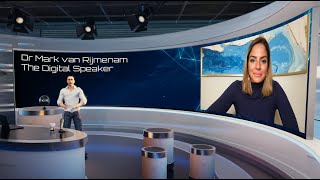
Dr. Mark van Rijmenam on how AI, big data, and blockchain reshape organizations. He outlines a four-step digital transformation framework: datafy processes, distribute data, move from descriptive to prescriptive analytics, and automate. Dubai's smart-government model shows what's possible.
Chapters
Foreign. Hello everyone and welcome to the Tech Journal. My name is Marc Vermenam and I am the digital speaker in this series. I project my digital twin into cyberspace to bring you the latest and greatest from the digital world. I cover all the latest digital news, from blockchain and crypto to quantum computing and AI. I also always try to take it a step further and look into what these digital innovations mean for our personal and professional lives. In today's show I have Sana Azam, founder of the Best Speakers and MC Bureau in the Middle East, Mina, speaker and an official member of the Forbes Business Council. And today we're doing something different and Sana is asking the questions to me. So great to have you on the show.
Thank you for having me. I'm excited to talk to you, Mark. Anything that helps us get clarity on the future is always in demand and fantastic. So we're excited to have a chat with you and just see what we can learn from your expertise. Mike, would it be okay if I can ask you some questions on what the future of the business looks like and with regards to your core areas of topic?
Of course. Sounds good, Looking forward to it.
So let's hear it. If you are currently leading a business in your field across any industry, what are some questions cool trends that you're spotting for people to future proof themselves?
Sure. I think what the main thing that's happening at the moment is that what I see is that technologies are converging. So we see that AI is benefiting from big data. Big data is being created with Internet of things. We have the blockchain that comes into play. So all these technologies are really helping each other to create what I call the organization of tomorrow, which is an organization run by and on data. And organizations that want to be ready for the future of work need to understand how they can benefit from these technologies. And if I always, when I talk about the future of work, I think there are three concepts that are very important for organization to be aware of. It's data, it's decentralization and automation. So with data, of course I refer to big data. You know, collecting all kinds of data from your, from your customers, from your employees, from the environment, etc. But in a secure, private and ethical way, of course, because you want to use data in the right way and not in the wrong way, as unfortunately still some organizations are doing with that data. You can then start to understand your environment. How is your environment changing? You can start to sense the opportunities that are happening. You can consequently then Try to change your organization accordingly and transform your business in order to benefit from the opportunities that are arising. So data is going to be very, very important for any organization if they want to be remain competitive in the years to come. Then we talk about decentralization, which I refer to, you know, blockchain technology or distributed ledger technologies. And I really think it's going to be the golden standards for blockchain. It's going to have a massive impact and it will fundamentally change how we run our society, how we build our businesses and how we collaborate between organizations. So that's something to be very, to be aware of. And then finally, of course, automation, artificial intelligence, machine learning, that's really here to stay. And with the vast amount of data that are being created, AI is getting better and better every day as well. And you can use AI to make your organization more effective and more efficient, but you should do so in an ethical or responsible way so that we can use AI for us and in a positive way and not against us. As some might have seen in the recent Netflix documentary Coded Bias.
Nice, I get that. So decentralization, automation and then data. So collecting the data, I get that. And these are really nice expressions that we've been hearing. And I'm going to say buzzwords almost because these are words that have been coming up a lot. So say now for people that on a day to day basis, how can they that are running say huge family offices or that are running these huge holding companies that are maybe in typically brick and mortar, not necessarily in the very digital space, what can they start doing in order to really move into this phase and evolution? Really?
Yeah, sure. So in order to help organizations who want to become digital, who want to digitally transform, just basically how I have digitally transformed myself into a digital twin, I have created a digital transformation framework which basically sets out four steps that you need to do if you want to become a digital organization. And you can do this at a very small project, which I would recommend to do, an initial project, or you can apply this to your entire organization. But it basically means you need to datafy your processes and your customer touchpoints. So you need to start collecting data with the various processes in order to be able to do something. Because if you don't have the data, then obviously you can't analyze and you can't benefit from it. So you can use the Internet of things, you use sensors or use online data to understand what is going on. Once you have the data, you need to distribute the data. You can distribute it either using the cloud, if it's for your internal users only, or you can distribute your data using blockchain. If you want to collaborate with your peers, for example, in your supply chain, then you need to analyze the data. So you can use descriptive or predictive or prescriptive analytics to analyze what is going on. And a small metaphor of how I look at this, you have descriptive analytics, which is basically business intelligence. And that's the same like looking into the rear view mirror of your car. You can see what has happened from one second ago to 10 years ago. But if you only look into your rear view mirror, you are certainly going to crash. So you need to have the foresight, you need to have your predictive analytics to understand what is going to happen based on historical data to be able to make the right decision. It's like your car's navigation system that helps you drive in the right direction. And then the final phase of understanding your business is prescriptive analytics, which not only looks at historical data and makes predictions, but then also makes the decisions itself based on what the best outcome is for the business. And you can best compare that to your self driving car driving you autonomously to your destination. So the third step is analyzing the data. And then the final step of course is to automate your processes and your customer touch points. And you can do that again using artificial intelligence or machine learning, or you can use that, that using private, using smart contracts on the blockchain to make it happen. And if you follow the steps of datafying your processes, distributing your data, analyzing your data for insights and then automate accordingly, then you can really turn any organization into a digital organization.
Nice. You make it sound really easy. As a four step model, that's all you do great. And I love that. Have you seen this happen in the public sector? Have you been seeing this? Do you have case studies, private or public sector, where this has actually been happening?
So I think what I see more and more is that a lot of also in the public sector they want to use technology. But unfortunately, at least in the Netherlands, a lot of government officials or the ones in parliament, they don't really have a clue of how to use technology or how to embed technology or how to create legislation for technology. I think that's different in the Middle east or in Dubai, where they want to be the smart nation or the smartest, I think smartest government in the world, which I think is fantastic. Where it really shows you that you have a clear understanding of what is going on, of how can you use these Technologies to create a better society. So I think Dubai is a fantastic example of embracing these new technologies and starting to digitally transform your organization, your government. And it shows you the amount, of benefit, number of benefits that you can get from that. So, yeah, I think my government can still learn a lot from what's happening in how Dubai is trying to build a smart government.
Yeah, we even have a minister of AI. So it's.
There you go.
The type of initiatives that are center, and they've been very public about this type of strategy. Interesting. And do you have any other tips for somebody else that wants to increase their digital literacy, that wants to become better in this space on an individual basis?
Well, I think it's important to stay up to date. And that is a bit, you know, that's a very big challenge to give to people because it's very difficult to stay up to date because the changes are happening so incredibly fast. It's my job to stay up to date and to understand how we can use technology or future tech in our strategy. And even I sometimes have difficulties keeping up. So it's very difficult to keep up. But I would recommend try to listen to the right podcast, follow the right thought leaders on that, go to the events, hire the right consultants to help you with this, Because I think the only way to be able to digitally transform your organization is if everyone in the organization has a shared understanding of what's happening and how you can use this technology, technologies. But, yeah, you should stay up to date and do your best to do so. And yeah, it will be difficult because the world is changing incredibly fast at the moment.
Okay, fantastic. And if, say, you were gonna set up a new business tomorrow, so you're. You're an SME or your future entrepreneur or even entrepreneur, and you're looking at the next thing, what would that be and how would you motivate that?
That's a very interesting question. I think it would be something within the AI space, because I think the AI space has tremendous potential. But I would do it in a way that is where we use responsible AI, where we use AI in a way that's beneficial to society, to citizens. And I think this whole. I would really focus on trying to create a model where we can use AI that's beneficial for all the stakeholders, really the stakeholder model. And I always believe that, you know, if you take care of your customers, your customers will take care of your shareholders, so that, you know that that will come eventually. If you just build a business that's beneficial for all stakeholders and not just one single group. And if you build, if I would were to build a new startup or a new company, I would really look into the possibilities of AI and how they can benefit for whatever I want to do and really try to do that in the most ethical way.
Do you believe that this format of interaction and using these type of, this event style is the way of the future?
Well, I think virtual reality or augmented reality is definitely the way forward also for the events industry. I think we're going to move to a hybrid format for at least a couple next couple of years. And smart event organizers will keep that forever because it just basically means you can add a whole bunch of people to your audience, but you should do so in a really innovative way. And that's what I'm trying to do. You know, of course I'm here as an avatar and that's a crazy different approach, but I think it has a lot of potential. And what I have developed is that my avatar can appear as a hologram on your stage for your fixed events, for your in person events. And then those people who are listening online or watching online, they can see the avatar completely in sync. And I think that that's, that's, you know, the nice thing about this and I think it's also, it's a great metaphor of digital transformation because if I, I've been able to digitally transform my, my business and of course, you know, I was required because due to Covid, I couldn't fly anymore and events were not organized anymore. And so I decided to digitize myself and to practice what you preach. And it really brings me a lot of benefit because all of a sudden I can, you know, speak at multiple locations at the same time. I can, at some point in time I'll be able to, you know, speak different languages fluently by cloning, cloning my voice, hopefully sometime as well. Yeah. And at some point, you know, I can be anywhere in the world or of this world, because in a digital studio you can really create any environment. And you know, these benefits show you what you can do once you digitally transform your organization. And I think that's the main example also for organizations. You know, if I can digitally transform my business, you, any organization should be able to. And it brings you fantastic benefits.
Well, that's exciting. I mean, the Middle east is really looking forward to seeing you more frequently in all your mediums as a digital person, as a hologram and in person as well, because things are opening up from over here and events are moving back to being live again.
Fantastic. Well, I'm very much looking forward to as well. So thank you very much, Sana, for being on my show and this time asking me the question. So I've been your host, Marc Veramin. I'm the digital speaker and do not forget to hit the like and subscribe buttons and I will see you next time for your information. Download. Thank you.
More from Dr.








Seamless Communal Events in the Metaverse with Doug Jacobson - Step into the Metaverse podcast: EP17


Dangers of the Convergence of Generative AI and the Metaverse and Solutions to Overcome it
