EP15 - Interview with David Shrier - Augmenting your career with AI
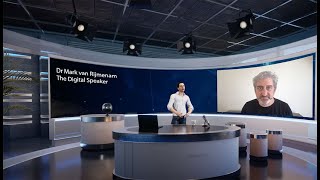
Dr. Mark van Rijmenam talks with David Shrier about how AI is changing careers and what ethical AI looks like. They discuss whether workers will adapt or be displaced, and how companies should integrate AI responsibly.
Chapters
Foreign.
Hello everyone and welcome to the Tech Journal. My name is Mark Veremenom and I am the digital speaker in this series. I project my digital twin into cyberspace to bring you the latest and greatest from the digital world. I cover all the latest digital news from artificial intelligence, machine learning, neural networks, quantum computing, crypto and blockchain. And I always try to take it a step further and look into what these digital innovations mean for our personal and professional lives. In today's show we have David Schreier sharing his insight with us on the hype of the day. Augmenting your career with artificial intelligence. David is the CEO and co founder of Esme Learning, the AI powered digital learning platform. He is a leading AI futurist who has driven over 9 billion worth of technology initiatives for Fortune 1000 companies and private equity. Shrier currently holds an appointment as professor of Practice, AI and Innovation at the Imperial College Business School. And he's a former MIT New Ventures Officer and lecturer at MIT Media Lab. Well, it's a pleasure to have you on the show, David. How are you today?
I'm well, it's great to be here. Thank you so much for having me, Mark.
It's an absolute pleasure and I'm actually super excited to talk to you because I have just read your book Augmenting your How to Win at Work in the Age of AI, which was recently published. So congratulations on your new book.
Thank you so much. Yeah, it was an exciting process putting it together. I got to talk to some really amazing people from, you know, people working at some of the largest management consultancies in the world, to cutting edge thought leaders who are pushing the frontiers of AI as a fantastic experience.
Fantastic. So what made you decide to write this book?
Well, I've been doing work in the artificial intelligence space for a very long time. I wrote my first AI program in 1991 and I've watched the market and the sector, the technology all evolve. And what I've noted is that we've passed kind of a critical threshold where AI has become truly useful and, and is beginning to have a significant impact on society and on the nature of work and some of the other activities I've been engaged in in academia and in private sector work has exposed me to some new directions to go with AI, to bring it together with people. And so I really felt it was important to communicate both the threat of AI to your career, to your job, to your future, as well as the opportunity that you and AI together can do something interesting.
Great. And I say, I read the book, and I really enjoyed it. I've been involved with AI, of course, also for quite a few years now. I follow what's going on there and I think I really enjoyed how you made the connection between, on the one hand, discussing the dangers of AI, but also saying how it actually can improve your career, how it can help you in your business. So I have a few questions related to the book and the first part I'd like to understand more about. You talk about the negative aspects of the bots coming, such as the effect that they had on the Brexit or the elections. How much harm do you think that AI can actually do to society in the near term?
It already has done significant harm, not by itself, but by how it's been applied by people with certain agenda that they are playing out. And so, for example, the votes for the US presidential election in 2016 and the Brexit vote in the UK were already close. There were already significant societal pressures and issues that caused each of those elections to be very, very close. But based on pretty rigorous research done by the National Bureau of Economic Research, the belief is that, you know, AI bots were able to tip the balance of each of those elections by greater than the margin of the vote. So. So that arguably has caused significant economic dislocation and other harms both in the US and the UK and more broadly elsewhere in the world. Longer term, however, there are even more profound risks around AI. You know, we're calling this the fourth Industrial Revolution, but the thought leaders like Eric Brynjolfsson, who's at Stanford, Stanford Business School, have said that you can, you can kind of think of the, the likely economic and jobs dislocation of the AI revolution as being comparable to the first Industrial revolution where, you know, entire workforces were made obsolete overnight. And people had, were very upset about this. And there were a lot of ultimately revolutions to topple governments. So we faced that level of risk from AI within the next five to 10 years.
Yeah, I think it's the speed at which the AI is being developed at the moment. You know, it's going really, really fast. And what I can definitely see happening is, you know, a lot of the monotonous jobs that they are, you know, they are, I think I see very clearly that AI can have a big impact on those jobs. You know, we all know the example of taxi driver or the truck driver, you know, that they are being taken over by AI. I think on the other hand, for the higher end jobs, human machine symbiosis is a lot more possible.
It's possible, but it's not as widely adopted as it should be. Today we're even seeing higher end jobs, whether that's in law or investment banking or other categories being replaced by AIs. And so that's a significant risk. There's also significant risk in the developing world which, which faces significant economic pressures and social pressures, more so thanks to Covid and you know, in developing economies, the impact of AI, the impact of robots is even more profound on the workforce and on labor dislocation.
Yeah, I can definitely understand that. And you know, I think for the high end jobs, I've spoken about it in the podcast before that, you know, recently Microsoft, they fired all their journalists I think from Amazon, the website, and they replaced it with GPT3, which is an. Interesting to see that really no job is safe here. But I can imagine that the amount of jobs, the amount of people that have jobs that are most likely to be replaced is very, very, very, very, very large number. So what do you think that these people have to do once they, once AI has taken over the jobs?
Yeah, I mean it's a big risk. And you cite GPT3,3 from OpenAI, which is backed by Elon Musk and I had a chance to play with that technology when writing the book. So actually part of one of the chapters is written by GPT3 and it's pretty good. It could replace me within, within a few years, two or three years, not, you know, 10 years. The, the broader workforce dislocation risk is significant. The projections now are somewhere on the order of 30 to 50% of employment within the next 10 years or so could be disrupted by AI. So, so significant risk there. But as, as you correctly point out there, there is this emerging symbiosis where, you know, maybe AI is not going to take our job away. Maybe instead AI is going to be our buddy, they're going to be there with us as we're going through our day and help us perform better at our jobs and even potentially unlock some new capabilities that don't exist today where AI and people together can do something that neither AI nor people by themselves can do.
And I definitely can foresee that human AI symbiosis will have make organizations more humane because there's more tasks for people to focus on, the customer, etc. But what kind of new jobs or tasks do you foresee happening then?
Well, I mean, I think the. So a lot of boring and repetitious things will get taken over by the AI. That's sort of like what's not going to happen is we're not going to be doing boring, repetitious work anymore. The AI will take care of all that for us. The new capabilities arise from essentially the ability of AIs to bring many people together and optimize collective intelligence intelligence. So Tom Malone has written about super minds, Sandy Pentland has written about social physics. But, you know, there's essentially this idea that, you know, large numbers of people can do very interesting things where the AI can serve as the glue to bring together people. And more than a glue, like a network, an active network of ideas that then can do things that sort of tap into this mass intelligence. And that's a really exciting idea because you can do things like predict the future. And we've run some experiments. We just published a paper recently where, you know, we got a large number of people from over 100 countries to correctly predict stock market movements. And we use the AI to tune those predictions so that the prediction market performed dramatically better, like one or two orders of magnitude better than conventional prediction markets have historically. So, so that kind of idea that, you know, you could tell if there's a problem emerging in a complex manufacturing project, you know, multi billion dollar project, you could identify problems early and take action. You could identify new market opportunities to take your company into. You could identify investment opportunities, again using the mass intelligence of the human brain as almost like sensors to detect new opportunity and then communicate that information back using the AI.
Well, I recently read the book Superforecasting by Philip Tetlock and then Gardner. I'm not sure if you've read that book as well. Where did a lot of research in if people can become superforecasters and what would be the characteristics of being a superforecaster and basically sort of predicting the future. So I can imagine that if you link these superforecasters and there are some traits that people have that actually show that you can be a supercaster and you link that to an AI. I think it will have the same effect of having a chess player or a Go player linked to an AI as well.
Maybe the research we've done suggests something similar but different, which essentially says that experts can be more right than the average person, but when they are wrong, they're dramatically more wrong. And so on the other hand, the average person is by definition average. So if you take the predictions of the average person, you get a perfect bell curve and you know, your error bar is like plus or minus 5%, which is great for a party trick, but not useful for Anything serious, business applications or financial applications. But if you blend those experts, the superforecasters, and the average person, and you temper the ratio of how they discover each other's forecasts, what's known as social discovery, you can produce dramatically better predictions. So you want the experts, but you also want the sort of the tempering wisdom of the crowd, and you want to bring them together. And that's a really exciting field. As we get more sophisticated about thinking about how AI and people can work together on these collective intelligence or super mind functions, you get into some dramatically exciting areas.
Well, I think not only exciting, but also you could almost say worrying areas of field. Because, you know, the more we have AI coming into our lives and we see that already every day happening, you know that AI is not always doing the right thing for us. You know, whether it's, whether it's by accident or it's intentional, in the end, AI is a technology that's neutral. You know, it can be used for good things, it can be used for bad things. And you are launching an AI Institute. You focused on ethical AI. So, so what does this, what does ethical AI mean for you and how, how should we go about this and how can we achieve it?
Well, an expression I like to use is trusted AI versus ethical AI just because it, it more acutely presents what we're hoping for, an outcome. We want AI that does what we want it to do, what we expect it to do, rather than it deciding by itself what it wants to go off in do. And we want AI to reflect our principles and our values. And so to me, ethical AI of will. So ethics are relative, right? Different cultures have different perspectives on ethics. But most Western cultures, classically Western, you know, say European and North American, South American cultures, have a shared set of values. And colleagues such as Luciano Floridi at the Oxford Internet Institute have done some research kind of extracting out what are the common ethical principles across many different kinds of countries. And those can give us some guidance on how we build trusted AI. Because there are certain things that everyone would agree. For example, I think that AI should do good things for us, and everyone would agree. I would think that AI in the process of doing good things for us should not do bad things. So an example would be, let's say I want to use an AI to improve my stock portfolio. So the AI should make trades that increase my bank account. That's good for me. At the same time, the AI should not be making trades that cause mass starvation. So, you know, in theory, you could use An AI to spike the price of commodities such as foodstuffs like sugar or rice. And you might be able to make money off of that if you had a good AI and you knew what you were doing. But that would cause mass starvation. And so in the process of doing something good, we don't want to do something bad. So those would be two of the five principles that professors Floridian cows have developed that, you know, benevolence and non malevolence, as they call it.
But then comes the question to me is, you know, what's good for you? What good means for you does not necessarily mean that good also means that to me, you know, and what we define as something being good, if we can define a global definition of what is good, what is good today might not be good tomorrow, and vice versa. And, you know, the AI that we create today will probably live on, whether it's, you know, in the form of child AI or different forms or whatsoever for years to come. So how do you envision that? You know, because that's one of the difficult parts, I think, when it comes to ethics, ethical AI or trusted AI, you know, everyone has their own perspective on it, and a criminal might be very happy to use it to do all kinds of really terrible things.
Separate out a couple of issues that you've raised there. So, so first, to start with the last issue, you know, a criminal is by definition someone that most of society has said is not a good person. So we could, we could largely agree, most of society would agree that the criminal should not be permitted to do bad things. There might be a small set of society that says a criminal should do bad things, but. But by debt. We've passed laws and everyone's agreed that a certain action constitutes a crime. And therefore society is defined who are criminals. And therefore we can sort of agree as a whole what I should not do. Right. The second issue you raised was one of basically autonomy, which is to phrase it another way. The AI should do what we want it to do. It should not just go off and do whatever it wants to do. And so this isn't a matter of simply setting the AI AI off and then it goes and does anything it wants. This is the AI needs to be following our guidance on an ongoing basis, so it does what we want it to do. The third issue you raised was around competing interests. And this is where we get into the realm of complex systems. Right. We see it today in the stock market, so about 90% or more of trading volume in the equity. These markets today. Are AIs, they're bots, they're not people. Most trading today, volume is high frequency trading conducted by artificial intelligence. And, and so it's not one AI, or even one AI against another AI. You have thousands of AIs that are all trading against each other. We need better controls and systems to manage those complex environments. And so this is an area that I think, unfortunately to date has not received sufficient attention, but it's something we definitely need to be thinking about very seriously, conducting research on and developing guidelines and principles around. And so, for example, the European Parliament is contemplating now new legislation around regulating AI and the approach. And I'm advising the Parliamentary committee, the Stoic Science and Technology Options Assessment. I'm part of an advisory group that is helping them and evaluate this new legislation and I believe that they are taking the right approach. So Eva Kaylee is the chair committee and she is guiding it in the direction of a risk based approach to regulating or managing AI. So we don't want to quash innovation, we don't want to hold back entrepreneurship, but we do need to regulate societal harms or potential harms. And so we need more of this kind of thinking and understanding behind how many competing AIs would interact with each other and what that would mean for us.
Is that also the reason why in your book you write that a philosopher would make an excellent AI program? I found that statement fascinating. Can you delve a bit deeper into that? What are the key characteristics of philosophy that should be part of, you know, of every AI course or, or that we should make sure that are part of the various algorithms in the AI that we are developing?
Yeah, well, so two, two separate ideas there. Right. So on the one hand, I am freely borrowing this idea from, from Tommy Meredith and Michael Dell. Tommy was the CFO of Dell during their initial rise and he invests now in a lot of strong AI technology. And, and so he was sharing with me that the best programmers that can hire into his strong AI company are, are these, you know, philosophy students from UT Austin. And, and part of it is because, you know, the programming of AI is getting easier because there's more basically machines. AI is even helping us program AI. So, so you're getting close to the point in time where instead of programming, what you will do is you'll describe a problem verbally to a computer and it will develop the code to address that problem. And so programmers in that new world order are symbolists and structuralists and architects. And then the AI does the messy detail of figuring out how to translate those ideas into action. And that is where philosophy students have an advantage because they're trained in formal logic. A lot of one of the major schools of thought around machine learning is something known as Bayesian or statistical, basically statistical learning. And so you have to be able to hold a lot of different and competing ideas in your head at the same time until an answer presents itself. And again, that's something that philosophy students are trained to do and are very good at doing so. So I think it's certainly an intriguing or provocative idea that the. What used to be viewed as the lowly philosophy student, you know, the joke used to be, you know, what did the computer science major say to the philosophy major? And the answer, the punchline of the joke was, I'll have a Coke with those fries. And so that will no longer be the case. Right. Sort of a robust employment market potentially in this new world. Because they're trained in formal logic, they have the ability to manage competing ideas and they can structure arguments in a comprehensible fashion. And if we're going to have conversational AI, which is where it's headed, everyone's talking to Siri or Alexa these days. But if we're going to have conversational AI, then people who know how to have structured conversations are going to do very well.
And then also I think with the recent news that we had GPT3 now able to translate English language into code, that will only become more important.
Then absolutely no question, even English majors may have a future life as AI programmers.
Well, I think that would be great news for a lot of students nowadays. But I think related to that, in the book, you also write that UX is very important when you create AI. Why is that?
Well, we still want these machines to interact with humans. We still need them to be congenial for us to interface with. Because what we don't want to do is create a digital divide that is even bigger than digital divide we have today. We don't want to make it so hostile to interact with AI that only very highly specialized people can be the high priests and priestesses of, of AI and talk to the machine and come out and, you know, give you the answer. We want to make it much more democratized. And for that to work, you need to have very good user experience, a good user interface. And, you know, a lot of work has already been done on that. Right. I mentioned a lot of these home AI devices or things that are carried around in our phones. And that field continues to develop at a rapid pace.
But then you know, we have this AI which is, you know, very easy to use, which is, has been developed by philosophers and by English students, so everyone is using it. And then in your book, you talk about the AI minders keeping track of what we do and what we, you know, what we have, what we said and where we've been and etc.
Well, I didn't quite phrase it as keeping track of what we do, but go on, I want to hear the rest.
Okay, well, please explain.
Distinction. Right.
I mean, so what is your idea that AI would, you know.
Yeah.
Follow us or how do you, how would you explain it?
Yeah, I mean, it would be, it's a coach or a buddy. It is something that is under your control with strong protections around your data. So I wear a biometric ring. I don't know if the camera can see this very easily, but there are little sensors on the inside of this ring. And it helps me, you know, monitor exercise, monitor sleep. This helps me live my life better. The data is more locally stored. It's under my control. It's not, you know, just being handed off to whoever. And those are good examples of a broader principle that now is beginning to get widely adopted of data localization. Meaning instead of centralizing everybody's data in one place to make a big target for a hacker, you keep it in little pieces with the individual and it's under your control. And so similarly, your AI will be under your control and the data around it will be local. And so, you know, I would find it useful to get executive coaching as I go through my day to do better at my job. Wouldn't that be great if, you know, I could get tips on how to do this interview better right after the interview. So the next time, you know, I do a better job on an interview. And so, you know, you can think of things like that. It's like Fitbit or the Oura ring or the Apple Watch or one of these wearable devices. Those have, I call, very lightweight AI technology embedded in them. And they're helping you live a better life. And so imagine a higher order version of that that also is able to help you through your work life and other areas.
Yeah, I'm all for it. I think it's great to have these technologies that help you live a better life. But my worry is that these technologies are not developed by a company that has the best thing best for with the consumers. There's so many examples of data being misused or data being hacked because it hasn't been stored properly. We all Know one of the biggest companies who doesn't have a very good track record on it. Aren't we heading towards a privacy nightmare? If everyone uses these monitors or AI tools to monitor their lives, in the meantime, it's all being stored somewhere and some people might get access, might misuse it. Aren't we heading into the wrong direction then?
Well, we get back to the reason why government intervention can be helpful. A lot of people, particularly in the tech circles, shake their fists at government intervention and say you're, you're hindering innovation, you're preventing entrepreneurship, and you're holding back progress. And, and the counter to that is that the, the poor, the poorest people, the least literate, are often the ones most exploited by these, these new technologies because they don't know how to turn off their privacy, you know, whatever, they don't manage their privacy settings or what have you. So this is where, you know, and believe me, I am a capitalist. I believe in entrepreneurship, I teach, I've taught entrepreneurship now for 20 years. But at the same time, I do think that we need to have innovation tempered with compassion. And we do need to have a government holding its protective hand over our data and our privacy. And so I do think that, for example, GDPR has done the general data protection regulation in Europe has done more good than harm. I wouldn't say it's perfect, none of these things are perfect, but it was an important step forward. And similarly, the new privacy regulations and AI regulations emerging in the US, in Europe, elsewhere, I think are net positive. Even if they do create some commercial friction or, you know, create some added costs, I think it's worth it because of exactly this, this risk that you describe, exactly this issue of if we don't have those protections, you know, commercial interests have already demonstrated that without some external intervention, like a government invention, they'll just do whatever they want. And Facebook is probably the worst offender among any of the big tech companies. Terrible cybersecurity, terrible abuses of their platform. They're making some small steps now to finally start to improve things. But you know, I look at Twitter as a contrast.
Right.
Twitter is much smaller, but they have been much more proactive about putting in place controls and remediation for issues. And I think that that's great, but I think that we need more and that's where government intervention ultimately is necessary.
Yeah. And I would also add to that, I think not only government intervention, but I think also education and the education that people understand how to use AI. Yeah.
Because fund digital literacy and AI literacy.
Yeah. I think that that's crucial because, you know, if the average Joe from the street doesn't understand why what this app does or how his data is being used, that's very problematic as well. And if we are able to educate the people on the usage of AI and ethical AI, then I think in the end the market will decide if they would allow a company like Facebook to continue with their practices or not. And hopefully at some point we'll be heading in that way.
That was one of the major inheritance behind why I wrote the book. Augmenting your career is intended to help the average person understand AI, understand what it means for the future of society and also the future of future of their job and then where to go with that information. What to do.
Yeah, so link to that if you know the person in the office or in factory or wherever. What are some of the AI systems available in the market that can help teams and help them become high performing teams?
Well, there are a few. And so for example, just in a very simple but ubiquitous level, both Microsoft and Google have started implementing rolling out an AI that will start to help you compose your emails. So you may have noticed as you start, if you're using any cloud based service, as you start to type, it'll put some gray text at the end of your sentence to kind of extrapolate out what the rest of that sentence would be. And instead of having to type the whole thing, you just hit tab and it'll finish the sentence for you. And so that technology, I've been watching it even over the last six months get notably better at what it does. So okay, it's a very simple productivity thing. But imagine if that could help you be 10% more productive in your job. Imagine if you know every day you got back three quarters of an hour of your time that you could do for anything else, because now you're being just like slightly more efficient with your time. So, so that's, I think, valuable. It's, it's on a modest sort of impact and level, but still it's everywhere. Everyone's using email and so this helps you be more efficient, effective. But there are more sophisticated tools out there. Another more sophisticated tool is also filtering your email inbox, right? So now instead of having to comb your way through not just spam, but the messages that are coming in that are all important in different ways, it's helping you kind of declutter your inbox and figure out for a particular issue or item where you need to pay attention. So that's now a Higher order individual AI assistant, but we can go much further. And so I was involved in starting a company that was spun out of MIT called Rift Analytics. And what Rift does is it's a tool that helps a video conference call be better. It helps me understand if I'm talking too much, you understand if you're interrupting me too much or not interrupting me enough, you know, and it gives you real time feedback and that data is presented to the individual. Right. So I now get some coaching on during the call how to, how to have a better collaboration and after the call, you know, how I can work over time to be better with my team. And we've done quite a bit of peer reviewed research around this that shows a dramatic improvement in team performance using this technology. And so that we're not the only ones who are working on this idea of collaboration. But there are others as well. But it's an exciting field, an exciting application of AI that begins to peek out over the edge of how we harness collective intelligence.
So over the years, I guess we will see that more and more organizations will employ AI to work together with the employees and therefore create better teams. And I think that that's a really good advantage of AI to help organizations perform better and at the same time use those same AIs also to have you as a person, person feel better. The ring you just mentioned, so you can monitor how your body is performing. So in the book you discuss also various other body improvements to upgrade ourselves. And there's of course a lot of debate going on on the Internet what to do with AI getting more and more advanced. Shouldn't we at some point merge with AI? That's why Elon Musk is the one who says if you want to win from AI, we have to merge with AI. And that's why he's building the company Neuralink and the implant, you might have seen it in the monkey that just playing ping pong. Now what is your idea that do we have to merge with AI or why? And why not? What's your opinion about that?
Do we have to? No, we don't have to do anything. But I think there are advantages if we integrate ourselves into AI or integrate AI with us and ultimately with, with, you know, sort of what we're doing in society. And so, you know, the interface is probably going to be, is probably going to be something, eventually going to be something neural. I was, I was having an argument today with a senior official at darpa, the Defense Advanced Research Projects association, big US government funded association that helps with Commercializing research. Right. And we were debating when Neuralink would actually be a sort of practical technology. And I was saying, you know, it would be widespread in 20 years. And he was thinking 30 to 50 years. But within a reasonable span of time, certainly within the span of time that I expect to still be alive, we're going to have these things implanted into our brains that help us think better and help us interact with. With AI better. Because right now, if I want to interact with an AI, I can either type on a keyboard that's about, you know, 60 to 80 words a minute if you're fast, or I can talk, which might be as fast as 120 to 150 words per minute. But that is massively slower than how your brain thinks and massively slower than computing speeds and network communication speeds. So when we can plug our brains directly into AI, we're going to dramatically improve the pace with which we do things in life and with which we interact with the AI. And that's why I think, you know, companies like Neuralink are important because they are trying to bridge that gap between human and machine.
Yeah. So I think, you know, what, what's one thing that that's for sure, you know, and it also came when I read your book, is that we are at the forefront of an exciting decade or decades where AI is going to have such a fundamental role in our society. And I think I'm very much looking forward to that, to see how we can use AI to create a better society, better organizations really use it for good purposes. Although I do think we have a long way to go to create the right legislation to make that happen. But it's been absolute pleasure to talking to you, David. Thanks for coming to my show and I will share your book and the link to where to buy it in the notes. So thanks for having being on my show.
Great. Thank you so much for having me.
Well, that's all for today. Thank you so much for joining us. For today, I have been your host, Mark Vereminom, the digital speaker, and this has been the tech journal. Do not forget to hit the like and subscribe buttons and I will see you next time. For your information, download Stay Digital.
More from Dr.








Seamless Communal Events in the Metaverse with Doug Jacobson - Step into the Metaverse podcast: EP17


Dangers of the Convergence of Generative AI and the Metaverse and Solutions to Overcome it
