Global Big Data Applications and Research Forum - Qingdao, China - Mark van Rijmenam
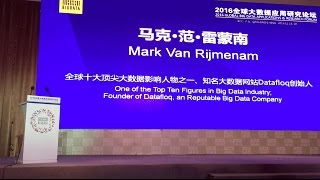
Dr. Mark van Rijmenam outlines seven data trends for competitive advantage: empowering front-line workers, blockchain for instant transactions, algorithmic business, hyper-personalization using 360-degree customer profiles, people analytics, security analytics, and fog computing for edge devices. He warns of risks from faulty algorithms and closes with implementation questions about shared ledgers and data protection.
Chapters
Thank you. Good afternoon. Good to be back here again. I have to apologize because the title of the speech today is not predominantly about blockchain. I'll share some other interesting trends, but I started this morning and I. And I would like to continue about that because the world is changing and the blockchain is part of that. Definitely to look at. Before I go into what is happening in the world, let's first have a look at how fast the world is changing and let's see how fast the amount of data is growing at the moment. Just a few years ago, we used to be having a few megabytes or gigabytes of data. Not that much as you could see. Nowadays there are a lot of companies who already collect terabytes or even petabytes of data. So for example, the large hydrogen collider in Switzerland collects petabytes of data per day. But it's only a matter of time before we really start to talk about the true amount of data that are coming our way. Exabytes of data is, is the 1 exabyte of data is the amount of data that's being created every day on the web. That's already quite a lot of data. That's a million gigabytes. So that's a million terabytes. A billion gigabytes. That's a lot of data coming our way. But now we see that in 2016 we'll have 1.3 zettabyte of data being created by us humans in the entire year. And the entire digital universe at the moment is the size of a yottabyte. And we are waiting just years away probably before we have the first brontobyte being created. And I've already heard the next term, which is going to be geobyte, which is 10 to the power 30. So the amount of data that we're getting is growing exponentially and we have to deal with that and we have to use that in our financial services industry. I already showed this slide this morning and Kirk explained it in depth in his presentation, so I won't go into depth about that. But we see that the type of different analytics that we're going to use in our company is really expanding to different fields. That's what I want to focus on. So this morning I shared three important trends that I think you should be aware of in your organization. First one is empowerment. So the mixed data approach. So how do you ensure that those people in your organization have to make decisions? And I'm not talking about the C level executives or the Board of directors, I'm talking about those decision makers who deal with the customer. So those people in the bank who are customer focused, customer faced, those are the ones who need to have the insights to be able to respond to questions the they get from customers. Or you're merging in an acquisition team in the bank that needs to have the answers to know how to value a certain organization. It needs to have all kinds of different data sources to be able to make the right decisions. So empower those decision makers within your business that have to make the decisions. So then of course, the blockchain. The blockchain is, I would dare to say completely going to change the financial services industry. We already see this happening at the moment. 50 of the global banks have formed a partnership which is called the R3 partnership. The R3 partnership, they are looking into how to develop new products based on the blockchain technology. They are working on systems to create settlements of transactions instead of days or weeks and to reduce them to minutes or even seconds. And as I mentioned this morning that we had the first global transaction taking place. From goods moving from the United States to Qingdao, that's the first time that we see financial transactions being moved instantly across the globe. The blockchain, and for most of us, we know the blockchain from Bitcoin, which is only one type of cryptocurrency. But you see that the amount of cryptocurrencies coming our way is also growing. You have different types of blockchains. For example, you've got the Ethereum blockchain which is predominantly focusing on smart contracts. You've got the Hyperledger which is predominantly focused on private blockchains. And you have all kinds of new startups working on blockchain technology. All of these blockchain technology, all of these blockchain startups, they work with so called tokens, cryptocurrencies. And these cryptocurrencies are going to change also the financial services industries because they are different from fiat currency, because a cryptocurrency resides online. And you can transfer cryptocurrencies instantly from one place on the globe to another place on the globe. That is significantly changing the way financial services industry will work. The third trend I mentioned this morning is the algorithms. The algorithms to ensure that we can basically automate our business, to ensure that we can create a more algorithmic, more programmable business. But we have to ensure that the algorithms are correct. So if you are a bank, you have an algorithm that determines whether or not someone is eligible for A loan. You better make sure that this algorithm is correct. Because if your algorithm is not correct, someone who is eligible for a loan might not receive a loan. That's bad for the customer and that's also bad for the bank because the bank loses money. However, if the algorithm gives someone a loan who should not get a loan, that's also bad, bad for the customer. You might think it's good because the customer gets the loan, but the customer cannot repay a loan. That's not good for the customer and it's bad for the bank because the bank has a very high increased risk of default. So it's very important to create the right algorithms to ensure that they are correct. So the empowerment blockchain and algorithms are one part of analytics within your organization, one part that you should focus on if you want to be ready and stay competitive. However, there are four more important trends that I'd like to share with you because I think these trends are vital for you if you want to stay competitive in the changing world. And the first trend I would like to talk about is the true personalization through big data. This is also called hyper personalization. It basically reflects that organizations now have the ability to collect and analyze so much amount of data to create complete 360 degree customer profile. Especially within the financial services industry, this is extremely important. The financial services industry has the requirement to know their customer. The better they know their customer, the better they are able to determine the risk profile of the customer, whether the customer is a consumer or whether the customer is a large enterprise. For any bank in the world, it's important to determine the risk profile to know the customer. And big data can help with that. So if we look at the, for example, the customers who want to obtain a loan, you can use all kinds of new data sources to get to know him or her. A good example is the social media data that has become available. Consumers nowadays publish almost their entire lives on social media. Whether it's WeChat, Facebook, Twitter, whatever. Everyone is publishing photos and images and talking about what they're doing in their lives. That data is a lot more interesting for a bank than some sort of form where you wrote down about your risk profile. Because what you say that you do is different from what you actually do. There's a very interesting example in Australia, where I live, is that the Australian tax office recently is doing a research, an investigation on a couple who said that they only were earning $60,000 for her and $80,000 for him. Well, on Facebook they were showing pictures that they were flying business class around the world, that they had four kids that all went to private schools, which is a bit different from what you would expect if you earn $140,000 a year, which still is quite a lot of money, by the way. So it was interesting to see that you can use the data from social media to understand what's going on with your consumers, who are your customers, what are they doing? So social media is becoming increasingly important to know your customer. Then we've got the quantified self. Quantified self is all about tracking and tracing your own behavior, and tracking and tracing your own behavior, how you're doing in terms of your health. Do you walk enough? Did you walk enough steps today? How much did you cycle, what's your heart rate doing, how did you sleep today, last night, etc. This is all information that's extremely relevant for financial services companies. What about an insurance company that wants to give you an insurance policy? If you are more healthy, it's very likely that you are more interested for the insurance company because you have a jurisdictional risk profile. Or what about if you have a car insurance? Nowadays you have to quantify itself for people, but you also have the senders in cars. Cars can monitor everything. So if you monitor how someone drives and monitor their driving behavior, if they drive too fast or not, if they brake abruptly or not, that all gives you information in how someone drives. And the better someone drives, the lower the risk profile, so the lower the insurance fee. So the quantifier itself, the sensors that we use nowadays are becoming very relevant. Of course, we also have location data. You have the ibeacon, which you can use, for example, in your retail banking stores, which you can place. And then you can know who is walking past your store at what moment, who's walking by with what kind of profile that person has. And you can then send personalized messages to that person at the right moment and at the right time to the right person. And that's basically the holy grail of hyper personalization. Sending the right message at the right moment to the right person at the right time with the right offer. So where it all comes together is when you start combining all these kind of different data sources to truly get to know your customer. Combining data sources from your internal CRM system, which is of course where you need to start. And also in the financial services industry, combine them with the transaction data of your customers, the sales data of your customers, and then start combining it with external data sources, social media data, quantified sales data, Location data whatsoever. The objective is to create a so called N is one so one. Instead of having six customer profile groups, you have n personal profile groups, which basically means for every customer, Whether you have 10 customers or or 10 million customers, you have an individual profile of that person which enables you to target that person with the right message at the right moment. Then the second trend that I'd like to talk about is HR analytics. HR analytics is all about how do your employees behave, what do they do, what kind of work do they do, how do they work? But also about finding the right talent and measuring the right talent in the right way. So with people analytics, it becomes possible to start analyzing your future employees and your current employees. And it becomes possible to, for example, if you want to find a new employee in a certain department within, let's say the bank, you can use first analytics to find on the Internet, on social media, through a friend of a friend, but then online, who is the right person that you normally would not be able to find when you have identified the right person or a lot of people came to you apart from this job post, sometimes it becomes very difficult to analyze the right person. So you can use assessments. But traditionally we used assessments to ask someone a question or online, whether it's online or in a meeting. And we determined how the answer that someone gave, but the answer is not really interesting. A lot more interesting is how someone answered the question. Did someone look up information? How long did it take to answer the question? Did the answer be? Was an answer skipped? Was the question skipped before moving backwards? All this information is a lot more interesting and tells a lot more about how someone behaves instead of the answer someone giving. And of course, the moment someone is starting to work, it becomes easy to understand how that person works, how knowledgeable that person is, what kind of insights that person offers to the organization. It becomes also possible if you know how someone is and what some of the strengths of someone is, to find the right project for that person. So the combination is of understanding who someone is and giving the right job. It goes even a step further. If you have a merger and acquisition and two companies are merging, you want to know the knowledge which is within an organization. With people analytics, that becomes possible. So when there's a merger, for example, you plot the two companies on top of each other. You instantly see the knowledge that you have within the organization which is lacking in which you need to hire new employees. Or you find the knowledge that is double and where you can fire people because you no longer need them. People analytics is also helping in that area. So Wells Fargo, an American financial services institution, uses predictive analytics to really measure the performance within the organization. They analyze their employees to a very detailed level to understand what they are capable of, but also to understand what the requirements of the employees are and to ensure that they better fit within the culture. So people analytics is nothing new. It's already being used around companies around the globe and actually makes these companies perform better because the employees within the organization are, are better capable of doing the right work at the right moment with the right people. People analytics to improve your organization, then the third trend, and this might be a bit of a, you know, it's very important to talk about it because it's so common. Unfortunately, wherever we have data, we have data breaches. So security becomes tremendously important for organizations. And probably what we'll see in the coming years is we'll see more and more data breaches. Of course, we have already seen a lot of data breaches in the past years, the Sony hack or a lot of online platforms that have been hacked. Within all these hacks, customer profile data is being stolen, your credit card information is being stolen, and all these kind of websites that store your credit card information. And that's a very bad thing if you want to truly use and be able to use big data for our advantage. So what we'll see is that in the coming years, any industry will be targeted by data breaches. Absolutely, any industry. And the problem with big data is, and with technology is that the hackers will always be more advanced than the organizations. Because for organizations, security is not their core business. It's doing retailing, it's doing banking, it's doing manufacturing. But it's not security. For hackers, security or breaching security is their core business. So there will always be more advanced than that. And therefore, I always say that if you're not being hacked, you're simply not being important enough because every organization will be hacked. And that's where it becomes important to start applying security analytics. Because security analytics can help you as an organization detect if a data breach is happening. But if a data breach breach is happening, that's not so much. Well, that's very interesting to know and you need to take action immediately. But it's a lot more interesting if you can prevent a data breach from happening, which is very difficult. But you can use predictive and prescriptive analytics to detect what's going on in your network to understand if a data breach is about to happen because of different anomalies within the network, different outliers, and all of a sudden, something is happening at a location that you're not used to be receiving traffic from. All this kind of information can help you to understand what's going on within your IT network. And when you know what's going on within your IT network, you're better able to respond to it. So security analytics is becoming increasingly important for organization to monitor their IT networks to understand what's happening. And then the fourth trend that I'd like to share with you is, is called fog analytics. And fog analytics is we are really at the edge of taking it off tremendously because of the smart machines that we're happening. The smart machines, or the Internet of Things or the industry 4.0 is really taking off at the moment. And we heard already in the different talks this morning, and that all the sensors that are being created are providing a lot of data. Basically, anything that can be connected to the Internet will be connected to the Internet. And I've seen connected toothbrushes, connected skills, connected pencils, connected whatever you can think of, anything that can be connected will be connected. And what we'll see is that in the coming years. And the predictions differ, but some say that by 2020, we have about 50 billion connected devices, while others say that by 2030, we have about a hundred trillion connected sensors. A hundred trillion connected sensors. That's a lot of data coming our way. And if you think that the consumer side of the Internet of things will cause a lot of data connect, a toothbrush probably doesn't bring us so much data, but a robotic within the factory will bring us a lot of data. And if you look at, for example, the engines in an airplane, they generate about a terabyte of data, I think every half hour or something like that. If you know that there are about at every single moment, there are a million people in the planes, in the air, that's a lot of data that's being created every time. So with the manufacturers that are starting to implement more and more robotics, who generate more and more data, it becomes more and more important to understand what's going on with it. And that's where fog analytics comes in. Because fog analytics, with so many sensors positioned around the globe, it becomes a balance in how much data you can store or you want to store, how expensive it is to send all the data from scattered around the globe to your data warehouse in the cloud, whatsoever. That's not, of course, for free, so it needs to be paid as well. So at a certain moment it becomes a question, do you want to store all that data, all the raw data, or do you first want to analyze data to understand on the sender and then only send the analysis of the data and throw away the raw data? This is what is called fog analytics and we see this happening at more and more locations. Of course it happens more in the industrial locations and not so much in financial services. But you see that organizations that have very sophisticated sensors have to make a choice whether or not they're going to store all the data. Fog analytics will have a big impact on the balance sheet because if you have to store all the data, it's more expensive than only the selection of the data. But it will also have an impact on your IT network. Will you be able to use all the raw data or not? And if you throw away all the raw data, what does that mean for the future if you want to reanalyze the data which you threw away? So it's all very important questions to think about if or not you're going to use for analog analytics. That brings me to the summary of my talk. At the moment, the world is changing rapidly around us and as I saw yesterday during the tour at the futuristic center of Qingdao, I see that Qingdao is working very hard and very diligently on creating a smart future, creating this smart city that really helps the citizens and the organizations in this area. These seven trends I think will help with that to create prosperous future and for organizations to remain competitive. So hyper personalization through data really knowing your customer, knowing who he or she is and what, more importantly what he or she wants at what moment. People analytics to understand what is going on within your organization, to know how your employees behave, to know what your employees need and to react to that accordingly. Big data security. I can't say it enough. You have to ensure that you do whatever it takes to protect your data. And most probably you can't protect your data because as I mentioned, if you're not being hacked, you're simply not important enough. So you will be hacked. So the next question then you should ask if I will be hacked, how do I prevent that my data remains safe? Which kind of encryption can I use to ensure that the data remains safe? If my data is being my cloud is being hacked, very important. Fog analytics, will I analyze the data on the edges of my network or will I store all the raw data for future potential use? And finally, the empowerment through data, mixed data insights to your decision makers, those decision makers that actually deal with the customer that sell your product on the road. They need to have the insights to understand what is going on and to take action upon that. The distributed Web, the blockchain. What will blockchain do for your organization when you have a distributed shared ledger with your competitors? And what data do you put on the blockchain and what data you don't put on the blockchain? And finally, the rise of the algorithms. How can you ensure that the algorithms basically, which they come back in all the other different areas? How can you ensure that the algorithms will be part of your organization? How can you ensure that you have a programmable business which also remains ethical and legal in terms of algorithms, so that they do what you want them to do and don't behave and basically don't disbehave? Thank you very much.
More from Dr.








Seamless Communal Events in the Metaverse with Doug Jacobson - Step into the Metaverse podcast: EP17


Dangers of the Convergence of Generative AI and the Metaverse and Solutions to Overcome it
