How to win your customer with predictive analytics - Mark van Rijmenam
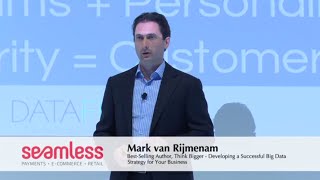
Dr. Mark van Rijmenam shows how companies use big data from social media, wearables, and location tracking to predict customer churn, sentiment, and lifetime value. He walks through examples from Uber, Nike, and Walmart, then argues that predictive analytics only works long-term if companies prioritize transparency and privacy.
Chapters
Winning your customer for life is one of the most difficult things to do. Fortunately, with big data and with predictive analytics, it becomes a little bit easier. As already mentioned, I'm the founder of Dataflog and a Dataflog. We see a lot of things happening around big data and one of the major things that we see is that accelerated change is really the only concept at the moment. Disruptive innovation is happening so fast that organizations need to keep up with it, and they have a little difficulties in that A lot of new disruptive innovators are appearing at the market and they use data at every possible way, in every possible touch point with the customer. They use data, they collect data, they analyze data, and they use that to win the customer for life. And what they do, they use all kinds of different types of analytics. And in the past we had primarily descriptive and diagnostic analytics, which are mostly looking at backwards what happened to the customer, what happened from a minute ago to what happened to about 10 years ago. But they don't tell you what's going to happen, and for that you're going to use predictive analytics. Predictive analytics uses the data of the past to create insights for the future. The really future of big data is prescriptive analytics, which is the most difficult part as well, because it not only tells you what's going to happen, but it also tells you what you should do to make it happen. And the problem with prescriptive analytics, of course, it creates a lot of value. It's also very difficult to do. So I'm not going to tell about prescriptive analytics, but I'm going to talk about predictive analytics, because that's why we're here today. If we look at what's happening at the moment in the descriptive innovators that are happening and are appearing at the market at the moment, these four organizations have just came to life in the past decade and what they do is they use that in every possible way. And it's quite remarkably because if you look at the largest taxi company in the world at the moment, Uber, they don't have any taxi taxis. They don't own any taxi cars. The largest phone company in the world doesn't own any telecom infrastructure. When WhatsApp was being bought by Facebook, they only had 19. Sorry, they only had 50 employees. They were valued at $19 billion. The world's second most valuable retailer doesn't own any inventory. And the world's largest movie house has no cinemas at all. So it's very interesting to see that these organizations that that don't own any physical assets have grown so much in the past decade. And what they do and what they use and why they are so advanced in that is they all use data. Common denominator with these organizations, and that's different from the existing organizations, is they use data and they use algorithms. So, as I already mentioned, they collect data. Absolutely every possible touch point that you can imagine. For example, Uber IM knows exactly who you are, where you are, what you need, how much battery you have left, and if your battery is almost dying, you will get a higher price, et cetera. They know everything about you, and they use the data that they have to analyze it with algorithms to gain a better understanding. And that's really changing the world. And one of the major examples, I think, that shows that algorithms are literally almost taking over the world is what happened a few months ago. A few months ago, you had the algorithm AlphaGo, which is developed by the Google company DeepMind, and it played the game of Go against the world champion, Lee Sedol, and it beat lee Sedol by 4 to 1. And this is extremely remarkable. And this is a tipping point in terms of artificial intelligence, because some of you might know that in 1999, there was an algorithm that beat Gary Kasparov with a game of chess that was also artificial intelligence, but that was, you could sort of call brute force artificial intelligence. So with every move that was to be made, the algorithm would calculate all the different possibilities that would become later on and would make a calculation of what would be the next best move. With the game of Go, this is not possible anymore because there are more possibilities within the game of Go than there are atoms in the known universe. So the artificial intelligence in the algorithm, it can't just brute force every calculation. So it has to use some sort of intuition, some sort of experience, to come up with what the next move will be. And what was very interesting to see is that the algorithm came up with moves within the game of Go that had never been played by humans before. And these moves were very surprising and enabled the algorithm to win with the game. So intuitive artificial intelligence is really changing the game. And what we will see that in the next decade or next two decades, algorithms are really going to change the organization, they're going to change the business. They will be our boss. That might be a bit scary, but algorithms will be your boss telling you what to do. They will be our copywriter, our assistant, our customer service, our driver whatsoever. They will be in every aspect of our business. And this is already happening. The company Associated Press uses algorithms to write financial reports. And these reports used to be written by analysts. These are not yet in depth reports, but they are reports based on the financial statement of a company, the profit and loss statement of the past quarter, etc. But it shows that the algorithm is really capable of writing reports already. And I believe it won't be long before organizations have algorithms that can write also the in depth reports. Another organization that's really using an algorithm in a quite remarkably way is the company Deep Knowledge Ventures from Hong Kong. And this is a venture capital firm that invests in pharma, pharma tech firms. And they have given an algorithm a seat at the board of directors. And this algorithm has an actual vote when they decide whether or not to make an investment in a certain company. So what does this algorithm do? It analyzes all kinds of different data sources from public data sources, news information, founder information, employee information, whatever is available on the market. The algorithm analyzes this and uses that information to come up with an advice whether or not to invest in a certain company. And if we talk about customers and how to connect with your customers. A few weeks ago, there was another remarkable event by Facebook. Facebook announced their messenger bots. And these are customer service of the future. It enables brands to connect with the customer no longer through a traditional call center, but through a chatbot, which basically is an algorithm where you can talk to. So this is no longer, it's no longer required to have an actual person sitting behind the telephone to answer questions for customers? No, you have an algorithm that answers the questions for you. So what do all these algorithms and all these have in common is that they use a variety of different data sources. That's why I always say when I talk to organizations that I actually don't like the term terminology, big data, because it implies that you need to have a lot of data. And I dare to say that there are very few organizations within this room who use petabytes or exabytes of data. That's why I use the term next data, which implies that you need to use all kinds of different data sources to create insights. And you don't need to have petabytes or exabytes of data. You could do with like hundreds of megabytes, gigabytes or terabytes combining different data sets, that's what's key. So if you want to win your customer for life using predictive analytics, you need to look, how can you use, what kind of data sources can you use to create these insights? And one of the first data sources that you could use that comes to mind is of course, social media. I don't have to explain what we can do with social media because that has been around for ages now. But be aware that there are hundreds and hundreds of different social media networks that have billions and billions of data points of your customers. So if you're able to connect the social media accounts from your customers and analyze what's happening and what they say and what they tell, it gives you a lot of insights in how they feel, what they are looking for, what their sentiment is. And that information is very important if you want to create a 360 degrees view of your customer and if you want to win a customer. One of the best examples, I think is the company Nestle. And they have about 2,000 brands and they monitor these brands in real time, 24 hours a day, seven days a week. And they have the digital acceleration team that uses all kinds of analytics tools to analyze what's going to happen and what their customers are saying anywhere in the world and about one of these 2,000 brands. And that's very interesting because the moment somebody talks about a certain brand, they react to it and they respond to it. So they create a touch point, and the moment they create a touch point, they create data and the data that they use to analyze who the customer really is. Another good example of another good example from a data source is the wearables and the Internet of things. The Internet of things is really driving massive amounts of data that you as an organization can use to better understand your customer. The wearables will tell you how the customer uses your product, when the customer uses your product, where the customer uses your product, and potentially also why the customer uses your product. And that information gives you valuable insights in how you can connect with your customer. A very good example is the Nike platform, which has been around, I think, for six or seven years at the moment. And Nike has created several wearables and has created the Nike platform, which allows runners to publish their statistics about how they run and using the wearables, they connect with the platform. Nike knows how much people run, where people run, when people run, with whom they run, et cetera. This is extremely valuable information if you want to connect with your customer because you have touch points much more often than you would normally have. Besides, it will also tell you how your product is being used, which will allow you to update your product a lot faster, creating a shorter time to market. Of course, customer sales data and demographics data is what we all have. We Know hopefully who your customers are, what products your customer bought, when they bought it, how they use it, where they live, what their age, et cetera. This is extremely important data and hopefully you have this in good order within your company because this is the starting point if you want to create a customer at 360 degrees customer view, and if you want to use predictive analytics to win your customer. Another data source that's only recently has become useful is location data. Ibeacons, which have been around for a few years now, enable organizations that enable retailers or restaurants or banks or whatsoever to connect with the customer in a whole new way. The moment a customer walks by your shop or your restaurant, you, you're able to push a message to their phone and share an advertisement or a commercial or discount or coupon code whatsoever to help to lure your customer in. And if you know your customer and you know what they like, and you know where they're from, and you know what products they bought, and you know who their friends are, et cetera, then you are really able to create a message that really sticks. So the real objective is to combine all the data sets that I just mentioned. So you have to combine click behavior, purchasing history, explicit feedback, which they for example, said in a feedback form, but also implicit feedback, for example, what they say online or on social media. These kinds of data sources are extremely important because they tell you a lot more about what your customers really want, what they're actually looking for. And the idea is that you create some predictive intelligence about your customer in real time to know your customer all the time. And when you do that, that will enable you to create an NS1 to create truly personal communication. So what we used to do, we used to manage the customer based on the customer sales data that we have you use to manage the customer. Then we went into interacting with the customer, which is the social media data. We started talking to customers through social media, through Facebook, through Twitter, whatsoever. And these touch points enabled us to better understand the customer. Nowadays there are more and more predictive analytics tools that enable you to analyze the customer to really understand who your customers are. And when you have done that, you can truly start to know your customer. The objective is that you as an organization should have is to create a 360 degrees customer profile. A profile that enables you to send a message or product or advertisement to your customer at the right moment in time, to the right channel, to the right customer, for the right price. Something that's very difficult to do, but with predictive analytics enables you to do so. So what are the different things that you can predict? There are a bunch of ways of ways that you can use predictive analytics to predict understand your customer. One of them is predicting the churn, predicting which customers you will probably lose. And we all know that losing a customer is extremely expensive because getting a new customer is a lot more expensive than retaining the customer that you already have. A good example of a company that does this really well is the company T Mobile from the usa. They analyze all the different data records that they have about the customer, where they call, with whom they called, for how long they called, who they are, who are their friends, et cetera. And they use this data to analyze if they are still happy. And if they all of a sudden see they notice that the customer has moved to a different location and they see an increase in dropped calls, it is probably very likely that, that the customer is going to switch to another provider. So what T Mobile USA does then is proactively connect with that customer to see what's the problem and to try to solve the problem before the customer has already left. So predicting churn is extremely valuable if you want to keep your customer for life. A second thing that you can predict is the sentiment. And with the sentiment, I mean, what do your customers think about what, how do the customer think about your product? What do they think about when they interact with you? What do they think about the commercial that you have just launched and it's become possible to analyze in real time. For example, if you publish a new commercial, how people think about that, and if you have all that information, you start to be able to predict what the sentiment is going to be if you're going to launch a new commercial. And then you already know whether a commercial or a product is going to be successful or not. So instead of just launching a product without knowing what's going to happen, this information tells you a lot more and gives you a lot of insights in whether or not a product is going to be a success. Oh, sorry. Then of course we have the customer support similar as Nestle does. By analyzing 2000 brands online, it enables you to understand what's happening with your brands across the globe. And if all of a sudden there's a peak of certain messages coming from a certain area, you can predict that perhaps there's something wrong with the product or a service. And using that information, you can predict what kind of customer service requests are going to be required. And you can already train or you can prepare your customer service desk if you're still using the old fashioned call center. So that helps you to predict customer support. Knowing who your current customers are will also help you who your future customer might be. Again, analyzing how your product is being used and analyzing all the social media data from your customers might reveal certain types of customers that you were not aware could be of use to you. Certain latent needs that resist with certain customers that tell you that are revealed by analyzing vast amounts of data. And all of a sudden you know, these customers are very, very interested in my product, I might start selling to them. So learning the new type of customers through predictive analytics. Of course, what's very important to know when doing business is knowing the customer lifetime value. And by analyzing all the different data sources, from social media to wearable data, to CRM data, to location data, and creating this NS1 and creating this 360 degrees customer profile, you're able to predict what the customer lifetime value is going to be in a lot more detail. Instead of having a vague idea what the customer lifetime value of the customer will be, you'll be able to predict with very much accuracy what it's going to be. Knowing your customer lifetime value allows you to better make better investment decisions in how you're going to lure that customer in. And finally, using predictive analytics, it enables you to predict where your sales is going to be and how your sales, how much sales is going to be improved by doing a certain marketing campaign. Knowing what the results, the return on investment of a certain marketing campaign will be is very valuable information if you want to create the best marketing campaign. One of the best examples of an organization around the world that's using predictive analytics to win the customer is the company Walmart. And they were doing big data when all of us were still using floppy disks in 1999. In the 1990s, they already used 180 terabytes of data per year. Nowadays they collect 40 petabytes. That's 40,000 terabytes of data every single day. And they use this data to analyze exactly who the customer are, where their customer lives, what their customer wants, when they want it, why they want it, and how they're going to get it. So they have brought personalized marketing to a completely different level. How do they do this? They have developed an algorithm called the Social Genome. And this algorithm combines a vast amount of different data sources, I think about 2 to 300 different data sources that they are using to truly get to know their customer. So they analyze who their customers are, the people they analyze which topics they are interested in what topics do they talk about with their friends, how do they connect with it? They know what kind of events they are interested in. This can be events like music or sport events, but this can also be lifetime events like a marriage or, or getting a child, which is interesting information for the company. They connect that then with the place where the customer is and how the customer moves and they connect it with the products that the customer is buying to truly create 360 degrees customer profile. And how do they use this? Well, a great example of this is the products Can n Go. It's an app which you have on your phone and you use this app to, to go into the Walmart store and to collect the products that you need, scan them and check out through your phone. Of course, if you want to use this product, you have to provide all kinds of information to Walmart, who you are, where you live, you have to upload your credit card information, etc. And Walmart by having that information, knows exactly who is who, who is in the store, at what moment, where are they in the store and which aisle they are, what do they buy, what do they don't buy. Which is also very important because somebody takes something from the shelves, scans it and then decides to descan it and put it back. And Walmart knows when they do that and potentially also know why they do it because there was a certain advertisement of a different product nearby. So all this information allows them to predict also shopping lists for the customers, which is of course very useful for their customers because it saves them a lot of time. So combining all these different data sources enables Walmart to really win the customer for life. So winning your customer for life using predictive analytics is all very interesting and it's very important by using all kinds of different data sources to really get to know your customer. But there's one thing, if you are dealing with massive amounts of data that your customer can never become the victim of it. And, and unfortunately too many organizations still fail in this and their customer becomes the victim due to privacy failures or security failures or whatsoever. So I've come up with four ethical guidelines that I think are very useful for organizations to adhere to when they start dealing with big data or using predictive analytics to win their customer. The first one is simplicity, which basically means that you, whatever you do with your data, whatever communication you have with your customer, you have to be able to tell that in a very easy to understand way. Most of the time customers don't know what's happening with the data. And how their data is being used. So that refers at the same time to the transparency. You have to be very transparent about how you're going to use the data, what data you use, why you use it, and how are you going to use it in the future. Of course, the privacy aspect is also extremely important. And privacy should be really as part of your DNA from your entire company, from the lowest level to the highest level. Everyone within your organization should breathe privacy if you want to win your customer. Because if you don't, the customers will leave to the competitor. Switching costs have become extremely low these days, so it's very easy for customers to switch. And then finally, of course, security, security. We have seen so many different data breaches in the past years, and I dare to say there are a lot more to come. In fact, I say that any organization can and will be hacked. And if you're not being hacked, you're simply not important enough. So that should be your starting point when dealing with big data and when dealing with predictive analytics to win your customer. Because if your starting point is that, okay, I will be hacked, but how do I prevent it once I'm hacked that my customer data becomes available to anyone else? So simplicity, transparency, privacy and security are extremely important. If you don't want that, your customer becomes a victim of your predictive analytics strategy. So to wrap up, if you want to win your customer for life, it is a combination of different aspects that you should take into account. So that's collecting data. Collecting data at every imaginable touch point that you have with your customer. But collecting data is not enough. You need to analyze the data. You need to have the algorithms to take to derive action from the data. Anyone can store data. It is what actions you derive from it through algorithms. By doing that, you will create a 360 degrees customer profile, which enables you to really truly personalize your marketing campaigns. By truly analyzing them and truly knowing your customer and sending them the right message at the right moment in time, through the right channel, for the right product, at the right price, you will be able to win your customer. Of course, never forget the privacy aspects and the security aspects when dealing with so much amount of data, because otherwise your customers will still walk away. Combining these different data sources and combining these different aspects will ensure that if you use predictive analytics, you will win your customer for life. Thank you.
More from Dr.








Seamless Communal Events in the Metaverse with Doug Jacobson - Step into the Metaverse podcast: EP17


Dangers of the Convergence of Generative AI and the Metaverse and Solutions to Overcome it
