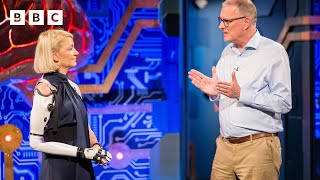
Sarah lost her right arm above the elbow in a train accident. Her AI-powered bionic arm reads 16 electrodes in the socket to sense muscle twitches and predict her intended movements. It takes about 10 seconds between thinking and moving right now, but she hopes future versions will be fast enough to let her ride a bike or drive again.
Questions this video answers
About 12 months ago.
Right leg below the knee; right arm above the elbow.
16 electrodes.
About 10 seconds.
Chapters
Now, Sarah, you have a truly remarkable story. Will you share that with us?
Yes, of course. So just about 12 months ago, I was in a terrible train accident. And as a result, I lost my right leg below the knee, and I lost my arm above the elbow.
Oh, wow, that's incredible. And so you've been fitted with a prosthetic arm. Those are nothing new. But what makes this one special?
So this one's pretty special because this is what we call a bionic arm, and it's powered by artificial intelligence.
Okay. Now, I understand at this point you've got a party trick to show us involving a can, is that right?
Yes. Well, the first thing I wanted to show you is that I've got a movable wrist that can turn all the way round, and then it's got a little bit of power as well. So let me try to crush this can for you. Oh, oh, oh, okay. It does work.
That really is quite a party trick. So how does your arm know how to do it?
Well, basically, the way it works is that I think about the movement that I want to make and I twitch a series of muscles, and the muscle twitches are being recorded by 16 electrodes that are positioned inside the socket and then transform that into electric impulses that run through the forearm and powers the covey hand, my bionic hand.
Okay, and where exactly does the AI come into the picture?
So the AI is a lot of data recording. It's basically every time I use the arm, every time I make a movement, it records it, it starts to learn how I use the arm, and it starts to predict the movements that I want to make, including rotating it like that.
I could watch that all night. Okay, so the AI is being trained on your body, but is your body and your brain, are they adapting to the AI?
So I did have a lot of training to understand because it's very different to think about a movement, and it's more difficult to control it when it is bionic. But when I take the arm off at night and I recharge it like an iPhone, then I miss it.
How would your life have been like without this arm?
Well, I have to say that this world is being designed for people with two hands. Everything. Think about the zipper on your coat, for example, or on your bag on your rucksack. Think about a parcel, a packaging for everything. You need to have two hands, one to hold it down and the other one to rip off the lid on something. And with the arm, it helps.
Okay, now, this technology is evolving. AI is moving very fast. What do you hope this arm is going to be able to do in the future?
So I really hope that this is going to evolve, become even more performant, because the idea is that at the moment, it takes me about 10 seconds to think about a movement and then execute it. That's the AI part that hopefully will reduce that time and become instantaneous, like my other hand.
Okay. So as the AI gets better and better, that's going to help you in your life.
And I really dream that one day I can go back to riding a bike, and if I'm lucky, maybe I can drive a car again.
Okay, Sarah, that is a truly remarkable story. Thank you so much for sharing it with us. Thank you, Sarah.