Misk Global Forum 2022: A New Era is Dawning with Dr. Mark van Rijmenam
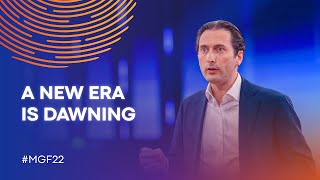
Dr. Mark van Rijmenam presents a keynote arguing the Metaverse is the next iteration of the Internet — an immersive 3D convergence of physical and digital worlds — that will reshape how we socialize, work, and learn. He emphasizes building an open, decentralized, interoperable Metaverse that preserves user control and self-sovereign identity, while warning of amplified risks (vastly more personal data, device telemetry, deep fakes, and health/addiction issues). The talk mixes cultural references (Snow Crash, Ready Player One), commercial examples (Decentraland, JP Morgan), and a generational call to plan long-term.
Questions this video answers
2010
Decentraland
Snow Crash (Neal Stephenson) and Ready Player One
Chapters
Thank you very much. It's a pleasure to be here back in the Kingdom. I joined and visited the Kingdom about four years ago, and it's fantastic to see how much change and how much progress has been made in the past four years. I'm going to talk about a new era that is dawning. And I am indeed a future tech strategist. And the picture that you see here is actually a digital twin of myself. I'm creating a synthetic version of myself, which also will be part of the Metaverse. I'm going to talk to you about the future, but as the late Clay Christensen said, that the next big thing often starts off looking like a toy. And nothing is more true than the Metaverse, because what you see here is the Metaverse. It's the office of JP Morgan, which was moved into the Metaverse about half a year ago on a platform called Decentraland, which is quite interesting because Decentraland is a blockchain based platform where there's a cryptocurrency that deals everything. And only a couple of years ago, JP Morgan said nothing that they didn't want to do anything to do with the Metaverse, with blockchain, or with crypto. The fact that they are now present at Decentraland shows that the world is changing. But what's also true is that any sufficiently advanced technology is indistinguishable from magic. And that's also true for the Metaverse, because in the coming years, we can expect to see the Metaverse completely changing and revolutionizing our society. And of course, we can't talk about the Metaverse without briefly mentioning its origin. It was first mentioned in the book Snow Crash by Neal STEPHENSON in the 1990s. And some of you might also know it from the book and movie Ready Player One. The book Ready Player One and also the Snow Crash showcase a rather dystopian future of the Metaverse, where the platform or the virtual world is owned and controlled by one company, one person, in a very centralized environment. Now, there are some people in the world who try to build this metaverse, but I certainly hope that we don't end up in such a metaverse. But what I can say for sure is that the Metaverse will be used in new ways to socialize, to work, to learn. It will change society, and there's no turning back. But to understand the Metaverse, you really have to immerse yourself into it. It's a bit like social media. It's a bit like the early days of the Internet. Back then, there were companies who said the Internet, that's going to be a fad. There's nothing I want to do with it. Well, we know how that ended. The same happened with social media, the same happened with the mobile web, and probably the same thing will happen with the Metaverse. Don't let that be your organization, or don't let it be you who misses this fantastic opportunity. Because I can guarantee you we are in for an absolute wild ride. But what is the Metaverse and does it already exist? But before we go there, let's first get some myths out of the way. The Metaverse is not gaming, the Metaverse is not virtual reality, and the Metaverse is not web3. It can be, however, all of the above, what I think that the Metaverse is. The metaverse is what I think is where the physical and the digital worlds are, are converging into so called digital experience, augmenting both the virtual and the physical world. Now, this definition that I came about took about 250 interviews that I did for my latest book, Step to the Metaverse. To understand what the Metaverse is, because it's such an abstract concept, it's so far away that it's very difficult to understand what this future is actually going to be. So let's unpack this a little bit, because where the physical moves into the digital world, for me, this is the part where we have a physical construct, physical, the reality, and we bring it into the digital world. We already have this today. If you are on a zoom call with your friends or with your colleagues, you are physically present in the world and you move into the digital world to connect with each other. So you could say that we are sort of already in the metaverse, version 0.1. The early days of the Metaverse are already here, but it's also where we create digital replicas of machinery, of products, of systems, of systems of systems, so that we can interact with these products in the virtual world. We can interact with it on your desktop, on your tablet, on your mobile computer, but also, of course, in virtual reality. So this is the first part of my definition of the Metaverse, where the physical moves into the digital. Now, the second part I think is much bigger. This is where the digital moves into the physical. And this is all about augmented reality. And augmented reality is really where we add an additional layer on top of reality. And the first example of augmented reality that got global attention was of course, Catch Them all, where we tried to catch all the Pokemons around the world. It was a major success. And for the first time really brought augmented reality into the limelight. But personally, I think that augmented reality will have a much bigger impact on society than virtual reality. It will allow us to create new layers on top of the physical reality. We could use these layers for entertainment. We can add, I don't know, a flying purple dragon above Riyadh that you can only see when you wear your smart glasses or when you use your mobile phone. Or we can use these to better understand how to fix a product, where we can augment a layer on a product and we understand how to operate it without actually knowing how it actually works. So augmented reality will have a much bigger impact than virtual reality. And I think both augmented reality and virtual reality are very, very important for the Metaverse. So when the physical and the digital are converging, we get this digital environment. I know it's not the most beautiful word, I'm glad I didn't coin it, but this digital environment happens to be an endless blue ocean for organizations, consumers, artists, creators, and society as a whole. And it is really going to change everything. Because the metaverse is not a fad. The Metaverse is not a hype. It is the next iteration of the Internet. The next iteration of the which is called the immersive Internet. The immersive Internet, where we move from a 2D Internet to a 3D Internet. And we humans, we are made for 3D, we're not made for 2D. So an immersive 3D Internet is much more aligned to what we find comfortable. And therefore, we can expect that the immersive Internet will become as pervasive as the air that we breathe, as the energy that we use. And it will result in the Internet that we, where we move from in order to go onto the Internet to make a conscious decision, for example, grab your phone, to an Internet where we are part of the Internet, we are in the Internet. And that's going to revolutionize society. It will create a multi trillion dollar opportunity that could benefit humanity as a whole. Now, there have been some reports from global companies which state that by 2030, the metaverse will contribute 5 trillion or 8 trillion or $13 trillion to the global economy. Personally, I believe it will be much more than that, simply by looking at the impact the Internet had on our global scale. So it will be tens of trillions of dollars. So it's something not to miss, not to ignore, or not to think it's a hype or a fad. And again, we are in for an absolute wild ride. However, only if we build it correctly, because we need an open and decentralized and interoperable metaverse. We don't want to end up in a metaverse which is owned and controlled by one company or one person or one entity. We want a metaverse that's all from us, from you and me. And therefore we need decentralization. There are three important characteristics of a so called open interoperability, decentralization and self sovereignty. I'll briefly touch upon each of these. First of all, interoperability, which basically means full transferability of your data and your digital assets. And mind you, that's not possible today. If you want to take your Facebook data and you want to download your videos and your posts and everything that you've created over the past decade, and you want to move it to another platform, it's not possible. If you want to send a text message from WhatsApp to Telegram or signal or imessage or whatsoever. Not possible. Well, we know that the benefits of interoperability are huge. For example, you can send an email from Gmail to Hotmail or Outlook. Imagine a world where that would not be possible. So interoperability is really crucial. It allows you the transferability of your data, but also of your digital assets. Your digital assets that can be your avatar, for example, or the digital fashion of your avatar, or any of the other products that you use in the virtual world. You want to be able to take those digital assets from one virtual world to the other virtual world, because otherwise it would be the same as buying your clothes for one restaurant and then have to buy new clothes for another restaurant because you can't take the same clothes to a different restaurant. That doesn't work. So we need interoperability. In order to achieve interoperability, we need decentralization. And decentralization is all about using blockchain technologies to return the control of data and assets to the user. So you control your data, you control your assets, and you determine who has access to this data and who doesn't. And blockchain, of course, is much in development. It's early days for blockchain technology. But it is very, very important if we want to create an open metaverse, that we control our own data. The third characteristic is what I call self sovereignty. Self sovereignty of your identity and your reputation. Again, so you're not only controlling your data and your assets, but also your digital identity. And for generation Z and generation Alpha, Those born after 2010, their digital identity is as important, if not more important, than their physical identity. Can you imagine having your digital identity being more important than your physical identity. So you want to make sure that that identity is safe and secure and is yours. So we need self sovereignty, need your identity to be personal, which means it's about you, it is private, you determine who has access to it, it's persistent. It means nobody can simply delete your data or the attributes of your identity. It's portable. It means you can move your identity from one platform to the other and it's protected. If your digital identity is more important than your physical identity, you want to make sure that your identity is secure and cannot be stolen. So interoperability, decentralization and self sovereignty are crucial if we want to create an open metaverse. However, if we talk about an open metaverse, we also have to think about some of the challenges. And one of the main things that I come across is that as humans, we often overestimate the short term and underestimate the long term. We have a very short term focus when it comes to creating our societies and building our organizations. And it's fantastic to see that the Kingdom is one of the few exceptions to the rule with your vision 2030. But when we create the metaverse, we have to have this long term vision, because we are creating something not for the next year, not for the next five years, but we are creating the Internet for the next two, three, or even four decades. So we want to make sure that we build this metaverse correctly. And if we move from a 2D Internet to a 3D Internet, we can expect that all the dangers and all the problems that we have in the current Internet will be extrapolated in the next Internet. And here you see some examples of challenges that we have. I won't go through all of them, but we can expect that in the Metaverse, we'll create 100 times more data than we do today. Let me give you a brief example. Some of you might have seen the launch of Meta Quest Pro a couple of weeks ago. This absolutely fantastic virtual reality device has an enormous amount of cameras on the front as well as on the inside, monitoring your eyes and where you look at and how long you look at, which tells a lot of information about you. It also monitors where you are, in which room you are, what's in your room, who's in your room, what the persons are doing in the room, etc. All kinds of very, very personal and very valuable information that is stored by, by a company that's not very well known for treating our data securely. So we have to be careful of how we use our data and which tools that we use. So that's one example of a danger. Another example of a danger that I want to stress is the danger of deep fakes. I mentioned at the start that I'm creating a digital twin of myself. A digital twin that will look like me, that will sound like me, that will talk like me, that will move like me, and basically I can send next year to this stage, and then I will stay home in Australia, and then my digital twin will be here. But if I can do that, then all of you can do that as well, because my images are online, my voice is online, so you can recreate me quite easily. Now, if that would happen to me, that would be annoying, but it would not be a real problem. But if it happens to a world leader or to a CEO of a large company, public company, we have some really big problems ahead of us. And it becomes more and more difficult to understand what's real and what's fake. And then the final issue that I want to take out of this list is the health issues. We already know that people can get addicted to gaming and that people sometimes even die when they game too much. Now, imagine a virtual reality world, an immersive world, where the immersive world is, to your understanding, much better than the physical world. You might get addicted to this, and you might get certain health issues. So we really have to think carefully about how we build this metaverse, how we create this next iteration of the Internet, because the metaverse is coming, and big data, blockchain and AI and all the buzzwords, they are converging into this immersive 3D Internet. And as we live in exponential times, it is important to know that once we think about the metaverse, we need to require a gestalt shift. We need to look at the metaverse from a different perspective. Some of you might know this picture, it's a very famous picture which allows you to either see a duck or a rabbit, but you can't see them both at once. And the moment you switch between a duck and a rabbit, that's called a gestalt shift. That's looking at the world from a different perspective. And that's what we need to achieve. Now, of course, this forum, we're talking about generational change and how the world changes from the one generation to another generation. But I think it's important that with the metaverse, with this change moving so fast, we shouldn't be too harsh also on the older generations who might have difficulties understanding the future, because the world is moving so fast and I want to finish off with a quote from a famous author, the author of the Hitchhiker's Guide to the Galaxy, Douglas Adams, because he said that anything that is in the world when you are born is normal and ordinary, and it is just a natural part of the way the world works. Anything that's invented between when you're 15 and 35 is new and exciting and revolutionary, and you can probably get a career in it. And anything that's invented after you're 35 is against the natural order of things. And mind you, I'm almost 40, so this also applies to me. The older we get, the more difficult it is to understand this technology and to understand the future. But I assume that most of you would fit in the second bracket. So most of you, or all of you, we can understand the metaverse. We can use the metaverse, we can understand the immersive Internet and use it to improve our society. And I think once you build your big ideas that you're thinking of, when you build the kingdom for the next generation, think about the metaverse and how it can be used to create a better society. Thank you very much.
More from Dr.








Seamless Communal Events in the Metaverse with Doug Jacobson - Step into the Metaverse podcast: EP17


Dangers of the Convergence of Generative AI and the Metaverse and Solutions to Overcome it
