Nyenrode Refreshment Day - 26-11-2020 - The Future of Work - Avatar
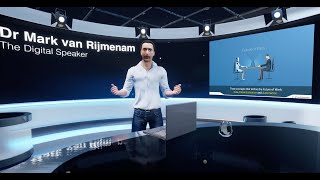
Dr. Mark van Rijmenam argues organizations must turn their processes and customer interactions into data, then use big data, blockchain, and AI to analyze and automate it. He shows how Alibaba and Tesla profit from this approach while warning about privacy, security, and bias risks.
Chapters
My name is Marc Verrebenam and I'm the digital speaker and I'm going to talk to you about how work is going to change in the coming years. Does anyone of you remember this? It is about four years ago I think that Google launched the self driving bike. Of course at that time it was an April Fool's joke, but recently the Chinese government did in fact launch a self driving bike. And it shows you how fast the technologies are changing and new technologies are coming our way. Therefore, I really would like to say that I think we live in exponential times and the world around us is changing faster than ever before. And what we see happening is that especially now with the coronavirus, the game is going to be changed forever. It is a so called black swan. It's something that nobody really saw coming at first, but when it happened it has a massive impact on it. And in hindsight it is sort of quite explainable of how it all happened. What we have seen in the past months since the pandemic started is that digital has become more important than ever before. And therefore we can say hi to the digital employee or like me, a digital avatar. And the digital employee can work from home, from anywhere in the world using new technologies and software tools to be able to be productive and effective their work. And not only within the workspace we see new technologies coming, but in everywhere in society we see new technologies that are changing the game. And what you see here is the Gartner hype cycle for emerging technologies. And it sort of shows you all the new technologies that are coming away in the next five to 10 years. And what's interesting to see about that, all these technologies have one thing in common, they all create data. And as a consequence we see that the organizations that are being built today are different from the organizations that were built yesterday. And we see that data is sort of the most important resource within an organization. And as a consequence we see the world's largest taxi company that has no taxis, telecom companies that don't have any infrastructure, retailers that don't have any own inventory, or a cinema house that doesn't own any cinemas. It is a different way of looking at organizations, a different way of working. And last year, and I don't have the numbers of this year, but last year during Alibaba singles day on November 11, Alibaba did 544,000 transactions per second. If you compare that to the Visa peak level of transactions, which is I think around 56,000 transactions per second, it's a tenfold. So that's enormous. And they did 38 billion dollar revenue in one day. Now the one, the day that I can make that revenue, I'll be very happy, I can tell you. But it shows you that for Alibaba, this was only possible because they have a different approach, because they are fundamentally a data organization where data is at the heart of whatever they do. And when we look at data, there's a famous quote from Peter Novik, director of research at Google. He said, we don't have better algorithms, we just have more data. More data beats the clever algorithm, but better data beats more data. So we need two things. We need a lot of data and we need high quality data in order to do something with that. So if you want to innovate in today's world as your organization, it really requires a different mindset. You have to look at your organization from a different perspective. And therefore, I think what happens when technologies converge, like a stunt shift occurs. So you either see a rabbit or you see a duck, but you can't see them both at once. And that's the interesting thing. What you also need to achieve within your organization, you need to look at your organization from a different perspective, from a data driven, a data focused perspective, to see how you can improve your organization. Because fundamentally, I believe that every organization is a data organization, no matter what product you make, no matter what service you deliver. At the heart, you are a data organization. And you can use that data to create better products and better services. But in order to do so, you really need to rethink all your processes. You need to rethink your customer touchpoints, and only then you are able to put the data to work. You can start to embed smartness within your organization. And that's when you are preparing your organization for the future of work. And there are three concepts that I briefly would like to touch upon that I think define the future of work. Obviously they are data or more or less big data. It's decentralization or more or less blockchain, and it is automation or artificial intelligence. I'll touch upon these three concepts briefly. First of all, Big Data, Big data helps us understand the context of your environment. It helps us to sense and seize the opportunities and transform your organization. And there's a famous movie, I think it's called the Big Short, which was about the financial crisis in 2008 that was also a black swan. But what happened that the main character in the movie was able to use data to understand what actually was going on in the market. And he, of Course had the opportunity to benefit from that. But it shows you that if you have sufficient data, you can understand what is going on in your environment and with your organization and you can act help and that can help you to act accordingly and to act change your organization on time. This is different from yesterday. Yesterday organization is very much focused on intuition and experience and these were used to make decisions you trust your gut to. Senior level decision maker said, I've been in this position for years, I know how the market works, so I know what to do. That of course has changed. Nowadays we use data, data collected by trillions of sophisticated sensors that are collecting exabytes of data at the edges of the network. Of course we know that the famous example of don't forget to buy milk by the fridge, I think this particular example will still be quite far away. But what we do see happening is that these sophisticated sensors are able to collect data for you at the edges of your organization. So if you are for example, an energy company, you have sophisticated sensors across your energy network and that data can help you prepare and be more efficient and effective as an organization. But of course, in order to do so you need to have the right analytics. There are basically four types of analytics. There's descriptive and diagnostic analytics, which basically means business intelligence. It helps you to see what happened from like 1 second ago to 10 years ago. It's like the rear view mirror in your car. Then you have predictive analytics. Predictive analytics helps you to understand what is going on and to make predictions of what will happen. It's like your car's navigation system that will tell you what the optimal route is, depending on traffic and depending on where you need to go. But you still need to make your own decisions. And the final phase of understanding your business is prescriptive analytics. It sort of combines the insights from business intelligence and predictive analytics to create multiple scenarios and based on those multiple scenarios make the optimal decision. It's like your self driving car driving you autonomously to your destination. It really helps you to optimize your business in new ways that were not possible before. So what I see happening also in my research is that when you start to use and employ big data within your organization, it really starts to allows you to empower your employees and your customers, creating more collaboration between them as well. Knowledge is power. So what you see happening is that organizations are lowering the decision making levels from your senior levels to anyone in the organization that are facing the customer or building a product. But to do so you need to start to Remove the silos within your organization. Plenty of organizations still today that I talk to have their data in silos and they are very reluctant to share that data with other departments within their business for whatever reason. But if you really want to benefit from big data, you need to start to combine these internal and external data. You need to remove your silos within your organization and, and make that data available for anyone who needs to have access to it. And you need to use various types of analytics to start to empower your customers and your employees, give them these insights so that they can make the best decision so you are able to really help and deliver a product that really serves your customer. You need to move from content to context. That's basically what it means. When you have more insights, more information about your environment, you have a better understanding of the context and therefore you are able to make better products and deliver better decisions. There's a famous example which I personally really like is the German company Kiese Kompresses, a very traditional German product company. I think they're over 100 years old now and they used to make these really big air cleaning machines. They still do actually, but instead of being a product company, they have changed their business model and now they are able to sell air as a service. They literally sell air. And they are pretty good at it. So what do they do is they have, they no longer sell these machines, but they give them away sort of for free. They install them for free and they are embedded with all kinds of sensors. And using predictive analytics, they can sort of predict when the machine is about to break down. And you as a customer, you only pay per cubic meter of air consumed. And so the case of compressors, they have an incentive to make that machine work all the time because if it breaks down, they don't make any money. So using their predictive analytics, they can understand and they can fix the machine before it breaks down so that it doesn't break down. And you as a customer always have the clean air that you require within your factory. So it's a win win for the product company who has found a new business model and can continue to make money, as well as for the customer who is getting a product that always works, that is guaranteed to always work, and probably pays less or as much as it used to do. It's a really new way of looking at your organization. It is this Gestalt shift that I was talking about earlier. Another organization which I think truly understands this already for years is Tesla. It really shows you what you can do when you start to datafire your business. Until a few years ago, if the large car companies such as Volkswagen, BMW or Audi, they had to recall their cars because there was a software update that needed to be done for whatever reason. So these cars, they had to be recalled to the garage. And millions of cars sometimes need to be recalled and costing a lot of money. What Tesla does, they can send you over the air an update for the car and you basically have a new car the next morning. A tremendous advantage for Tesla, how to fix cars without having to recall them and spending a lot of money on that. If you start to datafy your business, whether you're a car company or a company that makes air machines, it really shows you that you have a lot of benefits if you start to datafy it your business. Because when you do that, you are able to better take care of the customers. And when you take care of your customers, your customers will take care of your shareholders. So it is very datafiring your business means a very customer centric approach. But of course, you need to be taking into consideration that you do this in the correct way. And I'll come back to that at the end of my talk. So what we see happening is that big data is the new normal. It is a catalyst for other technologies also, such as blockchain and AI. So I'd like to briefly talk about these technologies for you to get a complete understanding of how these technologies converge. First of all, blockchain. Blockchain enables us to create peer to peer collaboration among industry partners, employees and customers. On the one hand, we had big data that enables collaboration between your employees and your customers. Blockchain enables peer to peer collaboration not only among your employees and your customers, but also with your industry partners in a very safe and sound way. I'm not going to explain what blockchain is. Blockchain has been around for quite a few years now. But the interesting thing about blockchain is that it enables this shared single source of the truth. And that simply is because a blockchain is a database, nothing more, nothing less. But instead of a database being write, read and edit, it is only a database which is write and read and which is shared with multiple parties. Because the fact that it's not editable, your data becomes immutable, verifiable and traceable. And these three characteristics does change the game completely. Because all of a sudden you have a technology that sort of enables a trustless system where you no longer require an intermediary to be this party that ensures trust within the network. So because this trustless system, I think blockchain will become the golden standard for the supply chain, enabling provenance, transparency and trust among all the players within the supply chain. A very simple example is that if you nowadays send flowers from the Netherlands to abroad, it shows you that you need a stack of papers probably as high as the flowers itself. If you start to use blockchain in combination with other technologies such as Internet of things, you can make that process completely digital and therefore a lot more efficient. You can get rid of the entire stack of papers to transport those flowers. Even more, you can embed agreements between the seller and the buyer using smart contracts on the chain. So, for example, you can say these flowers need to be transported with a temperature of 10 to 15 degrees Celsius. If the temperature rises below or above that range, automatically, it will be recorded on chain. We can be certain that the data has been collected correctly and has not been tampered with. And as a result, we say that if the temperature is longer above 15 degrees for, let's say, five minutes, then automatically the buyer will pay 10% less. And this efficiency using smart contracts, but also the provenance of the data of how the flower has been treated along the way, that creates the transparency and the trust. And I think as my work, as part of the 2Tokens foundation, we are working with developing several use cases, among others. One being in the supply chain, where we trying to develop electronic bills of lading, where we use the blockchain to help a supply chain basically go paperless. But apart from making a supply chain more efficient and creating this distrust in the system, it also offers customers a better experience in understanding where their food or their product has come from. It will enable to make fair trade truly fair. Because as a customer, when you buy coffee in a cafe, you can scan a QR code and you can see exactly where the beans in your cup of coffee came from, and which farmer produced them, and how they have been transported from, I don't know, Colombia, for example, to the Netherlands, and which parties were involved. And that of course creates a better experience for the end consumer, which I think is good for everyone. So we see that blockchain really enables this collaboration between industry partners. But then, of course, the final phase around the future of work is to automate your business as well, where we then start to collaborate with the artificial and increasingly with intelligent machines. So we see a shift from a pure human to human collaboration, to human to machine collaboration, to eventually machine to machine collaboration. And the future work will be where humans and machines are collaborating with each other effortlessly for the benefit of your customers and therefore also for your organization. If we look at artificial intelligence, there are three domains that I consider to be part of this. First of all, you have cognitive systems and cognitive systems, they are the ones that deal with the human world. This is where you can see a clear interaction between machines and humans. And one example is chatbots. A chatbot where you as a user ask a question to a computer and the computer is able to give an answer back. You have these very basic systems which are so called chatbots on rails, which are more or less like automated FAQ systems. But the more advanced the chatbot becomes, the more a real conversation you can have with a computer. And of course, that offers a lot of benefits for organizations where they can automate part, for example, of their call center. The second part is the physical world. And here we have robotics that are interacting with the physical world. An interesting example is the exoskeleton that Ford uses within the factory that allows the the factory workers to be able to carry more weight. Or it is the Boston Dynamics spot, I think the dog, which is being used in various ways already to help organizations where robotics and humans are starting to interact. Also in warehouses, for example, you see that there are a lot of benefits and a lot of efficiency to be gained. And the final domain is the information world. And here we use machine learning. We create machine learning models where we use data to train the machines and to be able to do their own thing. And the developments in this field are going really, really fast. And we now already have machine learning models that are able to create their own machine learning models. So it is a machine creating a machine. The further you go in this domain, the further away you are from the human aspect. Artificial intelligence is the seamless integration of all these three domains. You have a bit of a theoretical description, but you have an understanding of what I see as being part of artificial intelligence. If we go back a few years, this was really a milestone. It was in 2016 when AlphaGo beat then World champion Leagues it all in the game of go. I think we've all heard of this example. It took a lot of data to train this model in order to win it. A year later, they developed AlphaGo Zero, which was basically trained without any data. It was trained by playing against itself. And as a consequence, within three days, starting from scratch, it was able to beat the original AlphaGo, coming up with new moves and new strategies. And I think within 40 days, it was able to beat any other potential player, whether human or machine, and basically advanced our knowledge of the game of Go by thousands of years, becoming creating new moves and new strategies that us humans never thought about. And it is because AlphaGo has like an infinite amount of possibilities. I think there are more possibilities in the game of Go than there are atoms in the known universe. A brute force computation approach doesn't work. You need to have some kind of intuitive AI that is able to develop new solutions by itself. And that is what was so exciting about this breakthrough. Of course, the companies have not sat still since then. And last year, DeepMind developed an AI that was able to play games of hide and seek. So you had two bots, one that had to hide and the other had to find the other bots. And they let it run for hundreds and hundreds of millions of games. And every time the game improved, the bots, whether they had to hide or they had to find, the other bots, came up with new strategies. I think after 350 million games, they thought they had found all the different possibilities, but they just let it run for a bit longer. And after another 150 million games, all of a sudden they found a new strategy, an even better strategy. And that's of course, the interesting thing. In the digital world, playing 500 million games of hide and seek is not that difficult. It takes a couple of months probably to organize this. Of course, it takes a lot of computing power, and with that, of course, also a lot of energy resources. But us humans cannot play 500 million games of hide and seek. But in the digital world, we can. And Also last year, OpenAI released an AI agent called Atari 57. And this AI agent can play all Atari games at superhuman levels. So within these 57 games, it will beat any human because it's just so much more advanced. The challenge here is that it must be retrained for every game. We are not that advanced yet that it can learn from itself, from playing the other games. This is called transfer learning. And that's just a matter of time before we have arrived at there. And earlier this year, we saw the launch of GPT3, a language model based on 175 billion parameters. And this large number of parameters enables us to create a language model that generates highly realistic sentences and paragraphs of text. These sentences are so realistic that the Guardian recently had GPT3 write an opinion piece, which was incredibly well and easy to read. I read it, and for me, I was surprised how well it was written. So we see that there's a lot of Advancement being made and the next GPT, GPT 4 or 5 or 6, we'll probably have trillions of parameters creating more and more advanced language models. And also what we see is that AI is also moving into strategy. OpenAI's Multi Agent System learn to play the complex game of Dota 2. And in this game, bots have to collaborate with each other in order to beat humans. So they have to come up with strategies. And even in this game, AI has outperformed humans already. So AI is also moving into the strategy business. So what we'll see is AI will become our boss, our copyright, our journalist, our assistant, our driver, our customer service agent and our manager. And we see especially the last one we see already happening in companies also, such as as Uber, where drivers basically have a manager, an AI as a manager, because the AI tells you where to go, or the AI tells you where to pick up your food. So it's all being automated. The question that I always is how to start with artificial intelligence within your organization. And my metaphor always here is that AI is basically like lego. LEGO used to be my favorite toy when I was a kid. You know, fantastic toys to play with. And you basically only bound by your creativity what you can build. But it's very interesting to see that every block is interoperable with every other block ever being created by lego. And when they create LEGO LEGO blocks, there's a very minimal fault tolerance. So you are truly only bound by your creativity. And of course the funds that you have to buy more LEGO blocks. But the more you are creating these, the more you start to combine these blocks, the more advanced your structure can become. And the same applies with artificial intelligence. It doesn't make any sense to create one massive AI system, but you have to start from really small domains and being able to make these AIs, these models interoperable with each other, so that from that perspective, you can then create a more advanced model. And to show you that with LEGO it applies, but therefore also with AI, that with enough creativity and money, anything is possible. Because the employees of lego, they rebuilt a Bugatti Chiron completely by LEGO blocks. And it actually drives not very fast, I think 25 kilometers an hour. But the fact that they have been able to make this shows you how it works when you have different blocks being interoperable with each other. And we see this also, you might think that AI is so difficult to create and to embed within your organization. And on the one hand, that's absolutely true. Building machine learning models is no easy task. But thanks to robotic process automation and so called low code, we see that basically every employee now can start to automate their work. You don't have to learn to code, you don't have to build machine learning models. You can basically connect the various blocks and therefore automate various tasks within your work. If you start to do this correctly, if you start to correctly embed AI within your organization and enable this machine human collaboration, you will see that you will make your business more humane because your employees will no longer have to do these mundane, boring tasks. But, but they can focus more on the more difficult task, the more complex, and be more customer focused. But it is very important to be aware of that when you train AI. Generally what we do it is trained by biased data and built by biased developers. And as a consequence the AI that has been built is also biased. And there are tons and tons of examples about that. And I won't go through them because of the interest of time, but, but there are a lot of examples where this causes a lot of problems. So there we have it, three concepts, Big data analytics, blockchain and AI. And together they form the future of work. Together they help you create the organization of tomorrow. Then one final theoretical model. After all, we are at the university and it is important to show you, I think, how to basically start with this. And in my latest book, the Organization of Tomorrow, I created the Descrabless, a square model. And it basically shows you how you can start with these different concepts to help you prepare for the future of work. The first step is you really have to data file your businesses, your business processes and your customer touchpoint. You have to create data and you can do so using sensors and IoT devices. And as a result you will see already an initial change in culture. Once you have the data, you need to distribute the data. In order to distribute the data, you can use the cloud if it's purely for your internal processes. So you remove the silos and everyone has access to the data. Or you can use blockchain or DLT to be able to collaborate with businesses and industry partners. Once you have distributed the data, you can start to analyze descriptive, predictive and prescriptive analytics to really understand the context of what is going on. And the final phase is to automate your processes and you can do so using artificial intelligence or smart contracts. And the result is that you have a more efficient and effective organization. So data comes with great responsibilities within your business, but it's also important to be aware of that. It also comes with great responsibilities in terms of transparency, privacy, ethics, security. If you are being hacked, and basically any organization can and will be hacked, you need to ensure that the data, especially because it's your main resource within your organization, is safe and your customers are protected. So when you start building the future of work with data at the heart of it, be aware that this also comes with a great responsibility that you cannot take lightly. You have to ensure that the data is secure and safe. And once you do that, you are able to digitally transform your organization. And if you do it correctly, you'll see that there is a nice balance between the technology that you're developing, the skills that you require, the culture that you are building, and the profit that you're gaining with the organization. So a lot of information, so a few takeaways. I think what you want to do to prepare your organization for the future of work is to rethink all your processes and your customer touch points. Achieve this gestalt shift within your organization. Big data will bring the insights. Blockchain will enable peer to peer collaboration among employees, customers and industry partners. And AI will bring automation. And this data centric approach will create a new customer experience by taking the context into account. And the data organization offers therefore great opportunities, but also comes with great responsibilities. Thank you very much.
More from Dr.








Seamless Communal Events in the Metaverse with Doug Jacobson - Step into the Metaverse podcast: EP17


Dangers of the Convergence of Generative AI and the Metaverse and Solutions to Overcome it
