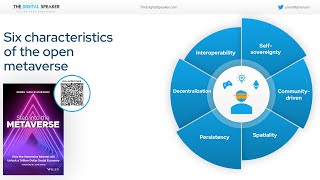
Dr. Mark van Rijmenam outlines six key characteristics required for an open, decentralized, and interoperable metaverse: interoperability (full transferability of data and assets), decentralization (use of blockchain to return data control to users), persistence (always-on virtual objects/identities), spatiality (spatial anchors to make assets findable), community-driven design (importance of communities and brand interactions), and self-sovereignty of identity (portable, persistent, private, protected reputation and identity). The talk emphasizes avoiding closed, walled gardens and highlights practical challenges (noted near the end).
Chapters
Because what we need is we need an open and decentralized and interoperable metaverse. We don't want a closed walled garden of a metaverse where you can't take your assets from one virtual world to a different augmented experience, because that would limit the power and the potential of the metaverse for society. And to achieve this open metaverse, I think there are six characteristics that are important to be aware of and I want to briefly go through all of them so you have a good understanding of how the metaverse, how we can create this open metaverse. First of all, and very important, interoperability. This means that we need full transferability of data and digital assets. That's currently not the case on the current Internet on web 2. So to say it's impossible to take your Facebook or your TikTok feed with your followers and your images and your interactions away from that platform, move it to another platform and just continue where you left off on Facebook. Until this day, it's not possible to send a text message from WhatsApp to let's say signal or telegram. But this interoperability is crucial so that if you win or earn or grab or in different games, a certain asset, you want to be able to take this asset from one environment to the other environment. Very important. The second characteristic is decentralization. We need to use blockchain technologies to return the control of those data and those assets to the user. Again, that's currently not possible. Our data resides with the various companies that you interact with. But if we want to have the most value of the metaverse, we need to be able to take that data and have full control of that data. And we can do that using blockchain technologies. The metaverse also needs to be persistent. It's always on, always there, unless the owner removes it. So what we don't want is just like in today's world that any company can just delete your profile or your identity whenever they think that is required. It should more reflect the physical world where you can't just knock down a building and the same you want in the virtual world. If you spend a lot of money on building a mall or well designed building in let's say the central land or the sandbox, you don't want it to be disappearing all of a sudden. Of course there are also some challenges related to this and I will get back to that towards the end. The next characteristic is spatiality. What we want in the metaverse is that we have spatial anchors on all the billions and billions of assets that will be part of the metaverse so that it becomes searchable and findable. There is currently no Google for the metaverse. It's currently impossible to find a particular asset in a particular virtual world. So we need to be able to make this metaverse a spatial web where it's possible to find whatever you're looking for as a fifth characteristic. It's community driven. Very, very important. Communities are key within the metaverse, and brands need to acknowledge this when they are interacting with existing communities. And as we will see, these communities have a different approach to a lot of things, different approaches to socializing, but also a different approach to working and to purchasing stuff online. The final characteristics is self sovereignty, self sovereignty of your identity, making identity, but also reputation, personal, private, persistent, portable and protected, which basically means it's personal, so it's yours, it's private. Nobody can peek into it if you don't want that it's persistent, nobody can just delete it. It's portable, you can take it from one end to another, and it's protected, so it's secure, so your data cannot be hacked.