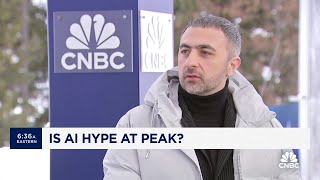
Transcript of a televised panel interview (YouTube) in which hosts Andrew Ross Sorkin, Becky Quick, and Joe Kernen interview Mustafa Suleyman (DeepMind co-founder, CEO of Inflection AI). Suleyman argues AI is transformational but may have reached "peak hype," discusses market valuation effects (Microsoft cited), business models that share savings/value, long-term labor-replacing risks alongside near-term augmentation, and consumer-facing products such as Inflection's Pi (positioned as emotionally supportive/personal intelligence). The tone is conversational with pragmatic optimism and attention to social and economic implications.
Chapters
Potential power and pitfalls of AI is top of mind here at the Forum. Joining us right now is Mustafa Salim and he is the co founder of AI research lab DeepMind, which was acquired by Google. He's now the co founder and CEO of Inflection AI. He's also the author of the Coming Wave, Technology power and the 21st century's greatest dilemma. And we're going to talk a little bit about the, the perils, the opportunities and that dilemma with Mustafa right now. Good to see you.
Great to be here, Andrew. Thanks for having me again.
So let's talk about maybe just say what we were talking about during commercial break. I hype. You go to the Promenade and it's quite, quite promenade being this, this street behind us. And it's like you can't, I mean, I don't know if people can see it over here, but you can't. Every, every, every.
It is quite surreal. I mean, it does feel like the entire event has been rebranded the World AI Forum. Every company on the street has been, you know, leading with the fact that they're now an AI first company. Look, I think on the face of it, that's amazing. I mean, AI is truly one of the most incredible technologies of our lifetime. But at the same time it feels like expectations about its delivery are higher than they've ever been. And maybe we have hit a kind of peak hype for this moment. So we'll see.
The scary thing about that is that when we've hit peak hype for things in the past, that usually means there's a reckoning in the market. Are you predicting that that's to come? That the market which is being giving huge props to anything that's labeled AI is going to take and start digging down a little deeper to figure out what separating the wheat from the chaff?
I don't think so. I think that this is a truly transformational. I mean, think about it. Everything that is of value in our world has been created by our intelligence, our ability to reason over information and make predictions. These tools do exactly that. So it's going to be very fun.
Jim Breyer was on with us yesterday, right?
Yeah.
He said that he believes there's $1 trillion of market cap in Microsoft's valuation today focused solely on AI. The question is, is there really a trillion dollars of value in that company as a function of AI is going to be a feature set that it's, that's in, that's embedded in every company? Are there going to be other companies that are going to Be sort of massive winners. Everyone's going to lose. I mean, how does that work in your mind?
I mean, I think more than 70% of the S&P 500 use Microsoft for various cloud Surface services. Imagine how much of that data about the way that a business operates is already embedded in their systems. And so the key goal of putting that data in there in the first place is to extract insight from the information to run things more.
But the question is, are they going to cap or more share as a result? How much more is a company like a Microsoft or Google or yourself in the future going to be able to charge those companies for this service? And on the other side, clearly those companies are either going to think that they're going to create remarkably more revenue as a function of it, or going to save on the cost side in terms of workforce.
These tools do two things. They take an existing process and make it massively more efficient. And there's a huge saving there. And what I'm starting to see is business models that share in the savings and the value add that is created. But secondly, they allow us to do new things that software has never been able to do before. These tools are creative, they're empathetic, and they actually act much more like humans than a traditional relational database where you only get out what you put in.
What does that mean for, for jobs in the future? I know right now it's a really tight labor market, but are they going to replace humans in the workplace in massive amounts?
I think in the long term we have to think over many decades, we have to think very hard about how we integrate these tools. Because left completely to the market and to their own devices, these are fundamentally labor replacing tools. They will augment us and make us smarter and more productive for the next couple decades. But in the longer term, that's an.
Open question, maximum hype. But there haven't been enough public companies to be a true mania yet in terms of sucking. You know, remember to the.com pets.com, we're nowhere near there yet. So what inning are we in before enough of the public gets to, you know, act on the hype? With a publicly traded IPO or stock.
We are just at the very beginning revolution.
The hype about it might be there, but. But the stock market hype is not there yet.
That's right. And in many ways I think that things are undervalued because if, if you're a company that has amazing data, really good distribution, you control your supply chain and your customer, then these Tools definitely allow you to deliver a better experience to your, to your user. And I think that that is underra much.
That's going to ask you a question real quick. One of the things inflection does, and you guys have talked about this is therapists. We're just talking about psychiatrists. Right. People like to interact more with his interface effectively.
Right.
Then they like to interface with an actual therapist as you're lying on the couch trying to tell them all your.
Problems because they don't think that the AI is judging them the way a person would.
Exactly right. So we make an AI called PI, which stands for personal intelligence. And we focused on EQ, ChatGPT and the other eyes out there focus on IQ. They're all about productivity and knowledge. We want a fluent, smooth conversational experience which is kind and supportive.
Or somebody just basically tells me I'm right the whole time.
Well, no, I mean it occasionally pushes back. That would be super boring after a while. Right. You wouldn't want to really engage with that. So it's finding the essence of when.
Here's my question. If an hour with a therapist is 100 or $150 in person, is your version in the future if you And I create psychiatry.com right. And you're going to. That's how you do this. Is that $5 an hour because it, because or are you trying all of a sudden it's $80 an hour and that's the margin.
Oh, I think it's a question of scale though. Right. So hundreds of millions of people who don't have access to kindness and support, to a really good analyst, to a project manager, to a chief of staff, to a scheduler, a personal assistant, to a financial advisor. You know, these services are only available to the top few percent of us in the world today. In the future, pie is going to be like having a high net worth family office for everybody. But it is going to be available.
But else for therapists and everybody else.
Who are in the for sure. It will create competition in that market.
You buy a dog, Andrew. I don't know what you pay for a therapist, but seriously, you should see the way my, my dogs look at me.
I feel.
Yeah, I feel fine.
I love the AI therapist though. They're never going to tell you that sounds ridiculous.
That sounds like how that sounds ridiculous to me. A machine.
Right?
Oh, Joe, that sounds. Sounds ridiculous.
Okay.
Right.
Yeah.
I want to thank you. I will be sending Joe my therapist. Bill. Thank you very, very much.