SAVE OUR SAVIOURS (Session 4) - How to Prevent Attacks on Hospitals, Doctors, and Staff
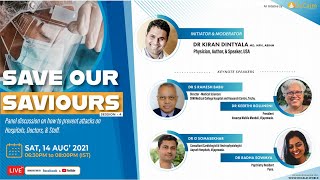
Four doctors discuss rising violence against hospital staff during COVID, driven by broken trust, bed shortages, and delayed test results. They recommend better communication protocols like SPIKES, transparency on pricing, mock mob drills called Code Violet, and stronger doctor associations to push back.
Questions this video answers
August 15, 2021.
About 65% (residents positive for burnout and moderate–severe stress).
About 48 hours or more (panel discussion reference).
Acknowledge; Introduce; Duration; Explanation; Thank you.
SPIKES protocol (setup, perceptions, invitation, knowledge, empathy, summary/strategy).
Chapters
I'm extremely honored to be sharing this space with such stalwarts, Doctors, teachers, amazing people. Thank you so much, Dr. Kiran for this opportunity. I am Dr. Radha Soumya. I'm a final year psychiatry resident. I've done my MBBS from Devrazar's Medical College, Bangalore. And currently I'm doing my post graduation in Psychiatry from Dr. D. Y. Patel Medical College, Pune. I have worked closely with COVID patients both in fever clinics, wards and ICUs in the last one year. And I have been posted for counseling the COVID patients and their relatives specifically in fever clinics and ICUs. Yeah. So. And we have also worked with migrant workers with the guidance of government of Maharashtra. And we have screened around 1500 migrant workers for increased substance use, depression, anxiety and stress. So yes, I'm really honored to be in the zoo meeting. Yeah. Thank you so much.
Thanks so much for joining us. Definitely. And I think we need more and more psychiatry doctors in India. Because there is one field that is not necessarily. That was given that much attention in Indian scenario typically so. And that's great. That's great to have you here today. I think Dr. S. Ramesh Babu from SRM has joined us. I can see him, I can see his screen, but I can't see him. Sir, you're there. He's still muted.
Requested him to unmute. Sir, he did not do yet.
Yeah, yeah. So probably he's still busy with a patient or something like that. So let's wait for him. Whenever he's ready, he will unmute himself and announce himself. But let's get started with what we had to do. So for the first question I will ask Soumya rather Soumya or Radha. How do you want me to call you?
You can call me Radha.
Radha. Okay. Rather. Yeah. So tell me what you have been seeing as a psychiatric resident in the past year with COVID and the violence, if violence. We want to talk more about the violence and you know, the problems, attacks and these kind of things. Have you been exposed to any of those things either in the newspapers or in the medical community that you know or directly. Did you see anything in your hospital?
Yeah. So coming to influence of COVID on psychiatry. First of all, as a psychiatrist, the amount of OCD cases have increased. Okay. And the new onset OCD because they are the worst kind of patients that already their threat is contamination and now.
People do not know ocd. Do you want to briefly tell them?
Obsessive compulsive disorder. Where there is an obsession most. The most common obsession is of contamination. So where they fear contamination and they come kind of go through, there's a compulsion to wash hands. So we have seen patients like 50, 60 times a day. They're just washing hands and they're in the bathroom for two to three hours. You know, this is just new onset. And the patients who are, who already have ocd, they have had suicidal tendencies. We have had so many patients being brought to psychiatry OPD with suicidal tendencies post because of flare up of OCD and there was no medications available. Yes, pharmacies are open, but a lot of psychiatric patients have just left their medications because they couldn't come to OPDs on a regular basis because of the lockdown and all that. So it had a huge impact on psychiatry patients wise coming to violence. I have, I have been subjected to a lot of physical like verbal abuse. I was not subjected to physical abuse while working at the icu especially where there is very close chances of death, where we're dealing with death. So the verbal abuse doctors, they keep calling us every time and they're like, so you're not fit to be a doctor. And you know, like so you have not provided information about this earlier. You know, so. So that is the kind of abuse we have been subjected to. And yeah, so. And many of my friends who were pregnant and married and I had my own family members. Like both my parents were affected with COVID while I was posted in the COVID duty. So it was a lot of turmoil. My mind was not in the right place but still I had to like put up a beret face and you know, treat the patients, answer the relatives questions. So it was a really tough time.
Thanks so much Dr. Radha for actually sharing that experience. That is exactly what people need to know. Exactly. You know, it has been tough for everyone, not just for the patients, even for the doctors during this Covid season. And Dr. Soumya Radha, being a psychiatric resident, she has seen it very closely up front. Everything that's happening. No, because she has to go counsel patients, help them understand there's death, there is some kind of depression or other psychiatric problems people are facing. Because when in the midst of crisis, in the midst of crisis, people tend to lose their cool. That is what happens. And in the midst of COVID which is I think probably the biggest crisis that people have seen in their lives for most people, you know, of course, apart from other relationship problems and financial problems which can happen. But a lot of people experiencing crisis at the same time, same time, it can magnify greatly all the negativity in People's lives in the community, in the medical society, everywhere. And it impacts, it impacts everyone around them. And when someone like Dr. Soumya Radha or any other doctor in fact goes there, tries to talk to them, tries to help them understand. It seems not all patients, but some of them can be verbally abusive saying things. Can you, if you do not mind, say couple of. Give me a couple of examples what it looks like or feels like.
They just make us feel like it's all our fault. We end up feeling extremely guilty after having conversation with the patient's relatives. So they say things like, you have not even informed this to us. You know, how did you people even become doctors? You know, I'm going to take this forward. Call your faculty, I want to talk to them. So these are the things and it really does come out as a threat. So when the tone and the way they speak is. It's a little difficult. I understand that they're going through something in their life. They're going through a real crisis. But all this was. Yeah.
So yeah, it really directly attacks our self esteem. That's a problem.
Exactly, exactly.
And you know, by the way, research shows that junior doctors or younger doctors are at a greater risk.
Yes.
Getting abused or having violence against them compared to senior doctors.
I have myself done a research in my college about burnout during COVID times. Stress and burnout of physicians, frontline workers during COVID times. And around 65% of all of us, all of the residents like they were positive for burnout and stress. Moderate to severe stress.
So yeah, that's. That's really high. Number 65%. I think it's way more than. Well, burnout is one thing, moderate stress is another thing as we know. But the numbers aside about how much is moderate stress and how much is burnout, that is huge. And I'm sure during COVID time it has dramatically increased. And really appreciate you doing that survey and finding it out. I think we'll talk more about it separately. Actually about that. In California, the California Medical association when they did their survey in ICUs it is 45%, 45% burnout. That's almost 50% of doctors are burnt out. I just want to share this with people who are watching this because it is not an easy job. It's not an easy job. It's a daily struggle. There is so much pressure on doctors in general.
So.
It is not all as rosy as it appears. A doctor's life, it requires superhuman patience, a lot of hard work. Giving up so much of entertainment. I Know how much entertainment I gave up and I still give up. And I'm sure all doctors here can watch for that. So it's not easy. So that's a point to be made. Now I think we have Dr. Ramesh Babu join us today. Thanks so much sir for joining us.
Good evening. How are you? I'm sorry I was a bit late because I was traveling.
I just.
Now I'm in Ooty so there's heavy traffic here. I couldn't reach in time.
No problem. Totally understood. Not at all. Dr. Ramesh Babu, let us briefly. Dr. Ramesh BabU, we have other panel members here.
Hello ma'. Am.
Dr. Som Shekhar who is electrophysiologist in Ayush hospitals in vijay.
Hello. Hello doctor.
And Dr. Kirti is a savior of many lives. She spearheads many projects in the community helping people both locally, nationally and internationally.
Oh great.
And Dr. Soumya Radha is the psychiatry residential dynamic psychiatric resident who is helping many, many patients as well as her colleagues during this Covid season. And she has good things. Excellent. And of course Dr. Ramesh Babu, he is with the SRM and actually he has been. He worked in Vijayawada too in the past and he is one of the elite members in this panel today. And we are so much honored to have him here. Sir, if you want to introduce yourself for one minute.
Yeah, yeah. I am Dr. Ramesh Baba as already told you. And I've got 25 years of managing corporate hospitals all over the country. And I was in Vijayawada as you said with Soumya Polo hospitals as its CEO. Now I'm at present working as the director of SRM Medical College Hospital which is 1,200 bed hospital having 250 seats, medical seats. I'm the director for that and of course and I'm also an NABH Principal Assessor Indian. I mean Indian National National Accreditation Board for Hospitals and Healthcare Centers. NABH Principal Assessor and also I am a lead assessor for Emirates International Accreditation center based in Dubai. So that's my. My native place is Ooty. That's why I just come here to UTI because my daughter's marriage is going to happen somewhere next month. So I come here on a leap longly.
Got it, got it. Thanks so much. As obviously you can see the vast amount of experience and exposure that Dr. Ramesh Babu has is going to be very helpful for us today. Sir, do you have any comments on doctors violence, violence against doctors and medical communities and what you have been seeing in the past year or so?
Few words from you I've seen because I mean, I mean been practice as well as managing hospitals for almost. For the past 30 years now. Managing hospitals initially 10 years I was doing clinical work. Now for the past 25 years I'm fully into managing hospitals. So there's a vast difference between what we saw and what we see now. Because at those days, Dr. Was God, today's doctor's dog. That's all just simply one word is twisted because people understand everything. Google has helped them a lot Internet age. So everybody knows everything. At least he knows something about everything. This is what is the. That is the. It may be an advantage as well as a disadvantage for the. Particularly for the doctor community. So what happened in the previously previous years Doctors now whatever the doctor was telling was right. And doctors. The doctor patient relationship was excellent. But today that is unfortunately, unfortunately it's coming down because we rely a lot of things on investigations. And as soon as we see the youngsters, I've seen as soon as we see the patient, they start writing the investigations. So they don't even interact with the patient. That is the entire problem. I say doctors are responsible. There may be a few black sheep here and there and that's because of hardly 1% of the entire medical community. And that's because of them we are in trouble. Now that's what I want to register this because that one person of black sheep that is there in every community, for that matter, every profession, you have black sheep. It doesn't mean. But that has affected the 99%. The rest who are good, who have been treating patients for a long time, who have been talking to patients, who have been communicating to patients just because of the one person with entire communities branded as though we are on a business thing. So that is why the trust is gone between the doctor and the patient. And because of all this globalization, everything now people think I'm paying you money, it's your bloody business to treat me. That's all. There is no question of trust, nothing. So you have to treat me. And if you are not treated, I'll go to some other doctor. Because there's so much of. There's a demand supply gap. So there is no. There are a lot of supplies. So he said, I'll go to the next doctor. And we doctors are also to be blamed because previously what we were doing is when one person walks into our hospital or clinic or whatever it is with some prescription, I've seen a lot of doctors just throwing that prescription into the dust bin and telling that forget about that, you tell me what is your problem? So we have judged our colleagues, our brethren in the community in a bad way. We have portrayed them in a bad way. And that has led to the people believing that only few doctors are good, all others are bad. They are all into money making machines. This is what the concept among the public. So that has given rise to slowly it has given rise to mistress. And after that, now the era of violence against doctors and the government is also to be blamed to a certain extent because of their lack of policies in certain matter particularly with the doctors. And then the media because you know, previously there was only Doordarshan. Today you have thousands of media, thousands of TV channels, thousands of books, thousands. So what happened? Everybody is waiting for some sensational news because they also have to live. So what do they do? Small things. They blow it out of proportion. So then they say then that, that, that media, that mindset is there in some of the people and they start reacting to that. And that reaction has led to all this violence and all. So the first point I would like to stress upon is that mistrust between the doctor and the patient, the doctor and patient relationship is eroding, is already eroded. So now what we have to do, we have to build that trust. So only way you can build the trust is communication. Because we have to communicate, communicate and communicate. We have to talk to the patients that they are not doing. So we have to do that first thing. Once we start doing communication, half of the problem is solved. So this is my first observation.
Yeah, thank you. That's 25 to 30 years of experience, you know, put together briefly in two minutes. That's amazing. Really. I have a lot of questions about it. What you said, not I don't know what is this but actually to further explore deeper each topic that you mentioned and we'll get there soon. Whoever wants to go next, Dr. Kirti or Dr. Shom Shekhar, please go ahead and share your perspective about for two minutes about what's going on.
Can I talk to our doctor? Okay, yeah. What Ramesh Karu said is true. Many of us know because of before COVID itself the doctor patient trust has been eroded. That is we all know and it reached peaks in past one year. To be frank, like he said, we there is a mistrust going on and we can't blame completely doctor community for this thing. There are several factors. We all know that thing. If you take doctor's point of view, like what he said, there may 1, if not 1, even that 2, 3% also is low compared to any other profession Whoever are black sheep and majority of the times they do try to do justice no doctor will try to do injustice for the patient because if a patient goes happily only that is going to give them happiness Apart from whatever their earnings and which is going to bring back patient Everybody knows this thing majority of the time this is what important and like what he said communication is most important but what happened in the Kobe time there were like what you said previously Everybody is burnt out. Everybody is burnt out the patient number outnumbered the number of beds available, number of doctors available, number of sisters available everything the outnumbered so there was definitely a lack of time for the doctors and the mental agony for patients because of a stressful period for them because everybody knows the mortality is quite high which is high in number if you take 3 to 5% whoever are admitted definitely are sicker in sicker patients the mortality compared to the total number it was very high so because of that only everybody is having tension and doctors were not having time we were used to work in a covet block so cardiologist used to work in a covet As a physician we warranted our time used to start at 56 itself used to start even till night 1212 also the phone used to rang and any of our patient old patients, relatives everybody used to call and we used to have means not even a minimal time for family and 24 by 7 phone and even then patients were not happy to be frank and they want to listen from we used to provide phones to patients so that they can talk if they are not so sick so can they they can directly talk on video call we used to give them camera after having those things also again one explanation not used to be sufficient so mainly even after to be frank there are quite a few number of deaths happened but what saved most of the time what acceptance is that every time to explain every time to show them with the transparency we used to whenever patient is sick if we know that they are going to not make.
It some kind of noise in the background I don't know from where it is coming, but.
Okay, yeah we used to allow them to take even personally we ourselves used to take to their patient where their father or son whoever are admitted so that if we think that he's not going to make up his critical ill so that they should not have a belief that we are. We are not doing everything right we want to. We have to be compassionate with whatever the clinical scenario so they should understand that we are trying our level best they didn't do anything injustice to their beloved ones. Even if they lose life, it is God's fit. That's what everybody wants. If somebody see. We all know that there are several factors for these things. One is lack of sufficient facilities from the government point of view or private point of. In India we all know we are depending on private health care, lack of facilities and financial burden. And above that expectations, unrealistic expectations we can say. Or the treatment response not meeting their expectations, we can say these are all several factors. Apart from that communication are knowing and having a feel that everything, whatever they are treating or the doctor treating is right. And we lost patient only because of its God destiny. That should be there in the patient mentality or the patient attendance so that we can avoid most of the times, even majority of the times that will solve the problem. Like what he said, proper communication is most important thing and transparency and beyond that that is the prime importance from from doctor's side. To prevent erosion of the trust or to have a belief firm from the patient retina's point of view so that we can avoid certain majority of the clashes. That is one thing, one aspect I want to tell at this point. Okay, got it.
Thank you. I think there are a lot of good points that you made. You know, I can see the direct experience dealing with COVID patients every day and what you have been seeing in your specific hospital. And I also believe that the experiences are going to be slightly different depending on where we work, the population around us and the facilities that are available at that particular hospital. And that is going to lead to a different perspective and opinion. But our goal really is to put all these things together and bring down to okay, what are the main factors? Of course we can provide guidance at a big level. But at every facility they will have to drill down deeper and see what is exactly their problem using some guidelines. Dr. Kirti, what would you say if you are given two minutes to express your perspective about this topic?
Basically what I tell with regard to the bonding and communications as the Dr. Ramesh Babu has already taught. About 30 years ago we used to have family doctor concept. But now the patients are moving towards the specialization and corporate hospitals or whatnot. So this is the area where it is shrinking the bondage and trust between the doctor and the patient. Because I am also coming from a doctor's family members. Are doctors in our family?
Yes.
And one more thing. Thing I want to tell especially with regard to Covid is because I myself have been through Covid in our family. 10 became COVID positive Ours is a joint family and we lost our aunt.
Also.
In the hospital care. So during that process once RTPCR report given and the time we have to get the report is about 48 hours or more than that in India.
Yeah.
So that creates anxiety and also the worsening of the patient. Some of the patients and then when we take to the hospitals there are no beds, no ventilators. So this is again a confusing state. So what we can the lessons learned from this is we should know how to manage the pandemic from a physical health angle and from a mental health angle also. And not only the patient but we have to deal with the families. That's very very essential because when I went to Canada in 90s I was hospitalized and underwent a major surgery. One thing the surgery and all those things the other thing is the most interesting thing for me is counseling. In how many hospitals do we have the counseling for the patient and family members? That's why we felt this gap. And when we have initiated a psychosocial well being of the COVID patients in home care or their family members or those who are stressful and want to have it we don't appointed a psychiatrist or a psychologist but every grandmother, every mother is a psychologist. That's what I feel it they know how to tackle the issues in a very soothing manner and make the person to be very comfortable because nowadays we don't have that system. So that's why we are going into back but how many doctor versus patient ratio where India stands.
Very, very bad.
And the pandemic Managing a pandemic is very very essential because we know pretty well that losing our own aunt but we got many calls in our for our tele counseling that we are not allowed to see our family member husband or son or whoever it is we are not knowing the status how my son is he's just 24 and he was admitted in XYZ hospitals then we used to talk to those doctors and convey the matter to them and as the previous speakers told that the Google has given us lot of information on this. So my son is not given this injection why they are not giving it? So the parents from the angle of their kith and kin they are so worried and so stressful.
Yeah.
Also don't blame them that losing the family member they became so tempered because they don't have the information they because the chain of communication is lost in this disease because the mode of transmission is different.
Yeah.
We are not allowing the family member to stay there and they can't even Go and see them also. So for the next pandemic, which it should not get, if we get it also, we should have to gear up. How to deal with the family members, especially dealing them and keeping them at a comfort stage. What we all can do it. That's very, very essential. And also physically, what I can tell as the doctors are dealing it, the patient responding to that disease is also for the treatment, very important. At the same time, I always tell since 1989, when I lost my daughter at the age of six years, the quality of treatment is very essential. And quality of testing centers is very essential because I gave my daughter's blood. And then they told come after three days. Then they told it is contaminated, the pipette is not clean. Can you bring the baby next day morning? By next day morning, the baby died. So since then, I feel that it's very close to my heart. This tropic case. It is not to blame the doctors, but how do we give a quality diagnosis and treatment to save the lives? Because if one died, it is such a precious baby for me. I know the doctors every day they are treated.
Yeah.
At the same time, my sister's son, who is working now in a hospital as a physician, he told that Amma, every day I have to see 300 patients and wearing that PPA kids and blouses and all those things. And again, using sanitizer, he got all the rashes and gangrenes on his hands. So it is also so painful for the doctors to see the death of.
The.
People when they are crying. And the second thing, they themselves are exposed.
And.
My son worked there. His wife is about to give birth for the baby. And after that she gave. So he kept leave for two months because he himself cannot put his son in the risk. So he took leave for two months. So we should understand the reality of the doctors and also we should understand the reality of the families and how to bridge it is the basic thing we have to do is counseling, which doesn't cost much. Spare a year here to them. And whatever the connections which we have, if we can connect to them and convey them the message, then they will be cool. Thank you so much.
Thank you. Thank you. I think every single person who spoke so far, all four of you have made such amazing points. And yet they are quite different points. You know, the perspectives and the topic that you thought is important, but there is an underlying unified message. You know, no matter what perspectives you have, I can actually see an underlying, unified message too. So let me sum up very quickly what I heard And I'll share my perspective. The first thing that I want to say is it doesn't matter what the problem is, really doesn't matter. Medical problem, financial problem, relationship problem, some other problem. The most essential skill that every human being must learn, must master, is how to stay calm in the midst of chaos. Because the truth of the matter is chaos is always going to be there in our lives. We think that everything is going fine and all of a sudden something happens out of nowhere and we must be prepared for that chaos. How to manage that chaos, how to collect ourselves and respond, not react and respond with our common sense, respond carefully to whatever the situation is. I think that is the number one skill that is lacking in most people, most people, and that needs to be reinforced. You know, that is one thing I'm seeing. Number two, communication. The communication must happen between the doctor and patient, between the hospital and the community. You know, between doctor and doctor. You know, as doctors, you know how the intra hospital communication systems and you know, where there is breakdown and all that. But essentially when communication happens, it greatly reduces the risk for misunderstanding. Because most problems in life come out of misunderstanding and false assumptions. And that is despite a lot of hard work, a lot of effort and good intentions. But if there is a communication lapse automatically there is chance for other people to see it in a different light than what we are seeing. And the same applies not only to the personal relationships, but actually doctor patient relationship. And a lot of times doctors are so busy, like you all mentioned, you know, seeing 200 patients, 300 patients a day, you don't have time to communicate either. You can go treat them very quickly, see in the two minutes that you have and tell them, hey, this is what it is, that's it. Or you could spend 30 to 45 minutes there with that patient and you can only see maybe 30 patients a day. So that is a huge problem in my opinion. So much of the problems that we are seeing may not be necessarily a personal problem, like you know, a problem with the person, whether it is a doctor or the patient. But you are in that kind of situation because the doctor patient ratio in India is one in each. Each doctor is supposed to see 1, 1, 1 to 1, 14, 50, it's.
90 physicians for 1 lakh population. I was just looking at it.
Yeah, there are different ways to put the numbers. And then in America it is 1 to 300 or 1 to 278, whatever numbers come to mind. I just want to show you the huge gap. And even for us here, when we see Patients, it's not easy to communicate with everyone. It's not easy because now you have less number of patients, but you have so much charting to do, and then there is so much nonsense you have to deal with the insurance companies. So there are other kinds of problems that we deal with here. So it all comes down to essentially the amount of time that you have at hand to do what you got to do and how you can communicate. Even if you have one or two minutes, what you want to do. I think that is going to be an essential skill that we all need to focus on. You know, in my experience, coming to communication, it makes a huge difference when we communicate properly. And what I have seen is if you only have two minutes, you came inside and saw the patient, and instead of standing a distance apart and talking to them like this, if you actually sit down, even though for two minutes, maybe next to the bed, you know, holding their hand and telling them in two minutes what you have to say, they will remember that quality time that you spend the two minutes. This Dr. Cares about me, and he told me I have 300 patients that I have to see today, so I could only actually spend two minutes with you. I'm so sorry. So he communicated that to me also. Yeah, I may not be happy that he only has two minutes from me, but that's the situation. Doing these kind of things, I believe greatly enhances the relationship and in my opinion, doctor, patient relationship, the foundation for it is trust. And the trust has to be built in the first few minutes when we see them in the first few minutes. Because beyond that, it's over if we, for some reason, whatever way that we are communicating in the first two minutes is not impactful and is not compassionate for whatever reason it is. That may not be our intention, you know, and I have noticed it when I took my father or mother to doctors and, you know, I noticed, like, how they communicate in the first few minutes. It makes a huge impact, Huge impact. Things might change, you know, later. They may, you know, actually come back and speak for 30 minutes and all those things. But I'm saying in this specific scenario, what we have, I think that is going to help. And the fourth thing, the communication between the public and medical community, you know, that is fractured, as we know. You know, still, I think there is doctor and patient getting together, talking. There is some amount of trust that is left there. But when you look at the big picture, the medical community and the public itself, there is a huge divide, Huge divide. The perception, like Dr. Kirti and Dr. Ramesh Babu said 25 to 30 years ago, Dr. Was just God, just go to them and then that's it. You feel that you are safe. Whatever happened, happened. You don't question it because there was trust, huge amount of trust at the time. And the trust is lacking these days because of various factors. I think some of them are media driven. Yeah. Some of them are doctor factors. Some of them are hospital and corporate mentality. And then of course media plays a huge role in blowing up. If there are thousand patients that you treated and there is one person, there is some kind of mistake, that one mistake is being magnified to the extent that defines that hospital or that doctor forgetting all the other good things that they have done. Right. So that kind of thing, like everyone mentions the Tagore scene, you know, in Chiranjeevi's movie. So there are many factors like that. And there are patient factors too. The amount of literacy that the patients have directly impacts, I believe the violence and their perspective towards doctors. But I wouldn't say, I wouldn't say exactly literacy, but also their mental attitude, you know, about. So you see the complex problem. Lot of things coming together. And I do agree with Dr. Ramesh Babu in saying that some doctors demean other doctors like taking the prescription and hey, who wrote this one? That kind of actions will be very impactful. And I know some people who have done that, even though it's not many, but that is one action. But there may be other things that doctors are doing that are putting ourselves at risk knowingly or unknowingly. So there are many factors. Patient factors, doctors factors, hospital factors and government factors, media factors. If you want to draw a pentagon here we have five different things. It is obviously complex problem. Now how do we deal with each one of them? Is the question I want to ask Dr. Ramesh Babu. Yeah. About the doctor's behavior. What is the gold standard? You know, in 30 years ago, how it was, these days, how it is. As an administrator, you're seeing a lot of things. Please enlighten us and educate us with what you are seeing and what should be a good practice so that we can take these points and make a list to guide the future generations and the current generation.
Yeah, just. Just a minute. Just. I think my. Am I visible now?
You're not visible, but you're audible.
Okay, okay. I'll just say that. See there are, as you rightly said, there are so many factors that you have to deal with it. Like right from the government side, there has to be some initiatives. From the patient side, there has to be some initiatives and from the doctor side, the media side, there's so many things like that. We can keep on talking on this.
Yeah.
So from the government side, see now the government of particular, our government is trying to increase the number of medical seats. But you see every time now the government is encouraging to have more number of colleges whether it's in the government sector or in the private sector. But that too is not enough in our country. As you said that the patient, doctor patient ratio is quite, there's a lot of difference compared to other countries like us and other things. So we have to go a long way. It will take another 10 years for us to come to that level. So. But government is trying its level best to do away all. Initially they were that Medical Council of India was there. But today.
Yeah.
Hello.
We lost you for a second. We can't hear you. So while.
Medical Commission because Dr. Ramesh Babu, we.
Can'T hear you properly. Your voice is breaking. Your voice is breaking. You're muted. Actually, you know, coming to the point that he mentioned there are government factors now the Indian government I believe is allotted, has allotted more budget to healthcare infrastructure. That is what I hear from many members. Yeah. So he's back.
Yeah. So what happened? The government is also trying its level best to improve the standards of the medical colleges, particularly the government as well as the private medical colleges. So the more number of seats are created. But what happened, See recently in this year the number of medical seats in India where there's a, where there were some 2,500 or 3,000 people who didn't want medical seats they were allotted but they didn't take it up. The fancy for the medical seats is coming down gradually because of so many factors, particularly the violence and all such things. And they know they have seen the dog. Usually this generation has seen their parents maybe who, who have been doctors and the sufferings, all these things. So this present generation thinks that being a doctor is not a good, good proposal. So they are trying to go to different, other proposals.
I want to say something here and then I let you continue because this thing came to my mind. So when I was a kid and then when I was seeing other doctors around and how my parents were talking about doctors, that was quite an inspiration, you know, oh, wearing a stat, going around with the steth and then everyone looking at you and you know, seeing you as a God or as a very respectable person, that was the picture that I grew up with in my mind. And even when I joined the medical college like for Example in Andhra Medical College, Dr. Ganeshwar, Dr. Ramana Simham and many other people, they were like hugely respected. Many a Dr. Nandiwara Srinivas Ragar, many other people hugely respected. And we used to think wow, that is how we are going to become once we finish medical college and then, you know, practice and all that. Now there is a huge gap. I know how it was then and how it is now. Probably the kids now and the younger generation is growing a bit. Oh these corporate hospitals, when you go to the doctors they don't even see and then you know they are treating so bad. Perception. It's all about perception and what is being constantly talked in the family, in the media, in the community, you know. So I am not at all surprised that people are not taking up this profession.
I actually had to go on a strike at home for about like a week. I would not eat food. My parents were like please don't take up MBBS become a engineer. My dad was dead against it but I had to go on a strike. Leave call. I say I'm not going to continue education unless I become a doctor. So then they're like okay, you see.
If the people are ready, residents and young doctors, their parents are afraid for whatever reason. Right? That used to be not the case before.
Can I talk? Yeah, yeah. Thing is that like what Ramesh sir sir had said, there is a dramatic difference towards respect. See, the basic point involved here is in our and means. Even during our MBBS times the investigations were very less. There used to be mainly clinical oriented practice. Whatever is missed is accepted. The clinical oriented practice used to be very interesting and we are very much fascinated. It is like a magic. Only diagnosing without anything support just by hand, touch or state or whatsoever. Coming to pinpoint clinical diagnosis used to be there is nothing investment involved. Yeah, that used to be charm. Even what people used to feel. Okay. And nowadays I will tell only one thing regarding profession now. It is one sort of livelihood for 90% of the people who are coming in for 10%. It is a passion. It is passion towards profession. Unless you have passion towards profession. I always tell my juniors who are plus 2 or 10 don't come into this profession. You can't enjoy this profession unless you have passion. Because I am seeing this thing very clearly that you have to read n long number of years. Clinical things will not be sufficient. People are not accepting. See I put strength and I come to a conclusion based on my clinical diagnosis. Once I see an investigation, same thing in my mind. I used to think oh see our clinical skill is still. Still prevailing. That is what satisfaction I am getting now. But yeah future that will not be there.
Yeah.
Even patients are asking sir can you get eco to me. They will come straight away and ask me why don't you get eco? See in bottom of my mind I know one thing that there is not going to be any change if I do eco. Also when you are not doing patients are see some very. I miss diagnosis in 1% or 2% of the times. But that is going to catch my bottleneck, my neck. That's what. And that golden era is lost for Dr. Prashant. There is no doubt about it. And people are not ready to accept. And that is one thing we have to keep in mind. When you why people are not taking that thing. And you are seeing even now the people who are creamy layer that will not. That will be only 10% of the time. 10% max or 15% rest. All are struggling. Really struggling. Restaurant and next generation. I am telling you very clearly 20% will struggle. Now there are no proper platforms for a interested, enthusiastic, mainly skillful doctors to practice. See See the platforms has to be provided by either private or government. Private people definitely will think it as an investment and how to get the returns. Because no bank or not party will going to spare any corporate hospital if they get into losses or turn the board. It is only six unit. They are treating as units and government they are running away from the investment towards government. See you are telling that the investment made by government percentage has gone up when that has gone up when it was much more than required. See if it is from 2% if the government GDP has gone to 5%. Do you think it is the correct percentage in this pandemic time? No. In pandemic the requirement is much more than what?
Yeah.
Now the requirement for investment is much higher than what it is invested by government even now.
Yeah.
And the first thing what I notice is that whenever I'm. I'm introspecting myself from past few days I am very happy. My patients are very happy. People come from 400300 km. As long as I treated without asking about finances. Even my hospital never asked me about how you are treating. What we are treating. We ran like a government setup only. Whatever in RO is a good scheme. As long as government sponsored. You treat a number of patient without asking money. Only talk to them about their disease in a honest way. I have to come to a diagnosis. These are investigations to be done. Then only I will come to know. We will go either Step by step or simultaneous. But these are the finances involved. So I will go step by step. Then only we will come to conclusion. Then we can start treatment and talk to them in a honest way and explain them everything in detail. Regarding steps, nowhere you should bring the finances into picture. As long as that happens, patients will be definitely at least accept things. Once the finance comes into picture regarding investigations, all these things several thoughts come to people's mind. That is not their fault. Even if I am there, if I take my car for a repair when they tell these are the problems, I don't mind when they say that is the more budget is involved with these things then I will think twice. If I keep myself in the scenario being a I go to mechanic same thing they come to a body mechanic. So that is what going to be their mind. That's what I felt. See then comes the expectations. There is no warranty for a God prepared mission unlike a human mission. So their expectation is not wrong. When we expect a product like Apple phone or car to have some guarantee they expect. I only tell them this is God prepared mission. I don't can't give guarantee. I can definitely wholeheartedly try in a better way. These are the pros and cons. You have to decide how to go about it. One thing like my boss says is true. They have to buy a procedure from you whether it is free or even by payment. Also they have to buy a procedure. You have to explain pros, cons, percentage of things with a well, you have to be thoroughly knowledge to explain them. Explain. Let them take a thing and the younger generation is going to be pitiable scenario because they don't have this opportunity. At least what we don't have what our ancestors are having. That means in the sense you have to expose and have a lot number of patients. We have the clinical equipment where your doctor patient is going to go down. But simultaneous that exposure will come or not. We don't know first thing. And once their clinical skill money is involved in any every investigation. So you can't set up a proper platforms or you don't have a job opportunity to work in platform. See like government setup they're telling you go to rural area. They have to again depend on whether infrastructure is available or not. In a government setup, we don't know. See all these things matter in this thing. That's what I personally feel.
That's amazing. Absolutely every single thing that you said is true. Two points I want to just highlight here are Number one, the loss of passion. The loss of passion now only people who are really passionate about helping people and passionate about medicine should actually join this profession. That is for sure. I can tell you. And I'm sure Dr. Ramesh Babu will watch for it. And also Dr. Samya Radha or any patient also who would like to go to a patient, go to a doctor who just wants to make money, right? I want to go to a doctor who is passionate about what he's doing. That is who I would like to. Who is compassionate about whatever that he's doing. But the problem here is I notice even those passionate doctors, those doctors with great compassion, they are losing their passion and compassion with time. The erosion of compassion, compassion fatigue, what we call because after doing it again and again and again and not seeing, you know, the good things that we came into this practice for, right? Whatever we came for, that really erodes a doctor's self esteem, his feelings of compassion. That is a huge issue with burnout. You know, they say a lot of doctors say it's not the workload also I am willing to help. I'm ready to stay here long hours and help people. And I rarely see a doc. I never, not rarely, I never saw a doctor who complained after having a long day and after having saved a life. Never, never, never. It is when from an administrative point of view, for example for us dealing with insurances and this kind of nonsense or when we try to get something done for the patient, the insurance company wouldn't approve it. What the hell the insurance company knows about a patient's condition? Did they come talk to the patient? Spent half an hour, 45 minutes, one hour, two hours like I did? No. Then how can they deny this is my side of the problem here? Or the lack of proper infrastructure, the communication between doctors, between staff, the lack of communication between doctors and patients or sometimes patients being nasty in some places, right? And then having false expectations. So all these kinds of things, you know. Definitely. And in, in Indian situation, violence, these kind of things, all these are contributing to the loss of passion and compassion in doctor community and leading to burnout. That is a huge thing. It is going to be more dangerous for the medical. It's going to be more dangerous for the patients, this kind of behavior than for the doctors in the long term. In my opinion, for whatever reason, if the doctors are getting burnt out and they don't want to practice the way that they used to, it is going to be very dangerous for the society in general. It's going to be crisis. But anyway, sorry, I took away the mic from Dr. Ramesh Babu. And then that has led to something else. Sir, please go ahead. Yeah, this is such a huge topic. Like, each one is like so much detail we can go into, you know. Yeah, please go ahead, sir.
Yeah. Now the. The responsibility of the doctors. Now I am telling you the responsibility of the doctors as we. We talked in, in detail about the communication. So that has to be there the community, every doctor has to be taught a communication skill and he has to learn it, acquire that communication skill and start communicating with the patients, their relatives and all. Even though there are counselors, everybody, it is better for the doctor concerned to talk with the patients and their relatives. And by way of the consent, the informed consent is one of the most important things where most of the medical people fail, I've seen, because they think the informed consent, getting the informed consent signed is the responsibility of the nurses. That is a very wrong attitude on the part of the doctor. So the informed consent, it is called informed consent because it has to be informed by the surgeon or the anesthetist or whoever is doing the procedure. That concerned person has to talk. Yeah, that is why it's called an informed concept. Not the junior doctor, not the.
And we can't hear you. Your voice is. Your voice is breaking up.
But okay. Is it now okay now?
Yeah, it is okay. Maybe you may want to switch off the video. Maybe that will give you a better bandwidth for the audio.
Okay. Okay. So they have to talk. They have to talk and get the informed consent signed by the concerned doctor. That is very important. And we are stressing, particularly NABH is stressing a lot of importance on the documentation part of it, because nowadays if you don't document, it is not done because the courts are viewing it very, very seriously. So everything has to be documented as far as the patient is concerned. How. What did you talk to the patient? Did the patient give you a concern and what treatment he or she is going to do? Everything has to be documented properly. That is what we are telling. Documented properly in the medical records. Whether it's return or emr, electronic medical record, whatever form it is, it has to be documented properly. Once we do this, definitely we try to be better doctors and definitely we can save ourselves from the wrath of the public. So that is what we have to do. And once we do this, definitely we will be in a better position and the role of the patients. Now the patients also have to understand the complex, the complications the doctors are going through and they have to cooperate. And finally, the media, the media is blowing everything out of proportion. That has to Stop. Because that has to come from the government side because they have to give a directive to the media that such things should not happen. And they are definitely blowing it out of proportion for smaller things. So these things, if you follow say everybody has got a role to play. The government, the medical colleges, the institutions concerned, the doctors, the patients and the media. If you start doing all these things, definitely I would like these things will come down. So I would like to give you a short final. I mean I can say that everybody, every hospital or every doctor, every hospital should follow these three things which are very important. I will call it simply as we all have studied community medicine in medical colleges. So community medicine previously it is called spm, Social and preventive medicine. So if you remember spm, that's more than enough. S is for strengthen the doctor patient relationship. P is for the poster displays. The poster displacement, the display of matter, whether it is legal, poster this, poster that poster communication. Everything has to display. And finally the mob drills. This is where that see I. I will tell you my example. Mock drills. Somebody call it as code violent, Code Violet or Code Brown or whatever it is name they call, give a color. But usually violent is associated with violet color. So we call it as code Violet and we train our people to say if there is a situation, particularly all such things are happening in the emergency ward, emergency department, casualty. I'm talking about the emergency department as well as the intensive care unit. These are the things where 80% of the problems happen. So in this such situations, if a code violence violet is announced, what is the responsibility of the entire hospital? Whether it's doctor, nurse or whoever it is, they should come there, sit there, I mean stand there silently, without any provoking anybody. Just stand there. Suppose there is a problem which is created by ten people. If hundred people come together and stand there, the people will soften down. This is what is going to happen. But I will tell you honestly this. I took a training in one of the hospitals. I took a training for all the people, including doctors. And then we did it, we did a mock drill. In the mock drill we said Code Violet and every lot of people came and unfortunately, unfortunately none of them was a doctor. All other people were present. The nurses were present, the technicians were present, the administrators were present, but none, no doctor was present there. That is the problem with doctors. So helping their own colleagues, they will think hundred times that once that unity comes, only we can get all these things get rid of. So this, that unity is still not there amongst the doctor community. This is a very, very Sorry, state of affairs. But comparatively, the unity is slightly increasing because of the efforts of Indian Medical association and some associations like that. But unfortunately, that unity is still not there. And once we improve, definitely we will also improve. So thank you.
Oh, that's amazing. Yes, definitely. The unity is another important point that you made. Coming together and solving a problem together. And SPM and the public health aspect, the community medicine, those are the classes that we used to bunk all the time.
But this, you have to do this.
Yeah, yeah, that was so important. And we didn't recognize the importance of it as young students, you know, going in because it is always about putting his teeth on someone's chest and trying to figure out things. Not so much about the community aspect of medicine, but actually the community aspect of medicine is far more important. But these kind of things we only understand with time, with experience. Yes, I think I like the acronym SPM and strengthening the patient to doctor relationship. There are a couple of people in the previous sessions that they shared their wisdom. Dr. Gopi Chand and Dr. Kamalakar, two doctors. They said something very powerful about building trust between the public and medical community. You know, right now, whatever it is, it is the way it is. Essentially know we can go back to what it was like 50 years ago or 100 years ago. You know, there is a corporate sector that is powerful in the entire, you know, medical society. And that is what it is. But the suggestion was each corporate hospital should take lead in their community, in their vicinity, whether it is 10km or 50km, whatever it is in their vicinity, and actually go build trust with the community, going for a tour, educating them, providing something for free, free blood pressure check, free diabetes check, and interacting with the community that way on a consistent basis. So people will see some kind of communication, some kind of compassion from them. That is one good thing that every single hospital system can do in its vicinity if it is planned properly. And it will also lead to better business case for them too. You know, the service itself, doing something for free and helping them out and educating them will develop a relationship. And when a patient really needs something or they'll remember, okay, I need to, you know, maybe consider going to this place. They are really nice to me. They gave me something for free. They did free checkup, they did free education, whatever it is. And when people are going in some place with trust, you know, with already some amount of trust, I think that is going to help. In my opinion, that is what their recommendation was and I really liked it. The other thing is the hospitals, the medical System. This is also coming from previous recommendations from various people. What they could do is maintaining transparency to the best extent possible and being upfront about the situations. Like for example, someone comes in, they need a angiogram. Let us say someone had a heart attack. They can say, you know, okay, this is what it is on a display somewhere, you know, in the patient's room or wherever it is, this is what it is going to cost you. And the room rent is this much medication is this much the cost of the doctor or angiogram, whatever it is, you know, sometimes providing all the nitty gritty details may not actually help, but at least overall view. And if you want to be in this room, it is going to cost you this much. And if you want to be in this room, it is going to cost you this much. And these are the things that you will get, you know, something of that sort. If it is explained to people right at the beginning, I think it may reduce a lot of angst, you know, or even if there is, oh, okay, I mean, this is too much. Maybe I don't want to get it done here. If it is an elective procedure, you see what I'm saying? Because a lot of times they come in and they go into a situation patients and then they see the bill only after three days, four days, five days, 10 days. And it's something that they just can't comprehend. How is it so high and the financial burdens of it. Another recommendation was it judicious use of resources. And that is going to be important for us, whether it is in general about medical practice, whether it is for Covid or whether it is our environment. Because it is lack of this judicious use of resources that is actually causing so many problems in the world, in my opinion. For example, in America we waste more paper than anyone else. And half of the paper in the world is consumed by America. I know, I noticed actually when I was a resident, I used to make a big deal of it. Even with my professors and these people. Sometimes they used to just print for one page, 10 pages. And I used to go and stop it. But the point is, judicious use of resources is very important. Waste management is very important. Preventing wastage of whatever resource that we have. Because coming to this point specifically, doctors ordering labs or echocardiograms or CT scans or MRIs without thinking too much. They should be used only when really needed. But that practice is not rewarded in the current system. Because there are a lot of places you make a lot of money if you do all these tests. And that is what is driving up the corporate hospital pricing or in general pricing in medical society, whatever it is, right, the cost is going up. This has to be taught, this has to be learned. But for this to happen, the government should provide proper incentives for doctors who are working hard because the doctor only makes very little bit of money. Then unfortunately the reality of life is he will have to dependent on extraneous sources. You see like everything is connected. Everything is connected and this has to be attacked from every single side. In my opinion, unless the government takes up a very active role as if we are going to war with Pakistan for example, you need to take this that seriously. Until then, things are not going to change. Yeah, a little bit here, a little bit here, in pockets of places. But things won't change at the pace that we want them to change. And if we do not learn from whatever that we experienced during COVID I don't think anyone can save us.
True and for sure. The most important point what you told two things are more important. Like what you have every. To be frank, every hospital will have what is called like what you said surrounding people. That community is always we can call it as catchment. Adopt a catchment area as a thing and to do more what for what you can do as a corporate social responsibility from all which we, all of us, most of the doctors have they don't feel bad in treating free majority of the times unless is pseudo BPL only they will feel bad for treating. That is one thing for sure. And second thing what is most important like what you said is government private ratio of catering health care should change. Government is catering 20% private is scattering 80% in a patient or in a population where 80% you are supposed to be BPL and 20% only are affordable. And the ratio is reverse which is not accepted. And government should be strict about it that they will take up in FA and even MCI and IMA should be willing to mold this healthcare towards that sort of system where the ratio increases from government of point of 20 to almost 30 40% and even private contribution goes less which can means in sense which can help the population. And nowadays with implementation of below power plan schemes schemes in almost all the states. In fact majority of the cost is controlled by government indirectly There should it is a type of insurance system. In fact below portrait it is a type of insurance system. Majority of the schemes are covered means majority of diseases are covered. And there should be proper insurance panel to address with both private and government panel doctors in that. And it should be where means encourage the majority of private hospitals participate in that that implementation of the scheme which is going to give benefit because the wastage of money will be less if private hospitals take care of this insurance because this scheme is stored tightly packed. If your private hospital wastes a little bit of resources it will be utter loss for the hospital. So they will try to implement it with the utmost care from the financial point of view. So that wastage of resources will go down. But simultaneously there should be involvement of both the government doctor and private doctor in deciding the prices and in deciding the packages and the inclusion of diseases so that the care to the patient comes in a best way and a cheap way with a comprehensive way. That's what I personally feel.
Yeah, I agree. I think government should take definitely more role into this. You know we haven't given chance to either Dr. Kirti or Dr. Radha Soumya for a while to express their opinions about these things. Whoever wants to go first.
I always feel that when I visit some of the abroad hospitals there is a patient tracking system is there in each and every hospital there even linked to the pharmacy also.
Yeah.
So like that in India, whether it's a private hospital or a government hospital we should introduce that patient tracking system which gives a kind of a transparency for the people and also brings a kind of an accountability on the managements.
Whether it is public or private.
And health is one of the aspects a domain which has to be captured by the government. Mostly.
Yes.
In the absence of COVID how much percentage in India is being allocated to health?
It's very less.
Yeah.
So in that arena how do we improve it? Because we are just talking of only the pandemic situation. But we should see that the scenario has to continuously go with the public private partnership wherever it is required. And currently the rhistry is there. I'll just add on to Dr. Shomasekhargaru that not only giving the services but also we should see that the payment should come on time so that many hospital will be enrolled. So the currently many hospitals are not enrolled although they want to do it because currently the investment on this or is also so much. That's why some of the hospitals they also want to go back. So what we have to see is balancing all those things and a perfect, accountable, transparent, sustainable model has to be developed in India which is there in many other countries.
I think. Yeah, I totally agree with you. You know I think we may need to take inspiration from Canadian health system model or UK health system model where there is a National, you know, model where you know, everything happens this way. You know I personally wouldn't suggest an American health care model for India or even for America actually because the insurances have become so strong here and I don't think they cater to the needs of the patients. It's all about money for most part. Yeah it's helpful. There is cutting a technology and all that. There are a lot of good things I would definitely say but we have our own problems. Every system will have their own problems. But I think for a country like India, you know something inspiration from Canadian or UK health model may be more helpful in my opinion. Dr. Soumya Radha, please go ahead and share your perspective. We talked about a lot and you have been listening patiently.
I really again communication. Right. So for all the doctors like me who are frontline workers who are dealing with patients and patients relatives as a counselor I really have, I have few tips. So it's a protocol, it's called spikes protocol. It's about breaking the bad news to the patient's relatives. So when the information is conveyed effectively that is half therapy in itself. So I the few six steps if it, you know, just try to incorporate it and see if it, if it makes a difference. So the spikes, the first is the setup. The area, the place where you're trying to counsel the patient and the relatives is really important. It's about the context more than the content. Please don't do it in front of the ICU before the room, before the security guard where there are hundred people. Please take them to an isolated counseling cell where it's just you and the patient's relatives and there is a safe secure environment. So first is the setup. The second p is the perceptions. So assessing the patients or the patient's relatives perceptions at that particular point is extremely important. Blame, anger, hostility, all these are very normal reactions when patient receives a bad news or when patients attend us receive a bad news. So it's very important that we as doctors are aware of that. Like try to analyze the perceptions. If it's hostility, if it's anger, so what is it that they're going through? So next is invitation. Sir has talked about consent, about informed consent. Here also something that really helps us. I want to share something with you. Are you willing to listen to it? Would you give me the permission? So taking that consent removes half of that barrier. So you just put it out as a bomb. It's really difficult for them to like accept it and take it all at once. So when the yes comes from their side, first so then it is a huge amount of barrier is really removed. So that is I then the knowledge. So whatever you're supposed to share with the patient's attendance or the patient, that is the key. And then e is so after you have shared the knowledge, please empathize with their emotions. So don't be cold towards it. Be a person for that 2 minutes, 3 minutes. Okay, step down from the doctor's shoes, try to empathize with their emotions. And last most important step is summary. Right from summarize the whole thing that has been. Everybody's looking for a closure at that point in time, you know, so all of a sudden when you receive a bad news, it's very difficult to analyze it and form a closure for the patient. So you as a third person, if you are able to like summarize the entire events effectively and give them a summary, it helps with the closure. So please read up spikes protocol for all frontline workers who are dealing with patients and their attenders. And breaking the bad news is an art. So please go through it, try to watch some videos and it can be built with practice. So that is my advice.
That's very good. A good summary of what needs to be done when breaking a bad news. I think breaking a bad news is one of the issues that even doctors years of practice sometimes struggle with. When there is cancer, when there is death, when there is something unexpected, it's not easy to break the news for the doctor, not it is easy for the patient. And yeah, I really love that protocol. Why don't you send to all of us?
I will, I will. Yes.
You know, we can share our emails here.
One thing I would like to say, Dr. Kiran.
Yeah, yeah.
See the doctors, I'm telling doctors particularly not everybody, but majority of them, yeah, they like to speak, but they don't like to listen.
Okay.
Yeah, this, this is, this is applicable to 90% of the doctors. I can say that because they think.
90% of people in general, I would.
Say okay, general, general it is particularly. It is more with the doctors. That is the most important thing is the biggest communication problem is we do not listen to understand. We listen to reply. Yeah, we listen to reply. That's all. Because we don't listen to understand. This is the main problem. So if you are a good listener, definitely your communication skills will be better. If you don't want to listen, definitely you will have a very bad communication skill.
That's my understanding, 100% I agree with you. You know, actually what you said, most people listen to reply, they don't listen to understand. And the communication skills are not necessarily taught whether at school or college or at job. Typically we have to learn by ourselves. I was very fortunate that I was exposed to communication skills when I was probably 18, 19 year old, fresh into medical college. I'll share that with you that information here. There is a very good book, the 7 Habits of Highly Effective People. And in that there is a chapter on empathetic listening. I think it is habit five, I believe, of the seven habits. It's really about listening to people. That is what I understood. I was very excited when I first read that one and I actually started applying it. And I could see such powerful change both in my friends, family, patients and everyone. When we can actually listen empathically and a lot of times to solve problems in life, you don't really need to suggest solutions. All you have to do is listen. Most human relationship problems and even other problems too. If people can really listen, it's just to understand, just to understand, nothing else. I think 90% of the problem will be solved. And until we really understand the other person, we are not in a position to advise anything. Until you make that connection heart to heart, we are not in a position to. And we try it all the time to do it that way, but it doesn't work out. Typically we need to also it's like a sliding scale system depending on where the patient or the other person is in communication. We have to go up and down, for example, when we are talking with the patient, for example, if they already have good amount of trust in you and there is an empathetic listening component already established and that could be done in one or two minutes. Also you could jump to the next level about advising, about saying something that you want to breaking the bad news. But if they are not ready, you may have to sit there for 20 minutes, 30 minutes, just trying to build that rapport and help them understand that you understand them. This is an essential skill and can only be developed with practice. Especially for the young doctors who watch this one can only be done with practice. And I know how I was many years ago, fresh out of residency, how I was communicating. I thought I was communicating right. But when I delivered the news, probably not the best way, I was thinking, I'm telling them the right thing, I'm doing the right thing, I'm saying the right thing. But they didn't realize that they are not in the right state of mind to listen to what I had to say. Now I always step back and try to assess. I Mean this is a very powerful skill I think try to assess, try to see what the situation is and that is how we reduce conflict for most part just understanding it. And I think Radha has put it together nicely in a format that people could, you know, use it spikes protocol.
Yeah.
So I agree with you Dr. Ramesh Babu, what you said. I agree with Dr. Soumya Radha. Any comments from Dr. Kirti or Dr. Shamshekar about this communication aspect or anything else?
Observation and hearing to the others is very important and also empathetic attitude is very important. That's what we do in our counseling every day. Whether it be Covid, whether it's hiv, whether it be domestic violence in any aspect. And we do train our community people also the community volunteers in all these skills.
Yeah.
If that comes, most of the problems are solved.
Yeah. So that is definitely. And you know one thing I would say is. Just the attitude of caring can make a huge difference. You know they may not be knowledge in the other person we actually solve the problem but just the attitude of caring can make a huge difference. That's the reason, you know, for doctors I believe the support system is very important. Like Dr. Ramesh Babu said, there are certain times that doctor has to explain the procedure especially come to the surgeons and anesthetists or if a cardiologist has to go to angiogram, they have to explain it so the patient understands the positives and negatives about the procedure. Yet there are many other situations where if proper ancillary support is provided to help people feel that they are cared for, it will soothe down many of their anxieties and they'll be in a better receptive state if something bad happens. But right from the beginning, oh we have insurance is what it is financially or whatever it is. You know, people are talking about a lot of things that are not necessarily soothing for them or not necessarily in a way that is soothing for them. No matter what the message is, if it can be done in a soothing way, I think it help when they had to face the inevitable and it will also create a great memory about their stay if everything goes fine. Well, I really like this place and I would like to go back there if I have to is the feeling that I think needs to be worked on. Yeah. Dr. Som Sekhar.
Yeah. No, nothing. You concluded everything in a detailed way. Yeah. Because to avoid one thing, what I felt in your word, very interesting. Is that true? Like what sir said, we should listen not to reply but to understand. Next thing to break news not only we should be perfect. We should be able to learn compassionate ways simultaneously. We should understand whether the situation is right and the how they are receptive or not. Also, we should assess when breaking things are explaining them. So you should like what you said. Support to system. Take people into confidence. Whoever are their relatives are. So whoever are good where you can. You have already established rapport. Rather than talking to a fresh person. As and when the situation come, that is more important. Like what you suggested. I completely agree with you.
Yeah, yeah. I mean, there is one thing I cannot say enough about this. Assessing the situation. If I had only to say one thing about breaking the news. It is about really assessing the situation. Are they ready? Are they not ready? Where are they in that spectrum of communication? You know, it's like a movie. If you start the ending and then the beginning is at the end, it wouldn't make sense. It'll be confusing. The beginning has to be there at the beginning and ending has to be there at the ending. So how. What we talk in the beginning and how to. I love the setup S. The setup in which we actually talk and break the news is very important because when you take them sit in a room or sit in a space where, you know, there is some privacy.
And then.
Discuss that, it changes everything. But, you know, I think in Indian setups, probably there are not in many hospitals, like government hospital, I'm sure there are no place where you could go and do that. Even in private hospitals. I don't know if there are enough places for people to do. I mean, all this had to be taken into building infrastructure, you know, and until that happens, people won't be using it. It's as simple as that. Coming back to, again, the multifactorial nature of the problem. Multidimensional nature of the problem.
Yeah.
Any final words? I think we have five more minutes before we end this call. I will actually quickly summarize what we said. I think everyone has made amazing points about what are the problems that we are facing and what needs to be done. And I'm also very happy that everyone here, the doctors and even from the community side, Dr. Kitty is directing all of us to be more introspective. That is where the answer is. No one said, I'm going to blame you. You know, no one is pointing fingers out. That is a very good gesture, you know, and that is what it should be like. Everyone should be thinking, what can I do to make it better? And I think patients should think that doctors should think that, administrators should think that government should think that if, if everyone thinks that way, I believe there'll be less conflict. Most of the conflict in the world is because there is a finger that is pointing always towards others. And you know how to accomplish it. You know, in a conference, in a setting like this, control setting, it's easy to do. But when hell breaks loose, you know that when things happen that is chaotic, right? Then it is like, you know, how do we handle it? That is a separate skill to be acquired. And you know, I have written some notes from previous sessions also there are two or three things that need to be done from doctor side in my opinion. One is stress management and burnout. Because if we are stressed and if we are burned out, then we won't be able to handle whatever situation that is coming to us. Number two, communication from our side that Dr. Ramesh Babu has emphasized so many times and every single person here. Communication. How can we improve? Our communication is what we can do. Meanwhile, while everything else happens, right. The third thing is hospitals to build rapport with a community. These are the things in our hands that we can do without waiting for the world to change for us. You know, the things that we could impact in our circle of influence, what we call and anything else that we can do in our circle of influence that if you want to add, please go ahead. What we can do in the current system, until the system changes.
Every time. I was stressing on the importance of communication that everybody in healthcare, whether it's a doctor or a nurse or a technician or an administrator, whoever sees the patients. So for them there is already a formula which is used mainly for the nurse. But I would like to emphasize that this should be used universally. All the healthcare professional professionals, that is called ADA D E T stands for acknowledge. You have to acknowledge the patient. You see, most hospitals, particularly in the government hospital, you just go there, ask the patient, I put the strength on his chest and ask her to something. Ask the interns what is happening. You write notes and read. This is what is happening even in private sector, most of the hospitals. So you should acknowledge that there is a person there who is sitting opposite to you. He's a patient, he has come there and you have to treat him. So first thing is acknowledging, acknowledging him. You have to say hello to him. So and so. Then you have to introduce yourself. Patient should know who you are. Whether you may be a big cardiothoracic surgeon, you may be a big director or CEO or whoever it is, you may be a nurse or you may be a technician. You have to introduce yourself See, just we should remember just because of that particular patient only we are getting our bread and butter that we will forget. Conveniently, whether it's government sector or private sector, we think it is his duty to introduce himself. No, we have to introduce ourselves. Then we have to tell him what is the nature of that. This is duration. That duration. D, A D stands for duration. How long he is going to be here at the hospital for one day, two day, three day, or one week or whatever it is. And then we have to explain. E stands for explanation. And finally T for thank you, you should thank him and leave. So when you do this, as you rightly said, it's two minutes, three minutes is more than enough to say to tell one particular patient. So if you do that every day, it becomes a practice. And this aid, acknowledge, introduce, duration, explanation and thank you. If you apply this to any patient, whether you are a doctor or a nurse or a technician or an administrator or. Or a housekeeper, whoever you are, you go and introduce yourselves, do these things, what you are planning to do for that particular patient. If you tell, the communication is complete. So once that communication is completed, you document that then you are safe, the patient is safe, and definitely all this violence or whatever it is. So this is my final say on this. Thank you.
Actually, that probably the single most important thing that you said or anyone said today is about our attitude towards people. You know, the most important thing that anyone can do, in my opinion, is just being a good human being in whatever sector it is. If you just get that one thing right, I believe everything else falls into place. Everything else. Because if you try to just be a good human being, then if you do not know how to communicate, you will learn how to communicate. Then if you do not know how to treat a patient, then you will learn how to better treat a patient. If you do not know the knowledge, you will acquire the knowledge. If you do not have the skill, you will acquire the skill. So all those things. But this attitude is at the core, in my opinion, for a harmonious society. And that is what is missing. And that is what exactly is missing in the society I'm talking about in general. And all these things are, yeah, I think it's good we acknowledge it, but we forget to put it in practice a lot of times. And that is a lifelong practice, that is a lifelong learning. All of us have to do that. But starting this is a good starting point, people to think about it, am I being humanistic or not? And it is because hugely of societal conditioning, in my opinion. There Is so much value put on making money or how you look, how much power you have and many other things that are portrayed to make people feel like you're only successful, you're only important. If we have all those things. How many people who really care about.
Others.
And are great human beings are being recognized? Right?
Very few.
Why is the person who is making lot of ruckus, who is very inflammatory, get so much media attention. So these kind of things? So the problem runs much deeper than what we are seeing actually. And every problem in the society is not because of one person or one section of the population, but is a manifestation of what the actual society is. Every single problem what we face is an outgrowth of the basic state of humanity that is in. That is what it is. So that's for future thought. But you know, I think we had such an amazing call today. Every single participant is an expert, you know, in. In what they do and what they have shared. It's very powerful. And the goal for this program is to stimulate the insights for people who are watching this. We may not find solution right away, but many small discussions like this will change the direction, you know, of the entire system. And more and more people will listen to some of the wisdom that is shared. The people like you, Dr. Ramesh Babu, Dr. Keerti, Dr. Soam Shekhar, Dr. Soumya Radha. And they will start thinking. All right. And I think that is how change begins. One person at a time, in my opinion. So thank you very much. It's a pleasure to be able to participate in this call with you all. Thank you.
Thanks a lot.
Thank you.
You're welcome.
Thank you all.
I've sent the protocol via email.
Yes, thank you.
Nice. Okay, take care.
More from Dr.

Is COVID Vaccination Safe for Cancer Patients_COVID Help_Dr Naidu_Dr Kiran Dintyala_Dr CalmExclusive
Is DELTA PLUS variant going to be worse than any variant? How to save ourselves from THIRD WAVE!
How to Build Our Mental Strength to Overcome Problems? _Personality Development_Dr Calm