SAVE OUR SAVIOURS (Session 6) - How to Prevent Attacks on Hospitals, Doctors, and Staff
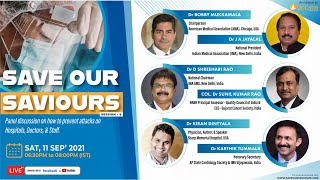
Dr. Kiran convenes doctors and medical associations to discuss violence against healthcare workers during COVID-19. Hospitals faced attacks, unpaid salaries, and around 719 deaths in the second wave. Solutions proposed include stronger legal protections, better hospital security, transparent billing, and increased government funding.
Chapters
It.
We selflessly led the countries fight against Covid. Racing against time, battling all of.
It'S.
A 10 hour shift in the morning, 14 hours at night. There is no break.
We fought hard so you could go back to your family soon. Even if that meant we stayed away from ours for days, months.
Because we've not been so helpless.
Everyone was singing our praises. We were touted as heroes, warriors, gods.
Powered by our corona warriors. India is firmly fighting COVID 19 doctors.
Doctors, health warriors, doctor, nurse, paramedical staff.
Doctors and medical workers are like soldiers.
The entire nation applauded us, healed our efforts.
Oh my God.
Really?
They're made out of coffee.
They're really dry.
I don't feel anything.
But these incidents are forcing us to think if the praises are mere lip service and our efforts would soon be forgotten. It's unfortunate how we are under constant fear of being attacked. Not just by kin of patients but at times by the police too.
On 23rd of May when I was returning from my hospital after performing my day and night shifts of the duty I was stopped by a police personnel at Bhattiya, Brisbane when I produced my identity card and also my car was bearing a logo and there was a statute of hanging in my car. Despite all these evidences, the police personnel did not allow me to go ahead. When I requested him that I'm a doctor and I'm already tired, kindly let me go, he became furious and used rude language. Not only this but also he caught.
Hold of my left index finger and.
Hyper extended it to near fracture. I cried in pain and agony.
The pain I have never experienced in my life.
Threats, abuses and harassment add insult to injury. All while we are under so much pressure.
Many karnois.
In treating you. What happens when we get infected? We are denied beds in the same hospitals where we are fighting it out every day, every hour, every minute, every single second. This is the state of some of the hospitals. Imagine having to work in these conditions. But we selflessly doctors, staff, nurses.
Some.
Of you feel breathless wearing masks for long. Imagine working for hours at a stretch, often without breaks while donning a PPE kit.
The PP kit is actually very very heavy.
And once you go inside it and inside the wards it is the environment. There is so hot you try to you drench and you sweat so much that it becomes really really difficult to move around.
You cannot see our emotions. While we fight in these heavy PPEs we run around the wards in them so we can keep serving you. But imagine having to make do with substandard torn BPs wearing used masks, worn gloves because there are not enough for.
All of us had dawned and gone.
Inside to realize that there were a.
Lot of shortcomings right from unavailability of the soap and sanitizers to the dawning docking area being almost in the same corridor. The masks which were being provided to.
Us were not of the standard quality.
Neither were the PPE kits.
So the masks being provided were given.
In open bare hand.
In our PPE kits the face shields.
We were being provided was that indigo? In fact even these sanitization tunnels were non functional.
In the middle of the pandemic with heavy workload, so many of us suffer the woes of unpaid salaries along with job insecurities. What happens when we demand the salaries that are rightfully ours? Listen for yourself.
Mr. Satender Jain came who's the health.
Minister of Delhi and we spoke to.
Him about basically about the salary issue.
But he clearly denied and said that.
You should not be complaining about all these issues.
All these issues and you should be.
Working and mother only serving for the people.
Corona cases have declined.
We can't be paying you so much.
And.
And you know like. And you don't want to work. Can leave and design and if somebody.
Found not to be working they would be thrown out.
Yeah, we were disheartened by listening by this attitude.
Actually.
About 719 of us have lost our lives due to Covid in the second wave alone. But we hardly have time to focus on our personal grief. We have so many to treat, many precious lives to save. Battling all odds, racing against time. We do not want grand tributes. Do not call us gods.
All right.
Can everyone hear me? Good, That's great. Hello everyone.
Hi.
Dr. Bobby Mukanda, Dr. Sunil Kumar, Dr. Sri Hari Rao. I think we are still waiting for a couple of panel members I believe Dr. Jailal and then I think Dr. Karthik. Thanks so much for joining me today for this discussion. Save our saviors. And I'm really honored to have the President of American the chairman of American Medical Association Dr. Bobby Mukhamla join us. And shortly the President of Indian Medical Association Dr. J. Lal also joins and also Dr. Sri Harirao who has been contact for the past few years. He has been helping me in coordinating this event. He's the President of IMA AMS and Dr. Sunil Kumar Rao. Colonel Dr. Sunil Kumar Rao. I also had the pleasure to speak with him a few days ago and he is the principal assessor of Quality Council of India for NABH which is the board that accredits the hospitals and healthcare professionals. And also Dr. Karthik, the honorary secretary for the Anand Vijayawada chapter of IMA will be joining us. So we can be very informal, just you know, relax and chill out and have just a nice discussion today. It can be an intense discussion but a good discussion about why we have to do this about save these saviors. A lot of people ask me why are you doing this? Why are doctors under so much trouble? And I also have to say that approximately two weeks ago in the previous session we had eminent members like Dr. Hariprasad, the President of Apollo Hospitals group and also chairman of Sunshine Hospitals. Dr. Gurva Reddy and many other prominent doctors, administrators who have vast experience are joining us for this program. And I'm really thankful to everyone who has participated so far. I think there are many panel members, many members out there also watching this both on YouTube, Facebook Live along with Zoom. And I want to welcome them all. Good morning to those people in America and good evening to those people in India. Yes, I think Dr. Karthik thumla has just joined us. Thanks karthik. Karthi, can you hear me? Hi. Karthik. Sorry, we can't hear the Internet connection unstable. Okay. Karthik, We can't hear you. Yeah, I think Dr. J. Lal, the Indian Medical association president has just joined. Welcome sir.
Yeah, welcome. Another by 10 minutes I will be in the car. So I'll be joining reaching the room in another 10 minutes.
Yeah, thank you. I know you're traveling and you mentioned that beforehand. Thank you so much for joining us. Yeah, so and let me introduce Dr. Bobby Mukla who is the chairman of American Medical association to you. And we are very eager to hear from you all the elite panel members about this topic. Saviors. And as you all have watched the video just prior where doctors are being attacked, medical communities are attacked and you know why I am. This program is approximately four months ago and I saw there's a huge Covid second wave in India and you know my people, they're suffering. I said you know, I need to do something about it. So I actually started doing daily Zoom calls to help people there. Like everybody used to get up in the morning, 5 o' clock and then 6 o' clock there used to be a Zoom call and you know for India of course it is six. And then soon I realized in the process that so much violence against doctors and I have seen that personally, you know, speaking to different people and seen on TV and all that. And I want to do something about it. And that is how this program has started.
And.
Yeah, and I looked into various reasons why this or the past four to five months. You know, I learned so much about it. But I want to learn from you today and I hope that we could to some kind of solution or direction that we can take. With that, I want to invite Dr. Bobby Mukhamla to say a few and begin this discussion. Sir.
Thank you. Kiran, can you hear me okay?
Yes, I can.
Okay, great. Thank you. Thank you for the opportunity to join this esteemed panel for this important conversation. It's an honor to be here to discuss the issue of violence against physicians, both here in the usa, but especially in India. And honestly, I can't help but reflect on things I was taught as an American born Indian growing up, attending Sunday bhalavihar classes. And one of the first things that we were taught about is ahimsa, right Non violence. And it's something that we are exposed to constantly throughout our studies in my Sunday classes. But even on the history side of what we learned, we were taught about nonviolent resistance that was championed by Mahatma Gandhi. So throughout my childhood, violence was always discouraged and peace was always held on a pedestal as something to aspire towards. And yet here we are discussing a very dark subject about violence against doctors. And while there's certainly some of this occurring here in the United States, the epicenter of this plague seems to be in my ancestral home of India, where many of you are. And so the very land of Bharat the non violently that nonviolently achieved its independence, where more than one third of the people are vegetarian because they believe so strongly in ahimsa. This is also the land where 75% of doctors have faced violence at work. It seems so inconsistent with the principles that made India a great democracy. Yet here we are discussing this huge problem. But again, it's not unique to India. There was a recent study of 145 doctors here in the United States that show that 59% had experienced verbal abuse and almost 10% had been exposed to physical abuse, mostly in the hospital settings, some in the community settings. But that's a rate that's five times higher than other industries. Clearly an outlier even among US occupations. It's not just in person threats, but in this era of COVID the division that's created in our society has brought out threats on social media. In fact, I had a letter mailed to my office and another one mailed to my home telling me that I should go back to the dictatorship of India because I was not welcome as a non white American here in this country. The letter just came about 10 days ago and we sent it to the FBI for fingerprinting because they wanted to see who may have written such a thing, I guess. I'm honored to be here to discuss this important topic. I'm hoping that we can learn from each other about ways to emerge from this chapter of practicing medicine both in India and the United States so that we can at least continue to practice our profession to help people without putting ourselves at risk. There's already enough risk from this COVID virus, let alone risk from violence from the patients that we are treating. So excited to participate. Thank you very much, Kieran.
Thanks so much. And Dr. Mukomla said the violence is not just in India, it's in America, it's in China, it's in Australia. The statistics show a steady rise of violence over the past decade actually. And In America, another 78% of emergency physicians say that they have faced violence or abuse at some point of time. And they worry about what's going to happen to them. And that's quite unfortunate. India, the situation is quite dramatic that we have seen and everyone here from IMA and you know, more than 70 or actually 80% of doctors felt threatened at some point of time. Now I know that back in June, June 18, I believe Indian Medical association has called, you know, for, you know, protest against this violence against doctors. Sir, Dr. J. Lal, can you give.
Me five more minutes? Give me five more minutes?
Yeah, five more minutes. You need five more minutes? Okay. Dr. Sehari Ravagaru, can you please tell us, you know, what led to that kind of a nationwide protest? 3.5 lakhs people, that is 350,000 people. Doctors, you know, came out on streets and what happened after that.
Today is a historical day.
So your voice is audible. Your voice is breaking up.
Good evening everybody.
It's okay.
Yeah. Better. There is some disturbance. Yes, please go ahead.
And American Chairman, American Medical Association, Dr. Bobby.
So we can hear you because it's breaking up. Maybe you need to the mic and put it close to your mouth I think or you know, remove that and directly speak. Thank you. Yeah, yeah, that probably is going to be better.
It's okay, sir. Good.
Any better? Yes. Sometimes technology more difficult here. I think I always have trouble too than these things.
Yeah.
As I told you, Indian Medical Academy is a multifunctional and multi factorial, multi faced organization. We have 3.5 lakhs members with 1750 branches all over India. And it is the largest non government organization in in India. As my president is a active dynamic personality and proactive for medical any problem he will be the front line and fighting for all the medical fraternity as actually we are fighting on June 18 for the demands of the IMA Central Hospital Healthcare Professionals Protection act with IPC and the Code of Criminal Procedures and also standardization and augmentation of security in each hospital and declaring the hospital as a protective zone. On that day all over India our doctors are come out from the Even though there is a COVID protocols are maintaining but our strength is known by the government of India and they have called for the tasks regarding this Save the Saviors. We are also called for the Save the saviors on that day the title is and where the fighting against the violence against the professional professionals we called on that day. And in our country since times in memorial the doctor's profession has been considered as a noble one being a savior of life and hence given the highest regard in the society. Even the present days, since the beginning of our outbreak of the COVID 19 pandemic health care providers have been shown more support, solidarity and gratitude than ever before. And there have been instances when attacks on doctors have taken place sporadically. This alarming trend reinforces the need for improved means to protect the doctors and health providers from acts of violence. As you know every almost you told before, 80% of the doctors are face this violence against every individuals. And regarding the provision, you all know the earlier days medical practitioners were required only stethoscope, BP operators and one table that is enough for the practice and the patients. Also the confidence or the doctors. And if anything happened to the patient, it was felt to be misfortune or God has given only that much of lifespan. So nowadays doctors have to start with all facilities under one group with the latest technology and equipments. It's very cost effective. Every patient such as Google comes with pre fixed ideas and also has suspicion about doctors investigations and his diagnosis and treatment. So nowadays doctors feels that every patient is a litigant and therefore if anything happened he blames the doctors. And in case the patient dies, the doctors taken a talks on the ground that the doctor portion has become a commercial. This is the provider the feeling of the government and the patients.
Yes sir. Thanks so much for sharing that. And you know I want to say this here. You mentioned many important points. One is the scenario has changed quite a bit compared to what it was 30, 40, 50 years ago. Even when I did med school like 22 years ago scenario has quite Changed. I never saw my sirs, you know, and other doctors that I know worried about anything of this sort in India at that point of time. But now every single person, every one of my colleagues that I speak with, they're like, what's going on here? And I know that personally every single of the night spoke with good doctors. Okay, you, yes, in any society there will always some bad apples. It doesn't matter what profession that you are in. But I can tell from experience and having worked with thousands of doctors that most doctors intend they want to do good for the patient. No one come out there saying that I want to do something bad. But yet why is this such a bad perception these days? Oh, they're just there to make money or they are just charging thousands of dollars. They don't care about us. Why is that perception, Dr. Colonel Sunil Kumar Raghar, can you please share with us your perspective about it? What is that?
Yeah, good evening to Indians and good morning to Americans. You know, I have been invited on two counts. Number one is I am from NABH also that is a national accreditation body. And the second count is that I am a chief administrator for Gujarat Cancer Society hospitals group of hospitals which are cancer hospital as well as medical college and hospital. And previously I have been working in various hospitals as administrator, as in charge administrators and have faced several such incidents which have been shown on television as well as which have been shown just before we started. Many of these are now become routine, as you said very rightly. And there is no doubt about the trust deficient. Even the CI FICI report for our country, for India, for the hospitals clearly mentions that the biggest threat to the healthcare business today is the trust deficient which is there between the patients and the doctors, which has come up as a big factor. Major, major reason which I feel as an administrator, doctor administrator, I am stressing on that because there are multiple administrators of different types who are interested more in making money and showing the P and L as a positive and make profits year after year, keep on increasing the rates. So these tendencies which have cropped up in our medical field is one of the reasons which all the doctors perceive because doctors clearly feel that the payment which they receive vis a vis the hospital receives, there's a tremendous amount of gap in that. And the patients definitely perceive that the doctor himself is taking that much money from the patient and you know, does not explain enough why that money is needed. For example, even in the NABH now we have made it compulsory to do a multidisciplinary counseling which Includes the person from billing, from finance to give the idea as to if there is a costly medicine, suddenly we start injection Meronem or Meropenem and various antibiotics for a common man which, you know, we are treating. We are, you know, treating mostly below poverty line patients and those which are in the government schemes and those really feel the pinch of it that if there is any change in the billing, so any factor which changes the billing of the patient must be explained. So that is where the trust deficient keeps on increasing a person if he is not explained anything. Another thing which we have introduced from the NABH side is the effective communication that also it is called enhanced communication in terms of various situations which arise. For example, a young patient dies suddenly in the hospital. Definitely that's a big red factor as far as violence is concerned. And most of the incidents which you must have observed are when a young person dies in the hospital. And inadequate explanation is perceived by the patient's relatives and some miscreants who mix up with the. With the relatives of the patient. Definitely create a further, you know, fights and things like that. So I feel that the trust deficient has increased multifold because of inadequate explanations. Not only by the doctors, but the healthcare professionals. I would say we work as a team, right? So when we work as a team, it's not only doctor's responsibility, it is the administration's responsibility, it is the nurse's responsibility, it is the team's responsibility to explain in whatever manner. Most of the times what happens is our colleagues, our fellow paramedical and medical professionals and nursing professionals just point it out towards the management has changed the policy or they say that this particular medicine you will have to buy, otherwise we cannot buy it from outside. You cannot do this, you cannot do that. And then slowly that starts increasing. That frustration amongst the patient relatives start increasing. I am not trying to side with their side of the patient side, but from you look at it from a poor man's perspective that if they are not explained in time, especially when the patient is young, critical and at the verge of death, has traveled multiple hospitals. By the way, this is also a new phenomena in India which has started that people are so much wary that violence may erupt in our hospital, so they pass on the buck to another hospital, thereby increasing the trust deficit further. That means you are making sure that you know the other hospital suffers because you are postponing the event by passing on the buck to another hospital. So these some of the factors only I'm explaining. Multiple other factors are there. Definitely. I think My fellow panelists will also throw a light on this trust deficient which has in which is increasing further and further.
Sure sir, you nailed the problem right on its head which is lack of trust, loss of trust. And that definitely is the cause that is leading to all the problems. When there is lots of stress, whether it is a personal relationship, whether it is a relationship at work or in the system itself. That is when people resort to violence or some kind of problems. But you know, actually there is a, you know slide that yesterday for this presentation and the number one is loss trust. And that is what every single doctor who has attended this panel so far has said.
Loss.
Why is that? I want to ask our IMA President Dr. J. Lal sir why there is such a loss in trust? What do you see? You know, being at being such a big organization and stress deficit is not.
Only in the medical profession. It is happening right now in our family. The amount of respect and amount of relationship with the parents, children, what the older generation had has totally gone. Now it has become more of a knowledge based relationship where it is coming whatever time of the time the patient has to fully depend upon the doctor for everything. And whatever the doctor says the patient was able to believe. But somehow whether it is a right or wrong, the social media and the Googles are able to give some negative or improper inputs to the minds of the people. So they always bring some questions into the relationship. That is what resulting in the trust deficit. But what I personally believe that this is a changing phenomenon. But the Dr. Community should also learn to cope up with that. Professional violence is a challenge of a professional hazard which we must be also acute enough to face and acute enough.
To.
Address to that need. And we cannot say that it is rising so that we are going to go away from that. And it has to be. One has to really face that. There are many ways on that because if you see an hospital, it is always an hospital is a human intensive organization. All the people inside the hospital, whether it is a doctor, paramedical person, the attender or the patient, everybody will be in a tense mode. None of them will be in a normal mood, including the doctor. So when there is a four kind of people, when they are meeting together with the different kinds of perspective and the tense mood, there is a violence is bound to happen erect to happen. And at that point of time then how our hospitals and the medical profession is making themselves equipped enough to face that solve it, identify when it is erupting and controlling it is the most important thing. Since you are talking about the Save the Saviors and I mean the medical profession also said teaching. One of the other areas which is worrying me a lot is a professional violence which is taking place within our medical profession itself. The amount of the violence, whether it is a virtual verbal, whether it is not mostly physical, it is a verbal and mental torturing. Then the mentorship situation, whether the students and the. The medical professionals are undergoing is much more the real literal violence which we are facing in the society today. If you are going through the students across the country, the doctors across the country, what they feel is the amount of stress they feel inside the teaching profession, the hospital professional, by their own seniors, by their professional elders, by that is the one end and second in the corporate hospital, by the multinationals and by the corporate owners with the for profit or oriented hospitals, what they are getting the mental torture and if they are not meeting out to hundred cases per month. And that amount of the turmoil and the face challenge they are facing. There is another component of the Save the Saviors which we need to rise to that occasion. What? Yes, we get the violence from the society, which we get the violence from the patients. But we do get the violence inside our house, inside our home. And that should be also addressed to the need of the people. So I will only say it is going to. We can never eradicate the violence. Violence is going to be the part because it is going to be. The trust deficit is so high with the knowledge exposition is taking place. But now our intention, our focus as an organization, ima, we are now focusing on how to solve this and how to prevent it. That only brings by the unity of the doctors, interconnection of the doctors and not talking anything bad about your colleague and always understanding and interacting with the colleague. Always believe that you are also at the vulnerable end and mutually trying to help with the colleagues and forming a network or union where that you will be able to support whenever your doctor colleague is in the problem. That is what we are now. IMA is focusing on that, on the professional violence and preventing the violence which is happening on the society.
Thanks, sir, thanks. And actually bringing out this topic also where it is not just coming from outside, but it's also coming from. It is, you know, from within. Where I know, like doctors being threatened or put a lot of pressure either by the administrators or other doctors, you know, senior doctors on junior doctors, entirely separate problem. But you know, so brings the point. But what is actually violence? What constitutes violence? The definition? Because violence is simple, simply an act of, you know, hitting someone, you know Physically assaulting someone? Yes, that is one part of it. But violence is also defined as telephonic threats, intimidation, verbal abuse. All these things constitute violence. When you take that because people are afraid when something happens. If someone calls you like somebody. Dr. Mukamala got a letter, right? Saying something. I mean that definitely creates a lot of fear in us and that prevents us from performing properly in our. No, I want to say this. Violence against doctors is not just a doctor problem. It is the public problem. It is a public health crisis. Doctors are under stress for whatever reason. If they are afraid, they won't be able to perform well. It is known very clearly. And Dr. Mukamla will they know more about physician burnout and stress leads to medical errors. Medical errors means it is not good for health. Medical errors is the third leading cause of death in America, right after cancer and hearts. So pressure doctor is Dr. E menace to public health. So there's a public health crisis. That's the reason people should be involved. You need to know that violence is not the solution. Violence is not the solution for anything. How do we solve that problem is the question now. What is the root cause? What is the root cause for this problem is what I am interested in. The reason is won't be able to solve any problem in our life unless we truly understand it. 50% of the solution is understanding the problem itself. So from that perspective, I want to ask Dr. Mukamala, what do you think is a root causer for this problem? I know that both live in America, but we are both coming to India. But we follow the news, we speak with our colleagues. Give me your perspective. I want to get to the root cause.
Yeah, I think of it as. My mom is a pediatrician. She's retired now. In fact today she's flying back to Vijayawada from the usa. And I remember spending time in her office when I was a young boy, just sort of doing paperwork, filing her charts away, cleaning up things like that. Just because I was cheap labor for her. But I saw the interaction she had with her patients and there was basically just two office staff, herself and her patients and she got to spend time with them. There was minimal paperwork, minimal computer work. The face to face interaction between a physician and their patient in that generation seems to be drastically different today. It's become from a very personal interaction to a very impersonal interaction. Multiple non clinical people interacting with patients, paperwork, insurance verification, all of these extra steps. I mean the fact that in the United states we have 1 million physicians. Every single one of those physicians has 1.5 full time employees just working on prior authorization to do the care that they think their patient needs.
Right?
1 million physicians, 1.5 million office staff just working on prior authorization. That's something that our patients don't like. If I tell my patient they need a CAT scan of the sinuses to see whether or not the pain is due to sinusitis or a mass or, or some neuropathic pain, the fact that they have to wait to get that CAT scan for a week or more and my office staff has to work on getting their prior authorization, it just creates frustration, that frustration, especially for patients in pain, patients that are in dire straits. They're waiting for their PET scan to see if their head and neck cancer has metastasized or not. That requires prior authorization. So for a week or more, they feel like the cancer is spreading every day while they're waiting for this CAT scan. That frustration needs an outlet. I think what we're seeing is that the outlet of that frustration is directed towards anybody and everybody, to the person that's checking them in at the office, to the physician that they see, to their family at home. And then you can multiply that by a factor of 10. When there's something like Covid and there's social isolation, less ability to have conversations because everybody's at home with masks on. And so I think it's just the corporatization of the care that's being delivered and all the multiple steps that are now required compared to when my mom was in practice one generation ago, that adds to the frustration. And the outlet of that frustration is this violence.
Well said, well said, well said. And you know, for people in India to understand what is prior authorization, it is when someone has insurance and then let's say Dr. Mukamla orders a test, sometimes you can simply order it and he can get it done, like simple X ray. But if you need a CT scan or mri, the insurance people take a look at it. Oh, you don't need it. Why do you need it? So they come and deny it. Sometimes that is very frustrating. Or they will take two weeks, three weeks, four weeks to actually authorize and then to schedule another two to three weeks. All these frustrations is what Dr. Mukhamla is talking about. And I mentioned this in our last meeting and actually prior to other meetings that in India we are under mentality, some of the doctors, that, oh, insurance is going to solve the problem. But in my opinion it will solve maybe some problem, but actually it can create a lot. Many Other problems that we don't even foresee right now. So it is not a unidimensional problem. This is a multidimensional problem that require a multifaceted approach to solve it. Now coming back to what Dr. Mukhamla said. Simple doctor in that simple office, taking care of the patient like a friend, like a family member that's lost. And this is another major thing many other panel members mentioned before too. Loss of the family doctor structure that is at its core. Because previously they used to have, oh, I have this doctor, you know, he's just in that little street, you know, two streets away from where I live. Always go to him and ask him and give me the answer that family structure is gone. Family doctor structure. I see that as a major problem. The second is medicine as business is a common theme that I have constantly from various panel members. What do you say about it? I want to ask Dr. Kali Tumbala to comment on medicine as business. Dr. Thumola is cardiologist, intervention cardiologist and honorary secretary of IMA Andhra Pradesh, Vijayawada sir, please go ahead, share your perspective on that.
Greetings to Dr. Kiran for his lovely meeting of international collaboration with our IMA India and as well as AMA with Dr. Mukamala. So I since I have my greetings to both of them, thank you for accepting and me being a part of it as well. And I also have my greetings to Dr. Sri Hari Garu and as well as Dr. Sri Hari of Gujarat Oncology as well. So coming to the problem. So I was very excited when Kiran told me that he wanted to have a collaboration between both the medical associations of the biggest organizations in the world who are actually working on the same similar lines. So first I would like to comment on what he has asked like medicine as business. And as you said, I Forgot to mention Dr. Mukamala Paravar father, my grandfather was his teacher. So that is what the three generations of doctors in my family. So I've been through all generations. There's just not 30 years I've seen my I've seen 40, but even more as well the family. So as he rightly pointed out, Dr. Bobby, it's going to be a paradigm shift for all the generations as well as we have seen people being almost like living at home when I was a kid, when my grandmother used to practice, so they were actually living in my home. So people used to come live with us and then get treated and go back home. So next came my father's generation where they used to come greet Us, give us some things and be with us for, for some time and get treated and go. So now, now it is more like they come, they get treated and go. So this, there is a paradigm shift as well as in the patient's approach to a physician and as a physician as well we have been almost the same but there are other corporate structures which have formulated over a period of time. So this changed the whole scenario of healthcare all across the world. And as we see this there is a lot of business coming into medical health care and you can see a lot of investments. People are excited a lot of medical healthcare facilities which were actually only for patient care but now only talking about P and LS as we can see Dr. Siyarigar who's also talking about P and L what about the EBAT or CBAT or whatever. I don't know all those financial terms either. So I've been practicing from morning just now I got time to have my lunch now it's around 6pm so that is how we used to work and but whereas our managements would be talking about more like how much generation is being done and what would be the profits and what should we do with it. So this is how there is a paradigm shift. We have to accept it because that is how the industries have been run and we can see the pharma giants which have run all across our practice and we have seen a lot of new molecules coming in which changed a lot of practices as well. In coming coming to the basic point of violence against doctors as Dr. Mukamal has already told that there has been a phased manner even in US where they've come to medical legal cases now they're coming up to abuses, they're coming up to beating up. So as I was excited when there is collaboration being done by IMA which has been a lead of various violence against doctors as Dr. Kiran has pointed out that June 18 was the day when we had a day of protest against violence against doctors as led by Dr. J. Lal sir. We have been a part of it and we have recognized a problem. The root cause is predominantly there is a distrust or the trust factor which is being deficient. And we also talked about financial issues being implicated into almost of it. So both of them should be solved by an international collaboration. And as we see if something starts in us the kind of policy making which starts in us will translate or will benefit the entire world. So we are just not talking about some policies being done by us and various facilities at the state level or at the national level or we should think of an international level solution for this kind of a problem. So we already have a state level kind of policy that if some violence happens that is going to be a homicide kind of culpable homicide. So they will be imprisoned for the minimum of six months and the kind of even going up to two years as well. So this kind of policies have to be continued and this has to be recognized and various levels. We have to solve this as a guideline. So as I was Stepan, we should have a collaborative. This can be included in the routine teaching practice management staff as well.
Are you audible?
Am I audible?
Correct.
You're going in and out Karthik. So you're going in and out.
Am I good? Tough?
Yeah.
Yeah.
Okay.
Yeah. Okay. So I would like to request both the associations to come up with some kind of collaborative guidelines which can guide the younger generation to for a better future and to actually get this solved that get these kinds of problems to have some kind of broad based solutions that can also be modified as a territory problems as well. As we can see there'll be more of medical legal cases in us. We should discourage them going to medical legal cases as well so that there'll be lots of negativism which will be thrown out of place from the policymakers as well. So a collaborative guidelines is what I request to be set it up and even a book. I think Karen likes writing books as well. So he should write a book on something like stop violence against Dr. Guidelines to stop stop violence against doctors and things like that. So. So I answered most of your questions and I had my comments as well. So thank you very much for giving me an opportunity on this platform.
Thanks Karthik for the offer. You're adding a lot of work to my already very busy but with all your help, if that is going to help people, I'll be happy to. But here it is. Every single person so far in this conversation mentioned something common that is loss of trust, right? Every single person without a doubt. Now what I'm going to do is I'm going to share my briefly. Hey Srinija, can you please give me the ability to share my screen please? Yeah, because I want to get to the problem. I truly believe unless we truly understand the problem and taking a multi dimensional approach, we won't be able to solve it. You know, I'll start off actually talking about it and once again the screen share option, I will actually share it. So the loss of trust there. 1, 2, 3, 4, 5, 6, 7. There are seven factors that I have written down here based on my understanding so far and I want your comments on that. Okay. Because we need to get to the solution. And number one perception in public that doctors are money minded. Corporate hospitals overcharge them and wrong information is being given to them to make them get treated in the hospital. Now whether that is true or not that is a totally different issue. But perception is such now to ask the IM President Dr. Jailal to comment on it. The perception in the public that doctors are money mind at corporate hospital. Is this true? And if Is that true? 10%, 20%, 50% it is majority.
It is true. They think doctors is an unavoidable evil and they are earning money out of their sickness. So always that is one of the very common problem which most of the time the violence is taking place or pretending violence is taking place only when they do not want want to pay for that. And something that death happens. It is definitely not because of their anything their anguish against the doctor or the hospital. They thought they are. They're thinking that when they are making a fuss on that then they come create some nuisance on that the hospital will let them off without paying that. So we have interviewed few of these incidents and people. And majority of the time the money and the perception of that the money they are taking more is one of the very very most important reason which is stimulating. Our people are tend to more do the violence at that time and they are getting some benefit out of that. And now there are organized groups are there some established gangs are there. And if you see we studied and violence taking place different hospital in most of the hospital the particular group is involved. So they immediately go there. They make something like a dialogue. They carry on and they get money on that. So both the perception of money they are going to spend and another perception of they can extract money. So both this is becoming a major reason for violence.
So money is the root cause of all violence. That is what I am hearing. Well, I don't exactly mean that. I know you didn't exactly mean that. But how money is just a tool we perceive it and how we use it is the problem actually now. Now Dr. Guruvar Reddy from SUN hospitals mentioned in the previous session that.
Most.
Hospitals that he knows they do not overcharge patients. Yes, there are some hospitals who do not provide proper treatment and they charge a lot of money. Yes there are but that is what I understood so far speaking people. And also the cost of healthcare has gone up significantly over the past one or two decades because of various reasons number one, the advancements in medicine, right? 20 years ago when I was in med school I rarely anyone getting a CT scan or mri. Now every single person is getting a CT scan or MRI for one reason or another reason. And even during COVID times a lot of tests are offered. So the cost of caring for people has gone up significantly. That is one reason. The other reason that I also understand is if someone needs to have a hospital then there is the cost of real estate. For example, in a place, Hyderabad or Mumbai, if you have hospital, you're running a hospital. The cost of real estate is so high and you are paying for it. And also in Andhra Pradesh it seems in Telangana it seems the electricity is being charged at a commercial charges for hospitals without having any subsidies. And all these there are multiple factors that they mention. How the cost of having a single patient in your hospital for simple treatment can cost like 2 lakhs, 1 and a half to 2 lakhs. A simple pneumonia patient. Now whose fault is it? Is it the hospital's fault? The charges are so high. Is the government's fault that everything, you know, the prices are so high. Who should we blame? Also why are we importing so many technologies? Everything is important, right? Everything that we do, there is no innovation inside the country. Everything is imported and that rises the cost. Whose fault is it? Is a doctor's fault? Then why are doctors being blamed? Or why are hospitals being blamed? I want to hear from Dr. Sunil Kumar Rao. Because you're also a CEO of a group of hospitals. It seems to be so I think you may have a great insight into this. Now I will come. We'll come down to other aspects There you know, for loss of trust which is poor communication, you know, and lack of family doctor, those other things we'll get there. But I want to tackle one topic.
Yeah. So first you have mentioned about the loss of trust is already has been commented by many panelists. Yes, first thing is this that the cost of medical care definitely has gone up. There is no doubt about it. But at the same time, if you think from public perspective, public also wants to get treated by good doctors. And many of the good doctors are in corporate hospitals or private hospitals or their private practice is there. So you can imagine the poor patient also wants to go to these hospitals. And the moment his money or her money is over, all these other problems start off as mentioned by Ima President also that you know, it just takes some time and the interference from various organizations starts. Like I was CEO of one of the private hospital Groups where there used to be regular negotiation with such type of organizations which are in Marathi it is called Rubena Hakka Parishad. So it is this. This type of organizations are flourishing everywhere. And always they are being given fuel by. By the politicians, local politicians, local small time politicians to make themselves big. And media of course is biggest culprit today in creating this mistrust. Because any of the stories is like, you know, sells hotcakes, sells like a hot cake. So immediately it is taken up even if it is very, very small miscommunication from the doctor or from the hospital side. It is immediately, you know, painted as if they have done some crime which is. Which is again adding, you know, fuel to the fire of mistrust and creating further problems. And miscreants getting into this like this Ruben Hakka Parishad I mentioned they have made big posters one of our political parties also during COVID times they have with the photograph of their leader put up the posters just, you know, across our hospital of every hospital, every branch, every branch that if you face any problem with money, any problem for paying money, please contact us. Our leader is so and so national figure. By the way.
Yeah, we see slightly picture here. Dr. Sunil Kumar. Yes, that's a good point. We sleep a slightly different thing. You know, when I drive every day there's a big billboard, you know like where it says that advertisement. The lawyers say if you have problem with this doctor or with this thing, you know, you call us this number and take care of it.
Same thing is happening in India now that these miscreants are creating problems. Even if the person, the patient. I have had incidents myself in my hospital where the patients have agreed, patients relatives have agreed. But these miscreants never allowed them to agree to this thing that we will settle on such and such aspect. So these type of incidents are happening and they are increasing in multifolds. And that is how we have to. In my opinion the best thing is to get together, act together. The police is the least supportive of all all these acts. Medical Protection act and all are only on paper. What happens. We have all gone together as local IMA with along with all the members of the hospital association to the police commissioner against one of the violence cases. And he clearly told that suppose I slap you in the middle of the road, what are you going to do? It's a non cognizable offense. So it is never linked with any criminal procedure, Criminal penalty code act and it is no longer valid. And even if I beat you here, what are you going to do you're going to do nothing and nobody is going to even register this as a cognizable offense. So leave aside the investigation into it. So we as doctors as well as hospital owners as well as hospital administrators we have to find solution for ourselves. This is not going to come from the government. Government may be doing certain things by passing some act or by passing certain regulations during COVID times. Fortunately the government has passed this epidemic under Epidemic act compulsory, you know certain penalties. But those are very very limited now. Now that already we are facing the situation where there is no COVID patient there and the government is not helping. The police is not helping in this cause. We have to help ourselves. I am of the firm opinion that we have to build up such type of protocols wherein we all, you know fight together. And this is going to stay. The violence is going to stay. As Dr. Jailal also mentioned that this is not going to go away. Sorry, I hope not.
I hope it doesn't rise anymore and hope we can find solutions to bring it down. But I want to ask Dr. Sri Hari Garu about what Dr. Sunil Kumar Rao said. The government has I think some kind of policy or regulation on since the AMA. You know the event on June 18, right? What exactly the government say and is it being enforced? What I hear is yeah it is not being enforced. No knows about it. Really sir, you are mute. You need to unmute yourself.
Yes, we have Act 11 of 2008 that is done by the Dr. V.S.E.K. reddy Garu in his period. At that time our doctors are fighting for against this violence at our in Hyderabad one incident happened in the so many of our students junior doctors. One day we have called for call call for strike presenter Dr. Erna Paragaru is given call. But the 10 hours our CM called the leaders of IMA and the health minister. The health minister at that time he called and met and discussed with the doctor's problems and given issue this posterior ordinance into 2007. But after that 11 of 2008 act under the act is implemented. And after that 19 states have got the same act. But they are insistent in that three years imprisonment. And there is a revenue recovery act also added in that act for that revenue any loss happened to the hospital. They have to recollect that amount totally total 200%. And this non billable act three years. Three years and imprisonment is for three years. But now that is not is any of these things.
Any of these things.
There is no single case file on this act because there are three. Nowadays the seven Years is the non available act. We were praying for that. Now that seven years must be added. Otherwise it is non billable. It is a bailable land. And also you have to enforce in the police manual. Actually there is no information to the lower cadre. There is no information to the station officer level. There is no information to the SP level also.
Voice is breaking.
We are connected on the conference with the dgp. But he does not know this act. But how can you know the lower cadre? So that is. That is not implemented. But that's why we are asking for the central law for the against this violence. There are other incidents acts out there. But they are implementing the pandemic act and disaster management acts also they are implementing. But we want the national act. But all the states with the seven years and immediately they have to arrest that the culprits were causing this violence against these doctors or parameters anybody and also government to improve the hospital infrastructures in government sector and strict implementation of the rules and acts and punishment for violence against doctors hospitals according to the appropriate rules.
You know one of things. One of the things that. Thanks very much. And you know one of the things that triggers my thought when you mention some of these points is that there is a huge gap between public perception of who doctors are and medical communities are and how we perceive ourselves. There is a huge gap. Everyone sees that right in this panel here. Everyone sees that we are thinking we have been working all our lives right from childhood, you know, studying hard, going to middle school and so much stress, pressure. And after you'd come out and then you're working tirelessly day and night to become a doctor who you are right. But people are not seeing us that way. We are seeing ourselves as saving people. But people are not seeing it that way. It's because of. I think in my opinion medicine has become business both in America and India. Unfortunately now business is not wrong in my opinion. But how are we conducting that business? Number one. Number two, transparency. That is what something they heard from previous panel members. Transparency of what we are doing. Transparency. I think Dr. Sri Hari Rao Garu had to leave because there's another conference at this time. Thank you, sir. So transparency. Does this cost so much? If every hospital has its on their patient's waiting room or somewhere else. Like cost so much to get the mri it so much to get the CT scan. It costs so much to get so and so. And this is what it is. If you give the breakdown, is it going to help Dr. J. Lal?
Yeah, that is a very good Question to ask the business. I mean business is not an unholy word. I think this is. I mean, unfortunately, once we come into the medical profession, we think that the business is a word which you should is a forbidden word. We should realize that the government and everywhere now we are recognized as only industry and a business. And we should know the business in a very transparent and perfect way. It is not that easy to put that what is their expenditure and put the CT scan how much it will cost. And that is not the exact way of doing the business. But the way of doing business is the mindset of our doctors has to change. Whenever you get a coffee, when you get a coffee from the tea shop or when a coffee from the five star hotel, the charges are different, but they are different with some utility for additional benefit which they are giving. You are sitting in an AC room, comfort and other infrastructure, facility. All that come. So the same doctor when he is going to give the facility to the people in an acceptable way. Giving all the comfort to the people, infrastructure facility to the people. And we trying to build the brand of his service along with his physical professional technique and professional outcome that is going to be accepted by the society. See when the corporates, the big malls coming, big hotels coming, People are able to go there and take that because they have some expectation that expectations are meeting out. But unfortunately that mindset is not coming into the small and medium sized hospital. They think that this is can be done only by the corporate and it cannot be done by a small and medium sized hospital. What Indian Medical association we are now trying to educate and empower our general practitioners and the family physician. Apart from the corporate, they have the very, very most noble and most most important sector is a human touch. They know the patient, they have a human relationship. When that can be combined with the business tactics of the corporate mind, I think then the hospitals can definitely able to do a phenomenal service to the society. So at this point of time, when we talk to save the saviors, as I said that we need to learn expectation of the people and how to face that in a real professional business way. So as far as I am concerned, business is a good word. Business is a professional word. Business has to be there to if you want to make the medical profession to go and meet out the needs of the society.
Thanks Dr. Jaylah. Dr. Mukamala, you want to comment on the business of medicine? In my opinion, of course, business by itself is not bad. Money by itself is not bad. These are all tools how we are using it for Helping people in balance, you know, profit making. So that we understand. But I want comments on the business of medicine, please.
Yeah, I mean, I think that again, I don't there's business breeds competition, competition breeds excellence. Right? I mean, that's the way that the business world works. But critical in that is the customer. In this case, the patient's ability to make a choice. So here in America, we have this problem of what we call narrow networks. A hospital system, multi hospital system that owns hundreds of hospitals across the country will develop their own insurance product and then sell that insurance product to patients. And then the patients are obligated to get their care from that hospital system. It eliminates the choice that patients have and who they can go to see. So you can have transparency in pricing.
Right.
If you want to get your earwax cleaned out at a hospital otolaryngologist, the fee for that may be $200. If you want to come to my office to have the wax cleaned out of your ear, the fee for that may be $100. But the patient doesn't have a choice of going to either of us because of their insurance. They have to go to the hospital otolaryngologist. Transparency is one thing, but choice is also important so that if the patient has a high deductible plan, they're paying out of pocket for the first $5,000, which is very common in this country. Now, choice is critical when you have a multitude of options. And so transparency is important, but choice is equally important. Transparency is useless if there's no choice in where you can go.
Yes, that's true. That's true. Now, do people in India have a choice where to go? Dr. Sunil Kumar sir, people in India have a choice where to go. But it's kind of no choice in a way, isn't it? Because at least perception, in Andhra Pradesh, which I know many places, hospital is, you need to go to a corporate hospital even though there is a government hospital. The perception is that the government hospitals are not good. And so you had to go to the corporate hospital. And when you go to corporate hospital, there is then charge that is associated. Now the question here is, what I understand is the cost structure is kind of similar. Like if you go to a small hospital or big hospital, they can charge whatever they want. And how do you standardize it? How do you standardize it? It's like, you know, drinking like coffee in Starbucks is different. You know, it has a different price and drinking in some other place different. So how do you standardize it? And why is it not being standardized? And one of the comments that I heard from previous panel members is, you know, based on primary care, secondary care, tertiary care, based on the facilities that the hospital has, certain pricing has to be there. What do you think about it?
Yeah. So there are two types of clear divisions in this aspect. Those who, you know, have money and those who do not have money in the sense that lower middle class, middle class, below poverty line. And of course those who have plenty of money, those don't come under any, any class. They are above every class, definitely have a choice and many of them prefer to go to foreign countries and take treatment of their choice and treatment of their doctors and choice doctors, etc. That is one class. But in India now the new phenomena which has invaded, I would say, you know, all the private sector as well as the government sector and all the medical college setups and all these by a scheme called Ayushaman Bharat scheme which was being run by various state governments in different, different names, different capacities like you know, Janakalyan Yojana or Atal Bihari Yojana or Indira Gandhi Yojana, whatever names may be multiple Yashaswini scheme in Karnataka. All these are examples of trying to standardize the cost of treatment for, for a person who holds those cards. Like for example, in Gujarat government, Gujarat there is a scheme called Ma Yojana, Ma Amrutam Yojana, that is Mukhyamantri Yojana. But now everywhere this clientele is increasing for the small hospitals also. Most of them for the sustenance purposes are taking this scheme and which is already gone beyond proportion. Even in the private hospitals, in the corporate hospitals also, especially the lucrative branches like radiotherapy, cardiology, cardiothoracic surgery, these branches are very, very, you know, inclined. Otherwise they don't have any clientele. Every person who's coming in Mercedes but would take this card with him and wants to have treatment done under these schemes. So this is a new phenomena which has started in India in various states under different names. But now it is getting standardized in terms of the corporate hospitals. Definitely the some of the standardization has come through something called PPN scheme, preferred provider network scheme which is 4 of the government insurance companies, government which are offering the health insurance they have got together and they have made certain standardized rates for various procedures. Whether it is cardiology, whether it is, you know, pulmonology or any other branch, any super specialties. As well as specialties, ICU treatment also especially in Andhra Pradesh and this thing, they have included even Hyderabad, they have included certain medical packages Also into this. So the cost is getting standardized through these schemes in a big way. But as you said, certain hospitals, those who have taken these schemes also compare their private charges and tell that this is a government scheme, this is a private scheme. So that kind of standardization is happening slowly, but it will take time. Definitely. People are trying to exploit certain things under this aspect as well. As for the private patients, they do charge at exorbitant rates sometimes, notwithstanding the financial status of the patient. And that's how that trust factor which we were talking about starts going away. But some of the good work is also done through these standardizations is what I wanted to bring to the house.
Thank you.
Yeah.
You know, what I'm understanding is this topic is too vast to discuss everything in one session. That is very clearly evident and very complex, too. Very complex. There is a cost medicine, there is lack of trust. And then also people not able to effort. It's not cost of medicine, people not able to afford. In America we have problem with insurance, but insurance pays. Everyone who goes to the hospital, they'll get treated first, life is saved. After that what happens? You go bankrupt because you can't pay or you know, you get some kind of financial aid. This is a different thing here, at least get treated. There is one good thing that I like about it here. Now it's like the way that I compare it is like let's say you want to Tesla right now, America, you could drive Tesla. There are charging stations everywhere. You know, the roads are much better and it's much easier to maintain. But if you want to drive Tesla, there are no charging stations, right? The commodity is there, so the people can't really afford it. You know, most people, right? So the cost of care has risen so much, but the people's standard of living has not is creating a huge gap. There is one thing that I heard from the panelists before, right? Because everyone wants to get a. For example, the latest treatment for Covid monoclonal antibody cocktail, it was 60,000, 70,000 rupees. Right now it is available, but how many people can really afford it? The affordability is a big factor. What I want to ask Dr. J. Lal from IMA is. Sir, I know that this is a vast topic and we can solve everything in one day.
I do understand your topic, but that is what one of the big demand Indian Medical association is making is. Health shall be the fundamental right of an individual. The constitutional right, the right to live is given. But health, the fundamental right, it has not been ensrained. If the Constitutionally if you say the health is a fundamental right. So the responsibility of providing that fundamental right comes with the public health department. It is a government responsibility. So even in there the public health department has to take care of that. If you see Indian health care budget, our budget allocation in the GDP is 1.5 to 2 percentage for the public health. So majority of the India that is set up from the private health care. That is the reason why there is a mismatch. And what is that? Availability. And the mismatch is coming. So instead of that the government. It is the responsibility of the government to ensure the basic health care to the individual. And if the public health institutions are made as par with what is expected of the people, this issue will be able to be solved. But unfortunately that is not happening. Though we are making it, putting it. Now India the one good thing has happened is education has become a fundamental right. So every corporate school or a college has to give at least 25 to 30 percentage of free education to the every student who is meritorious, who is coming and applying. So something like that. We are working that to make health as a fundamental right. And only when that will be there. And before I finish I just want to add on that one of the issue which Indian Medical association we are working on as we are talking about the trust deficit also now for the patient, when he is really aggrieved, he has no alternative arrangements are not there where he will go and complain, where he will get the relief for him. So that mechanism we should develop that is Indian Medical association we are trying to make a grievance retrocession. Every day I am getting at least 10 to 15 complaints from the patient saying that this has happened, this has happened, something are genuine, something that demands are high. So be should protect. As we talk about the violence against the doctors, we must also provide a belief in the patients that there is an alternative mechanism. When they are really aggrieved, they can go represent and they can get the benefit. It cannot be done in a national level. It has to be done at every level. We are asking what every district, every Indian Medical association branch. If they can have. 50 violence and their agreements, the grievances can be sorted out. That is another area where Indian Medical association is now working on that issue. On these issues.
I think that is probably the single most important thing that you said. Because like couple of other participants Dr. Gauti, Mukala, Anupama and other doctors have mentioned here we need a health care system that is affordable. And probably it's like something like In UK or where the government takes care of the health needs of the patients, I think that probably is a solution that we all should move towards. Coming from a high perspective, seeing everything that is happening at the highest level. Why is it so difficult to get such an important thing? Everyone knows, right? Everyone knows your health is important. Why is that? 1.52% GDP on health. And while there is so much spending on something else and what are the obstacles? I won't really understand that because that is what is going to solve the problem. Yeah, we talk about trust, you can talk about organized mobs, you can talk about financial burden, all those things. But I think this is the core problem really. Government policy, how it is treating healthcare. I think in my opinion that is what it is. We have a saying in Telugu, yadaraja tada praja. So whatever happens at the highest level, however they see things and how they do things, people are going to be affected by it and they follow them simply. So why is it? Tell me, understand please. Like why is it so much resistance to get these kind of things done? And we know the problem.
I guess. Kieran, I'll just jump in just real quick because you made me think of something. This is Bobby from the ama.
Yeah.
You mentioned a small percentage of the GDP being spent on healthcare in India. Spending more doesn't guarantee an outcome. So I just googled it. 17.7% of the GDP of the United States is spent on health care. Almost 18%. 10 times what you're talking about. And yet we still have similar issues where I sent you a graph actually in your email that basically shows administrative costs of healthcare in the past 30 years have gone like this. Physician compensation for healthcare is like this. How we spend that increased portion of GDP has a direct impact on patient satisfaction and improving metrics like infant mortality, maternal mortality, life expectancy, this sort of thing. So spending more doesn't guarantee an outcome. It's the strategy of that spending that is much more critical than just increasing the dollar amount.
Oh, I can't. You know that that's the kind of problem that we have in United States. And it's not all rosy here. Both Dr. Mukamala, myself and many other doctors practice here. They know about it. And we have like. Physician burnout is a huge thing here, of course in India too. But physician burnout is a huge thing in America despite all the great facilities. Right. So why is that? Shows exactly. Money is not going to solve the problem completely. Yes, that is an important part of it, but it is the policy behind it. The policy behind it. That is what is going to solve the problem. And that has to be very carefully structured in my opinion. You know, having seen the American side of medicine and know the Indian side of medicine to some extent, a lot of people are thinking the insurance is going to solve the problem or the government involved is going to solve the problem. It is not going to solve the problem. It is going to provide a part of the solution. But still the policy making that is going to determine. Sir, I want to get back to that question. Dr. J. Lal like what is the main obstacle that you're seeing? Like IMA is a powerful body and 3.5 lakh doctors and eminent doctors and administrators like you. And when you go speak with the health ministry, what do you hear?
Yeah, there is two things are there? One is the government or the ministry works with a political background. And what is the return they get in their investment. Whatever the fund they are going to spend for the health and health infrastructure that is not going to bring back them votes or whether not bring back to them in the return and what they are expecting them to develop. Because it is an area where it is not a given priority choice of the people, not only the government, the public. Even if you see the households. Every household will have some budget allocation for electricity, their school children, education, their school expenditure. But none of them will have a budget for even their health and health benefit and health welfare. So that concept is now only slowly coming in. And the government is not realizing now the health will bring the economy also in a cascade way progression it will make after this corona. Now they are slowly realizing the importance of the health. Health is a very important predictor for the economic development of the country also. So I do hope at least after this Covid impact which has created and it has realized the life is more important than the wealth. The government may come forward to develop the infrastructure and put in there. But as on date their greatest obstacle is one is the huge population. The amount of work which they need to do is very high. They always cover with an economist welcome how much return back or impact it will going to create. So they are always the economists are putting a negative thing and more more so the most common problem what we feel in the health administration. One country where it is managed by administrators when just because they get an IAS degree they feel that they know everything and there is no qualified medical professionals are there in the top level give up administrative position. So IMA is also working on that. And we are now trying to bring a cadre called Indian medical service like administrative service. And if you can have a person who has the medical background and importance of the medical and public health issue and also the administrative skill and if he is able to be there in the administrative level. I think some of this issue and making the proposal to the government. Ultimately what the minister decides is what his bureaucrat is going to give, what the technocrat, what the bureaucrat offices are going to the gimmeal port. Most of the time the ministry is also deciding on that. So this is a big progressive decision has to be made, big impact has to be made. Slowly we are progressing on that. I do hope by at least the next budget we will have some increase in the budget allocation that will subsequently increase and if it is there. I don't, I don't take the word of Dr. Bobby that though USA is putting 18% they still have a violent. But there is lot of difference in the violence what is happening in US and the violence what is happening in India. The money is the reason for violence in India. I do not believe the money is the reason for violence in the us. It is a prestige and it is something more is working on that. So budget allocation, if it is more definitely we will be able to bring down the violence also to maximum possible extent.
Thanks. I think Dr. Mukamal is mentioning more about the quality of care and the frustrations in the system, not per se violence. And you know, you definitely. Dr. Jalal has enlightened us.
Can you excuse me? I have to now join another meeting. So I will be absolutely.
I have one last thing I want. What I want to happen is Dr. Mukamla is here from AMA and Dr. Elal is here from IMA. And this is the first time AMA and IMA together on a platform. And I want this kind of collaboration. This is the seed I believe and I want this to grow into a tree where there is collaboration happening between Africa and India for the benefit of both nations.
Thank you.
Thank you. Thank you.
Branch. There's a 2, 3 meeting in between. I would join with you.
Absolutely no problem at all. We understand. We appreciate your time. We appreciate your time and I also. It's almost one and a half hour. We need to close out this session too. And you know I immensely thank everyone and I would start with things that I want to share with people here and going to spark further thought about this topic and I'm going to share briefly some things here. You know, while we solve the problems we need to survive. Yes. The policy need to change. Yes. Need more money. Yes. There is more accreditation needed of the hospitals. All these things are going to take time. Unfortunately. Unfortunately. And people doing their best are doing their best. So what I propose for our healthcare professionals in this process while we wait for the change to happen is building resilience. That is important and that is both America and in India building resilience. Because we need to survive first and we will only survive all the stress of this. What we are facing if we become resilient beings. I know that doctors are more resilient. New, new study shows that doctors are more resilient than general population. We are already doing a lot but probably we need to do even more to build that resilience. I think that is important. There is another factor constantly that I hear from people is lack of proper communication. And that happens here in America. I see that all the time. How can we improve our communication skills so that it is going to benefit both the as well as ourselves? That is going to be the key in my opinion. Most of the problems in the world is because of lack of communication, 80 to 90% of them. And that communication must happen. Yes, we don't have time. I understand that is a problem. But how can we use the little time that we have to communicate properly. That is the skill that we all need acquired for our own benefit as well as patients benefit. We need to as doctors focus on work life balance and gaining financial stability. Also maintaining a healthy lifestyle and getting a positive attitude. All these things will protect us in this process. And I know that AMA is working big on physician burnout and Dr. Mukhao will definitely see these things as something of interest for all. Then the external factors like we talked about, the infrastructure, the policy change and the premium quality medical education that is needed for the younger physicians. That has to happen. And the accreditation like we talked about Dr. Sunil Kumar Rao more about it. And also there is digitization for ease and transparency in delivering care. We had to use technology for that and there is law enforcement. All these things have to come together, come together to solve this problem. And again this is merely the first of, you know, the initial, one of the most initial sessions of many other that we are going to conduct. But last words from people about what I just shared.
Yeah, Dr. Mukhan, I think it's been.
A great session Dr. Kiran and it's been nice to have Dr. Jailal, Dr. Bobby and Dr. Srihari and Dr. Sunil Rao Baru here for comments. And there's been a comprehensive condensed statement that what you have given I think as Dr. Jalal said finances is the main issue in India to at least 90% of them for the violence against doctors in India and would be, it would be different like a pride or some kind of vengeance or some kind of hard feelings that what people have in us. So there should be a collaboration as you mentioned that both the medical association should come together to solve the basic fundamental problem. And we can use technology, we can use technology in solving at least half of them where transparency as Dr. Bobby was also talking about transparency and approachability as well. So we can bring in technology and we can advise hospitals to adapt technology so that people are more access to their hospital bills and how they're getting billed every time that they get it done. And this reduces the kind of burden onto each family as well. So I think the session made a lot of strong points and we should have a collaborative sessions in future as well. And to come out as I suggested to some kind of policy makings. I request Dr. Bobby to take it up at a higher level. As we can see it will change a lot of things all across the world. As you mentioned, there can be something in Australia, they can be having something in Europe somewhere. So it's going to be a major policy decision that he's going to start up and storm into in the next decade to come.
Thanks Karthik. Definitely. It's on rise everywhere, America, everywhere. Yes, Dr. Muhammad, please.
I just wanted to say thank you Kiran for including me in this conversation. I think we have a tendency to look for solutions in isolation in our own environment. But yet when we live and share this planet together there are solutions that can be learned from each other. That's why I appreciate this conversation. Just so that I can offer what the environment is here in the United States but also learn from my mother country as well as far as solutions and situations and cross pollinate ideas.
Thank you. Thanks Dr. Mukhamla. That's amazing what you just said. We all need to learn from each other. We share that together. And that perspective is so important today, especially in this world where there's globalization for everything including coronavirus. So Dr. Sunil Kumar Rao, any final words?
Thank you.
It was a great session. And thank you Mr. Nageshwar Rao and Dr. Kiran to include me in this conversation. And I'm grateful for the conversation which we had with the IMA presidents of both countries. And you know, it was really nice. And as I said, I think from my side I have made my points very clear that we have to as a doctor community we have to work together instead of, you know, making differences within our community and fight this together, especially this violence portion of it, which, which needs, I mean, apart from government support, I think we should support each other more then only we'll be able to, you know, solve this issue to a large extent.
Thank you.
Thank you.
Oh, that's amazing what you just said. Unity in unity, that is strength and often is not seen in Dr. Communities, not so much as in nursing community or as in, you know, other communities. We are very independent people thinking independently of and I think that's definitely something that we need to work on as physicians. And I know that we can solve all the. And answer all the questions in one session. I wish I. I feel like there is so much more discussed, but because we are limited by our time. Thanks everyone. And then I also want to thank Mr. Nagashiro, who my friend as well as the quality manager in I hospitals for helping me with this session, connecting with the different people. And Mrs. Srinija Rama behind the scenes, working on the technology and all that is needed to make this happen. I want to thank every single person in this panel. Dr. Mukham, Dr. Sunil Kumar, Dr. JLR Sri Harao and Dr. Karthik Thummala for their presence. And it's an honor to share platform with you all today and I look forward to connecting with you again soon. Thank you very much.
Thank you everybody.
Thank you. Thank you.
Bye.
Increasing the dollar amount.
Oh, I can't. You know that that's the kind of problem that we have in the United States. And it's not all rosy here. Both Dr. Mukamala, myself and many other doctors practice here. They, they, they know about and we have like. Physician burnout is a huge thing here, of course, in India too. But physician burnout is a huge thing in America, despite all the great physicians.
More from Dr.


Is COVID Vaccination Safe for Cancer Patients_COVID Help_Dr Naidu_Dr Kiran Dintyala_Dr CalmExclusive
Is DELTA PLUS variant going to be worse than any variant? How to save ourselves from THIRD WAVE!
How to Build Our Mental Strength to Overcome Problems? _Personality Development_Dr Calm