SAVE OUR SAVIOURS (Session 7) - How to Prevent Attacks on Hospitals, Doctors, and Staff
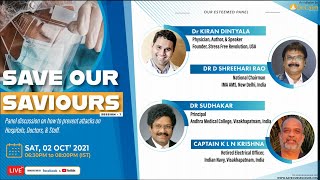
Dr. Kiran and panelists discuss violence against doctors and hospital staff in India during COVID. They trace it to lost trust, poor communication, and weak infrastructure, then propose solutions like better transparency on costs, communication training, and legal awareness.
Chapters
A separate group called AMKAN Andhra Medical College of North American Association. So Andalo, he has been instrumental in conducting zoom calls almost every day for a long time. And then currently it is once weekly regarding Covid. Since the beginning of COVID Dr. Sudhakar Garu along with many other eminent people like Dr. Chilimuri, Dr. Khairam all came together and I was part of that meeting, those meetings and they were very beneficial. So thank you sir for doing that and thanks for joining us today. And talking with you the other day brought all my memories back from Andhra Medical College. When I did the medical college there spoke about Narayan Rao Garu and other professors. That's great. And Dr. Sri Hari Garu, always smiling whenever I see him. Such a nice gentleman. And he's one of the key people in IMA Indian Medical Association. And we are honored to have you sir again today to join us.
And.
Also say hello to our IMA President Dr. J. Lal who is probably sitting right next to you right now. Hello to him. And then Captain Krishna Garu. I actually met him through one of the zoom calls where you know, I was doing some zoom calls for Covid related issues with patients and then he was asking a lot of questions. He was concerned about the society and then you know we were able to interact and I realized that this person is a very good person and has social awareness and that is how we continued our conversation and I invited him to join this from the patient side. So. And Gandhi Jayanti Subha Kangshalu, Gandhi Gyramana patients. I think one of non violent. So you know first of all I want to get to the core problem. We have seen some violence, actually a lot of violence over the past year since the beginning of COVID Even though the patients are grateful for doctor services, hospital services, at the same time there is another sect of the population who was very unhappy either about the outcomes or why the financial charges are so high. And I have also seen that the trust between the and the medical community has significantly been breached over the past two decades. I believe it is quite different from when I was in India in medical college and what I used to see in my professors, you know, what I used to see in other doctors. Now it is quite different. The dynamics have changed. Now keeping all these things in mind, the focus for this specific session is how to build back the trust that is lost between the public and the medical community. And also can we understand why the financial charges have gone up so much and how can actually we bring it down? These are the two main issues so with that anyone can get started whether it's Dr. Sudhakar or Sriharao Garu with their answers for what I just said.
Yeah. Thank you very much Kiran for having us here on the show. And hello Sri Hari and also Captain Krishna and Lavanya. And it's a wonderful event that you have been thinking for the last many weeks. I came to know and I had the privilege of watching one of the videos as well. And am I audible, Kiran? Am I clear?
You are very much audible.
Yes sir. Yeah. The crux of the problem is loss, lack of trust.
Yeah.
So as you know that the only constant thing in this world is the change, right? Change has taken place, right, from in various areas, not only in the medical field, but also in judiciary, in police, in politics and various other walks of life. However, when it comes to doctors, there are certain expectations of the patients, patients and patients relatives. They take the change happening in the other fields and they extrapolate those changes onto the doctor and the doctor patient relationship as well as the treatment policies. So it is the unrealistic expectations of the patients which is causing the problem, Number one. Yeah. Number two. Number two, it is the lack of communication. This is the era of communications. So in the world and times people never used to ask a question. No doctor was asked a question. But over a period of time, with the explosion of the information that is available to the public, with the explosion of the information in the Internet, the expectations of the people have gone up. That is number one.
Right.
The second one is similarly, the life of the doctor has become very fast. So people are not ready to cater those many hours or those many. They cannot really cater to the needs of the patient in terms of communication. They will not be able to communicate. That's the reason, main reason, between what we see in India as well as in other countries. Communication is given a lot of importance in America. Here also though, we teach our students and we tell our younger colleagues that the communication is very important. It takes some time for people to realize that how important communication is. This problem has to be solved. But I'm sure that it cannot be solved forever for the simple reason people will be unhappy despite whatever you do. But our aim should be to minimize the unrest, to minimize people attacking the doctors, to bring back the trust between the doctors and the patients as well as the patient's attendants. So this is the ultimate aim. So a lot of steps have been taken in the past as well. Like for example the Act 11 of 2008 that was brought in by Vayas Rajshekar Reddy he said that this act was passed in 2008. And this is if somebody causes damage or abuses a doctor, it is a cognizable offense. And the individual is will immediately be arrested and appropriate action will be taken. And all the damage that is caused to the hospital because of the vandalism will always be recovered from the individual who has done it. So this has been there. But like any other problem in our society, we have a lot of rules and regulations, lot of acts. But when it comes to the implementation, it is very difficult to implement. Number one, the implementing authority will not have so much of seriousness as the sufferers, because the doctors are the sufferers here. But the people who are supposed to implement the these are the police. Automatically the police will be on the side of the patients or the patient's attendants. So automatically this particular act which has come into existence more than 12 years or 13 years is still not known to many people. Not only the doctors, but even the police do not know that such an act ever exists. So there is a requirement rather of requirement of educating people, the police, the judiciary, the doctors as well as the patient community with regards to this particular act. Because this is a deterrent. This is a deterrent to such eventualities. Like for example, you have the. When you compare yourself with the judiciary, let us say so judiciary, as you know, has got extraordinary powers under the Constitution. We all agree and abide by them. There is a simple contempt clause there. With that contempt clause, people are kept at bay most of the times and they are not they people cannot go against the judiciary because it has become so popular, it is utilized so widely. That's the reason why people this judiciary is basically protected. Similarly, for doctors to be protected, basically the law has to be understood by everybody. Simultaneously the communication skills are to be improved and also the doctors have to understand that it is 50% of the problem can be can be solved by properly communication, getting with the patient and telling everything right in advance rather than taking the records of trying to explain them after the adverse event takes place. So that is one very, very important aspect that one has to understand. And of course, despite doing all this, there are many people who are who are likely to commit the unrest. And these are the people who has to be taken care by the law. So this is preliminarily what I feel and I'll come back with more as the discussion goes on, I'll come back with more and more of ideas with regards to the charges that you are mentioning that these charges are high these days. But when you compare the rest of the world, the charges are still lower in India compared to the other countries. The charges are the medical expenses. The higher medical expenses is highly relative term because you have the plastic surgery being done in the government medical colleges to the corporate hospitals, you have the same services available free of cost, at a moderate cost and at a higher cost from the individual's perspective. However, one has to understand where to go which is the particular hospital which he can afford. So even if one goes to the topmost hospital, the expenses are far less compared to your the other professions. For example, recently there was a bill, there was a. The. The lawyers were paid by the state government for appearing in for 20 times in a court of law to one particular lawyer that has come to some 80 lakhs and odd. That means every appearance of a doctor, of a lawyer, he would get 4 lakhs out of it that has been paid by the government. Can you ever imagine a doctor charging even if I operate for 10 hours continuously standing, doing a beautiful microvascular reconstructive surgery, can you ever imagine me earning 4 lakhs a day, which is impossible. So this comparison though some people feel is not fair. That happens because we are all in the society and we are equals to the highest paid lawyers. But that can never happen with the doctor. So the charges or the expenses is a highly relative term. And people who cannot afford try to go to a corporate hospital and later they feel sad for being charged there. And they have an avenue of government hospital which they never utilize. This is a very unfortunate aspect. So as far as the charges or expenses in the hospitals are concerned, I have no inhibition to say that it is not fair. It is reasonably fair in all our circumstances. And it is the consumer or it is the patient or the patient's attendance who has to take the call and go to the appropriate place.
Excellent, sir. I think there are a lot of good points that you made. Number one, the cost comparison and comparison to other professions. These are all great points. And it's interesting because that's true. Last time also one of the participants asked this question. If medical industry is classified not under service industry but under business, then why can't you charge whatever you want? Essentially like for example, if a lawyer charges what they want. If a movie actor takes, you know, crores of rupees, then how is a doctor or a healthcare professional different from it? Why is there this mistreatment? Of course, at the same time we also understand the affordability of a common man because the for example a movie actor he's getting paid by some producer who brings in a lot of money. Either through financing or through his own money. And a very clear marketing is done to promote the movie to make the money. Even after that they face so many losses. There's a different issue. But you know, in this situation as a doctor and at the healthcare industry it is the common man for most part who has to pay us. And is that the reason why there is so much struggle? That is one question that I have. And I also want to ask Dr. Sri Hari Garu to comment on what Dr. Sudhakar said.
Good evening everybody.
Sir, at the outset you are conducting the seventh webinar and the CV Save the Saviors today Dr. Sir. And Captain Krishnagar is there. And regarding this expenditure and the payment of the patients. Because patients are expecting free from the service from the hospital. They are thinking that the hospitals are the for the sake of the service on service for the people. But we are paying the commercial tax. Commercial current we are preparing the 16 other taxes also. So it is not possible. Because last time grower itself told One day one patient admitted hospital and without treatment he lived. Next day he recharged. Next day it cost 1.5 lakhs. So it is a very cost effective. Nowadays earlier olden days I had. Last time I told it is a simple stethoscope and stable and one tenant is required for the doctor. But now it is technically developed. You need all the investigations and equipments and in one roof, under one roof. And for that you have to pay where all the equipments are imported. We are importing everything. We are paying the taxes for that. But that's why it is not patients are thinking that way. Charges are heavy. But as compared with the previous chase at that time so diagnosis they give the patient longer time. They have to admit in long time and taken treatment. These are all the cost effect. But nowadays within one short of time they will diagnose the disease. And the spotter you can give the treatment. So it is reduced the price. But technical. They are thinking that the doctors are charging. But this is not for the doctors they are. They are charging for the technique only. And high chances in hospital Government are paying very less. Because they. They are telling that they. As you earlier discussed about COVID Covid government is paying normal prices 4,000 rupees per day. And then in case of any requirement separate oxygen and all they are planning 6,000 the ICU they are paying 10,000. Because of that it is not maintainable by the hospitals. That's why they Will charge more more. Because government if you ask for the charges for the hospitals and sub the dates. They are not discussing with the actually Indian Medical association, nursing homes, associates working for the doctors and the public. But they are not asking that they're not involving the associations. That's why they are keeping their mind and they are fixing the charges. That is the problem. Patients are thinking that the hospitals are charging. But that is not the right right. That is actually they are fixing the prices less. That's why actual price of the at the time of charging that thinking that the charges high. And actually because of that they are attacking the doctors. Attacking the doctors and destroying the property. As the snow doctor told 11 of 2008 is there. But there's no action taken any anyone. And also actually so anti social elements. They are doing in a nonsense. Because they are waiting for the any problem comes in any hospital. They come forward without the patients or attendants attendance. And also also they are not working. They are not properly safeguarding the hospitals. They are thinking that they you can. You can discuss with the patient and complete the process in short time. You can settle the issue. Actually they their duty is to protect the doctors and healthcare. But they're not doing their their duty. And also ask legal people also come forward and issuing the legal notices and filing the criminal case against the doctors. Without any problem or any judges of the doctor. And also and the media want the sensational news. They want sensational news. But they don't want the doctor's version. They are publishing the any negative reports immediately. That's why. And whenever. Whenever camera and TV channels come out to the hospital. The agitation is more. The distraction is more. That is the problem. And also government also they're almost all fixing the everything for the private hospitals. But they are not having the facilities. And all in the government sector. But they have to improvement the everything in the government. Then government sector. Then only they asking for the private sector. Because nowadays fire is very very many problems for the crores of rupees to fix up the fire in hospital. But there is no fire equipments in the government aspect. Before fixing anything. Government not discussing as I told earlier. They're not discussing without the associations or any options or any doctors or the concern. That is the problem. The main problem virus rights also not involving the there if the anything related to the any subject to the doctors or anything. They have to involve all the doctors. And they have performed with the expert committee. And all that is not the things are happening. And also another CPA protection act also insisting the Investigations on for the patients. So you have to earlier headache. You can treat with the tablet. But nowadays it's not possible the doctors to diagnose treat the patient before. Because you have to diagnose the cause. Then only you can prescribe the treatment. These are the problems are there. But we are facing a lot of problems. But even though the attacks are going. But for that check our doctors has to know their things. Because the trust is required. For the hospitals part we are lacking that trust. Because the people, media and government also lack the trust on the doctors. Doctors. And because there's some problems is there the doctors also taking the treatment. During treatment you have to concentrate on the patients and communicate properly. And take care of the patient. And attention required for the patient. You don't have time. We tell the patient and do examine after some time. That may be acceptable. But also defensive practice. Mainly defensive practice. In case of any emergency. They are referring the cases to the longer and higher centers. And that is the during the travel time also patients are dead. That may cause the attacks on the hospital. And some hospitals are not giving accepting checks or any insurance policies. And some hospitals are not admitting the patients if they have the Insurance or the RX3. Sometimes they refuse the admission. That may be the that sometimes they are the causes for the attacks. And also investigation. You have to explain the patient the expectation and limitations. That if you advise for the ventilator and ECMO you have to. You know inform the patients. And the what the cost and what what is the final outcome of the patient. That is the these are the things are there. So mainly transparency. They are lacking the transparency. And where package also we had to fix up packets according to paper. My patients cannot for the management. So proper communication. As I told proper communication is required. And generally this generous people wants money quick money. They want that that is the problem. And the language you have to use. All the people are speaking in Telugu. Telugu. But they were not communicating the patient properly. Once the patients you have to communicate the clinician only. They're not the other person third person. Sometimes the clinician is treating but the with the patient they are communicating the other person. The third person is communicating the patient. That is not sufficient.
And.
And also in manufacturing now our units also we were committed to less manufacturing units. The our suggestion. So these are the problems now facing the our medical fraternity. And these are the causes for the attacks and darkness. For that you have to take public and partnership required. Private and public partnership is required for the maintain the hospitals. And you have to treat the patients. Good manner. Yeah.
Sir, you made a lot of good points. And one of the things that I, you know there are two things that really are very clear in your. What you are saying. One is it's not so much that the doctors or hospitals are charging too much. It is not that they are charging too much is essentially the affordability is low as a public in general. That is one common theme that I have been hearing because it's not like we are charging way too much than what it is supposed to be. That is what I'm hearing from you. It simply is not affordable because as a person most people are making let's say 20,000 or 30,000 per month or even less than it. Then they can't afford 1 1/2 to 2 lakhs per day in a corporate hospital. At the same time you also made another point that in the government sector is the government helping the government hospitals to set up proper infrastructure and keep up with the latest advancements that are needed. You know, when that happens then public health will have more trust in the government hospital. That is what I am hearing from you. So they can go there instead of private hospitals. Now we'll come back to that one. I'll ask actually that question to Dr. Sudhakar Garu because he's a principal of Andhra Medical College and closely associated with King Judge Hospital. But before that I. I want to.
Hear.
Captain Krishna Garu comments and based on what you heard so far from Dr. Sudhakar and Dr. Sri Harigaru.
Yeah. First of all, good evening Dr. Sudhakar Garu and Dr. Srihar Ragharu and a very good morning to Dr. Kiran and for conducting this series of webinars on Save Our Saviors. I think both of them have covered most of the points which I had leaving me very little scope for any discussion. But notwithstanding that. So I have discussed when this particular thing has been told with few of my friends and other people basically to give a perspective from perspective of the. From the patients and the patient's family point of view. There's absolutely, and I say it again very strongly and emphasize there is absolutely. The doctors are held in very high esteem in this country without any doubt. And one second, one more thing. What I want to bring out is an assault on a doctor. An isolated incident cannot be attributed to the whole community of doctors or the entire profession. It's an isolated case and I request that isolated case be thoroughly studied and find out the reasons for any violence that has taken place. Having said that one is it is easy for a Person from outside to talk about these things. Because a doctor during his course of a day attends to a number of cases in a day. So for him, each one he attributes to is a case. Whereas the person who comes here as a patient is a head of a family. He's a mother, she's a mother or she's a brother, father, son, daughter, son, daughter in law. They are relatives and who are very well placed or looked after in their family. So they come to the hospital only when all the chips are down and depending their hopes on a hospital. Okay, so it is basically more than any other thing, it's an emotional issue when they come to the hospital and give the care of that particular patient in the hands of the hospital and the doctor. So now having said this, now let us see the case. By I mean the steps that are that happen once a person is admitted in the hospital. Let us take an ICU case. A patient, because of an issue, he comes to the hospital as an emergency in ICU case. The point starts at this particular point of time is how long is he made to wait and the precious time that is lost while admitting him. I am not blaming the doctors. What I am trying to say is how best this time, the loss of time can be minimized so that the patient gets a better treatment and his life can be saved. Here when we are talking about the doctors, we are talking about the life of an individual is at the state. If a car is gone, if a car gets defective, you can replace a car, okay, you spend 5 lakhs, 10 lakhs, 20 lakhs, 30 lakhs. But if a life is lost, it cannot be replaced, you cannot come back. So that is a place, that is a time and that is probably an occasion where the sensitiveness within the doctor and the hospital is required to be there while looking after the patients. That's one. And after being admitted, the second thing is when, how and fast is being taken into an ICU and what treatment has been started, the initial normalization or stabilization process, how fast has it been started thereafter, how much time has it elapsed before a specialist doctor has come to see him? And the tests which are required to be undertaken, the prescription of of tests and the prescription of medicines. So these are the other points which come into the things. Next is as has already been brought out in one of the by one of the panelists. The main critical issue is apprising the patient or the family about the seriousness of the case where in very lucid terms, depending upon the patient and the family, they are, they are required to be explained how serious is the case. Once that is explained, if an incident happens, probably they can understand it. If that is not particular thing has not been explained to them properly, that gives rise to sudden burst of emotions and which, which results in vandalism or, or what do you call attacks on the hospital or the doctor. And other thing is, when a patient comes to a hospital during the first critical period, if, if he's properly informed about what the problem is, the patient also can have a second, a chance for a second opinion is required to be given to him. These days, during the days of Internet, people go there and then start looking after the Internet, which is not wrong and we should not be taken in a wrong sense because by doing this he's taking some information. But definitely he is not capable or he's not as knowledgeable as a doctor. A doctor has done a course of about five years to seven years and more than that. But this at least the Internet gives him a chance to understand what, what are the terms that are being used by the doctors and what is the criticalness of the illness and what are the other alternatives that are available to him.
Yeah.
Okay, now coming to this wait time because wait time when a person is brought to the hospital, that's the time the patient. So family, relatives, friends who are there, they are totally charged up with emotions. So that's the time probably a very well placed person in the hospital is required to be taken, is required to be employed to suit their emotions because it is totally a play of emotions here, nothing else. Yeah, so that is one. Next is, as I told you, admission in the hospital ICU probably because after a patient has been admitted, some hospitals do allow one patient or one relative or friends to visit him in icu which can be avoided because of what you call the sanitization requirements. Yeah, because people do not want to come into a. Because of the sanitation issues. So it is nowadays using the technology, it is definitely a cost effective thing to provide a webcam at each of the bed so that the. And the link can be given to the patient's family once he's admitted in an ICU so that they can at least look after the patient, how he is, whether he's being looked after well or not. That is probably one of the very good confidence building measures.
Right.
As far as a patient who is admitting the ICU is concerned. Next is we talk, we're talking about tests because it has become a standard practice the moment a patient goes a list of tests Whether required or not required, I am not competent to judge which is required. Which is not required. Yeah, but the series of tests are given to him whether all of them are really required or not. So probably a rationalization of tests which are actually required for that particular disease are required to be given.
Right.
Okay. So that is one. And here in this particular case, the medicines which are prescribed are the families. They go to the concerned pharmacy which is attached to the hospital, buy them and come them back. This is very small issue, but this is a great confidence building measure because people see that the medicines which have been bought by them are. If they're not used, they go back to the pharmacy. Okay. So if that particular thing has been. If that can be ensured that whatever you are bringing, they are being utilized properly. It's a very small issue, but gives a great boost and a great confidence to the family that yes, everything is already in this particular hospital. I need not worry about anything. That's one. Next is about the case history. Case history needs to be made transparent. The medical case history which is kept for. On each of the bed, that needs to be transparent. It should need to be available and the family members, if they want it, I think there should not be any hesitation in probably sharing the case history sheet so that it helps them in taking a proper second opinion if it's required.
Yeah.
So that. That is a one and other thing. What has been told as one of. By one of the panelists is let's.
Hold on to this one for one second so that we can get some of the answers to the questions and then we can get back to the questions again so that we can have this rampant.
Yeah.
I will ask Dr. Sudhakar to shed light on some of the things. Captain Krishna.
Yeah, yeah, yeah, sure Kiran. And thank you Captain Krishna for bringing out so many important issues which are in the minds of the common people who come to the hospitals. The first thing is he spoke about the time lag between the admission and the patient's arrival. We have to understand that India has 140 crores of population. And if you look at the doctor population ratio, it's not that much. When somebody is not admitted on time. The patients also should understand what the doctor was doing inside. I have a lot of experiences wherein the patient is interested in only himself. He's not interested in the neighbor, however serious or sick the neighbor is and the doctor is attending on him. It is a very common scene for us in the emergencies where the person with abrasions, simple abrasions will be Making lot of creating a lot of problems there rather than a patient who is unconscious and the doctor naturally goes to the unconscious patient and tries to revive him. And because this is very innocuous and to make that gentleman understand that what his problem, his problem is not so severe or serious, is not possible for the paucity of time. Because the number of patients that you see in India is far more than what you see in the other places. It's very nice to talk about counseling the patient, talking to them, talking to them repeatedly. Spending lot of time. When you are seeing 10 patients a day in America, you'll be seeing 100 patients in India. But the doctor in India and the doctor in America will have the same 24 hours a day, unfortunately. So that's where the doctors in India are in a disadvantageous position because of the population. You cannot reduce the 140 crore population to 40 crore population overnight or it would never happen. On the other hand, you have to increase the doctors. That also would not happen overnight. But the expectations do take place overnight, unfortunately. So at this moment of time and the people's expectations are very high, like through the Internet, through the Googling he was telling me. So it takes lot takes away a lot of our time. Because if I have to answer a person who has to, who comes with a background knowledge from the Google University, I would require a lot more time than I tell a patient without that. Because he does not stop, he doesn't know where to stop asking questions. He keeps on asking questions. Sometimes he even show you some of the good results that have been published in the Internet. He would not talk about the worst results. He will not talk about the complications. The third one is he would always. Being a plastic surgeon, I have the experience of people asking me to make somebody like a film star. They'll come out with a magazine if you can assure them that you will be making you're a good doctor, otherwise you're a bad doctor. As simple as that. So with experience of over 30 years in the medical field, I always feel sad sometimes that why am I working though we try to do our best and the time lag is not entirely dependent on the doctor. Most of the times if somebody is sitting quiet and not doing anything and not admitting the patient has to be penalized, that is quite understandable. But 90% of the times it is the lack of time. Time is. Yeah.
Doctor, one minute. If I can interrupt you for a minute here. Yeah. What you said is absolute, right here we are looking at the doctor, doctor per se and the Hospital administrator, administration, person. These are the two aspects which come into picture or which come into the role for this particular issue. So either the doctor or the hospital, what you call administration needs to look into this particular aspect. As I 100 agree with you. If you look into the patient and the doctor ratio in India it is, I mean it is to just give.
The number 1 in 250 in Western countries like America, England is around that, somewhere around 1 in 200, 1 in 250 around that range. In India it is 1 in 2000, 1 in 2500 around that range. So you can see the vast difference between.
Yeah, yeah, I like that. Captain Krishna has said just now the hospital administration and the doctors, they are to be separate. So the more you employ people, the more you have in the hospital, the more would be the cost for the patient. Again we are talking cost cutting. So one of the cost cutting measures is the doctor acts both as a doctor as well as an administrator. That's a cost cutting measure again. So if you have to have the administrator altogether separate, that basically means that you have to put all those on the patient himself. In a country which spends 0.8% of the GDP on the public health and in a country where the expectations are skyrocketing on par with the western world, how can we match these two? We are in the lowest four countries of spending as far as the health is concerned. But when you take the expectations that the patient probably will be in the top 10 in the world. So how can we match these two? That is something which is which we cannot even imagine. So we'll have to understand that the pricing is in accordance with the services that are available. And in a medical op in King George Hospital, a doctor looks after 100 patients, which is in about three or four hours, which is a crime if considered if it is done outside this particular country. But they are hard pressed. If you send some, if you take only 10 patients and send 90 patients away, turn them back, would it serve the purpose of the community? It will not. So the doctors are working under great pressure. That has to be understood. That's why, you know, philosophically I, most of the times I tell people that the main problem with the health care scenario in India is everybody knows what the doctor is supposed to do, but nobody knows what they are supposed to do. To put it in nutshell, everyone has an understanding what a doctor is supposed to do. If you ask them to write about the doctor, what are the responsibilities of the doctors? They can write pages together the moment you give Them and ask them what are your responsibilities? Nobody cares. They do not understand. So that is the crux of the problem. That is the crux of the problem. I always feel. And at the same time, in the same voice, I wish to say that just because people do not know what they are supposed to do, we cannot leave it at that point. We should always try to improve the situation at every point. You may say that, you know, just because people are not responsible enough, are we going to leave them like that? No. Still there is its scope for improvement. We all should strive for this, for the improvement of the system. And we should always, but can never be compared to the Western world.
I totally agree with what you are saying. Because of the ratio of patients, the population and the doctors. The very purpose of this particular seminar is to identify these particular problems. And if any corrective measures can be taken or not. If we cannot take any corrective measures, if that is a foregone conclusion, then I think we are. We are losing the very purpose of having a webinar.
Yeah, that's what I'm saying. That's why in my. Towards the end I said that, you know, we always should try to bring this gap down. Always narrow this. Yeah, narrow this gap. And at the same time there are two things that I have told you. One is the population or the mismatch of the doctors and population. The second one is the expenditure that we put forward. We have no money to put forward towards our. How many people in our country have the insurance? People are not ready to pay 10 rupees from their pocket towards the insurance. But when the time comes, they want to be treated free of cost. Twenty years ago, when I visited usa, the first thing that I have realized there the basic difference would be was the insurance. Those people have insurance, most of them have insurance. And here most of them do not have insurance. That is all the difference that they have that has made to make people aware that they have to have the health insurance. They have to take care of their own health and they have to take care of the society as well. Like I have told you earlier, people are interested only in. Only themselves. They are not interested in the neighbor. They should have a bigger heart to look at their neighbors. Also, when it comes to an emergency, they should feel that the person who requires attention first should always be allowed. Which is. Which never happens. Which never happens. Even if they come to my outpatient.
Department.
My roll call or the way I see the patients, nobody would wish to follow the cue. Nobody wish to follow the. Give respect to My time. So they want to be treated. Everyone wants to be number one. Everyone wants to be first. They are not bothered about the candidate who is standing behind them.
Absolutely. Having understood the Indian environment what we are trying to look at this particular point of time is how best we can make the existing and meet the requirements. We know the Indian environment.
So for that the first thing is understanding. We have to spread this word of understanding. Please do understand that this is our situation here in India. Please do not have the expectations which are beyond the ability of a particular doctor or the medical fraternity in general. Number two, have the same system and the faith that you had about 50 years ago. And the doctors.
Okay.
And these are the challenges that we have. Educating. Educating. Educating is what is required.
In fact other. In one of the seminars we spoke that what's happening is now with the. With the growing of corporate hospitals. Even for a small issue a person is going to a corporate hospital. There is. There is no concept of a primary clinic or what you call a local clinic. Supposing since you are in Vishakhpatnam. If I am talking Sitam Dara MVP Colony 2, three private clinics should be available here. Where a person should go there into that particular place and after that only when they refer then they should be going to a hospital of a. With a higher facilities. Okay. That is one. Next is.
Comment here one second. And Srihari Rav Garu, if you are still there, I know that you're in the middle of meeting another thing too. But if you're still there, you're welcome to comment. Sir, I know you're muted so. Sir, I have a question. Dr. Sudhakar Gar. Yes. Whatever that is said is true. There is no doubt about it. It's not. I can also tell you from my experience talking to different people and being in practice for a while now. Most doctors mean well. Most doctors, I can tell you most of them and work very hard, try to make things happen. But the system has to enable proper care also it is just not. I'm not Chiranjeevi or Pawan Kalyan or Balakrishna. Whatever you want. That can change things overnight like a hero. Unfortunately that is the situation. We are all normal common people, even the doctors. Except that we have extra knowledge about medical care what to do. But the limitations are the same for all of us. The primary reason why I'm actually conducting these webinars is I think education for more people understand what are the limitations and what can be done to overcome limitations. I don't think it is a Doctor problem only. I don't think this is just a health community problem. I think this is a public health crisis. This is. This is a public problem. The entire thing like everyone should come together. The media, the public, the government, of course, the doctors, community, the hospitals, administrators, everyone has a role to play in this one. Only then I believe we can improve the system. Sir, I have one question for you. Dr. Sudhakar King George hospital being a government hospital and like Dr. Srihari Ragharu said, you know, there is a gap between the government hospitals and private hospitals because of the infrastructure that is available. So can you comment on that for a second? Because an average person, they want to. A lot of times I heard from other doctors saying that. Why don't you go.
Please mute yourself. Please mute yourself. Please mute yourself. Unless you want to say something.
Yeah, Hello.
Yeah. Yeah.
Our national president is there.
Yeah, we would like to say hello to him.
One second. I will give. Yeah.
Hello.
Hello, Dr. Jayla. How are you?
Yeah, we are meeting here in Nisaka pattern now.
So this.
Right.
Thank you, doctor.
National secretary.
Good to see you.
Yeah.
Hello, doctor.
Hello.
Yeah, yeah.
All the best.
Thank you.
Thank you. Okay.
Sir, I'm reading. Sir, please carry an.
Sir.
Yeah.
Thank you.
Sir, your participation. Yeah.
Okay. Okay.
So sir.
Yeah, I got it. I got it. Kiran, you asked me.
Yeah, yeah.
You asked me about the facilities in the government hospital versus private hospitals. Right? Okay.
Yeah.
Again here let us say if you are provided 100 rupees to a government hospital you are expected to see 100 patients. In a corporate hospital, you spend hundred rupees and you see 10 patients. That means you are distributing 10 rupees to each patient.
Yeah.
That is to put it very simply. Okay. Here the requirements in the government hospital are higher because of the higher patient turnover. But the budgetary allocation is limited for the reason that the government do not have enough money. I do not want to blame the government because government will have its own priorities. Priorities in terms of education, health, agriculture, so on and so forth. And of course the welfare schemes. So if you put the budget, government budget that is given to the private hospitals and compare that with a corporate hospital looking at the number of beds that they have. You know that the King George hospital has about 1500 beds now officially. But unofficially you have 2200 patients every day. So the bed occupancy is more than 100% always. It is like having five or six corporate hospitals.
Right.
But do you have the budget of the six corporate hospitals to King George Hospital? No. That's why you will be working under a lot of pressure.
Yeah.
Starting from suture material to the antibiotics.
Right.
You have certain limitations.
Right.
So this is primarily because all those who go to the corporate hospitals, they do not pay from the pocket. Like I have told you earlier. Many of them will have insurance, either personal insurance or they will have the insurance from their respective companies. Most of them, maybe around 80% of them have, will be. The third party will be paying. The out of pocket expenditure is not that much. So they all can afford. About 20% of them will definitely have to pay from the pocket. Those who can afford.
Yeah.
So the budgetary constraints in the government hospitals always make them less equipped.
Yeah.
Number two, the ambience. The people who come to the government hospitals.
Yeah.
Will have lot more people attending on them in the sense the relatives. Yeah. Here there is no order for you because their lifestyle is like that. If one person gets admitted, you'll have at least six or seven person visiting them. So every day in King George hospital you have 15,000 to 16,000 people attending on the patient's attendance. Attending on the patient as patient's attendance. What does it do? It ultimately makes the hospital less hygienic. Yeah. And in fact, it requires more budget than the corporate hospital. In a corporate hospital, if you have 100 patients in that, maybe you'll have one another hundred, maybe 200 attendants a day, not more than that. Because the rules are very stringent there. People who go there will listen to the hospital administration, that they are not supposed to visit the patient. And here the system is not like that. So the challenges are much more in government hospitals and the budgetary requirements are much more than in the corporate hospitals, which are not met with. So this is a main reason for the government hospitals not being able to perform to the expectations of the public, particularly in terms of the hygiene and sanitation.
Yeah, yeah.
Though the expertise is skyrocketing. If you look at King George Hospital, the persons here, the doctors particularly, particularly the heads of the departments and professors, they are of the top quality.
Yeah.
And you will not find so experienced doctor outside in a corporate hospital. But still people prefer corporate hospital because of the ambience.
Yeah.
Because of the ease of getting the care there.
Right.
So that's how it happens.
Yeah, yeah. No, all these are very valid points and again, I am not under the illusion that we are going to solve all the problems in a day or in a week or even in a year. But these are all good discussions. That is what I want to happen. I want more and more this discussion Happened. Krishna Garu, please go ahead, please.
Yeah. So as I've been. So the only thing which a patient's family requires from the hospital is. Yeah. Saying again and again the patient's well being and timely reports to the. To the family, to anyone concerned. So what happens is once it has been admitted, I understand all the constrictions are, all the restrictions are there. But if you don't get to know what's the problem, what's being done to them, there's obviously that much of what you call restlessness will be cropping up in the family members.
Yes.
And I've seen cases where the doctors are very good.
Yeah.
But the communication has become poor. So I do not know what's happening. And we try to circumvent because at my stake level we could turn around these particular issues. So a doctor used to send an SMS on a regular basis. So patient, this is the problem. This is the problem. This is what we are doing it. Fine. That actually brings you, brings your tension down. The family is good and okay. Now they are looking after the patient. So there is no need for us to worry that sort of a thing, is there?
Yeah.
Having said that now. Now I have one more thing is rationalization of treatment.
Once again, Krishna, you are bringing good points. I want to answer about the communication aspect something because that is important topic. Everything that you're bringing is important. So I just want to make sure that everything is answered not only for us but everyone else watching outside the panel. And also this is going to be transmitted through various social media and YouTube channels. I want people to get answers. Communication is the key. Without any doubt. I think 80% of the problems in this world can be solved by proper communication. Whether it is husband and wife, whether it is boss and employee, whether it is patient and doctor. But communication is a two way street. It is a two way street always. And in lot of relationships what I notice is either this person is not saying anything or not saying things properly or this person is not understanding. No matter how much this person is saying, you know, the problem is on either side often. Okay, now coming to the healthcare sector, what I notice is, and I can tell you honestly, even coming from now, you know, America where I am practicing now, even here communication is a problem. There is a communication lapse between doctor and doctor. There is a communication lapse between doctor and patient. There is a communication lapse between the medical system and other different parts like the nurse or the consultant, different things. So there is a core issue. It is a core issue. Even In America, okay, In India, I believe the problem is compounded by the fact that the lack of time, the lack of time, but that should not always be the excuse, lack of time in my opinion, okay, A cognizant doctor, a conscientious doctor, you know, even though he's trying his best, you know, because of lack of time, you know, all these things happen. But I think there are certain things that we as doctors in general, even here, I'm talking about not just in India, can learn to enhance the communication. That is a skill that needs to be developed. And unfortunately that is a skill that is not taught in school, in college, in medical college, even after you get to work. This is something some doctors develop by their self effort. By their self effort, how to do like in one minute they could communicate what they need to and somehow calm down the situation and then make people feel at ease. And I agree with you, that needs to be focused upon. And in my opinion, in India, in America, wherever it is, separate communication related classes to be held right from medical college. That is very important. Number two reason for lack of communication, even from very good doctor. A lot of times is apart from time issue, they are stressed, they are under pressure. They are under pressure, they want to say something, they care about the patient, they even think about sending you a text message. But they are distracted by something else. You know, so the pressure under which they constantly. A lot of doctors, a lot of engineers, lot of people in general, we are not taught how to handle pressure. We are not taught how to handle stress. So the another thing that I equally propose, whether it is medical college or corporate hospital, wherever it is, is stress management. How to be calm. Because when your mind is calm, you could multitask and still not be making mistakes. When our mind is restless, we can't even focus on one thing properly. We get easily distracted and we miss things, we make mistakes. So these are the two comments that I have on this issue of communication. How to improve them.
Yeah, may I interpret here? What you said is absolutely right. Very good professionals lack communication skills. Yeah, I mean to a large extent we can talk in general, very good professionals, they lack communications. So what is required is take the load of them. The load of communication needs to be taken away from them.
That is not possible.
50,000 rupees per day. Because even in America, I know that, I know we live in an ideal world. Krishna Garu, you, me, Sudhakarjar, we all know what needs to be done. But practically when it comes to it, for example, even for myself, right? I'M busy doing things and I want someone else to communicate on my behalf to the patient.
Right.
To some extent that may solve the problem, but not always. But I think that is to be considered.
As you said, out of 10 patients.
Yeah.
Probably where the doctor's direct interference may be required. May. May come down to one or two patients. May not be for all 10. At least for other not very critical or serious situations, probably an offloading of communication may help. Maybe this is a point for consideration.
You want to say something about it. That is an important point. Do you want to comment on that one?
Yeah, yeah and yeah, definitely. Right in the beginning, in my opening remarks, I spoke to you about the communication. Communication is the key. Communication is very, very important. There are no two opinions about that. Yeah. Here I'll have to defer with Captain Krishna in one aspect.
Yeah.
Every patient wants to be communicated in Indian scenario by the doctor himself. Now if I say that you are okay, that's why I don't speak to you. Would not basically satisfy him. If I have 10 patients, all my 10 patients expect me to talk to them. So that is an inherent quality of any patient. So there is nothing to feel sorry about that. But at the same time, the clever doctor will usually try to distribute the time in such a way that wherever it is necessary, he would spend a little more time wherever it is not necessary. But he takes care of every patient, communicating with every patient to the extent possible, to the extent needed. So communication is very, very important. I fully agree with you. Like you said, all the problems, 80% of the problems can be avoided by properly communicating. So at this juncture, I wish to tell you something. Now that the National Medical Commission has come out with different teaching pattern, what is known as competency based medical education. We are all going to teaching our students in this. This has come into work since 2019. And here there is what is called aet com that means attitude, ethics and communication. We take a class every week starting from the first year MBBS because this has been realized by the National Medical Commission, the erstwhile Medical Council of India also, and thought that we should have a specific time for teaching the students of the attitude, ethics and communication. Because these three are very, very important for individuals when they go into the practice. So every Saturday we teach them about this. Not only teaching, it is not a didactic lecture. So we will give them lot of exercises. Like for instance, I'll give you one example. If an adverse event has to be broken, if a sad note needs to be broken out to the Patient, how do you deal with that? So this is an exercise that is given to the individual. Initially we teach, later we give an exercise, we give case scenarios that this is what has happened. How do you deal with the patient's attendance at this point of time? So this is an integral part of the medical education now? Yeah, that's fortunately. Yeah, I think it takes a few more years for the fruits to be reaped. So this is something that is I think a welcome gesture and let us see how it works out. But we've been trying right from this first year onwards for the medical students to teach these attitudes, ethics and communications.
Actually as you said, for a patient the first thing is disease will just vanish. If he sees a pleasant doctor in front of him, half of his disease is gone. Yeah, that is, I mean that is so Other point which I want to bring out is rationalization of cost of treatment and degradation of hospitals as we are talking of One is I'm keeping aside the government hospitals since most of the discussion is centered around the private hospital. Also because very little we can do about the government hospitals within the purview of. Within the purview what we have. So how can this cost be rationalized? And like what I see is the insurance companies, when a bill is forwarded to them, they carry out their auditing or checking. They do it obviously they have a system of. A system of cost of the treatments, cost of various procedures. So now these procedures, whether we can grade them as per the hospitals. If it is a one single star hospital, this per cost should be this much. If it's a two star hospital this per cost should be. Cost can be this much. If it's a three star hospital, cost can be this much. So what is changing here is not the treatment cost per se but the facilities that are being extra provided by the graded hospitals. Once our hospital may not be very good in the giving the facilities may not be an attached bathroom or may not be attached nurse or may not be something like that or two star hospital can do something more. If this are hospital can be give something more. If this rationalization of cost can be done probably I mean it will be slightly more transparent that. Yeah, for this particular range of hospitals this is a charges I can expect. So that is one point.
Should we take comment from Dr. Sudhakar Garu about that?
Yeah, yeah, yeah. It's a very good idea. I think I. I welcome that. And it's being done in some of the hospitals. In fact that's how the broad classification of Nabh Hospitals have come into work. All the NABH accredited hospitals are. They charge a little higher than the non NABH accredited hospitals. That holds good as far as the physical facilities are concerned, but not the services. Because if a hospital, let us say a two star hospital wishes to have a five star doctor, naturally they have to pay for the doctor who is more experienced. They have to pay more. So like he said for the facilities, if it is a general ward, this much of amount, if it is a special ward, I think that's being done in most of the hospitals even if they are there and it has to be displayed. The most important aspect here is that they have to tell the patient in advance. The patient should never. Patients or attendants should never take their final bill by surprise. Right in the beginning they should understand that this much would be the cost of this particular procedure. And that solves many problems.
Absolutely. Because after a patient is admitted in the hospital, if it's an emergency case, within one, two days, the hospital should be able to tell him the approximate cost for the treatment. So then the patient can take a call whether to continue in that hospital or look for an alternate.
That's one I like that very much. I just want to comment on that. Transparency and you know, the communication part coming back to while the pipeline is being built, while a new road is being laid for a better health care structure across India. So what are the things that, whether it is the doctors or the health systems, what can they do from their side to reduce the chance for friction, to reduce the chance for violence or if you take that into consideration, two things. One, we already discussed communication. The second thing is like Dr. Sudhakar said right from the beginning, okay, this is what is going to cost you for one day, two day, three day, and you know, the ICU stays so much or the ward, it is so much. I think if patients have some kind of idea right at the beginning, they may be able to say, you know what, maybe I don't want to be here, maybe I don't, I want to go somewhere else. So it will give them at least the option, you know, they, they can make a conscious decision and they understand. Okay, it is okay. You know, we will end this session in the next five minutes or so because I think it is already one.
And a half hour.
I'm sure Dr. Sudhakar has the next appointment. So Dr. Krishna Garu, I can invite you to ask more questions. For now it is the last question.
In cases of incorrect diagnosis, incorrect treatment procedures followed and in incorrect prescription of medicines. So these Things not all doctors do it. We are talking about those erring ones or cases where the errors have taken place. It is nothing. It is not a generalized. But these cases do take place and how do we correct them? What is the redressal and grievance system which is a prompt system which can. Which is in place.
Yeah. I think Kiran, I think this is a very pertinent question and I think we have to have one more one hour session on this. I am ready to answer this. But I. I require at least one hour because I was in the AP Medical Council earlier along with Sri Hari. Even I was an in charge chairman also for that. And this is a very important pertinent question that Captain Krishna has raised. And I think I wish that you should have one more session exclusively on this particular topic. If you allow me to make a final word, I'll make a final comment and leave.
Sure sir.
We'll definitely.
Yeah.
We will connect another session to actually have this discussed. But yes, let us take your final.
Verse and then we'll. Yeah. Like I have told you earlier, I have told you something like everybody knows what the doctor is supposed to say do and they do not know what they're supposed to do. That is one. Yeah. I teach more of stuff my students being a teacher, I teach most of my students only one thing.
Yeah.
Just imagine yourself in the position of the patient or the patient's attendant.
That's all.
This is what I want to tell the doctors and this for the public. Please do understand. Imagine yourself in the position of the doctor and understand. So if both the parties can understand, I think most of the problems can be solved. That's all from my side.
That's true. If everyone can do that, understand simply I would say not 80%, 80% with communication, with understanding, 99% of problem will be gone, including terrorism. And that is the biggest challenge we have. That's true.
Yeah. I'll just close down with a small example like why I'm telling you about this incorrect diagnosis is a patient who is not suffering from this is Parkinson's disease has been given to take a syndopa or syndopa plus medicine and syndrome is used for Parkinson's disease.
Yeah.
Okay. That's number one. One is a patient doesn't have it because that has been gratified later by a third doctor. And we said after stopping that medicine the patient has become. All right.
Yeah.
And. And to. To differentiate between Parkinson's and Parkinson's plus I think the other disease, which I'm not very correct sure. At this particular point of time they asked to undergo FDG scan and brain PET scan which costs whooping 35000 rupees one. And number two, it takes a patient at least 12 hours of sitting for that particular procedure to complete it. When a patient comes to Kiran, we can ask.
We can answer all these queries in the next session that you are planning.
How would we do that? Huh?
Yeah.
Thank you.
Definitely I can answer all those questions. No problem.
He will be Captain Krishna Garu. I will again invite you. And I again invited Dr. Sadhakar Garu. And then we can have a non rush discussion about other questions also.
How about that?
Huh? Okay. Okay. Great notice. Good night Dr. Sudhakara Garu.
Thank you sir. Thank you.
Good night.
Thank you.
A lot of good points made by you. I really appreciate your time and your expertise. And also Captain Krishna Garu, thanks for joining us and asking some of the patient related questions so that we as doctors have the ability to discuss them and clarify and build a better healthcare system.
Thank you. Thank you. Thank you very much Kiran for having us here. And thank you Captain Krishna and a very good night for all of you and let us meet again next time.
Thanks. Bye.
More from Dr.


Is COVID Vaccination Safe for Cancer Patients_COVID Help_Dr Naidu_Dr Kiran Dintyala_Dr CalmExclusive

Is DELTA PLUS variant going to be worse than any variant? How to save ourselves from THIRD WAVE!

How to Build Our Mental Strength to Overcome Problems? _Personality Development_Dr Calm