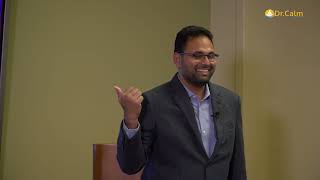
Dr. Calm leads a five-minute breathing and visualization exercise, then nurses from Eisenhower Medical Center explain how the technique helps them handle pandemic stress. They describe it as a daily micro-practice that shifts focus to the present moment.
Chapters
But we somehow our mind tricks us to think about the future a week from now, a month from now, a year from now, 10 years from now. And we keep worrying about it, isn't it?
That's a problem.
You keep thinking about it and that is what leads to stress. Stop the incessant thinking about the problems. Focus on, let's say, how about I'm going to focus on something positive and I'm going to focus on this moment, whatever that is happening now.
And then you throw out all the.
Negativity and come back to this moment. Because there is only one moment, this moment. Right.
Doctor Palm presented just kind of techniques on how to really combat the chaos and stress that we have to deal with in our everyday lives and especially in our profession.
So we saw Dr. Kong today, came and talked to all of our new grad cohort.
We're in charge of our own stress, so we're in control.
As of right now, we're in a stressful time.
When you throw out all that and come back to this moment, stay here, everything else stops.
You're just here. And then you access your innate health, your peace and joy that is within you. Focus on that.
You see what I'm saying today? To actually feel that ability to let go of those stresses that we had just from today kind of led us.
Through a relaxation exercise, a meditation exercise.
On top of the many stressors that we have, that could be 10, 20 to 30 normal stressors. We're dealing with the pandemic relaxation techniques.
And tools that I can give to the new nurses to help them manage.
Their stress, help instill that. That should be something we do every day.
It's significant to me was how to get into that state of relaxation, because that's something that I think many of us struggle to do.
He actually did a presentation. We told us to shut our eyes, to focus on our breathing.
Let's close our eyes, all of us, and I'm going to take you through this relaxation exercise for five minutes and then you, you will feel what I mean.
Just devoting 20 minutes like the doctor said would definitely reduce my stress significantly.
And we don't have to let outside factors control us.
I walk away with just the guidance of being able to find time and the importance and follow through with making meditation a part of my daily life.
Sit back, relax.
This is something I'm gonna take home with me and practice.
I learned that it's very important to kind of take the time for self care.
Stress is internal.
The best part of the presentation definitely.
Was the relaxation part, five minutes out of my day. That could really be used in that manner for me to find a balance.
Close your eyes, Close your eyes. Don't make any noise. Be mindful of everyone else in this room.
Really just make the effort to work out our mind and focus on, you know, finding our inner peace.
Sometimes we're floated to the COVID units, or sometimes our patients end up having.
Covid take a deep breath.
Because I feel like it was something that I needed, and I think all of us needed. So that was the best part for me today.
It's super essential for us to really just take that dedicated time to kind of take care of ourselves before we take care of our patients.
It's been pretty stressful not to let.
Chronic stress affect you, that you have control of your own mind.
How you internalize it is how you handle your stress or what you make of it. And that made a lot of sense.
Let go of every single.
I like the fact that he used his graphics and talking about, you know, how stress and the calm, stress and peace, that continuum, how we slide up and down.
You can go outside of the stress to take control back of your life.
I think the biggest takeaway is that stress is how we perceive it. It's something that is internal, from within us.
Let the whole will come to a standstill just these five minutes.
The very best of the seminar was just empowerment, feeling empowered, teaching us how to be empowered.
But today, since he was here and kind of guided us through it, it made me get past that point, and I really got to see how effective it was.
Do not move. Just stay there. And as you are relaxing your body slowly and steadily, you will notice your breathing also slowing down. Notice your breath. Notice as the breath is going in, then as the breath is going out.
Important for us to manage so we can continue to give proper care. And not only that, but to properly take care of ourselves and to return to work and be the best that we could be.
You know, all those thoughts were gone. You were just focusing on your breathing, and it was almost like you just left.
There's a variety of tools that we can use to combat stress.
The highlights of the toolbox.
I work night shifts, so I'm really. My schedule's often really tired. I was super tired before the whole exercise. After, I feel like I just took a little nap.
It's equally important to take care of your mind as it is your body, if not more important, that we need to make sure we incorporate that into our stress relief.
You know, stress is Caused by our thoughts. And, you know, a lot of things.
Could be external, But I think the biggest highlight was the demonstration of doing the meditation.
We're always in control.
He gave a presentation about stress management today.
So having that opportunity that it, you know, doesn't take an hour or two.
As he mentioned, that stresses can come from external factors. However, every person can react to it. We get to choose how we react to it.
Feel as if there is a shield around you and nothing can penetrate you.
But it's a natural process in life. I mean, we wouldn't be able to react to things, you know, if we didn't have some stress in our lives. It's part of life.
And I think in practicing these techniques, you're going to be able to better react to stressful situations and to let it go.
I think my favorite part of the summer is definitely the meditation, but just.
Recognizing that and being able to kind of put any situation that, you know, kind of using that visualization as a.
Process is to find that inner peace.
Experience that headspace and relaxation again, I.
Have to learn to find ways to manage my stress level anticipation and be able to fall asleep and find using.
That meditation technique and to get back towards that peaceful mind rather than sticking in that chronic stress area.
I'll just be more calm throughout the day.
This is temporary. We can control that.
We don't ever truly get to take the time like that and kind of experience it and make more of an effort.
My name is Christy McKeown. I'm a clinical educator.
We can balance it back out. We're back in the peace side.
My name's Emily.
I'm Doris Velasquez.
Yes, I'm Brian.
I've actually attended a previous seminar with.
Dr. Kalm, and I'm one of the nurses here at Eisenhower Health.
My name is Brian Martinez.
Thank you, Dr. Dentiala.
We're at Eisenhower Medical center, and I am a nurse and a registered nurse here in the new grad program.
Okay.
My name is Victoria. I'm a nurse here at Eisenhower Medical Center.
Just totally relax.
What happened a minute ago, that's past. It's gone. What's about to happen a minute from now, the future is not yet here.