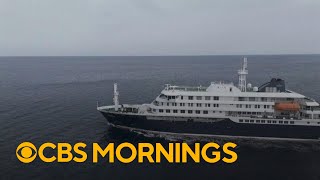
The segment reports a hantavirus outbreak aboard the cruise ship MV Hondius, which is sailing from Cape Verde toward the Canary Islands. At least eight passengers are believed infected, three confirmed cases, three deaths and one critical patient; a Dutch stewardess who was not on the ship but had contact with a deceased passenger is hospitalized. U.S. authorities are tracing and monitoring the roughly seven American passengers who have already returned to the United States (two in Georgia, one in Arizona, others elsewhere). The State Department is leading the response, the CDC has activated its Emergency Operations Center and is distributing passenger lists to state and local health departments. Dr. Céline Gounder, a public‑health journalist and former Ebola aid worker, explains the quarantine process (honor‑code self‑monitoring with thermometers and symptom diaries), notes that hantavirus’s incubation period is longer than Ebola’s, and advises exposed individuals to stay near hospitals capable of providing ECMO. She also emphasizes that hantavirus transmission differs from COVID‑19, aiming to calm public fear. Local officials on the Canary Islands warn that their health system is ill‑equipped to handle a large influx of potentially sick passengers, raising questions about whether the ship will be allowed to dock.
Chapters
This morning, health officials are tracing the contacts of passengers who were on a cruise ship with a deadly virus. Officials in Georgia say they are monitoring two American passengers who recently came home, and another is being watched in Arizona. So the ship is now heading toward the Canary Islands in the Atlantic, but it may not be allowed to dock. Tom Hanson is here with the latest. Tom, this saga is a nightmare, ongoing nightmare for these poor people. Good morning to you.
Good morning to you, Gail. So many developments here. More than two dozen passengers who were on the infected ship disembarked nearly 2 weeks after the first passenger died of the deadly virus, according to the ship's operator. Now, meanwhile, health officials in Arizona and Georgia say none of their residents who were on the ship are showing signs of infection.
U.S. health officials are monitoring Americans who were aboard the MV Hondius but departed before the ship went into quarantine. The MV Hondius is less than 1 day into a 3- to 4-day journey from Cape Verde to the Canary Islands, and already the plan to get the nearly 150 passengers off the boat is facing pushback.
Tiene que estar a la guarda.
The Pénérifé Maire says his island is ill-equipped to handle the aid needed to be administered to the passengers and warns that allowing the ship to dock could pose a greater health risk for the local population. So far, at least 8 people on board are believed to have been infected with the hantavirus. 3 of those cases have been confirmed. 3 passengers have died and 1 is in critical condition. And now the Dutch Health Ministry is reporting a stewardess is in the hospital after showing possible symptoms of hantavirus. She was not on the cruise but had reportedly been in contact with a woman who died from the virus. Rouhi Jeannette was a passenger on the cruise. He recorded this video of the captain announcing the first death days later.
One of our passengers sadly passed away last night. Tragic as it is, it was due to natural causes, we believe.
Following the captain's announcement, Jeannette said the passengers on board continued with social activities.
He said It was due to natural causes and we are not infectious. This was relaxing at the time, but it was also misguiding us because—
Clearly so many questions here now. Oceanwide Expedition, which operates the cruise ship, issued a statement saying in part, at the time of the announcement, no evidence of a virus or contagion was present on the vessel. Now the State Department told CBS News it is monitoring the situation and is in close contact with the crew ship and health authorities regarding the status of the American passengers. Guys.
Oh boy. Tom, thank you so much. Medical correspondent Dr. Céline Gounder is here. She's also editor-at-large for public health at KFF Health News. Céline, good to have you here because this is very frightening for many people are listening to this. So we just heard about the Dutch stewardess who's hospitalized. What are they doing now to trace contacts from her and other people?
Yeah. So the Department of State, from the U.S. perspective, is leading our response. As we have heard, about 7 Americans who are on the ship are back in states, including 2 in Georgia, 1 in Arizona. The CDC has activated their Emergency Operations Center, which shows that they're taking this seriously, and is sending passenger lists to state and local health departments to track those people down and follow up. If they are quarantining the passengers as they did for us for Ebola— so I was an aid worker in West Africa at the time. I had to quarantine for 3 weeks at home. When I returned, they gave us thermometers, they gave us symptom diaries. We had to call in every day to check in about our symptoms and temperatures. There was no enforcement of the quarantine.
Yeah.
It was just honor code, but I did stay at home. And the quarantine in this case would be longer than 3 weeks than for Ebola because the incubation period for hantavirus is longer. Big picture, if anybody was exposed, they would want to stay, rationally speaking, near a hospital because if you do start to get worse and develop severe hantavirus disease, you may need ECMO, which is the heart-lung bypass machine, and not every hospital even has that. So you would want to be near that kind of hospital.
When I think about rodents and viruses, my mind goes to the movie Outbreak, which scared the daylights out of me. Um, how worried should we be?
I think big picture, people should understand this is not COVID. I think we all have PTSD from COVID including a cruise ship with an outbreak. This is not COVID. The mechanism of transmission is different.