We Responded to Ebola. Here's Why This Outbreak Terrifies Us. | Read & subscribe: celinegounder.com
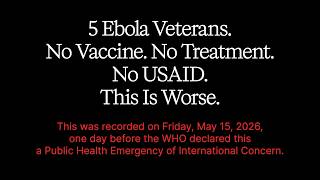
Infectious-disease experts discuss a new Bundibugyo Ebola outbreak in the DRC with 240 suspected cases and 65 deaths. This strain has no approved vaccine or monoclonal-antibody therapy, and delivering care in a conflict zone is nearly impossible. Funding cuts and surveillance delays have left the region dangerously unprepared.
Chapters
Hey, I mean, I'm not really a scarf kind of gal, but I think you're fooling me. It's quite beautiful. So I was like, everybody needs, you know, a cranky-ass middle-aged blonde bitch.
You got to flip it around very loudly.
I forget if it was CNN or MSNBC that Leslie Jones saw me wearing a scarf. It's like— and now she does a whole bit on Instagram about my scarf.
That's amazing.
That's really funny. Hey.
Hey guys.
Sorry. Hey.
That wasn't me scarfing down my chicken parm.
Good. I just got my sushi delivery. I think everybody except maybe Angie was in West Africa for Ebola. Is that right? Yeah.
I'm not really the on-the-ground kind of person.
You're the nerd in the lab.
Well, I'm not a penis implant surgeon, so that's a good start.
It's not too late, Angie. I need you to have ambition. Listen.
Green Bay. Green Bay. It might be a decent secondary career, and honestly, it's a worthy pursuit.
So an infectious disease specialist, an ER doc, and a virologist walk into a bar, which is basically what is happening right now. Naheed's got her chicken parm. I've got my— sake and sushi, and we are going to talk about Ebola. So welcome to the most on-brand Friday night in infectious diseases. Here's what we know so far. So 240 cases, suspected cases, 65 deaths in Ituri Province in the DRC. Bundibujiyo, Ebola virus. So this is only the third outbreak known of this particular strain. Species of this strain of Ebola. We also have seen an imported case confirmed in Kampala, which is the capital of Uganda. There's no approved vaccine, no approved treatment for this species, and WHO received a signal May 5th, so about 10 days ago. INRB confirmed this May 14th, and then Africa CDC declares the outbreak today. So grab your drinks if you haven't already. We're gonna get into it. All of us here were part of the West African Ebola outbreak response. That was the 2014 and 2016 outbreak. Angela, you actually have a slightly different role from the rest of us. You are not just an armchair pontificator. You actually do real stuff in the lab.
I study the host response to emerging viruses, and that was actually how I got into the West African outbreak. So my role is really to understand how the virus works and it causes disease. And for Ebola, my work has shown actually that the way the host responds in those different cell types determines what the outcome is. So my role in all of this is not to do the brave stuff that you guys do, um, going out onto the front lines. It's to support our scientists back home by helping us understand actually how this virus kills people. Host genetic background alone will determine whether or not an animal will die from Ebola. So you can infect them with the same dose. Some of them will die with severe hemorrhagic disease, and some of them will lose a little bit of weight and fully recover. So they essentially have mild Ebola. And one thing we really don't understand is in the real world, how many people out there have had mild Ebola?
I have, you know, I think, yeah, I mean, hantavirus is what has been in the news up until now. So like there's probably a ton of mild hantavirus too, right? I would imagine so.
But hantavirus is a little bit different than Ebola because I think hantavirus actually via the pulmonary route is less infectious than Ebola. With the West African strain of Ebola, as little as one infectious unit can cause uniform lethality. I think hantavirus, you have to get a much larger dose.
I want you to expand on that. There's been this whole debate about airborne, and yes, probably there's some— I don't— I hate the airborne droplet debate too.
Yes, I do too.
But like, okay, let's say it's a speck spectrum. Hantavirus is probably on the droplet end of the spectrum, but this relates to the infectious dose. How would you explain that?
This is something that I think is really hard for people to wrap their minds around, and it's really hard for hantavirus because we actually don't know what the receptor for hantavirus is. We do know what the receptor is for Ebola, and we know what types of cells it infects, so we have a much better idea of what makes an animal susceptible. With hantavirus, we actually just don't know that much about it. We just do know that most of the infections seem to arise from transmission from rodent feces, and it seems like in those cases people are actually inhaling quite a large dose. I hate the term airborne because it implies— it implies measles, essentially. Um, this is definitely transmitted by the aerosol route, and any virus theoretically could be transmitted by the aerosol route presuming that there are susceptible cells within the respiratory tract, which of course there are for hantavirus. But the cells that it prefers to infect are deep in the respiratory tract. So hantaviruses prefer to infect the lining of blood vessels and specifically the lining of the capillaries where the oxygen comes from your breath and goes into your blood. And we really don't know that much about this because people haven't really studied hantaviruses that much. There haven't been that many infections of hantavirus pulmonary syndrome anyways. There's only been 900 total. There's about 30 cases a year unless there's a big outbreak in North America. South America, there's more Andes virus. It tends to be more exposure to it. Uh, it's a different hantavirus than the one that tends to be in North America, which is the Sin Nombre virus. Andes virus has in other cases been shown to transmit person to person once the infection becomes symptomatic, and it it starts spreading, you basically start off with viral pneumonia. But that also means that you're not shedding a ton of virus from the upper respiratory tract. So you're not going to be potentially infecting people with every breath you take the way that you would be potentially with COVID You will be transmitting it that way in very specific circumstances, like for example, a cruise ship, which is a floating tin can, stuffy, poorly ventilated, probably what happens in most of these hantavirus cases where there isn't onward transmission, you get a lot of replication in the person who has it, but they are not really going to be shedding that much virus unless— in order to get hantavirus, you have to probably be exposed to a pretty large dose of the virus to actually get enough into your lungs to establish the infection. I know enough about hantaviruses to know that there are huge knowledge gaps here. One of the reasons that people haven't really studied it that much is that it's just not as much of a priority because it actually isn't that big of a health threat right now. There's really nothing to suggest that we're seeing emergent hantaviruses that would be more infectious or that would have greater pandemic potential.
So, Naheed, tell us a little bit about your experience working in West Africa.
Yeah, actually, I did a little bit of VHF work West Africa and for a little bit. Yeah. So I, I actually ran a biocontainment care unit for about 10 years, similar to the UNMC unit, which is the biggest of the type that we're talking about in the US. And the one that I ran, the Special Pathogens Unit at Boston Medical Center, backed up our biosafety level for laboratory. Angie's been there. She's visited us. I ran the pre-med unit for about a decade, and because of that, I got involved not just in West Africa, which I'll tell you a bit more about, but then also in East Africa and Uganda, which Kudoka also worked in as well. I was in Fort Portal off and on and then also visited Arua, which is in the upper border, northeastern border of DRC on the Uganda side as well. So in West Africa, I was deployed 4 times, first with WHO and then with Partners in Health working as an Ebola treatment unit. And one of the times that I was deployed, Kudip and I actually overlapped. We were in Port Loko together. In that period of time, I think I must have seen around 500 Ebola patients over like multiple deployments. My basic lesson for emerging pathogens is that you always see the sickest patients because that's who comes to care. And as we learn about emerging pathogens, whether it's hantaviruses or Ebola, Bundebusha, you generally see mortality higher than— I actually remember very distinctly, I had a patient where it was taking a few days to get results back. So we had this young guy who came in with flu-like symptoms who was like, Doc, you gotta let me out. I'm already feeling better. It's not Ebola. I'm already recovered. And by the time his test came back, he was totally fine and the test was positive. The other thing is a lot of times mortality is decided by where patients appear, what health systems they appear. And that's actually probably the case both for hantavirus and for Ebola virus disease as well. Like when you look at returning expats during West Africa, many of them had lower mortality. They got really good standardized supportive care in addition to targeted medical countermeasures. And once we started improving that in places in East Africa, that alone helped decrease mortality, improve survival, right? So it is possible, for example, for Rontavirus, that we may only be seeing the very sick patients. And now that we have patients who are not in rural areas, you may see a better mortality profile. Now I run a surveillance platform with colleagues from around the world called called the Biothreats Emergence Analysis and Communications Network, or BEEGAN. BEEGAN. Yes. We've been reporting a lot on the increase in cases both in Argentina and in Chile with the 2026 season seeing early season cases and higher case fatality rates so far in 2026. Take it all with a grain of salt. It's the numerator, it's not the denominator. We don't know if it's just, uh, the cases we found.
Do you incorporate environmental or ecological data into that? Because one of the things they found with Sinombre virus is that the deer mice that transmit it in the American Southwest multiply when there's a big rainy season and there's more of these pine nuts that the mice eat. So there's more mice and there's more Sinombre virus circulating, there's more cases.
This is supposed to be a big El Niño year. Like, what does that mean, right, ecologically? In terms of the host, in terms of risk of transmission.
Big part of the increase in cases in Andes or Hantavirus in general in both US and in Latin America, as you know, is the fact that the vector has a bigger geographic scope now. So you're seeing a lot more, more of these wild mice and you're probably seeing more human exposures because of that. And there's a lot more encroachment by humans into areas where these mice are.
Many of them anyways like to hang out near people because proximity to food, water, shelter, all that stuff.
Based on your experience, I've never seen a Bundibugia patient. So let me be—
there's, there's not a lot of experience with Bundibugia cases. So this is a particular strain of Ebola that we're talking about right now.
There is no Bundibugia vaccine that has entered the clinical phase of evaluation, which means that we won't have a vaccine, even an experimental one, to control this outbreak. And that's a huge problem considering the size and scale that it's already at, that you can't use the existing vaccines for these viruses too.
Naheed, where are we in terms of developing vaccines or treatments for Bundibuja as opposed to Sudan or Zaire strains of Ebola? And why does that even matter? One of the things that was super cool for me when I was working in Guinea The tail end of my time there is when they started enrolling people into the Ebola vaccine trials in Guinea. So we at least had something that we could study, right? Like, where are we at in terms of Bundabujo?
Medical countermeasures generally make leaps forward when there's an outbreak. Even when you have things on the shelf, a lot of times efficacy studies have to wait until you might have an outbreak, an opportunity to potentially test for efficacy, right? Bundibugyo, as you said, is one that we haven't had that many outbreaks in, and that kind of reduces the scientific imperative, the public health imperative to push some of these products into development. There's 6 species of Ebola virus, and of those, the ones that we have the most experience with are Zaire, which is Ebola virus disease. We have Bundibugyo, which we're talking about right now. Zaire Ebola virus, we have the most amount of treatments and vaccine data on because we had the biggest West African Ebola epidemic. There's been smaller outbreaks then in DRC after that. And because of that, we have vaccine candidates, we have monoclonal antibody candidates. When it comes to Sudan virus, because of the recent outbreaks and also because of the frequency of the outbreaks, we have a couple of candidates. We don't have anything that's far enough out in clinical development with safety, even with monoclonal antibodies for Bundibugyo. In this scenario, your options are really good supportive care. The trouble with that is you have a scenario where this outbreak looks like it's been going on for a while, is happening in an area that probably is pretty resource limited when it comes to healthcare capacity and particularly healthcare workers. For anyone, including you, Céline, you know this being in an Ebola treatment unit, that providing good supportive care, putting IV bags on hour on the hour, is both dangerous to healthcare workers. It is really difficult to do when you have a large group of people. Even with supportive care, I think we're gonna be debilitated, at least in where the, the epicenter appears to be with this outbreak.
IV fluids in the US, that is such a basic thing. Like you walk into the ER. Yeah. And you're hooked up to IV fluids, almost everybody, right? Unless you're in like congestive heart failure or like, but that's such a basic thing. And the— that is not a basic thing over there.
I don't know, Ebola treatment in particular, because you're dealing with needles with a high mortality pathogen as a healthcare worker when you're in full personal protective equipment, and it kind of changes your maneuvering. We don't have good—
anything, right?
Like, I'm telling you, it's the new ribavirin.
That's exactly what I compared it to earlier, is ribavirin.
But it did have some benefit in those who presented early. The PALM trial, again, it's got terrible side effects. You have to monitor the blood work. You probably can't do that in places where you don't have support. But it is, it is the only thing that I can think of that has been tried on an Ebola species with some effect, efficacy. Yeah.
The numbers you shared, like there's, there, it's worth doing, right?
If you can do lab, lab oversight because you don't wanna cause, either, um, hepatic failure.
To reverse Ebola pathology is very, very difficult. I use a technique called global transcriptomics where we basically look at the entire sort of library of genes that the host is expressing at any given point. We can use that data to infer different drugs that would switch pathways on or off that would be predicted to modulate outcome. And so we identified back in 2018 that corticosteroids could potentially do this. Corticosteroids are thought to maybe be pro-viral because they're immunosuppressive, but they're also anti-inflammatory. To really oversimplify things, Ebola virus disease is a disease of uncontrolled inflammation.
Like COVID, right? Like a lot of the people who died from COVID especially early on, it was this overly exuberant inflammatory response that people were developing.
That's exactly— What my work has shown with Ebola, and actually we're starting to show it with SARS-2 as well, what we see in animals that end up progressing to death is that it's not just that they have crazy inflammation going on. Initially, there's nothing going on. The virus completely suppresses the host response, and then when the virus comes up, the host does respond, but by then it's too late and it's unable to, to regulate inflammation at all. Corticosteroids into these animals, and we just dose them after the day after they were infected, we were able to delay the time of death, but they still died. So that's the real problem, I think, with a lot of these Ebola drugs is that if you don't get it early, like with remdesivir, it sets off this cascade that once the horse is out of the barn, it's impossible to get it back in.
It's actually interesting, Andi, the patient presentations were sometimes biphasic. You know, the cytokine storm is coming, the second phase, right? Where they would be okay for a little bit and then they would get really bad as the immune her response kicked in.
I want to turn to Megan now.
So I got pulled in to work with IRC in 2014. I make mathematical models. Now I do machine learning. I was supposed to work on electronic health records and all the fancy stuff because we always want tech as a solution. And then I was like, oh, no. They really need boots on the ground. And I ended up being one of the coordinators because I'm also a doctor. Running the Ebola units as we open them with IRC in Sierra Leone. We turn schools into triage centers because I think this really points to how do you make systems work where systems aren't thought to work? And there's a lot more resilience in these systems to make them work. And how do you get communities to find Ebola patients, bring them locally, have like an emergency department and then have those patients go to the Ebola units if they need treatment or go home. Many people also have malaria. They have other untreated diseases.
And the protocol, literally you're treating them for malaria and typhoid at the same time, right?
Right.
You always treat for malaria because that was something also that confused people who weren't used to the whole protocols is that people would think, oh, they test positive for malaria. They don't have Ebola. Actually, if you test positive for malaria, you're more likely to have Ebola. Because your immune systems could put, and you develop malaria. Almost any woman in labor will check positive on that checklist, which is horrible too, because then people say, oh, she's just giving birth. There've been so many deaths of nurses and other people who wanted to help that woman who was giving birth and all of the body fluids, birth, Ebola makes you go into labor. So you have early labor, you have more bleeding. So with IRC, it was basically working with local staff to build up these centers and then to try to triage and then to try to really understand the fog of war. We worked with health centers directly that had been taking care of Ebola and had actually had to take care of more Ebola cases than almost any outbreak ever had by the time the first foreigner showed up to help. People who had never signed up to do global health, never wanted to work in high-consequence pathogen centers, were just random nurses who came to work one day and were stuck taking care of Ebola patients. And it meant a lot to them 'cause these are community members, but at the same point, their family members are saying, why can't you just stay at home? Like, why are you putting your life at risk? Especially if it's just begetting infection after infection. One of the hospitals I worked at, Bo Sierra Leone, had over 200 patients before anyone else came because the cavalry doesn't come immediately when you have these outbreaks. It takes time for everyone to come. They did not have any infections related to their Ebola unit. They had some healthcare workers infected on the labor delivery ward, but they were able to, with really limited PPE, with creating their own protocols, not have any outbreaks. I worked with those centers. I worked with these other triage units trying to figure out how do you make systems work. I think one of the important things was this part about testing. There was this kind of big push to have more beds and more beds. And the problem was actually not that you needed more beds, it's that you needed really efficient systems and that people would have their blood tested. You get some off to the lab, they have a really common name. The blood comes back 4 days later. You don't know which person, which Muhammad Kroma was, and then you would end up having to send it again. So you'd have someone in a bed for like 7 days waiting for their results. And in those 7 days, maybe they got infected with Ebola Or maybe somebody else got turned away and didn't get a bed. So it was all about how do you make really efficient systems, figure out where those pain points are, and make it so it— you can get results within one day. We also heard about the IV fluids. We really prioritize oral rehydration.
Why, Megan?
Because you could in one hour have a nurse give 100 cc to one patient by IV, or you could have a nurse sit outside tell 10 patients to drink 1 liter and get all of those patients rehydrated.
You have a nurse to do that.
You wanna have people who are trained around.
Right.
There's a certain mentality to know how to work around a, a boli unit.
I guess the idea is why do you need to tell somebody?
Because it's sort of like when you have Ebola, you do not, you don't remember what happened.
Like foggy.
Yeah.
You're total fog. A friend of mine who was a scuba diver was like, they all have the bends. When you'd see patients come to the clinic, you would know who had Ebola. You'd ask them a question, you'd be like, what's your name? And they'd be like, yeah. You had to keep saying, are you drinking? It's just they didn't remember that they had a drink in their hand. They had to drink it. So you needed to have someone to continue to reinforce. You only have a limited amount of PPE. You only have a limited number of healthcare workers.
Megan, you mentioned pregnant women, and this is one of the things that I think is some of the most horrific situations I have seen are with women who are giving birth in the middle of a viral hemorrhagic fever, whether it's Ebola or Lassa.
We have a checklist to determine whether you have Ebola: a sore throat, easy bleeding, abdominal pain, fever. If you check off a certain number, then you would be admitted as a suspected patient. And we had to keep it really strict because you're working with your neighbors and your friends, and otherwise you'll be like, oh, there's no way my uncle has Ebola. He totally just—
well, it can go the other way because it's like the only healthcare available.
We have a lot of people who came in, yeah, because you got free healthcare.
That's a horrible side to this too, is that TB patients who could not get treatment, we would see horrendous progressive tuberculosis, HIV.
The person who ran the TB unit locally— I'm a TB doctor— and we were able to get people on TB meds during Ebola.
I just say the saddest story that I will tell is a woman.
This whole idea of being dropped off to an ETU, not people seeking voluntarily, but I had a case of domestic violence case where the husband dropped off his wife after beating her and said, look, unexplained bleeding. It broke my heart.
Oy.
A lot. Well, on the other inverse of that, I think we had a patient who was incarcerated, didn't have Ebola, was brought in because he was like, my, I'd rather have a better chance somewhere else.
Craig, you deployed to Guinea with MSF during the West African outbreak. And Turi province is in an active conflict zone now. Yeah, it's 1,700 kilometers from Kinshasa with gold mining that is driving constant population movement. They're migrant workers. What's that operating environment mean for just like the super basic stuff? We don't have treatments, we don't have vaccines for this. All we have is contact tracing. Isolation, safe burial, and I guess testing. And contact tracing in this context, like, how do you even do that?
Yeah, we're in big trouble at this point. We're like weeks behind, right? When I saw that there were cases separated by hundreds of kilometers, my first thought was like, holy shit, do you know how long it takes to go hundreds of kilometers in Eastern Kivu? Like days and days and days, right? West Guinea, from Gakédou to Conakry, there was a road that would take you directly to Kisidougou and It was paved. It was like an hour and a half. That same ride would have taken you a day in Eastern Congo. The fact that you not only have so many cases and that they seem to be hundreds of kilometers apart, many hundred kilometers in a place like that, that's a really, really bad sign. I remember hearing a case of a family, this guy who died, and they straight up Weekend at Bernie's him, dressed him up, hat, the whole business, put him on a bus and drove him across the country, right? Because you need to be buried in your homeland, your ancestral homeland. If you don't, they're going to come back and they're going to haunt you. And so I'm thinking about that, right? And like all the different places that these folks who were sick in this outbreak now in Eastern Congo and in Uganda, all the places where they likely stopped, maybe got care at a clinic, assuming that, you know, proper PPE was obviously not used. The amount of stuff that we learned in such a short period of time today means that this just can't be good at this point. About a year ago, I wrote something around the theme of "We will regret this" when Elon Musk gleefully tore apart USAID. The USAID team that had like 60 folks for outbreak response, including, I think it was like 10 for Ebola, like they all just went away, right? During the Uganda outbreak last year, concerns around, this was like right when the second Trump administration was coming in, they were starting to cut things. Who was going to set up airport screening in Entebbe at the airport in Uganda? Normally that's something that the US would do and people are like, yeah, but like the Ugandans can do it. And I have to remind folks that like sometimes countries either don't want to do it, don't have the resources, don't have the training to do it. And often the US would go in and would very nicely and certainly say, we're going to do this. And we'll help you do this, we'll give you resources to do this. But that means now, like, I'm sure WHO is going to try to help, but like, I don't have full faith that the airport screening and all the other things that folks like my parents would be concerned about— there being exportation of cases to the region and abroad— those things aren't going to get set up as seamlessly or as quickly as they would have a year ago or 2 years ago. We now have a— what is it— the penal specialist running the hunt of virus. And listen, I, as the only man on this call, I would like to say that I am fully concerned about penile health. I think it's an important study and we need urologists.
Admiral Brian Christine, who is leading the hantavirus efforts and as far as I can tell has no experience with any viruses whatsoever. So let me get into Deborah Birx mode here.
Okay, please.
It is very important But people have the right expertise and listen to the experts. We have this under control. Except we don't, because this guy is basically an expert in making dicks longer and harder and, uh, doesn't know anything about respiratory disease at all.
Listen, the guy that knows dicks better than I do— does everyone need to be in the role that has to be like a hardcore infectious disease? Like, I mean, sure, that'd be nice. But the fact that like we now don't have a permanent FDA director, the fact that we have one guy running the NIH and also running the CDC, which is impressive even when you don't have multiple outbreaks, the fact that we don't have OPPR, that we don't have WHO connections, it's not just the penile guy in place. It's the fact that around him there's nothing.
We talk about the number of cuts within the HHS, whether it's at CDC or NIH, that did a lot of the research, the cuts made to large grants to support this stuff. Also, the global funding has decreased. Everywhere else, WHO in many of these countries, many of these programs might be started with, okay, what's going on with Honda? Oh my God, there's an Ebola outbreak. And oh, there's a Rift Valley outbreak in Malawi. Oh shoot, there is another meningitis B cluster in United Kingdom in Reading.
I know NIH employees who were instrumental in past Ebola outbreaks, including bringing vaccines after they were first approved to these remote sites. Some of those people are under investigation for starting the pandemic because of political reasons. We have people being prosecuted and persecuted by their own government. Our NIH director and acting, acting CDC director, which is what I call him because his acting CDC directorship expired and he's just kept the job, he doesn't know what he's doing at all. And his pandemic preparedness plan is essentially like quit smoking, treat your diabetes, because people don't get sick.
So I want to bring in Brutica.
Sure. So I went to West Africa in, um, October of 2014. October. October. Nahid's actually the person who helped train me when I first got there, and I was there for about 3 months, and I was helping Initially run our Ebola treatment center and then went over to the local government hospital and ran the Ebola treatment center that had been set up there prior to any expats coming. I think it was probably one of the scariest things that I've ever done. We had to figure out how to make the hospital run again in a way that was safe. And then after that, I also went on to working to develop a clinical, a mobile clinical trials capacity in Uganda. After that, I worked with MapBio, who developed some of the monoclonal antibodies. MAP is a monoclonal antibody that was initially used during the 2014 outbreak and, and then was compared to 3 other monoclonal antibodies during the 2018 outbreak in DRC.
Craig, did you get ZMapp?
It's a long, weird story.
Wait, you were getting like black market ZMapp?
I was offered ZMapp when there was no more ZMapp. There was going to be a plane that was going to bring it from Winnipeg or whatever. It was going to be the good stuff. Canadian ZMapp flown down to New York City just for me. And I was like, the maple flavored ZMapp. Can you imagine?
Is it black tar heroin or is it—
Yeah, exactly.
It's just friendly maple flavored ZMapp. It's fine.
So you were at the WHO during public health Emergency of International Concern declarations. This is a big fucking deal when this happens. WHO gets the bat signal on May 5th, but the outbreak of Ebola is not confirmed until yesterday, by which time we already have almost 250 cases, suspected cases. Only 20 have been tested. What does that timeline tell you about what's going on with surveillance and lab capacity in the Eastern DRC?
My understanding is that there have been multiple partners on the ground, so not just WHO, but right, the Ministry of Health, INRB, Africa CDC, so lots of different people on the ground. I think that while I understand 10 days sounds like a long time, when you think about how long it takes to get to where the roads they're bumpy, they're not paved, you can't go very fast, right? You can't just speed down a highway like we do here in the United States, right? The other issue is the very real, um, violence and conflict right now in that area. So the people living in that area who may be sick probably may not want to go out and may delay seeking healthcare. The healthcare systems themselves are very basic. I think it can be really hard for someone who hasn't been to these areas or worked in these areas to understand how basic some of these, uh, healthcare systems are. Like, in some instances you might just have, like, if you're lucky, a building, right? But you don't have electricity, you may not have any laboratory capacity, right? So when you're talking about the fact that they got the signal on May 5th and it was confirmed May 14th, people had to get there. They have to investigate. They— and the samples, I believe, were run at INRB in Kinshasa. So then they have to get the samples from Ituri Province to INRB and to run those samples. I actually think 9 days is not so bad.
And I guess to, to Craig's point earlier about the withdrawal of USAID, a study came out yesterday or the day before in Science where these researchers took the opportunity to look at cuts to USAID and examine the correlation between increases in violence and destabilization of these areas with the loss of funding. Oh, and guess what? They strongly correlate. It turns out that stripping USAID funding from places creates lower opportunity costs for increasing violence. So that creates additional issues with the military conflicts that Krutika mentioned. And I know that this has historically been a problem, with some Ebola outbreaks.
Well, Jay Bhattacharya is a health economist. He is an expert in the economic incentives here. I want to go back to you, Nahid, because I think the case in Kampala, this man died. My understanding is he was admitted the 11th, died the 14th. So yesterday, as of the time we're taping this. His body was transported back to the DRC that evening. We don't know how long he was symptomatic, right, in Kampala, how many contacts he had. We know healthcare providers in particular with these kinds of infections, viral hemorrhagic fevers including Ebola, are super high risk. What are you watching for, not just in Kampala, but among healthcare workers in this region right now?
From some of the unverified sources that we're seeing on Beacon, there's reports that there's already been healthcare worker deaths in this area. I think one of the local newspapers or reports sort of talked about 4 healthcare workers being dead. Again, all unconfirmed. Please take this with a grain of salt. Um, so I mean, it does not surprise me. I think if you have 240 suspect cases and 65 deaths, that probably the real number is even bigger than that because we talked about the fact that a lot of people may not be able to come to care. So take that consideration into— and so without personal protective equipment, Megan alluded to this before. I wanted to talk about this a little bit because it's important. When Ebola patients first present, they look like anybody with fever, nausea, vomiting, diarrhea, right?
So this is a point I've been trying to make because this drove me crazy during COVID of like certain people were like, here are the symptoms of flu, here are the symptoms of COVID And you can actually tell them apart with symptoms. And I was like, maybe there are trends at a population level, but the individual level, you cannot do that. And in fact, almost all viruses manifest with fever, chills, nausea, vomiting, diarrhea, shortness of breath, and cough. And that is just the rule across the board. And so you cannot tell the difference based on those symptoms.
Exactly. And so we could—
we wouldn't need diagnostic testing. That's literally why we do diagnostic testing.
Here's what's likely happening. Tons of people are showing up with malaria-like symptoms. Health care workers, pharmacists, community health workers are giving them malaria medications. They're saying, go home, take this malaria meds. They're going home. They're so— they're exposing and they're getting sicker. If they stay within the health care scenario as they get sicker, that's when you really start to see symptoms in later stages start to look like septic shock, right? It's a, it's that immunological response. And then you have in very extreme cases, and this is what Megan would say, you don't see bleeding diathesis the way that Hollywood thinks and tells you. A lot of times they're just, they have blood in their vomit, they have blood in their stool, they have diarrhea. So they may have, right, a little bit of blood there.
It's more like an oozing thing, right?
Like, and by the way, there are a lot of other diseases that can kind of present like that too. I'm guessing we probably will hear that a lot of healthcare workers have already been affected. And then you worry about how long was this patient in Kampala in a large hospital? What ward was he in? What were the other patients there, right? What was the exposures to healthcare workers? I'm really glad to hear that Uganda has taken the stance to do all the work in terms of locking down and contact tracing. Kuteke, you were saying?
What I was gonna say, I think the other thing that's also concerning about the situation in Kampala and, you know, I lived there, it's an extremely, extremely crowded city, right? We don't know where this man was. We don't know To your point, how long he was there, when did he start having symptoms, who he could have exposed, but in also very large areas, not just the hospital. And very early on, these symptoms are very nonspecific. So now you're in a situation where you may have had many people in crowded areas exposed. Beyond Uganda, South Sudan is on the other—
Yes.
Area that is very concerning, especially because you have all the conflict there already, the refugee camps, and those are other large congregate settings where people don't have access to healthcare. And so it's another area that is really of concern that we are gonna need to keep an eye on. But I can also look at the other side of it and understand why it was not detected early on because these people are presenting with nonspecific symptoms. They're in an area that's endemic for malaria. And so that's what people are going to think they have. They're not necessarily going to think of Ebola. Going off of what Angie said about the USAID funding, I know that talking to my colleagues, not just in Uganda but in, um, DRC, they were leveraging the supply chain, the infrastructure there to do testing for HIV. And then you're layering on trying to do diagnostics for other diseases. That is now gone. And so that is another very real example of the challenges that we're facing during this outbreak right now.
I was up in Arua, which is on the Uganda side of that border between near South Sudan and DRC, and the healthcare posts in most of these border towns along the way, they're overwhelmed for the reasons that Kritika talked about, like huge refugee crisis, right? So it is easy also from that perspective to miss a signal from the noise. When you have so many signals of so many different diseases that are going on.
So what concerns me is that not only do we have all the factors of the West African outbreak, but we also have armed conflict in the area with the ADF, and we have refugee camps. So like, this is actually worse. We have factors that make this worse than what we had in West Africa. We had a cross-border migrants, we had urban, you have all of that in this equation plus this other stuff. So Kritika, from your WHO experience, how does cross-border Ebola coordination actually work? The Africa CDC today included WHO, UNICEF, US CDC, Europeans, MSF, and actually several pharmaceutical companies. What does this coordination look like in practice?
It's super complicated in lots of different aspects, right? I think, you know, one thing that struck me when the announcement came out is that the announcement came from Africa CDC. It didn't come from the Ministry of Health.
What does that tell you?
There's a lot of politics, right?
And that's the—
yeah, I mean, we saw this happen with mpox as well, right? So right before the 2024 emergency was announced, Africa CDC held a meeting 2 days before the WHO emergency committee met, and they declared mpox clade 1B a public health emergency of continental security, right? This was the first time that that had ever been done. 2 days before WHO meets. So WHO is meeting to discuss, and then they declare it an emergency of international concern. So there's a lot of politics going on, right? I do think that there are going to be lessons learned from the 2018 outbreak that happened in Equateur Province where they were dealing with a lot of the same things. We had healthcare workers, frontline responders who were under attack. There was a WHO employee who was killed. So it is a very scary situation. And so it's already hard enough dealing with Ebola. Now in a conflict setting, you're dealing with other countries. What I suspect may happen is there's going to be an incident management team stood up. That's what they did for mpox. It was Africa CDC and WHO and the ministries of health. I'm hoping, and I'm— I would suspect that's probably something's going to happen because everyone's going to have to work together to try and get this outbreak under control and to figure out other places it could spread. And then can I add one more thing that I think is really important and ties it back to kind of what's going on in the United States. So we are—
That was literally what I was about to ask you, but go for it. Okay.
So we are literally in like, in weeks inviting the entire world to the United States. And I'm in Texas where we have the most World Cup games. We are actively preparing. Argentina is playing here in Dallas. DRC is playing in Houston. And so people were already getting up in arms about hantavirus given that outbreak. So now we have this situation where we have— people are more aware of hantavirus. We have DRC playing in Houston and they're going— their fans are going to want to travel. And what's going to happen to our healthcare system?
Are their fans even allowed in the country?
I don't know.
It's— I don't know, to be quite honest. I have no clue. But this is going to be a challenging situation. And, you know, for the state of Texas, I'm, I'm leading an initiative where we have set up an infectious disease consult line between the health department and the University of Texas, where we will basically have ID physicians taking calls from people anywhere out in Texas worried about infectious diseases. So now what's gonna happen, we're gonna get these calls and trying to figure out how to triage them. And I think one of two things is gonna happen. One, they're gonna get called on everything and we're not gonna have— know what to do.
Fever, nausea, vomiting, diarrhea, everybody.
I imagine you're working in the emergency room And you have a patient from DRC who comes in with fever. And Texas is still very, very traumatized by what happened in 2014.
Right.
And Dallas in particular.
Dallas in particular. Now we have these, these things happening and we don't have the infrastructure to be able to manage this, right? CDC isn't even testing for Mpox anymore. What's going to happen is we're going to have an influx of people. People are going to get sick. We're going to be trying to figure out what to do. And we don't have the national government coordination to manage this. And it's, it's quite scary. And I keep saying that these things that are happening, they're tests for us, right? We have failed for hantavirus.
Oh yeah, stress test failed.
I suspect we're gonna fail again.
Yeah, with Ebola. And you know, and the other thing is, is all these experts that we had in our federal government that had experience with these, they're no longer there. So it's also institutional knowledge, scientific knowledge that's gone. These people would work with our colleagues overseas. So what's going to happen? I think this is actually in many ways much scarier than what happened in 2014 and in 2018 because of all those other dynamics going on right now.
I add one thing that makes it even worse. If you recall from the last World Cup, there were rumors going around because members of, I believe, the French national team, uh, had flu-like symptoms, and this somehow turned into, oh, they don't have COVID, they have MERS.
Zizou would just like to say he was named after Zinedine Zidane. Um, Zizou, right?
Hi, Zizou.
And he said, I do not have MERS.
I know, Mommy's like, but I don't think dogs are susceptible, to be perfectly honest.
I don't—
I haven't looked at dog DPP4.
That's why we need a virologist on every single call.
Last time it was all these, you know, sort of merchants of doubt who were doing this. This time it might well be inside the building. Secretary of Health and Human Services. I think that what we need to reckon with is that Robert F. Kennedy Jr. is lying to the American people in a way that will cause them to make health decisions that are going to get a lot of people killed. And this is an opportunity, I think, to further that mission and really export it to the rest of the world, which they've already been actively doing.
Okay, so Craig, I want to come back to you. So you were an Ebola patient in New York City in the fall of 2014. And I remember vividly, I was on CNN with Brooke Baldwin in 2014. You were already back in New York. Mm-hmm. And she's asking me about subway poles and bowling balls. Seriously, subway poles and bowling balls. And you're not paying attention. To who's actually at risk and who is suffering, right? We're more than 10 years later. What is your reaction to the way this is being framed now?
If you recall, in the aftermath of Casey's forceful quarantine in the state over—
Casey Hudnall.
Yeah, Casey Hudnall.
Yeah.
Yep. She's forced to be in this containment unit. In the parking lot of Newark Airport or something.
Yeah, it was like on the runway or something or like, you know, an unused—
something outside. Like, it was terrible.
I can't imagine a worse situation at Newark except possibly the old United Club.
Yeah, but then imagine it with Chris Christie yelling at you at the same time. No, I mean, it was like the last bipartisan moment in this country, right? When you had Chris Christie, a Republican governor, and Andrew Cuomo, a Democratic governor, trying to outdo each other for how much more they knew about public health and disease transmission than the CDC. And I wrote something a couple months after that. What was fascinating is I wrote that like, at a time of crisis, we don't need 50 individual decisions that change with the proximity to the next electoral cycle. Because if you recall, if you do an analysis of the number of media mentions of Ebola prior to the midterms and after the midterms, it's a factor of 20. They were calling Obama President Ebola. I distinctly recall Fox News saying that ISIS was weaponizing Ebola and then using it to crawl across the southern border. I think it was a preview of what we ended up seeing some years later with COVID So I think my own cases, one, made me realize that I'm unbelievably happy and lucky that I am here and alive. I am really sad at all the folks that all of us lost taking care of patients. In West Africa, people like Dr. Sheku Murkan, who had potential access to a dose of a medicine that was willing to be flown to me from another country at a moment's notice, and he wasn't even involved in a conversation about whether he should receive that. And what it means around access to medical countermeasures and the fact that the U.S. spent $800 million to create something, a treatment, which is amazing, but the majority of folks in previous outbreaks, primarily in the Congo, haven't had access to that. Despite one of the treatments coming directly from the blood of a Congolese survivor and being trialed in the Congolese community, what does that mean in terms of the future, our equity, and our ability to respond to these opportunities? And the thing that I keep coming back to is people keep saying to me, we have this anti-science phenomenon, it's all about anti-science and global anti-science. And I'm like, maybe that's not it. When I talk to people, it's not that they don't think science doesn't work, they think that it doesn't work for them.
For them.
For them. And I think about my parents here in the US, and I think about them being like, who cares about the NIH? I pay a bunch of money in taxes, and then a bunch of research gets done at a university, and then they sell these really fancy things from the NIH to these companies that make a bunch of money off of that, charge me a bunch of money that I can't pay, and it becomes this weird distant abstraction. So it's not necessarily anti-science, it's that disbelief that science doesn't work for them. And I think we've seen that over and over again, particularly in Ebola outbreaks. And I suspect we'll probably see some version of that here soon.
To you, our acting CDC director said that the CDC has country offices in the DRC and Uganda and is absolutely committed to providing resources. And this is CDC technical expertise. At the same time, you have the USAID which is more of the boots on the ground people. They have the capacity to do the contact tracing and screening and laboratory stuff, and yet they have now been dismantled. So how big is the gap between NIH director slash acting CDC director, Dr. Jay Bhattacharya, between what he is saying and what the response actually needs?
Number one, we do have technical expertise in these countries. I would argue that the people in these countries probably have just as good, if not better, technical expertise because they've dealt with these outbreaks for a very long time. When I was in Uganda, I worked with the MOH and the Emergency Operations Center when there were outbreaks. I think that they are very well trained. But what we don't have is the infrastructure that's been dismantled, the healthcare workers, the community health workers that are no longer employed that we would need to do things like contact tracing, that we need to do things like surveillance, that we need to be able to help care for these patients. The number of healthcare workers you need just working in Ebola treatment center is quite a bit, right? And so Those people, a lot of them have lost their jobs now. And so what are you going to do? Where are you going to find these people that lost their jobs because there's no more USAID funding to now come and help? I think back to 2014, nobody had Ebola on their mind until Kent Brantley got repatriated to Emory, right?
Oh, by the way, I started pitching stories about Ebola because I was doing media by this point. I started probably January of '14 because I was seeing the reports, right? Not a story, not a story, not a story, not a story, until Kent Brantley gets sick.
Second, it's a white person from a wealthy country. That's when it becomes a crisis. And that has been the entire discussion about hantavirus. It is not We are worried about people in South Africa, on St. Helena, in Argentina. We are worried that it's going to turn into an airborne virus and it's going to affect people in America.
I want to come back to you, Megan. I think measles is actually the biggest threat related to the World Cup. We have this massive outbreak in Bangladesh, you know, and so on. We have real vulnerability here in the US. It's not going to be hantavirus. I don't think it's going to be Ebola.
We have a lot of people coming from all over the world that we're hosting.
We're not really preparing for it the way other countries have. I've been doing a deep dive into what's happening on that kind of preparedness. I've talked to Ziad Namish, who organizes preparedness for the Hajj. I've talked to people who do preparedness for prior Olympics, prior World Cups.
I think we've broken it down to be city and state and county. Responding now. I mean, we'll see. I mean, New York City has been preparing heavily. California, obviously Texas has been. I think we're seeing now that we're just a nation of 50 states responding to public health emergencies. And I think we, this erosion of public health trust is going to be, of course, a bigger issue. Measles, any respiratory or diarrheal illness. We keep talking about trust now in the US. We're talking about the DRC. This is an area that has incredible levels of mistrust and everything that's been happening in the US has only added to that. This is an area that has close to 6 million people displaced, more deaths than any conflict since World War II cumulatively. And this is an area where you feel like nobody's ever coming to help you because you've had all of these bad things happen and then people are dying from malaria, they're dying from measles. Did anyone come? No. But then when you have all you have Ebola, suddenly you have all of these international folks coming in, lots of money being spent, big vehicles. It's called Ebola money.
Ebola business.
This is literally what people in West Africa said to me. Ebola is a hoax. Ebola is the flu.
Yeah.
Ebola, it's business. It's for your NGOs to make money off of contracts of USAID. And you come in with your big 4x4s and you all fancy money and—
yeah, they're right. Like, you see all of these vehicles, you do the quick math, you're saying how much money all of this is and you're like, hey, we have not put this money down on measles, on malaria. You're suddenly putting it down on this. I mean, it's a way to really break trust. And then we're talking about how we're, we're seeing over 200 cases now. I mean, We've had a large problem with Ebola outbreaks. People just don't seek care because they want to believe that Ebola is fake because it's such a horrible reality. You don't want to think it's real. So you just end up having people not seek care, just hoping that they get better from whatever it is. We've talked about how Ebola is— when it first starts, it's just like any illness. So you convince yourself you do not have Ebola. And then having all of these programs suddenly be pulled out. It just adds to all of this distrust that, I mean, it will be a real issue. And public health and outbreaks are always about trust. I wish that that had been communicated. I felt like when people watched Ebola in West Africa from afar, from the US, and they saw how people were scared and they had distrust and they saw outsiders coming in and they just thought, oh, that's so nuts. And they didn't realize that that's something that happens in any outbreak.
Ebola.
Business.
Ebola's a hoax. The start of COVID was massively traumatizing cuz it felt like it was a replay of all of that, right? I had people on the ground saying, why do you care? We've had women dying in childbirth. We've had kids dying in malnutrition for decades. Why do you care about this? Well, it's very clear why we care because We're worried it's going to spread here.
So can I, can I counter that? I agree. I am worried it's going to spread here. Kampala, right?
It's a—
I think people in the United States are going to pay more attention to hantavirus than they are to the Ebola outbreak.
People keep asking me, is this a pandemic? And I go, no. And then they kind of lose interest.
I actually think this is the outbreak that's going to have legs, not hanta.
It's Ebola.
Get declared, I think it's gonna be a public health emergency that's going on.
More from Dr.


"You Don't Bring Water to People Who Think You're Killing Them" | Inside Congo's Ebola Trust Crisis
"We Had to Become Farmers" | A Doctor in Congo on What Happened When USAID Left